Page 4 of 624

Contents
This owner’s manual should be considered a permanent part of the
vehicle and should remain with the vehicle when it is sold.
This owner’s manual covers all models of your vehicle. You may find
descriptions of equipment and features that are not on your
particular model.
Images throughout this owner’s manu al (including the front cover)
represent features and equipment that are available on some, but
not all, models. Your particular mo del may not have some of these
features.
This owner’s manual is for vehicles sold in the United States and
Canada.
The information and specifications in cluded in this publication were
in effect at the time of approval for printing. Honda Motor Co., Ltd.
reserves the right, however, to discontinue or change specifications
or design at any time without notice and without incurring any
obligation.2 Safe Driving P. 29
For Safe Driving P. 30 Seat Belts P. 35 Airbags P. 42
2Instrument Panel P. 73
Indicators P. 74 Gauges and Multi-Information Display P. 103
2Controls P. 109
Clock P. 110 Locking and Unlocking the Doors P. 111
Security System P. 133 Opening and Closing the Windows P. 136
Adjusting the Mirrors P. 161 Adjusting the Seats P. 163
Heating and Cooling System
* P. 195
2 Features P. 199
Audio System P. 200
General Information on the Audio System P. 299
HomeLink ® Universal Transceiver
* P. 349 Bluetooth ® HandsFreeLink ® P. 352, 377
2 Driving P. 411
Before Driving P. 412 Towing a Trailer P. 420
Parking Your Vehicle P. 503Multi-View Rear Camera P. 512
2Maintenance P. 519
Before Performing Maintenance P. 520 Maintenance MinderTM P. 523
Checking and Maintaining Wiper Blades P. 545
Heating and Cooling System
*/Climate Control System* Maintenance P. 558
2 Handling the Unexpected P. 567
Tools P. 568 If a Tire Goes Flat P. 569
Overheating P. 585 Indicator, Coming On/Blinking P. 587
When You Cannot Unlock the Fuel Fill Door P. 597
2 Information P. 601
Specifications P. 602 Identification Numbers P. 604
Emissions Testing P. 607 Warranty Coverages P. 609
Page 6 of 624
4
Quick Reference Guide
Quick Reference Guide
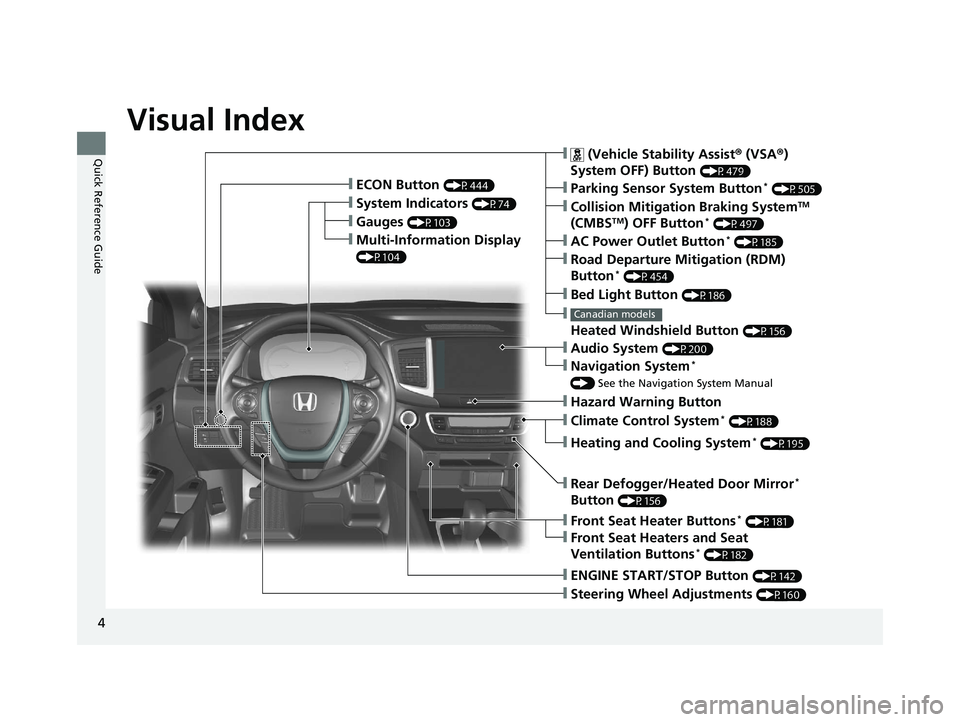
Visual Index
❙Gauges (P103)
❙Multi-Information Display
(P104)
❙System Indicators (P74)
❙ECON Button (P444)
❙Collision Mitigation Braking SystemTM
(CMBSTM) OFF Button* (P497)
❙
Heated Windshield Button (P156)
Canadian models
❙Parking Sensor System Button* (P505)
❙Steering Wheel Adjustments (P160)
❙ENGINE START/STOP Button (P142)
❙AC Power Outlet Button* (P185)
❙Road Departure Mitigation (RDM)
Button* (P454)
❙ (Vehicle Stability Assist ® (VSA ®)
System OFF) Button
(P479)
❙Bed Light Button (P186)
❙Audio System (P200)
❙Navigation System*
() See the Navigation System Manual
❙Front Seat Heater Buttons* (P181)
❙Front Seat Heaters and Seat
Ventilation Buttons* (P182)
❙Rear Defogger/Heated Door Mirror*
Button
(P156)
❙Heating and Cooling System* (P195)
❙Climate Control System* (P188)
❙Hazard Warning Button
Page 9 of 624
7
Quick Reference Guide
❙Side Curtain Airbags (P51)
❙Grab Handle
❙Coat Hook (P178)
❙Seat Belts (P38)
❙Sun Visors
❙Vanity Mirrors
❙Moonroof Switch* (P140)
❙Map Lights (P172)
❙HomeLink® Buttons* (P349)
❙Sunglasses Holder (P179)
❙Front Seat (P163)
❙Side Airbags (P49)
❙Seat Belt (Installing a Child Seat) (P63)
❙Seat Belt to Secure a Child Seat (P63)
❙LATCH to Secure a Child Seat (P60)
❙Rear Seat (P166)
❙Map Lights (P172)
❙Back Window Switch* (P138)
* Not available on all models
Page 12 of 624
10
Quick Reference Guide
Safe Driving (P29)
Airbags (P42)
● Your vehicle is fitted with airbags to help protect you and
your passengers during a moderate-to-severe collision.
Child Safety (P55)
● All children 12 and younger should be seated in the rear seat.
● Smaller children should be properly restra ined in a forward-facing child seat.
● Infants must be properly restraine d in a rear-facing child seat.
Exhaust Gas Hazard (P70)
● Your vehicle emits dangerous exhaust gases that contain carbon
monoxide. Do not run the engine in confined spaces where carbon
monoxide gas can accumulate.
Before Driving Checklist (P34)
● Before driving, check that the front seats, head restraints,
steering wheel, and mirrors have been properly adjusted.
Seat Belts (P35)
● Fasten your seat belt and sit upright well
back in the seat.
● Check that your passengers are wearing
their seat belts correctly.
Fasten your lap belt as
low as possible.
Page 28 of 624
26
Quick Reference Guide
The rear door cannot be
opened from inside the
vehicle. Why?Check if the childproof lock is in
the lock position. If so, open the
rear door with the outside door
handle.
To cancel this function, push the
lever to the unlock position.
Why do the doors lock
after I unlocked the doors?If you do not open the doors within 30 seconds, the doors are
relocked automatically for security.
Why does the beeper
sound when I open the
driver’s door?The beeper sounds when:
●The exterior lights are left on.
●The power mode is in ACCESSORY.
Why does the beeper
sound when I start driving?The beeper sounds when:
●Driver and/or front passenger are not wearing their seat belts.
●The parking brake pedal is not fully released.
Why do I hear a screeching
sound when I apply the
brake pedal?The brake pads may need to be replaced. Have your vehicle
inspected by a dealer.
Page 35 of 624
33
uuFor Safe Driving uYour Vehicle’s Safety Features
Safe Driving
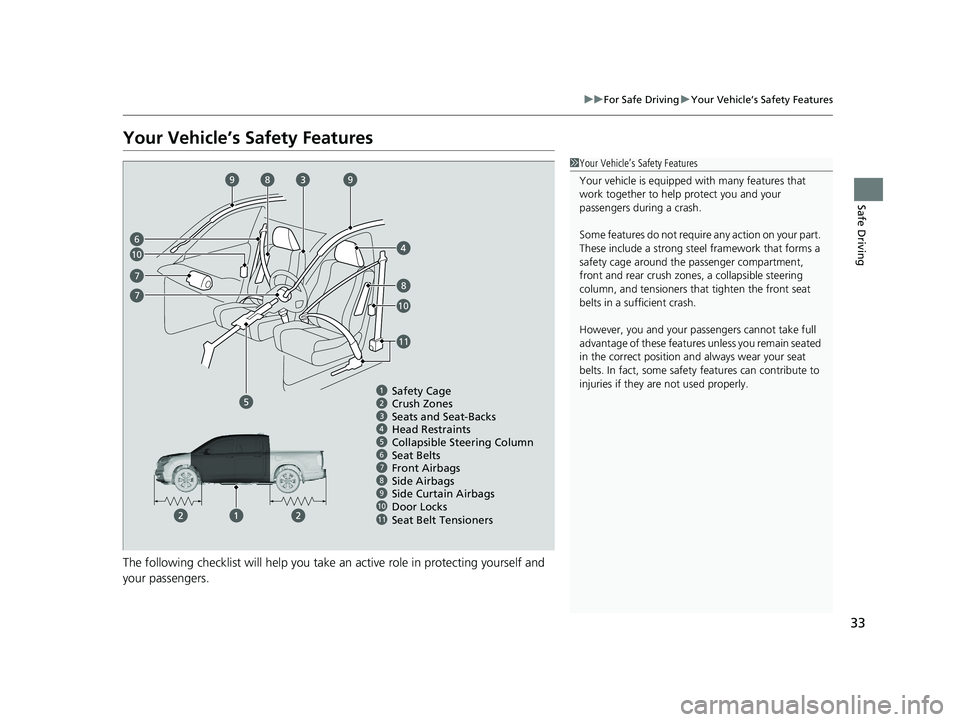
Your Vehicle’s Safety Features
The following checklist will help you take an active role in protecting yourself and
your passengers.
1Your Vehicle’s Safety Features
Your vehicle is equipped wi th many features that
work together to help protect you and your
passengers during a crash.
Some features do not require any action on your part.
These include a strong steel framework that forms a
safety cage around the passenger compartment,
front and rear crush zone s, a collapsible steering
column, and tensioners that tighten the front seat
belts in a sufficient crash.
However, you and your passe ngers cannot take full
advantage of these features unless you remain seated
in the correct position and always wear your seat
belts. In fact, some safety features can contribute to
injuries if they are not used properly.
678910
Safety Cage
Crush Zones
Seats and Seat-Backs
Head Restraints
Collapsible Steering Column
Seat Belts
Front Airbags
Door Locks
Seat Belt Tensioners Side Curtain Airbags
11
6
7
8
8
9
10
10
11
7
Side Airbags
9
Page 36 of 624
34
uuFor Safe Driving uSafety Checklist
Safe Driving
Safety Checklist
For the safety of you and your passenge rs, make a habit of checking these items
each time before you drive.
• After everyone has entered the vehicle, be sure all doors are closed and locked.
Locking the doors helps prevent an occupant from being ejected and an outsider
from unexpectedly opening a door.
2 Locking/Unlocking the Doors from the Inside P. 121
•Adjust your seat to a position suitable for driving. Be sure the front seats are
adjusted as far to the rear as possible while allowing the driver to control the
vehicle. Sitting too close to a front airbag can result in serious or fatal injury in a
crash.
2 Adjusting the Seats P. 163
•Adjust head restraints to the proper position. Head restraints are most effective
when the center of the head restraint alig ns with the center of your head. Taller
persons should adjust their head restraint to the highest position.
2 Adjusting the front head restraint positions P. 168
•Always wear your seat belt, and make sure you wear it properly. Confirm that any
passengers are properly belted as well.
2 Fastening a Seat Belt P. 38
•Protect children by using seat belts or chil d seats according to a child’s age, height
and weight.
2 Child Safety P. 55
1Safety Checklist
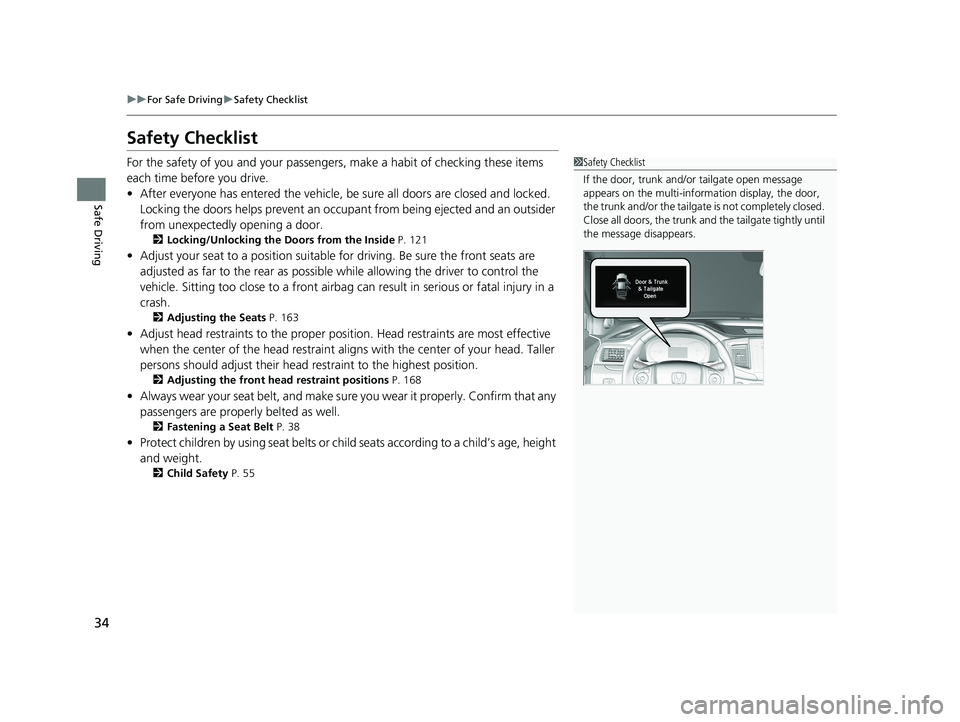
If the door, trunk and/or tailgate open message
appears on the multi-inform ation display, the door,
the trunk and/or the tailgate is not completely closed.
Close all doors, the trunk and the tailgate tightly until
the message disappears.
Page 37 of 624
35Continued
Safe Driving
Seat Belts
About Your Seat Belts
Seat belts are the single most effective safety device because they keep you
connected to the vehicle so that you can take advantage of many built-in safety
features. They also help keep you from be ing thrown against the inside of the
vehicle, against any passengers, or out of the vehicle. When worn properly, seat
belts also keep your body properly positioned in a crash so that you can take full
advantage of the additional protection provided by the airbags.
In addition, seat belts help protect you in almost every type of crash, including:
- frontal impacts
- side impacts
- rear impacts
- rollovers
■Lap/shoulder seat belts
All five seating positions are equipped with lap/shoulder seat belts with emergency
locking retractors. In normal driving the retractor lets you move freely while keeping
some tension on the belt. During a collision or sudden stop the retractor locks to
restrain your body.
The front passenger’s and rear seat belts al so have a lockable retractor for use with
child seats.
2 Installing a Child Seat with a Lap/Shoulder Seat Belt P. 63
1About Your Seat Belts
Seat belts cannot complete ly protect you in every
crash. But in most cases, seat belts can reduce your
risk of serious injury.
Most states and all Canadian provinces and territories
require you to wear seat belts.
If you extend the seat belt t oo quickly, it will lock in
place. If this happens, sli ghtly retract the seat belt,
then extend it slowly.
3WARNING
Not wearing a seat belt properly increases
the chance of serious injury or death in a
crash, even though your vehicle has
airbags.
Be sure you and your passengers always
wear seat belts and wear them properly.
3WARNING
Allowing passengers to ride in the pickup
bed or on the tailgate can result in death or
serious injury in a crash.
Make sure all passengers ride in a seat and
wear a seat belt properly.