2019 FORD TRANSIT tire pressure
[x] Cancel search: tire pressurePage 266 of 529

When washing:
•
Take care when using a power washer
to clean the engine. The high-pressure
fluid could penetrate the sealed parts
and cause damage.
• Do not spray a hot engine with cold
water to avoid cracking the engine
block or other engine components.
• Spray Motorcraft Engine Shampoo and
Degreaser on all parts that require
cleaning and pressure rinse clean. In
Canada, use Motorcraft Engine
Shampoo.
Note: If your vehicle has an engine cover
remove the cover before application of
Motorcraft Engine Shampoo and Degreaser.
Immediately rinse away any over spray.
• Never wash or rinse the engine while it
is hot or running; water in the running
engine may cause internal damage.
• Never wash or rinse any ignition coil,
spark plug wire or spark plug well, or
the area in and around these locations.
• Cover the battery, power distribution
box, and air filter assembly to prevent
water damage when cleaning the
engine.
CLEANING THE WINDOWS AND
WIPER BLADES
Car wash chemicals and environmental
fallout can result in windshield and wiper
blade contamination. Dirty windshield and
wipers will result in poor windshield wiper
operation. Keep the windshield and wiper
blades clean to maintain windshield wiper
performance. To clean the windshield and wiper blades:
•
Clean the windshield with a
non-abrasive glass cleaner. When
cleaning the interior of the windshield,
avoid getting any glass cleaner on the
instrument panel or door panels. Wipe
any glass cleaner off these surfaces
immediately.
• For windshields contaminated with
tree sap, chemicals, wax or bugs, clean
the entire windshield using steel wool
(no greater than 0000 grade) in a
circular motion and rinse with water.
• Clean the wiper blades with isopropyl
rubbing alcohol or windshield washer
concentrate.
Note: Do not use razor blades or other
sharp objects to clean or remove decals
from the inside of the heated rear window.
The vehicle warranty does not cover
damage caused to the heated rear window
grid lines.
CLEANING THE INTERIOR
Note: Do not allow air fresheners and hand
sanitizers to spill on interior surfaces. If a
spill occurs, wipe off immediately. Damage
may not be covered by the vehicle Warranty.
Note: Do not use household cleaning
products or glass cleaners, which can stain
and discolor the fabric and affect the flame
retardant abilities of the seat materials.
Note: We recommend distilled water when
cleaning.
Fabric, Carpets, Cloth Seats,
Headliners and Floor Mats
Note: Avoid soaking any surface. Do not
use excessive amounts of water to clean
the vehicle interior.
Note: To avoid spots or discoloration, clean
the entire surface.
263
2019 Transit (TTH) Canada/United States of America, Vehicles Built From: 02-01-2019, KK3J 19A321 AB enUSA, Edition date: 201812, First-Printing Vehicle Care
Page 270 of 529

General
•
Store all vehicles in a dry, ventilated
place.
• Protect from sunlight, if possible.
• If vehicles are stored outside, they
require regular maintenance to protect
against rust and damage.
Body
• Wash your vehicle thoroughly to
remove dirt, grease, oil, tar or mud from
exterior surfaces, rear-wheel housing
and the underside of front fenders.
• Periodically wash your vehicle if it is
stored in exposed locations.
• Touch-up exposed or primed metal to
prevent rust.
• Cover chrome and stainless steel parts
with a thick coat of auto wax to prevent
discoloration. Re-wax as necessary
when you wash your vehicle.
• Lubricate all hood, door and luggage
compartment hinges and latches with
a light grade oil.
• Cover interior trim to prevent fading.
• Keep all rubber parts free from oil and
solvents.
Engine
• Change the engine oil and filter prior to
storage because used engine oil
contains contaminates which may
cause engine damage.
• Start the engine every 15 days for a
minimum of 15 minutes. Run at fast idle
with the climate controls set to defrost
until the engine reaches normal
operating temperature. •
With your foot on the brake, shift
through all the gears while the engine
is running.
• We recommend that you change the
engine oil before you use your vehicle
again.
Fuel system
• Fill the fuel tank with high-quality fuel
until the first automatic shutoff of the
fuel pump nozzle.
Cooling system
• Protect against freezing temperatures.
• When removing your vehicle from
storage, check coolant fluid level.
Confirm that there are no cooling
system leaks and that fluid is at the
recommended level.
Battery
• Check and recharge as necessary. Keep
connections clean.
• If storing your vehicle for more than 30
days without recharging the battery,
we recommend that you disconnect
the battery cables to maintain battery
charge for quick starting.
Note: It is necessary to reset memory
features if battery cables are disconnected.
Brakes
• Make sure the brakes and parking brake
release fully.
Tires
• Maintain recommended air pressure.
267
2019 Transit (TTH) Canada/United States of America, Vehicles Built From: 02-01-2019, KK3J 19A321 AB enUSA, Edition date: 201812, First-Printing Vehicle Care
Page 271 of 529

Miscellaneous
•
Make sure all linkages, cables, levers
and pins under your vehicle are covered
with grease to prevent rust.
• Move vehicles at least 25 ft (7.5 m)
every 15 days to lubricate working parts
and prevent corrosion.
Removing Vehicle From Storage
When your vehicle is ready to come out of
storage, do the following:
• Wash your vehicle to remove any dirt
or grease film build-up on window
surfaces.
• Check windshield wipers for any
deterioration.
• Check under the hood for any foreign
material that may have collected
during storage such as mice or squirrel
nests.
• Check the exhaust for any foreign
material that may have collected
during storage.
• Check tire pressures and set tire
inflation per the Tire Label.
• Check brake pedal operation. Drive
your vehicle
15 ft (4.5 m) back and
forth to remove rust build-up.
• Check fluid levels (including coolant,
oil and gas) to make sure there are no
leaks, and fluids are at recommended
levels.
• If you remove the battery, clean the
battery cable ends and check for
damage.
Contact an authorized dealer if you have
any concerns or issues.
268
2019 Transit (TTH) Canada/United States of America, Vehicles Built From: 02-01-2019, KK3J 19A321 AB enUSA, Edition date: 201812, First-Printing Vehicle Care
Page 275 of 529

Federal Motor Vehicle Safety
Standard No. 139. Grades B and A
represent higher levels of
performance on the laboratory
test wheel than the minimum
required by law.
Glossary of Tire Terminology
•
Tire label: A label showing the
OE (Original Equipment) tire
sizes, recommended inflation
pressure and the maximum
weight the vehicle can carry.
• Tire Identification Number
(TIN): A number on the
sidewall of each tire providing
information about the tire
brand and manufacturing
plant, tire size and date of
manufacture. Also referred to
as DOT code.
• Inflation pressure: A measure
of the amount of air in a tire.
• Standard load:
A class of
P-metric or Metric tires
designed to carry a maximum
load at set pressure. For
example: for P-metric tires
35 psi (2.4 bar)
and for Metric
tires 36 psi (2.5 bar). Increasing
the inflation pressure beyond
this pressure will not increase
the tire capability.
• Extra load: A class of P-metric
or Metric tires designed to carry
a heavier maximum load at
42 psi (2.9 bar)
. Increasing the
inflation pressure beyond this
pressure will not increase the
tire ’s load carrying capability. •
bar
Metric unit of atmospheric
pressure.
• kPa:
Kilopascal, a metric unit
of air pressure.
• PSI:
Pounds per square inch, a
standard unit of air pressure.
• Cold tire pressure:
The tire
pressure when the vehicle has
been stationary and out of
direct sunlight for an hour or
more and prior to the vehicle
being driven for
1 mi (1.6 km).
• Recommended inflation
pressure:
The cold inflation
pressure found on the Safety
Compliance Certification Label
(affixed to either the door hinge
pillar, door-latch post, or the
door edge that meets the
door-latch post, next to the
driver seating position) or Tire
Label located on the B-Pillar or
the edge of the driver door.
• B-pillar:
The structural
member at the side of the
vehicle behind the front door.
• Bead area of the tire: Area of
the tire next to the rim.
• Sidewall of the tire:
Area
between the bead area and the
tread.
• Tread area of the tire:
Area of
the perimeter of the tire that
contacts the road when
mounted on the vehicle.
• Rim:
The metal support
(wheel) for a tire or a tire and
tube assembly upon which the
tire beads are seated.
272
2019 Transit (TTH) Canada/United States of America, Vehicles Built From: 02-01-2019, KK3J 19A321 AB enUSA, Edition date: 201812, First-Printing Wheels and Tires
Page 277 of 529
15: Indicates the wheel or
rim diameter in inches. If
you change the wheel
size, you will have to
purchase new tires to
match the new wheel
diameter.
E
95:
Indicates the tire's
load index. It is an index
that relates to how much
weight a tire can carry.
You may find this
information in the Owner ’s
Guide. If not, contact a
local tire dealer.
F
H:
Indicates the tire's
speed rating. The speed
rating denotes the speed
at which a tire is designed
to be driven for extended
periods of time under a
G
standard condition of load
and inflation pressure.
The tires on your vehicle
may operate at different
conditions for load and
inflation pressure. These
speed ratings may need
to be adjusted for the
difference in conditions.
The ratings range from 81
mph (130 kph) to 186 mph
(299 kph). These ratings
are listed in the following
chart. United States of
America DOT Tire
Identification Number
(TIN):
This begins with
the letters DOT and
indicates that the tire
H
meets all federal
standards. The next two
numbers or letters are the
plant code designating
where it was
manufactured, the next
two are the tire size code
and the last four numbers
represent the week and
year the tire was built. For
example, the numbers 317
mean the 31st week of
1997. After 2000 the
numbers go to four digits.
For example, 2501 means
the 25th week of 2001.
The numbers in between
are identification codes
used for traceability. This
information is used to
contact customers if a tire
defect requires a recall.
M+S or M/S:
Mud and
Snow, AT: All Terrain, AS:
All Season.
I
Tire Ply Composition
and Material Used:
Indicates the number of
plies or the number of
layers of rubber-coated
fabric in the tire tread and
J
sidewall. Tire
274
2019 Transit (TTH) Canada/United States of America, Vehicles Built From: 02-01-2019, KK3J 19A321 AB enUSA, Edition date: 201812, First-Printing Wheels and Tires
Page 278 of 529
manufacturers also must
indicate the ply materials
in the tire and the
sidewall, which include
steel, nylon, polyester,
and others.
Maximum Load:
Indicates the maximum
load in kilograms and
pounds that can be
carried by the tire. Refer to
the Safety Compliance
K
Certification Label
(affixed to either the door
hinge pillar, door-latch
post, or the door edge
that meets the door-latch
post, next to the driver
seating position), for the
correct tire pressure for
your vehicle.
Treadwear, Traction
and Temperature
Grades:Treadwear The
treadwear grade is a
comparative rating based
on the wear rate of the tire
L
when tested under
controlled conditions on
a specified government
test course. For example,
a tire graded 150 would
wear one and one-half
times as well on the
government course as a
tire graded 100. Traction:
The traction grades, from
highest to lowest are AA,
A, B, and C. The grades
represent the tire's ability
to stop on wet pavement as measured under
controlled conditions on
specified government test
surfaces of asphalt and
concrete. A tire marked C
may have poor traction
performance.
Temperature:
The
temperature grades are A
(the highest), B and C,
representing the tire's
resistance to the
generation of heat and its
ability to dissipate heat
when tested under
controlled conditions on
a specified indoor
laboratory test wheel.
Maximum Inflation
Pressure:
Indicates the
tire manufacturer's
maximum permissible
pressure or the pressure
at which the maximum
M
load can be carried by the
tire. This pressure is
normally higher than the
manufacturer's
recommended cold
inflation pressure, which
can be found on the
Safety Compliance
Certification Label
(affixed to either the door
hinge pillar, door-latch
post, or the door edge
that meets the door-latch
post, next to the driver
seating position), or Tire
Label which is located on
the B-Pillar or the edge of
275
2019 Transit (TTH) Canada/United States of America, Vehicles Built From: 02-01-2019, KK3J 19A321 AB enUSA, Edition date: 201812, First-Printing Wheels and Tires
Page 279 of 529
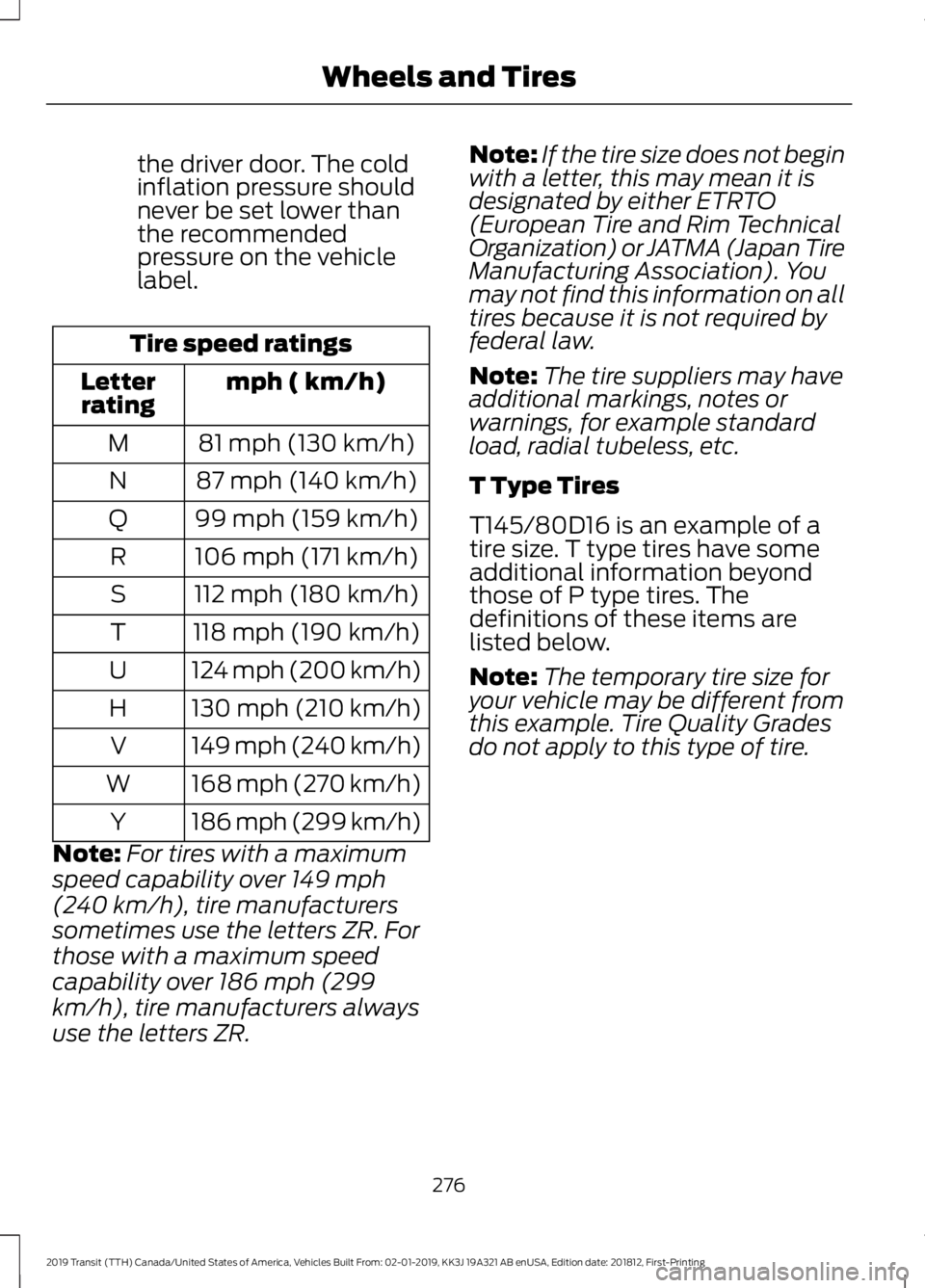
the driver door. The cold
inflation pressure should
never be set lower than
the recommended
pressure on the vehicle
label.
Tire speed ratings
mph ( km/h)
Letter
rating
81 mph (130 km/h)
M
87 mph (140 km/h)
N
99 mph (159 km/h)
Q
106 mph (171 km/h)
R
112 mph (180 km/h)
S
118 mph (190 km/h)
T
124 mph (200 km/h)
U
130 mph (210 km/h)
H
149 mph (240 km/h)
V
168 mph (270 km/h)
W
186 mph (299 km/h)
Y
Note: For tires with a maximum
speed capability over 149 mph
(240 km/h), tire manufacturers
sometimes use the letters ZR. For
those with a maximum speed
capability over 186 mph (299
km/h), tire manufacturers always
use the letters ZR. Note:
If the tire size does not begin
with a letter, this may mean it is
designated by either ETRTO
(European Tire and Rim Technical
Organization) or JATMA (Japan Tire
Manufacturing Association). You
may not find this information on all
tires because it is not required by
federal law.
Note: The tire suppliers may have
additional markings, notes or
warnings, for example standard
load, radial tubeless, etc.
T Type Tires
T145/80D16 is an example of a
tire size. T type tires have some
additional information beyond
those of P type tires. The
definitions of these items are
listed below.
Note: The temporary tire size for
your vehicle may be different from
this example. Tire Quality Grades
do not apply to this type of tire.
276
2019 Transit (TTH) Canada/United States of America, Vehicles Built From: 02-01-2019, KK3J 19A321 AB enUSA, Edition date: 201812, First-Printing Wheels and Tires
Page 281 of 529

LT: Indicates a tire,
designated by the Tire
and Rim Association
(T&RA), that is intended
for service on light trucks.
A
Load Range and Load
Inflation Limits:
Indicates the tire's
load-carrying capabilities
and its inflation limits.
B Maximum Load Dual lb
(kg) at psi (kPa) cold:
Indicates the maximum
load and tire pressure
when the tire is used as a
dual, defined as four tires
on the rear axle (a total of
six or more tires on the
vehicle).
C
Maximum Load Single
lb (kg) at psi (kPa)
cold:
Indicates the
maximum load and tire
pressure when the tire is
used as a single, defined
as two tires (total) on the
rear axle.
D
Additional Information for
ETRTO Euro-Metric
Commercial Vehicle Tires
Euro-metric commercial vehicle
tires end in the letter "C" (for
example, 235/65R16
C). The "C"
does not signify the tire's Load
Range like the T&RA LT tire
dimension (for example,
LT245/75R17
E).
Tire Load Capacities are identified
by the Single/Dual Load indexes
that follow the tire size on the
tire's sidewall (for example,
235/65R16C
121/119).
Note: Tire Quality Grades do not
apply to this type of tire.
278
2019 Transit (TTH) Canada/United States of America, Vehicles Built From: 02-01-2019, KK3J 19A321 AB enUSA, Edition date: 201812, First-Printing Wheels and TiresA
BC
BDE142544