2019 FORD TRANSIT coolant temperature
[x] Cancel search: coolant temperaturePage 194 of 529

BREAKING-IN
You need to break in new tires for
approximately 300 mi (480 km). During
this time, your vehicle may exhibit some
unusual driving characteristics. The engine
also needs to break in. Avoid hard
accelerations and driving too fast for the
first 1,000 mi (1,600 km). If possible, avoid
carrying heavy loads up steep grades
during the break-in period.
REDUCED ENGINE
PERFORMANCE WARNING: If you continue to drive
your vehicle when the engine is
overheating, the engine could stop
without warning. Failure to follow this
instruction could result in the loss of
control of your vehicle.
If the engine coolant temperature gauge
needle moves to the upper limit position,
the engine is overheating. See
Gauges
(page 91).
You must only drive your vehicle for a short
distance if the engine overheats. The
distance you can travel depends on
ambient temperature, vehicle load and
terrain. The engine continues to operate
with limited power for a short period of
time.
If the engine temperature continues to rise,
the fuel supply to the engine reduces. The
air conditioning switches off and the engine
cooling fan operates continually.
1. Gradually reduce your speed and stop your vehicle as soon as it is safe to do
so.
2. Immediately switch the engine off to prevent severe engine damage.
3. Wait for the engine to cool down. 4. Check the coolant level. See
Engine
Coolant Check (page 236).
5. Have your vehicle checked as soon as possible.
ECONOMICAL DRIVING
The following helps to improve fuel
consumption:
• Regularly check your tire pressures and
make sure that they are inflated to the
correct pressure.
See Technical
Specifications (page 305).
• Follow the recommended maintenance
schedule and carry out the
recommended checks.
• Plan your journey and check the traffic
before you set off.
• Avoid idling the engine in cold weather
or for extended periods. Start the
engine only when you are ready to set
off.
• Do not carry unnecessary weight in your
vehicle as extra weight wastes fuel.
• Do not add unnecessary accessories
to the exterior of your vehicle, for
example running boards. If you use a
roof rack, remember to fold it down or
remove it when not in use.
• Drive smoothly, accelerate gently and
anticipate the road ahead to avoid
heavy braking.
• Switch off all electric systems when
not in use, for example air conditioning.
Make sure that you unplug any
accessories from the auxiliary power
points when not in use.
191
2019 Transit (TTH) Canada/United States of America, Vehicles Built From: 02-01-2019, KK3J 19A321 AB enUSA, Edition date: 201812, First-Printing Driving Hints
Page 214 of 529

Protected Component
Fuse Rating
Fuse Number
Crankcase pressure sensor.
7.5 A
F28
Not used.
-
F29 Positive crankcase ventilation valve heater element.
7.5 A
Cooling fan.
60 A
F30 Not used.
-
Not used.
-
F31
Windshield wiper motor.
30 A
F32
Not used.
-
F33
Not used.
-
F34
Powertrain control module.
15 A
F35
Particulate matter sensor.
15 A
F36 Selective catalytic reduction system.
Nitrogen oxides sensor.
Fuel volume control valve.
7.5 A
F37
Not used.
-
F38 Air conditioning clutch.
7.5 A
Exhaust gas temperature sensor.
15 A
F39 Fuel vaporizer system fuel pump.
Coolant bypass solenoid valve.
Low-speed cooling fan.
High-speed cooling fan. Protected Component
Relay Number
Ignition relay 3.
R1
Not used.
R2
Not used.
R3
Not used.
R4
Not used.
R5
Windshield wiper on/off relay.
R6
211
2019 Transit (TTH) Canada/United States of America, Vehicles Built From: 02-01-2019, KK3J 19A321 AB enUSA, Edition date: 201812, First-Printing Fuses
Page 223 of 529

Protected Component
Fuse Rating
Fuse Number
Audio unit.
3 A
F29
Cooling fan.
40 A
F30
Cooling fan.
40 A
F31
Windshield wiper motor.
30 A
F32
Not used.
-
F33
Not used.
-
F34
Powertrain control module.
20 A
F35
Mass air flow sensor.
20 A
F36
Not used.
-
F37
Air conditioning clutch.
20 A
F38
Exhaust gas temperature sensor -3.7L.
7.5 A
F39 Fuel vaporizer system fuel pump -3.7L.
Coolant bypass solenoid valve -3.7L.
Low-speed cooling fan -3.7L.
High-speed cooling fan -3.7L.
Exhaust gas temperature sensor - 3.5L Ecoboost.
10 A Fuel vaporizer system fuel pump - 3.5L Ecoboost.
Coolant bypass solenoid valve - 3.5L Ecoboost.
Low-speed cooling fan - 3.5L Ecoboost.
High-speed cooling fan - 3.5L Ecoboost. Protected Component
Relay Number
Ignition relay 3.
R1
Not used.
R2
Not used.
R3
Not used.
R4
Cooling fan.
R5
Windshield wiper on/off relay.
R6
Windshield wiper high/low speed relay.
R7
Brake vacuum pump.
R8
220
2019 Transit (TTH) Canada/United States of America, Vehicles Built From: 02-01-2019, KK3J 19A321 AB enUSA, Edition date: 201812, First-Printing Fuses
Page 239 of 529

•
Sustained towing operation above
1,000 mi (1,600 km).
• Sustained high-speed driving at Gross
Vehicle Weight Rating (maximum
loaded weight for vehicle operation).
• Sustained use of diesel fuel other than
ultra-low sulfur diesel (ULSD).
OIL CHANGE INDICATOR
RESET
Only reset the system after changing the
engine oil and oil filter.
Resetting the Oil Life Monitoring
System
1. Switch the ignition on. Do not start the
engine.
2. Fully press the accelerator and brake pedals at the same time.
3. Keep the accelerator and brake pedals
fully pressed.
4. After three seconds, a message appears confirming that the reset is in
progress.
5. After 25 seconds, a message appears confirming that the reset is complete.
6. Release the accelerator and brake pedals.
7. Switch the ignition off.
ENGINE COOLING FAN -
DIESEL WARNING:
Keep your hands and
clothing clear of the engine cooling fan. Under certain conditions, the engine
cooling fan may continue to run for several
minutes after you switch your vehicle off.
This could happen in low ambient
temperatures and independent of the
engine coolant temperature, for example
short journeys or low coolant temperature.
See Diesel Particulate Filter (page 145).
ENGINE COOLING FAN - E85/
GASOLINE
WARNING:
Keep your hands and
clothing clear of the engine cooling fan.
Under certain conditions, the engine
cooling fan may continue to run for several
minutes after you switch your vehicle off.
ENGINE COOLANT CHECK WARNING:
Do not remove the
coolant reservoir cap when the engine is
on or the cooling system is hot. Wait 10
minutes for the cooling system to cool
down. Cover the coolant reservoir cap
with a thick cloth to prevent the
possibility of scalding and slowly remove
the cap. Failure to follow this instruction
could result in personal injury. WARNING:
Do not put coolant in
the windshield washer reservoir. If
sprayed on the windshield, coolant could
make it difficult to see through the
windshield.
236
2019 Transit (TTH) Canada/United States of America, Vehicles Built From: 02-01-2019, KK3J 19A321 AB enUSA, Edition date: 201812, First-Printing Maintenance
Page 242 of 529

If you drive in extremely hot climates:
•
You can decrease the coolant
concentration to 40%.
• Coolant concentrations below 40%
decrease the freeze and corrosion
protection characteristics of the
coolant and may cause engine
damage.
Vehicles driven year-round in non-extreme
climates should use prediluted coolant for
optimum cooling system and engine
protection.
Coolant Change
At specific mileage intervals, as listed in
the scheduled maintenance information,
the coolant should be changed. Add
prediluted coolant approved to the correct
specification. See Capacities and
Specifications (page 307).
Fail-Safe Cooling
Fail-safe cooling allows you to temporarily
drive your vehicle before any incremental
component damage occurs. The fail-safe
distance depends on ambient
temperature, vehicle load and terrain.
How Fail-Safe Cooling Works If the engine begins to overheat,
the coolant temperature gauge
moves toward the red zone:
A warning lamp illuminates and
a message may appear in the
information display.
If the engine reaches a preset
over-temperature condition, the engine
automatically switches to alternating
cylinder operation. Each disabled cylinder
acts as an air pump and cools the engine. When this occurs, your vehicle still
operates, however:
•
Engine power is limited.
• The air conditioning system turns off.
Continued operation increases the engine
temperature, causing the engine to
completely shut down. Your steering and
braking effort increases in this situation.
When the engine temperature cools, you
can re-start the engine. Have your vehicle
checked as soon as possible to minimize
engine damage.
When Fail-Safe Mode Is Activated WARNING:
Fail-safe mode is for
use during emergencies only. Operate
your vehicle in fail-safe mode only as
long as necessary to bring your vehicle
to rest in a safe location and seek
immediate repairs. When in fail-safe
mode, your vehicle will have limited
power, will not be able to maintain
high-speed operation, and may
completely shut down without warning,
potentially losing engine power, power
steering assist, and power brake assist,
which may increase the possibility of a
crash resulting in serious injury. WARNING:
Do not remove the
coolant reservoir cap when the engine is
on or the cooling system is hot. Wait 10
minutes for the cooling system to cool
down. Cover the coolant reservoir cap
with a thick cloth to prevent the
possibility of scalding and slowly remove
the cap. Failure to follow this instruction
could result in personal injury.
Your vehicle has limited engine power
when in the fail-safe mode, drive your
vehicle with caution. Your vehicle does not
maintain high-speed operation and the
engine may operate poorly.
239
2019 Transit (TTH) Canada/United States of America, Vehicles Built From: 02-01-2019, KK3J 19A321 AB enUSA, Edition date: 201812, First-Printing Maintenance
Page 243 of 529

Remember that the engine is capable of
automatically shutting down to prevent
engine damage. In this situation:
1. Pull off the road as soon as safely
possible and switch the engine off.
2. If you are a member of a roadside assistance program, we recommend
that you contact your roadside
assistance service provider.
3. If this is not possible, wait for a short period of time for the engine to cool.
4. Check the coolant level. If the coolant level is at or below the minimum mark,
add prediluted coolant immediately.
5. When the engine temperature cools, you can re-start the engine. Have your
vehicle checked as soon as possible to
minimize engine damage.
Note: Driving your vehicle without repair
increases the chance of engine damage.
Engine Coolant Temperature
Management (If Equipped) WARNING:
To reduce the risk of
crash and injury, be prepared that the
vehicle speed may reduce and the
vehicle may not be able to accelerate
with full power until the coolant
temperature reduces.
If you tow a trailer with your vehicle, the
engine may temporarily reach a higher
temperature during severe operating
conditions, for example ascending a long
or steep grade in high ambient
temperatures.
At this time, you may notice the coolant
temperature gauge moves toward the red
zone and a message may appear in the
information display. You may notice a reduction in vehicle
speed caused by reduced engine power in
order to manage the engine coolant
temperature. Your vehicle may enter this
mode if certain high-temperature and
high-load conditions take place. The
amount of speed reduction depends on
vehicle loading, grade and ambient
temperature. If this occurs, there is no
need to stop your vehicle. You can
continue to drive.
The air conditioning may automatically
turn on and off during severe operating
conditions to protect the engine from
overheating. When the coolant
temperature decreases to the normal
operating temperature, the air conditioning
turns on.
If the coolant temperature gauge moves
fully into the red zone, or if the coolant
temperature warning or service engine
soon messages appear in your information
display, do the following:
1. Stop your vehicle as soon as it is safe
to do so. Fully apply the parking brake,
shift into park (P) or neutral (N).
2. Leave the engine running until the coolant temperature gauge needle
returns to the normal position. If the
temperature does not drop after
several minutes, follow the remaining
steps.
3. Switch the engine off and wait for it to
cool. Check the coolant level.
4. If the coolant level is at or below the minimum mark, add prediluted coolant
immediately.
5. If the coolant level is normal, restart the engine and continue.
240
2019 Transit (TTH) Canada/United States of America, Vehicles Built From: 02-01-2019, KK3J 19A321 AB enUSA, Edition date: 201812, First-Printing Maintenance
Page 270 of 529

General
•
Store all vehicles in a dry, ventilated
place.
• Protect from sunlight, if possible.
• If vehicles are stored outside, they
require regular maintenance to protect
against rust and damage.
Body
• Wash your vehicle thoroughly to
remove dirt, grease, oil, tar or mud from
exterior surfaces, rear-wheel housing
and the underside of front fenders.
• Periodically wash your vehicle if it is
stored in exposed locations.
• Touch-up exposed or primed metal to
prevent rust.
• Cover chrome and stainless steel parts
with a thick coat of auto wax to prevent
discoloration. Re-wax as necessary
when you wash your vehicle.
• Lubricate all hood, door and luggage
compartment hinges and latches with
a light grade oil.
• Cover interior trim to prevent fading.
• Keep all rubber parts free from oil and
solvents.
Engine
• Change the engine oil and filter prior to
storage because used engine oil
contains contaminates which may
cause engine damage.
• Start the engine every 15 days for a
minimum of 15 minutes. Run at fast idle
with the climate controls set to defrost
until the engine reaches normal
operating temperature. •
With your foot on the brake, shift
through all the gears while the engine
is running.
• We recommend that you change the
engine oil before you use your vehicle
again.
Fuel system
• Fill the fuel tank with high-quality fuel
until the first automatic shutoff of the
fuel pump nozzle.
Cooling system
• Protect against freezing temperatures.
• When removing your vehicle from
storage, check coolant fluid level.
Confirm that there are no cooling
system leaks and that fluid is at the
recommended level.
Battery
• Check and recharge as necessary. Keep
connections clean.
• If storing your vehicle for more than 30
days without recharging the battery,
we recommend that you disconnect
the battery cables to maintain battery
charge for quick starting.
Note: It is necessary to reset memory
features if battery cables are disconnected.
Brakes
• Make sure the brakes and parking brake
release fully.
Tires
• Maintain recommended air pressure.
267
2019 Transit (TTH) Canada/United States of America, Vehicles Built From: 02-01-2019, KK3J 19A321 AB enUSA, Edition date: 201812, First-Printing Vehicle Care
Page 521 of 529
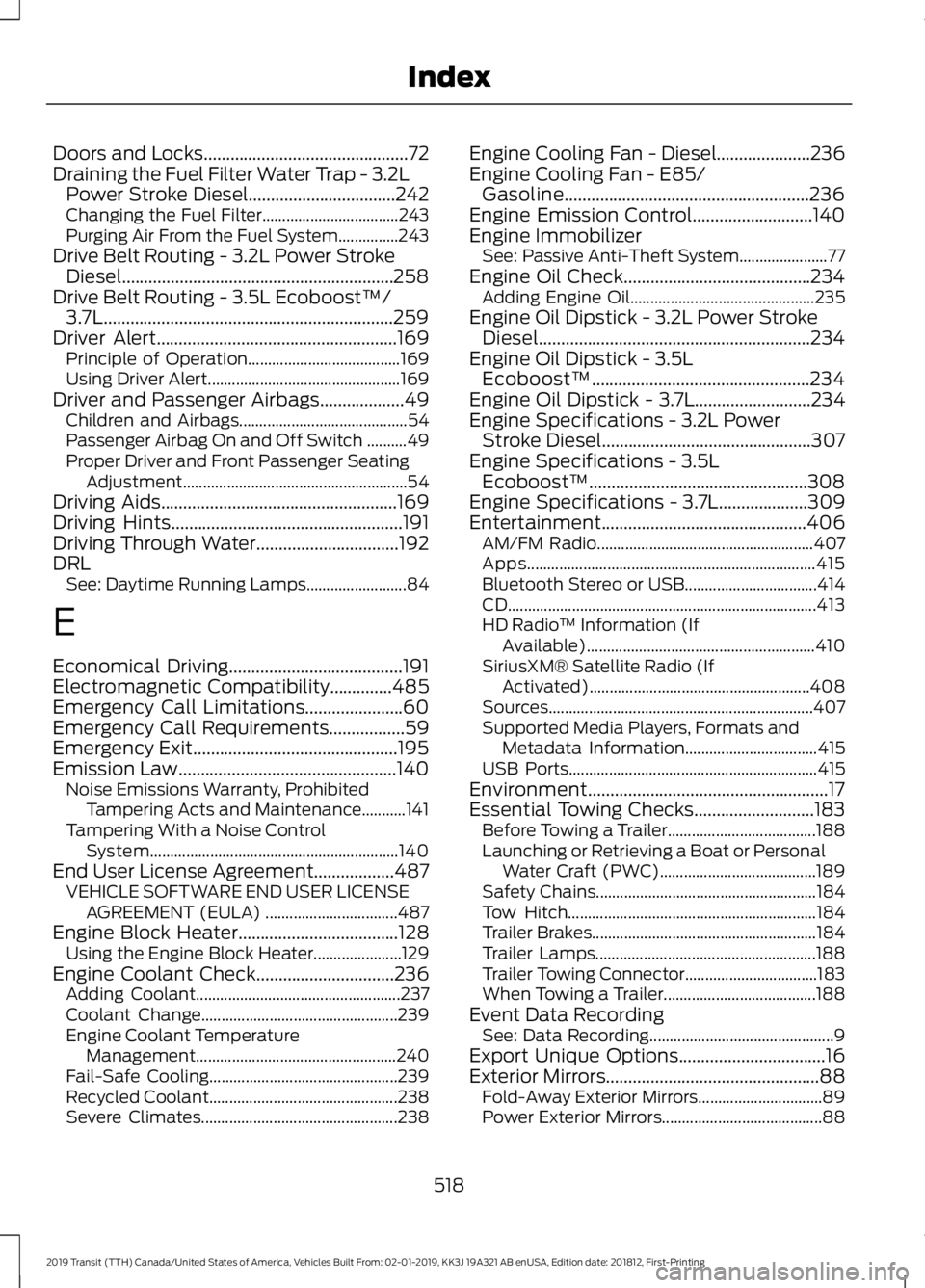
Doors and Locks..............................................72
Draining the Fuel Filter Water Trap - 3.2L
Power Stroke Diesel.................................242
Changing the Fuel Filter.................................. 243
Purging Air From the Fuel System...............243
Drive Belt Routing - 3.2L Power Stroke Diesel.............................................................258
Drive Belt Routing - 3.5L Ecoboost™/ 3.7L.................................................................259
Driver Alert......................................................169
Principle of Operation...................................... 169
Using Driver Alert................................................ 169
Driver and Passenger Airbags...................49 Children and Airbags.......................................... 54
Passenger Airbag On and Off Switch ..........49
Proper Driver and Front Passenger Seating Adjustment........................................................ 54
Driving Aids
.....................................................169
Driving Hints....................................................191
Driving Through Water................................192
DRL See: Daytime Running Lamps......................... 84
E
Economical Driving
.......................................191
Electromagnetic Compatibility..............485
Emergency Call Limitations......................60
Emergency Call Requirements.................59
Emergency Exit..............................................195
Emission Law
.................................................140
Noise Emissions Warranty, Prohibited
Tampering Acts and Maintenance...........141
Tampering With a Noise Control System.............................................................. 140
End User License Agreement
..................487
VEHICLE SOFTWARE END USER LICENSE
AGREEMENT (EULA) ................................. 487
Engine Block Heater
....................................128
Using the Engine Block Heater...................... 129
Engine Coolant Check
...............................236
Adding Coolant................................................... 237
Coolant Change................................................. 239
Engine Coolant Temperature Management.................................................. 240
Fail-Safe Cooling............................................... 239
Recycled Coolant............................................... 238
Severe Climates................................................. 238Engine Cooling Fan - Diesel.....................236
Engine Cooling Fan - E85/
Gasoline.......................................................236
Engine Emission Control...........................140
Engine Immobilizer See: Passive Anti-Theft System...................... 77
Engine Oil Check..........................................234 Adding Engine Oil.............................................. 235
Engine Oil Dipstick - 3.2L Power Stroke Diesel.............................................................234
Engine Oil Dipstick - 3.5L Ecoboost™.................................................234
Engine Oil Dipstick - 3.7L
..........................234
Engine Specifications - 3.2L Power Stroke Diesel
...............................................307
Engine Specifications - 3.5L Ecoboost™.................................................308
Engine Specifications - 3.7L....................309
Entertainment..............................................406 AM/FM Radio...................................................... 407
Apps........................................................................\
415
Bluetooth Stereo or USB................................. 414
CD........................................................................\
..... 413
HD Radio ™ Information (If
Available)......................................................... 410
SiriusXM® Satellite Radio (If Activated)....................................................... 408
Sources.................................................................. 407
Supported Media Players, Formats and Metadata Information................................. 415
USB Ports.............................................................. 415
Environment......................................................17
Essential Towing Checks
...........................183
Before Towing a Trailer..................................... 188
Launching or Retrieving a Boat or Personal Water Craft (PWC)....................................... 189
Safety Chains....................................................... 184
Tow Hitch.............................................................. 184
Trailer Brakes........................................................ 184
Trailer Lamps....................................................... 188
Trailer Towing Connector................................. 183
When Towing a Trailer...................................... 188
Event Data Recording See: Data Recording.............................................. 9
Export Unique Options
.................................16
Exterior Mirrors................................................88
Fold-Away Exterior Mirrors............................... 89
Power Exterior Mirrors........................................ 88
518
2019 Transit (TTH) Canada/United States of America, Vehicles Built From: 02-01-2019, KK3J 19A321 AB enUSA, Edition date: 201812, First-Printing Index