2019 FORD TRANSIT instrument panel
[x] Cancel search: instrument panelPage 7 of 529

Ordering Additional Owner's Literature
.......................................................................206
Reporting Safety Defects (U.S. Only) .......................................................................
206
Reporting Safety Defects (Canada Only) .......................................................................
206
Fuses
Fuse Box Locations ...................................
208
Fuse Specification Chart - 3.2L Power Stroke Diesel ............................................
209
Fuse Specification Chart - 3.5L Ecoboost™/3.7L ......................................
218
Changing a Fuse ..........................................
227
Maintenance
General Information ..................................
229
Opening and Closing the Hood .............
229
Under Hood Overview - 3.2L Power Stroke Diesel ..............................................
231
Under Hood Overview - 3.5L Ecoboost™ ........................................................................\
232
Under Hood Overview - 3.7L ...................
233
Engine Oil Dipstick - 3.2L Power Stroke Diesel ...........................................................
234
Engine Oil Dipstick - 3.5L Ecoboost™ ........................................................................\
234
Engine Oil Dipstick - 3.7L .........................
234
Engine Oil Check .........................................
234
Changing the Engine Oil and Oil Filter ........................................................................\
235
Oil Change Indicator Reset .....................
236
Engine Cooling Fan - Diesel ....................
236
Engine Cooling Fan - E85/Gasoline .....
236
Engine Coolant Check ..............................
236
Automatic Transmission Fluid Check ........................................................................\
.
241
Brake Fluid Check ........................................
241
Power Steering Fluid Check .....................
241
Washer Fluid Check ...................................
242
Draining the Fuel Filter Water Trap - 3.2L Power Stroke Diesel ..............................
242Fuel Filter - Gasoline
.................................
244
Changing the 12V Battery ........................
244
Checking the Wiper Blades ....................
246
Changing the Front Wiper Blades ........
246
Adjusting the Headlamps ........................
247
Removing a Headlamp ............................
248
Changing a Bulb .........................................
249
Bulb Specification Chart ..........................
254
Changing the Engine Air Filter - 3.2L Power Stroke Diesel ..............................
255
Changing the Engine Air Filter - 3.5L Ecoboost™ ...............................................
256
Changing the Engine Air Filter - 3.7L .....
257
Drive Belt Routing - 3.2L Power Stroke Diesel ..........................................................
258
Drive Belt Routing - 3.5L Ecoboost™/ 3.7L ...............................................................
259
Vehicle Care
Cleaning Products .....................................
260
Cleaning the Exterior ..................................
261
Waxing ............................................................
262
Cleaning the Engine ...................................
262
Cleaning the Windows and Wiper Blades ........................................................................\
263
Cleaning the Interior ..................................
263
Cleaning the Instrument Panel and Instrument Cluster Lens ......................
265
Repairing Minor Paint Damage .............
266
Cleaning the Wheels .................................
266
Vehicle Storage ...........................................
266
Wheels and Tires
General Information ..................................
269
Tire Care .........................................................
270
Using Winter Tires ......................................
287
Using Snow Chains ....................................
287
Tire Pressure Monitoring System .........
288
Changing a Road Wheel ..........................
293
Technical Specifications .........................
305
4
2019 Transit (TTH) Canada/United States of America, Vehicles Built From: 02-01-2019, KK3J 19A321 AB enUSA, Edition date: 201812, First-Printing Table of Contents
Page 53 of 529

WARNING: Your vehicle may have
an airbag deactivation switch. Before
driving, always look at the switch to
make sure it is in the appropriate
position. Failure to put the switch in the
proper position can increase the risk of
serious injury or death in a crash. The front passenger airbag on and off
switch has indicators that will illuminate,
indicating that the front passenger frontal
airbag is either on or off. The indicator lamp
is located on the instrument panel.
Note:
The passenger airbag status indicator
OFF and ON lamps illuminate for a short
period of time when you switch the ignition
on to confirm it is functional. Passenger airbag
Passenger airbag status
indicator
Switch position
Disabled
OFF: Lit
Off
ON: Unlit Enabled
OFF: Unlit
On
ON: Lit
Turning the Passenger Airbag Off WARNING:
If the light does not
illuminate when the passenger airbag
switch is off and you switch the ignition
on, have the passenger airbag switch
serviced immediately by a qualified
technician. WARNING:
To avoid switching on
the airbag, always remove the ignition
key with the switch in the off position. WARNING: Never
place front
seat mounted rear-facing child or infant
seats in front of an active passenger
airbag. WARNING:
You must switch the
passenger airbag off when using a
rearward facing child restraint on the
front seat.
50
2019 Transit (TTH) Canada/United States of America, Vehicles Built From: 02-01-2019, KK3J 19A321 AB enUSA, Edition date: 201812, First-Printing Supplementary Restraints SystemE282245
Page 60 of 529

The system consists of the following:
•
Safety Canopy curtain airbags above
the trim panels over the front and rear
side windows identified by a label or
wording on the headliner or roof-pillar
trim.
• A flexible headliner which opens above
the side doors to allow air curtain
deployment · Crash sensors and monitoring
system with a readiness
indicator. See Crash Sensors
and Airbag Indicator (page 57).
Properly restrain children 12 years old and
under in the rear seats. The Safety Canopy
will not interfere with children restrained
using a properly installed child or booster
seat because it is designed to inflate
downward from the headliner above the
doors along the side window opening.
The design and development of the Safety
Canopy included recommended testing
procedures that were developed by a
group of automotive safety experts known
as the Side Airbag Technical Working
Group. These recommended testing
procedures help reduce the risk of injuries
related to the deployment of side airbags
(including the Safety Canopy). CRASH SENSORS AND
AIRBAG INDICATOR WARNING:
Modifying or adding
equipment to the front end of your
vehicle (including hood, bumper system,
frame, front end body structure, tow
hooks and hood pins) may affect the
performance of the airbag system,
increasing the risk of injury. Do not
modify or add equipment to the front
end of your vehicle.
Your vehicle has a collection of crash and
occupant sensors which provide
information to the restraints control
module which deploys (activates) the
front safety belt pretensioners, driver
airbag, passenger airbag, seat mounted
side airbags, and the Safety Canopy®.
Based on the type of crash (frontal impact,
side impact or rollover), the restraints
control module will deploy the appropriate
safety devices.
The restraints control module also
monitors the readiness of the above safety
devices plus the crash and occupant
sensors. The readiness of the safety
system is indicated by a warning indicator
light in the instrument cluster or by a
backup tone if the warning light is not
working. Routine maintenance of the
airbags is not required.
A difficulty with the system is indicated by
one or more of the following: The readiness light will not
illuminate immediately after the
ignition is turned on.
57
2019 Transit (TTH) Canada/United States of America, Vehicles Built From: 02-01-2019, KK3J 19A321 AB enUSA, Edition date: 201812, First-Printing Supplementary Restraints SystemE75004 E67017 E67017
Page 85 of 529
GENERAL INFORMATION
Condensation in the Exterior Front
Lamps and Rear Lamps
Exterior front lamps and rear lamps have
vents to accommodate normal changes
in air pressure.
Condensation can be a natural by-product
of this design. When moist air enters the
lamp assembly through the vents, there is
a possibility that condensation can occur
when the temperature is cold. When
normal condensation occurs, a fine mist
can form on the interior of the lens. The
fine mist eventually clears and exits
through the vents during normal operation.
Clearing time may take as long as 48 hours
under dry weather conditions.
Examples of acceptable condensation are:
•
The presence of a fine mist (no streaks,
drip marks or large droplets).
• A fine mist covers less than 50% of the
lens.
Examples of unacceptable condensation
are:
• A water puddle inside the lamp.
• Streaks, drip marks or large droplets
present on the interior of the lens.
If you see any unacceptable condensation,
have your vehicle checked by an authorized
dealer. LIGHTING CONTROL
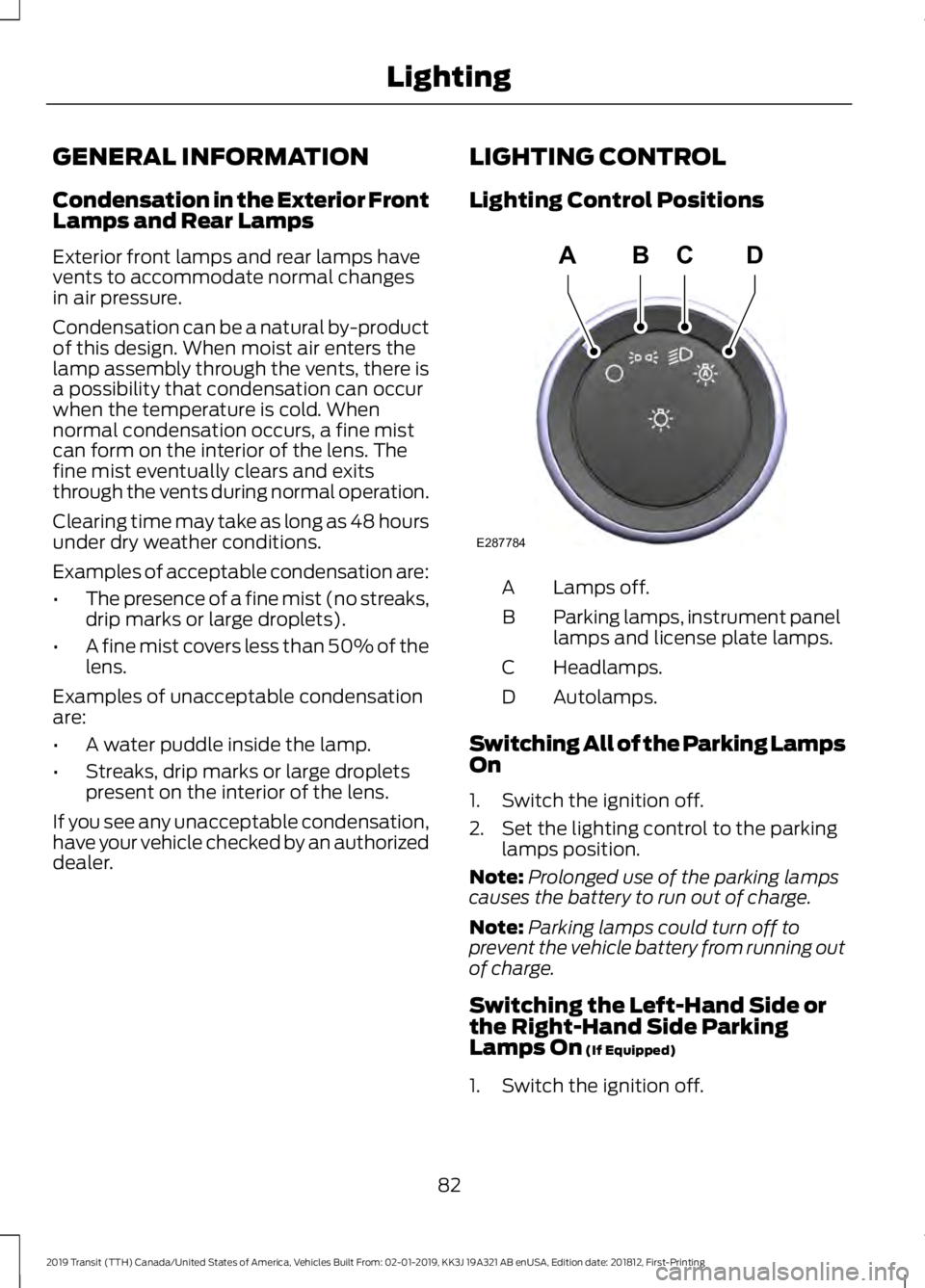
Lighting Control Positions
Lamps off.
A
Parking lamps, instrument panel
lamps and license plate lamps.
B
Headlamps.
C
Autolamps.
D
Switching All of the Parking Lamps
On
1. Switch the ignition off.
2. Set the lighting control to the parking lamps position.
Note: Prolonged use of the parking lamps
causes the battery to run out of charge.
Note: Parking lamps could turn off to
prevent the vehicle battery from running out
of charge.
Switching the Left-Hand Side or
the Right-Hand Side Parking
Lamps On (If Equipped)
1. Switch the ignition off.
82
2019 Transit (TTH) Canada/United States of America, Vehicles Built From: 02-01-2019, KK3J 19A321 AB enUSA, Edition date: 201812, First-Printing LightingE287784
ADBC
Page 110 of 529

MANUAL CLIMATE CONTROL
Fan speed control: Controls the volume of air circulated in your vehicle. Adjust
to select the desired fan speed or switch off. If you switch the fan off, the
windshield may fog up.
A
Recirculated air:
Press the button to switch between outside air and
recirculated air. When you select recirculated air, the air currently in the
passenger compartment recirculates. This can reduce the time needed to cool
the interior, when used with
A/C, and reduce unwanted odors from entering
your vehicle.
B
Note:
Recirculation air may turn off automatically, or be prevented from turning
on in all airflow modes except MAX A/C to reduce risk of fogging. Recirculated
air may also turn on and off automatically in instrument panel or instrument
panel and floor airflow modes during hot weather to improve cooling efficiency.
Temperature control:
Controls the temperature of the air circulated in your
vehicle. Adjust to select the desired temperature. If you select MAX A/C, the
system distributes recirculated air through the instrument panel air vents. This
mode is more economical and efficient than normal air conditioning. Turn the
temperature control to maximum heat to turn the auxiliary heater on
C
Air conditioning:
Press the button to switch the air conditioning on or off. To
improve air conditioning when starting your vehicle, drive with the windows
open for two to three minutes.
D
Air distribution control:
Adjust to select the desired air distribution.
E Select to distribute air through
the instrument panel air vents. Select to distribute air through
the instrument panel air vents
and footwell air vents.
107
2019 Transit (TTH) Canada/United States of America, Vehicles Built From: 02-01-2019, KK3J 19A321 AB enUSA, Edition date: 201812, First-Printing Climate ControlE147011
AEBDC
Page 111 of 529
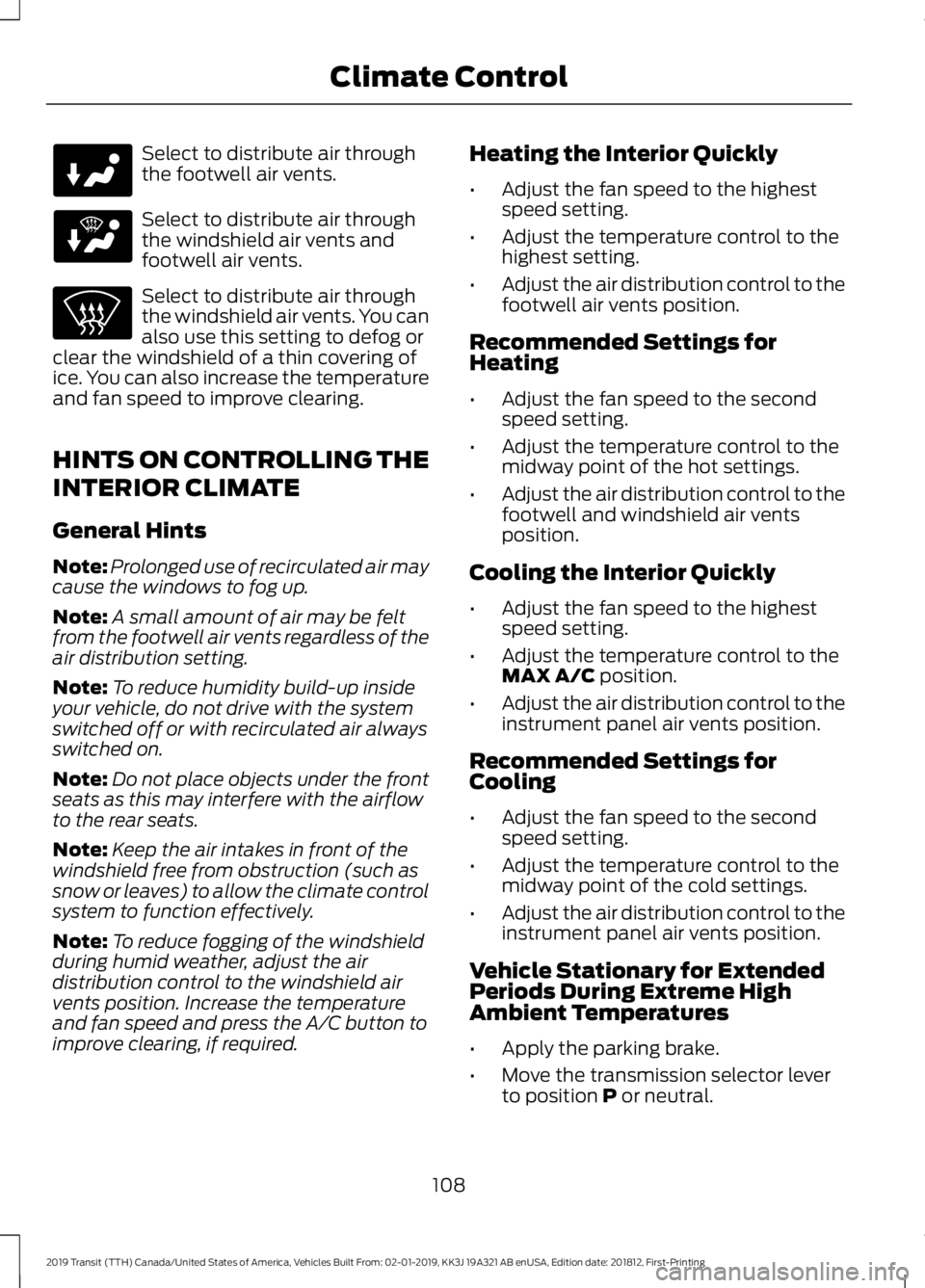
Select to distribute air through
the footwell air vents.
Select to distribute air through
the windshield air vents and
footwell air vents.
Select to distribute air through
the windshield air vents. You can
also use this setting to defog or
clear the windshield of a thin covering of
ice. You can also increase the temperature
and fan speed to improve clearing.
HINTS ON CONTROLLING THE
INTERIOR CLIMATE
General Hints
Note: Prolonged use of recirculated air may
cause the windows to fog up.
Note: A small amount of air may be felt
from the footwell air vents regardless of the
air distribution setting.
Note: To reduce humidity build-up inside
your vehicle, do not drive with the system
switched off or with recirculated air always
switched on.
Note: Do not place objects under the front
seats as this may interfere with the airflow
to the rear seats.
Note: Keep the air intakes in front of the
windshield free from obstruction (such as
snow or leaves) to allow the climate control
system to function effectively.
Note: To reduce fogging of the windshield
during humid weather, adjust the air
distribution control to the windshield air
vents position. Increase the temperature
and fan speed and press the A/C button to
improve clearing, if required. Heating the Interior Quickly
•
Adjust the fan speed to the highest
speed setting.
• Adjust the temperature control to the
highest setting.
• Adjust the air distribution control to the
footwell air vents position.
Recommended Settings for
Heating
• Adjust the fan speed to the second
speed setting.
• Adjust the temperature control to the
midway point of the hot settings.
• Adjust the air distribution control to the
footwell and windshield air vents
position.
Cooling the Interior Quickly
• Adjust the fan speed to the highest
speed setting.
• Adjust the temperature control to the
MAX A/C position.
• Adjust the air distribution control to the
instrument panel air vents position.
Recommended Settings for
Cooling
• Adjust the fan speed to the second
speed setting.
• Adjust the temperature control to the
midway point of the cold settings.
• Adjust the air distribution control to the
instrument panel air vents position.
Vehicle Stationary for Extended
Periods During Extreme High
Ambient Temperatures
• Apply the parking brake.
• Move the transmission selector lever
to position
P or neutral.
108
2019 Transit (TTH) Canada/United States of America, Vehicles Built From: 02-01-2019, KK3J 19A321 AB enUSA, Edition date: 201812, First-Printing Climate Control
Page 112 of 529

•
Adjust the temperature control to the
MAX A/C position.
• Adjust the fan speed to the lowest
speed setting.
Side Window Defogging in Cold
Weather
• Adjust the air distribution control to the
instrument panel and windshield air
vents positions.
• Press the
A/C button.
• Adjust the temperature control to the
desired setting.
• Adjust the fan speed to the highest
setting.
• Direct the instrument panel side air
vents toward the side windows.
• Close the instrument panel vents.
Maximum Cooling Performance in
Instrument Panel or Instrument
Panel and Footwell Positions
• Adjust the temperature control to the
lowest setting.
• Press the
A/C and recirculated air
buttons.
• Adjust the fan speed to the highest
setting initially and then adjust it to suit
the desired comfort level.
REAR PASSENGER CLIMATE
CONTROLS
Adjusting the Blower Motor Speed Directing Air to the Overhead Air
Vents
When you direct air to the
overhead air vents, the system
distributes cold air.
Directing Air to the Footwell Air
Vents When you direct air to the
footwell air vents, the system
distributes hot air.
Directing Air to the Overhead Air
Vents and the Footwell Air Vents When you direct air to the
Overhead and footwell air vents,
the system distributes warm air.
HEATED WINDOWS AND
MIRRORS
Heated Rear Window
(If Equipped)
Note: Make sure the engine is running
before operating the heated windows.
Note: The heated rear window button is
located on the instrument panel, near the
instrument cluster. Press the button to clear the
heated rear window of thin ice
and fog. The heated rear
window will automatically turn off after a
short period of time.
Note: Do not use razor blades or other
sharp objects to clean or remove decals
from the inside of the heated rear window.
The vehicle warranty does not cover
damage caused to the heated rear window
grid lines.
109
2019 Transit (TTH) Canada/United States of America, Vehicles Built From: 02-01-2019, KK3J 19A321 AB enUSA, Edition date: 201812, First-Printing Climate Control E72507
Page 123 of 529

12 Volt DC Power Point
WARNING: Do not plug optional
electrical accessories into the cigar
lighter socket. Incorrect use of the cigar
lighter can cause damage not covered
by the vehicle warranty, and can result
in fire or serious injury. WARNING:
Do not use a power
point for operating a cigar lighter.
Incorrect use of the power points can
cause damage not covered by the
vehicle warranty, and can result in fire or
serious injury.
Note: When you switch the ignition on, you
can use the socket to power 12 volt
appliances with a maximum current rating
of 15 amps.
If the power supply does not work after you
switch the ignition off, switch the ignition
on.
Note: Do not hang any accessory from the
accessory plug.
Note: Do not use the power point over the
vehicle capacity of 12 volt DC 180 watts or
a fuse may blow.
Note: Always keep the power point caps
closed when not in use.
Do not insert objects other than an
accessory plug into the power point. This
will damage the power point and blow the
fuse.
Run the vehicle for full capacity use of the
power point. To prevent the battery from running out of
charge:
•
Do not use the power point longer than
necessary when the vehicle is not
running.
• Do not leave devices plugged in
overnight or when you park your vehicle
for extended periods.
Locations Power points may be in the following
locations:
•
On the instrument panel.
• Inside the cargo area.
AC Power Point
(If Equipped) WARNING: Do not keep electrical
devices plugged in the power point
whenever the device is not in use. Do not
use any extension cord with the 110 volt
AC power point, since it will defeat the
safety protection design. Doing so may
cause the power point to overload due
to powering multiple devices that can
reach beyond the 150 watt load limit and
could result in fire or serious injury.
Note: The power point will turn off when
the ignition is switched off or the battery
voltage drops below 11 volts.
120
2019 Transit (TTH) Canada/United States of America, Vehicles Built From: 02-01-2019, KK3J 19A321 AB enUSA, Edition date: 201812, First-Printing Auxiliary Power PointsE185878