2019 FORD TAURUS fuel pressure
[x] Cancel search: fuel pressurePage 264 of 515

•
Cover interior trim to prevent fading.
• Keep all rubber parts free from oil and
solvents.
Engine
• Change the engine oil and filter prior to
storage because used engine oil
contains contaminates which may
cause engine damage.
• Start the engine every 15 days for a
minimum of 15 minutes. Run at fast idle
with the climate controls set to defrost
until the engine reaches normal
operating temperature.
• With your foot on the brake, shift
through all the gears while the engine
is running.
• We recommend that you change the
engine oil before you use your vehicle
again.
Fuel system
• Fill the fuel tank with high-quality fuel
until the first automatic shutoff of the
fuel pump nozzle.
Cooling system
• Protect against freezing temperatures.
• When removing your vehicle from
storage, check coolant fluid level.
Confirm that there are no cooling
system leaks and that fluid is at the
recommended level.
Battery
• Check and recharge as necessary. Keep
connections clean.
• If storing your vehicle for more than 30
days without recharging the battery,
we recommend that you disconnect
the battery cables to maintain battery
charge for quick starting. Note:
It is necessary to reset memory
features if battery cables are disconnected.
Brakes
• Make sure the brakes and parking brake
release fully.
Tires
• Maintain recommended air pressure.
Miscellaneous
• Make sure all linkages, cables, levers
and pins under your vehicle are covered
with grease to prevent rust.
• Move vehicles at least 25 ft (7.5 m)
every 15 days to lubricate working parts
and prevent corrosion.
Removing Vehicle From Storage
When your vehicle is ready to come out of
storage, do the following:
• Wash your vehicle to remove any dirt
or grease film build-up on window
surfaces.
• Check windshield wipers for any
deterioration.
• Check under the hood for any foreign
material that may have collected
during storage such as mice or squirrel
nests.
• Check the exhaust for any foreign
material that may have collected
during storage.
• Check tire pressures and set tire
inflation per the Tire Label.
• Check brake pedal operation. Drive
your vehicle
15 ft (4.5 m) back and
forth to remove rust build-up.
261
Taurus (CPH) Canada/United States of America, enUSA, Edition date: 201806, First-Printing Vehicle Care
Page 266 of 515

GENERAL INFORMATION
The recommended tire inflation pressures
are on the tire information label on the
driver side B-pillar.
Check and set the tire pressure at the
ambient temperature in which you are
intending to drive your vehicle and when
the tires are cold. See Technical
Specifications (page 291).
Note: Check your tire pressures regularly to
optimize fuel economy.
Only use approved wheel and tire sizes.
Using other sizes could damage your
vehicle and could make the National Type
Approval invalid.
Installation of any tires that are not the
original equipment tire size can cause the
speedometer to display incorrect vehicle
speed.
TIRE SEALANT AND INFLATOR
KIT
(If Equipped)
Note: The temporary mobility kit canister
contains enough sealant compound for one
tire repair only. See your authorized Ford
dealer for additional replacement sealant
canisters.
The kit is under the load floor of the trunk.
The kit consists of an air compressor to
inflate the tire and a sealing compound in
a canister that will effectively seal most
punctures caused by nails or similar
objects. This kit will provide a temporary
tire repair allowing you to drive your vehicle
up to
120 mi (200 km) at a maximum
speed of 50 mph (80 km/h) to reach a tire
service location. Air compressor (inside)
A
Diverter knob
B
On and off button
C
Air pressure gauge
D
Sealant bottle and canister
E
Sealant filling clear tube
F
Sealant tube - tire valve
connector
G
Air compressor hose
H
Yellow cap tool
I
Air hose -tire valve connector
J
Accessory power plug
K
Casing/housing
L
263
Taurus (CPH) Canada/United States of America, enUSA, Edition date: 201806, First-Printing Wheels and TiresE144618
Page 286 of 515

If the tires on your vehicle have all season
treads, they will provide traction in rain and
snow. However, in some climates, you may
need to use snow tires and cables. If you
need to use cables, it is recommended that
steel wheels (of the same size and
specifications) be used, as cables may chip
aluminum wheels.
Follow these guidelines when using snow
tires and chains:
•
If possible, avoid fully loading your
vehicle.
• Use only SAE Class S snow chains,
snow cables or equivalent on the front
axle for P235/55R18 equipped vehicles.
The use of snow chains, snow cables
or other traction assist devices that are
larger than SAE Class S may cause
damage to your vehicle ’s wheel house,
suspension and/or body.
• Do not install tire chains, cables, or
optional traction devices on the rear
tires. This could cause damage to the
vehicle ’s wheel house or body.
• Install cable chains securely, verifying
that the cables do not touch any wiring,
brake lines or fuel lines.
• Do not exceed 30 mph (48 km/h) with
tire cables on your vehicle.
• Drive cautiously. If you hear the cables
rub or bang against your vehicle, stop
and retighten the cables. If this does
not work, remove the cables to prevent
damage to your vehicle.
• Remove the tire cables when they are
no longer needed. Do not use tire
cables on dry roads. TIRE PRESSURE MONITORING
SYSTEM WARNING:
The tire pressure
monitoring system is not a substitute for
manually checking tire pressures. You
should periodically check tire pressures
using a pressure gauge. Failure to
correctly maintain tire pressures could
increase the risk of tire failure, loss of
control, vehicle rollover and personal
injury.
Note: You should only use tire sealants in
roadside emergencies as they may cause
damage to the tire pressure monitoring
system sensor.
Note: If the tire pressure monitoring system
sensor becomes damaged, it may not
function. Each tire, including the spare (if
provided), should be checked
monthly when cold and inflated
to the inflation pressure recommended by
the vehicle manufacturer on the vehicle
placard or tire inflation pressure label. (If
your vehicle has tires of a different size
than the size indicated on the vehicle
placard or tire inflation pressure label, you
should determine the proper tire inflation
pressure for those tires).
As an added safety feature, your vehicle
has been equipped with a Tire Pressure
Monitoring System (TPMS) that
illuminates a low tire pressure telltale
when one or more of your tires is
significantly under-inflated. Accordingly,
when the low tire pressure telltale
illuminates, you should stop and check
your tires as soon as possible, and inflate
283
Taurus (CPH) Canada/United States of America, enUSA, Edition date: 201806, First-Printing Wheels and Tires
Page 287 of 515

them to the proper pressure. Driving on a
significantly under-inflated tire causes the
tire to overheat and can lead to tire failure.
Under-inflation also reduces fuel efficiency
and tire tread life, and may affect the
vehicle
’s handling and stopping ability.
Please note that the TPMS is not a
substitute for proper tire maintenance, and
it is the driver ’s responsibility to maintain
correct tire pressure, even if under-inflation
has not reached the level to trigger
illumination of the TPMS low tire pressure
telltale.
Your vehicle has also been equipped with
a TPMS malfunction indicator to indicate
when the system is not operating properly.
The TPMS malfunction indicator is
combined with the low tire pressure
telltale. When the system detects a
malfunction, the telltale will flash for
approximately one minute and then remain
continuously illuminated. This sequence
will continue upon subsequent vehicle
start-ups as long as the malfunction exists.
When the malfunction indicator is
illuminated, the system may not be able
to detect or signal low tire pressure as
intended. TPMS malfunctions may occur
for a variety of reasons, including the
installation of replacement or alternate
tires or wheels on the vehicle that prevent
the TPMS from functioning properly.
Always check the TPMS malfunction
telltale after replacing one or more tires or
wheels on your vehicle to ensure that the
replacement or alternate tires and wheels
allow the TPMS to continue to function
properly.
This device complies with Part 15 of the
FCC Rules and with Licence exempt RSS
Standards of Industry Canada. Operation
is subject to the following two conditions:
1. This device may not cause harmful interference, and 2. This device must accept any
interference received, including
interference that may cause undesired
operation. WARNING: Changes or
modifications not expressively approved
by the party responsible for compliance
could void the user's authority to operate
the equipment. The term "IC:" before the
radio certification number only signifies
that Industry Canada technical
specifications were met.
Changing Tires With a Tire
Pressure Monitoring System Note:
Each road tire is equipped with a tire
pressure sensor located inside the wheel
and tire assembly cavity. The pressure
sensor is attached to the valve stem. The
pressure sensor is covered by the tire and is
not visible unless the tire is removed. Take
care when changing the tire to avoid
damaging the sensor.
You should always have your tires serviced
by an authorized dealer.
Check the tire pressure periodically (at
least monthly) using an accurate tire
gauge. See Inflating Your Tires in this
chapter.
284
Taurus (CPH) Canada/United States of America, enUSA, Edition date: 201806, First-Printing Wheels and TiresE142549
Page 301 of 515

CAPACITIES AND SPECIFICATIONS - 3.5L DURATEC
Capacities
WARNING: The air conditioning refrigerant system contains refrigerant under
high pressure. Only qualified personnel should service the air conditioning refrigerant
system. Opening the air conditioning refrigerant system can cause personal injury. Capacity
Item
6.0 qt (5.7 L)
Engine oil (with oil filter).
11.1 qt (10.5 L)
Engine coolant.
Between MIN/MAX on brake fluid reservoir
Brake fluid.
2.4 pt (1.15 L)
Rear differential (All Wheel Drive) fluid.
10.9 qt (10.3 L)1
Automatic transmission fluid.
17.9 fl oz (0.53 L)
Power Transfer Unit (PTU) fluid (All Wheel
Drive).
Fill as required
Windshield washer fluid.
19.0 gal (71.9 L)
Fuel tank.
1.43 lb (0.65 kg)
A/C refrigerant.
5.24 fl oz (155 ml)
A/C refrigerant compressor oil.
1 Approximate dry fill capacity. Actual amount may vary during fluid changes.
298
Taurus (CPH) Canada/United States of America, enUSA, Edition date: 201806, First-Printing Capacities and Specifications
Page 447 of 515
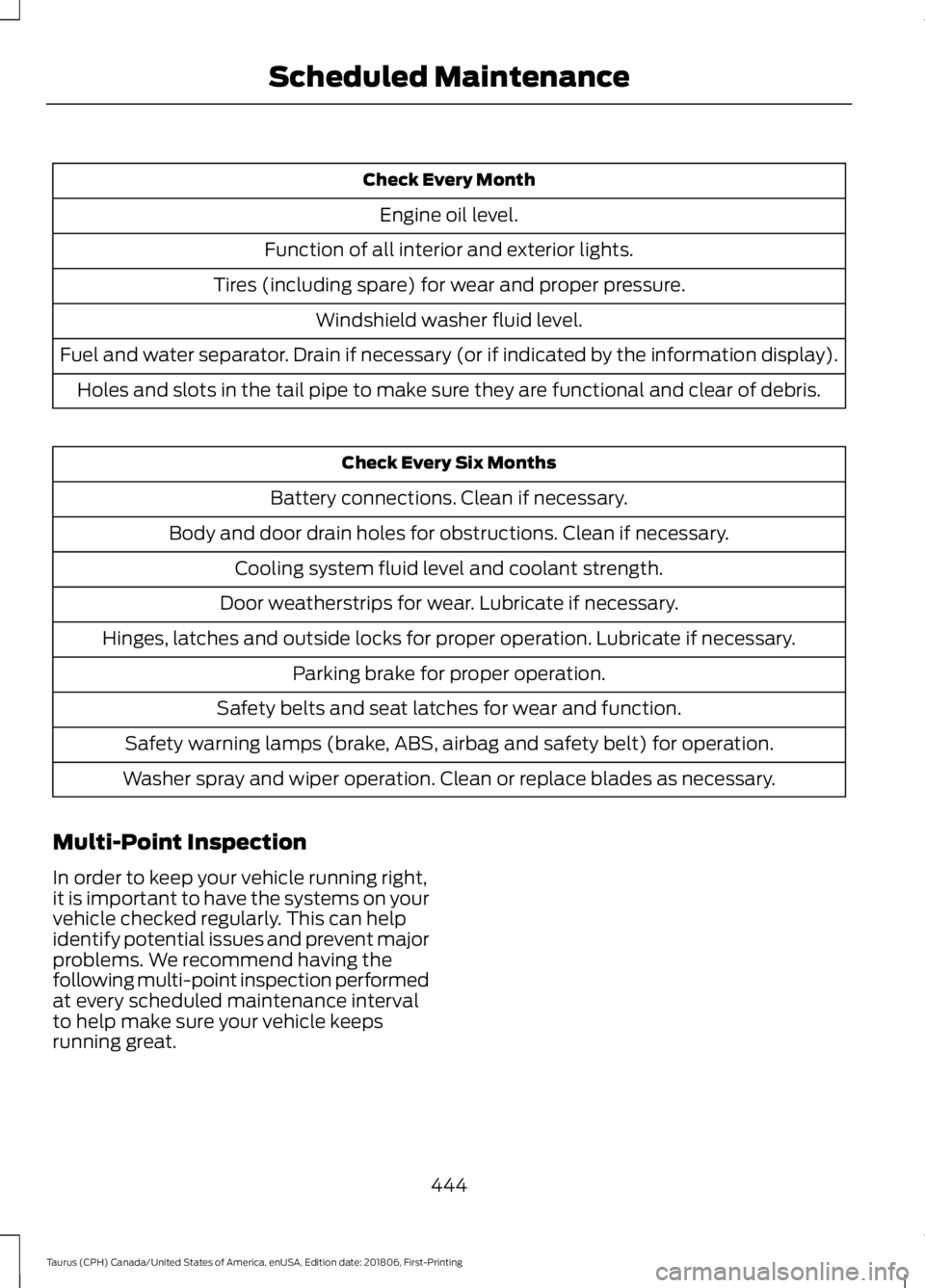
Check Every Month
Engine oil level.
Function of all interior and exterior lights.
Tires (including spare) for wear and proper pressure. Windshield washer fluid level.
Fuel and water separator. Drain if necessary (or if indicated by the information display). Holes and slots in the tail pipe to make sure they are functional and clear of debris. Check Every Six Months
Battery connections. Clean if necessary.
Body and door drain holes for obstructions. Clean if necessary. Cooling system fluid level and coolant strength.
Door weatherstrips for wear. Lubricate if necessary.
Hinges, latches and outside locks for proper operation. Lubricate if necessary. Parking brake for proper operation.
Safety belts and seat latches for wear and function.
Safety warning lamps (brake, ABS, airbag and safety belt) for operation.
Washer spray and wiper operation. Clean or replace blades as necessary.
Multi-Point Inspection
In order to keep your vehicle running right,
it is important to have the systems on your
vehicle checked regularly. This can help
identify potential issues and prevent major
problems. We recommend having the
following multi-point inspection performed
at every scheduled maintenance interval
to help make sure your vehicle keeps
running great.
444
Taurus (CPH) Canada/United States of America, enUSA, Edition date: 201806, First-Printing Scheduled Maintenance
Page 509 of 515

General Information on Radio
Frequencies...................................................46
Intelligent Access................................................. 46
General Maintenance Information.......442 Multi-Point Inspection..................................... 444
Owner Checks and Services.......................... 443
Protecting Your Investment........................... 442
Why Maintain Your Vehicle?......................... 442
Why Maintain Your Vehicle at Your Dealership?..................................................... 442
Getting Assistance Outside the U.S. and Canada..........................................................219
Getting the Services You Need................216 Away From Home............................................... 216
Global Opening...............................................75
Opening the Windows........................................ 75
H
Handbrake See: Parking Brake.............................................. 161
Hazard Flashers..............................................211
Headlamp Adjusting See: Adjusting the Headlamps...................... 251
Headlamp Exit Delay
......................................71
Headrest See: Head Restraints.......................................... 114
Head Restraints
..............................................114
Adjusting the Head Restraint.......................... 115
Tilting Head Restraints ..................................... 116
Heated Exterior Mirrors
................................112
Heated Rear Window...................................112
Heated Seats
...................................................121
Rear Heated Seats.............................................. 122
Heated Steering Wheel
...............................65
Heating See: Climate Control......................................... 105
Hill Start Assist...............................................161 Switching the System On and Off...............162
Using Hill Start Assist....................................... 162
Hints on Controlling the Interior Climate...........................................................110
Defogging the Side Windows in Cold Weather.............................................................. 112
General Hints........................................................ 110
Quickly Cooling the Interior............................... 111
Quickly Heating the Interior.............................. 111
Recommended Settings for Cooling............112 Recommended Settings for Heating.............111
Hints on Driving With Anti-Lock Brakes.............................................................161
Home Screen.................................................373
Hood Lock See: Opening and Closing the Hood..........234
I
Ignition Switch................................................131
In California (U.S. Only)..............................217
Information Display Control.......................65
Information Displays.....................................85 General Information............................................ 85
Information Messages
.................................94
Adaptive Cruise Control.................................... 94
AdvanceTrac ™...................................................... 95
Alarm........................................................................\
95
All Wheel Drive..................................................... 96
Automatic Engine Shutdown.......................... 95
Automatic High Beam Control........................ 95
Battery and Charging System......................... 96
Blind Spot Information and Cross Traffic Alert System...................................................... 97
Brake System......................................................... 97
Collision Warning System................................. 98
Doors and Locks................................................... 98
Driver Alert.............................................................. 98
Fuel........................................................................\
.... 98
Keys and Intelligent Access............................. 99
Lane Keeping System........................................ 99
Maintenance........................................................ 100
MyKey..................................................................... 100
Park Aid................................................................... 101
Passenger Sensing System Message..........101
Power Steering.................................................... 102
Reminder Messages........................................... 101
Remote Start........................................................ 102
Seats....................................................................... 102
Starting System.................................................. 102
Tire Pressure Monitoring System.................103
Traction Control.................................................. 103
Transmission........................................................ 103
Installing Child Restraints
............................18
Child Seats............................................................... 18
Using Lap and Shoulder Belts.......................... 19
Using Lower Anchors and Tethers for CHildren (LATCH)............................................. 21
506
Taurus (CPH) Canada/United States of America, enUSA, Edition date: 201806, First-Printing Index
Page 513 of 515

Stability Control............................................164
Principle of Operation....................................... 164
Starter Switch See: Ignition Switch............................................ 131
Starting a Gasoline Engine
........................132
Cold Weather Starting - Flex Fuel
Vehicles.............................................................. 133
Failure to Start..................................................... 133
Guarding Against Exhaust Fumes................134
Important Ventilating Information...............134
Stopping the Engine When Your Vehicle is Moving................................................................134
Stopping the Engine When Your Vehicle is Stationary......................................................... 133
Starting and Stopping the Engine...........131 General Information........................................... 131
Steering
............................................................194
Electric Power Steering.................................... 194
Steering Wheel
...............................................64
Storage Compartments.............................130
Sunroof See: Moonroof........................................................ 77
Sun Visors..........................................................77 Illuminated Vanity Mirror.................................... 77
Supplementary Restraints System..........37 Principle of Operation......................................... 37
Symbols Glossary
.............................................7
SYNC™ 3.........................................................361 General Information.......................................... 361
SYNC™ 3 Troubleshooting......................424
SYNC™ Applications and Services........................................................339
911 Assist............................................................... 339
SYNC™ AppLink ™
......................................341
SYNC Mobile Apps............................................. 341
SYNC™.............................................................321 General Information........................................... 321
SYNC™ Troubleshooting
..........................352
T
Technical Specifications See: Capacities and Specifications............293
The Better Business Bureau (BBB) Auto Line Program (U.S. Only)........................218
Tire Care..........................................................269 Glossary of Tire Terminology......................... 270Information About Uniform Tire Quality
Grading............................................................. 269
Information Contained on the Tire Sidewall............................................................. 271
Temperature A B C............................................ 270
Traction AA A B C.............................................. 269
Treadwear............................................................ 269
Tire Inflation When Punctured See: Tire Sealant and Inflator Kit.................263
Tire Pressure Monitoring System...........283 Changing Tires With a Tire Pressure
Monitoring System....................................... 284
Understanding Your Tire Pressure Monitoring System ...................................... 285
Tire Repair Kit See: Tire Sealant and Inflator Kit.................263
Tire Sealant and Inflator Kit
....................263
First Stage: Reinflating the Tire with Sealing
Compound and Air....................................... 265
General Information......................................... 264
Second Stage: Checking Tire Pressure........................................................... 266
Tips for Use of the Kit...................................... 264
What to do after the Tire has been Sealed................................................................ 267
What to do when a Tire Is Punctured........265
Tires See: Wheels and Tires..................................... 263
Towing a Trailer
............................................202
Load Placement................................................. 202
Towing the Vehicle on Four Wheels.........................................................206
Emergency Towing........................................... 206
Recreational Towing........................................ 206
Towing.............................................................202
Traction Control
............................................163
Principle of Operation....................................... 163
Transmission Code Designation............297
Transmission..................................................149
Transporting the Vehicle
............................214
Type Approvals............................................488
Radio Frequency Certification for Keys and
Remote Controls.......................................... 499
Radio Frequency Certifications for Blind Spot Information System.......................... 497
Radio Frequency Certifications for Body Control Module............................................. 499
510
Taurus (CPH) Canada/United States of America, enUSA, Edition date: 201806, First-Printing Index