Page 245 of 490
Drive moderately during the first 300 miles (500 km). After
the initial 60 miles (100 km), speeds up to 50 or 55 mph (80
or 90 km/h) are desirable.
While cruising, brief full-throttle acceleration within the
limits of local traffic laws contributes to a good break-in.
Wide-open throttle acceleration in low gear can be detri-
mental and should be avoided.
The engine oil installed in the engine at the factory is a
high-quality energy conserving type lubricant. Oil changes
should be consistent with anticipated climate conditions
under which vehicle operations will occur. For the recom-
mended viscosity and quality grades, refer to “Dealer
Service” in “Servicing And Maintenance”.
CAUTION!
Never use Non-Detergent Oil or Straight Mineral Oil
in the engine or damage may result.
NOTE: A new engine may consume some oil during its
first few thousand miles (kilometers) of operation. This
should be considered a normal part of the break-in and not
interpreted as a problem.
PARK BRAKE
Before leaving the vehicle, make sure that the parking
brake is fully applied and place the gear selector in the
PARK position.
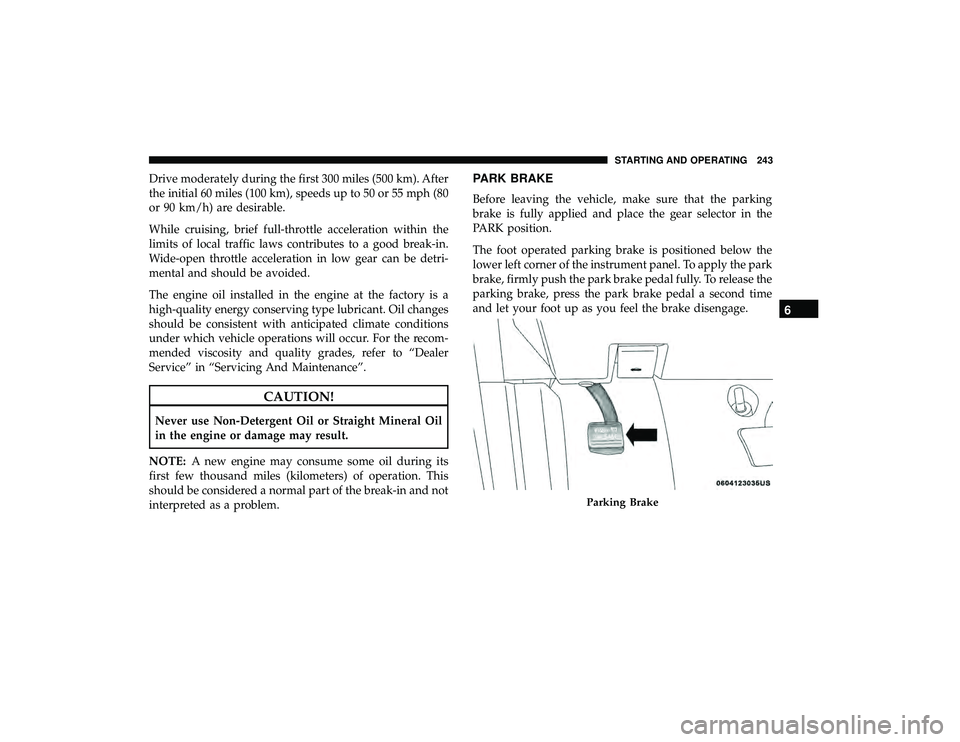
The foot operated parking brake is positioned below the
lower left corner of the instrument panel. To apply the park
brake, firmly push the park brake pedal fully. To release the
parking brake, press the park brake pedal a second time
and let your foot up as you feel the brake disengage.
Parking Brake
6
STARTING AND OPERATING 243
Page 276 of 490
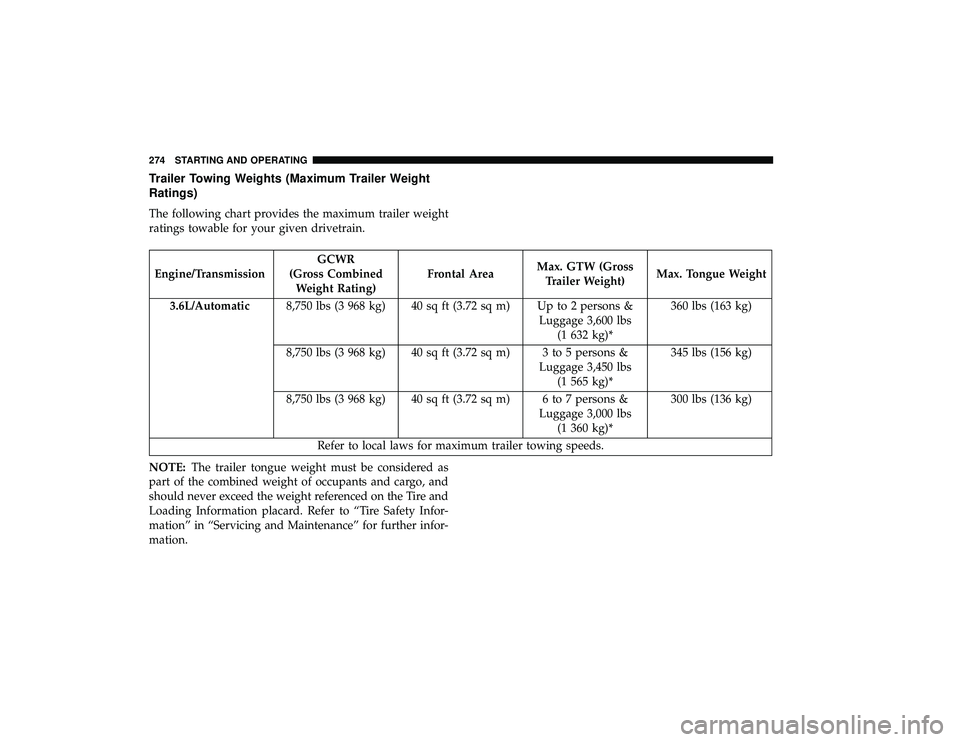
Trailer Towing Weights (Maximum Trailer Weight
Ratings)
The following chart provides the maximum trailer weight
ratings towable for your given drivetrain.
Engine/TransmissionGCWR
(Gross Combined Weight Rating) Frontal Area
Max. GTW (Gross
Trailer Weight) Max. Tongue Weight
3.6L/Automatic 8,750 lbs (3 968 kg) 40 sq ft (3.72 sq m) Up to 2 persons &
Luggage 3,600 lbs(1 632 kg)* 360 lbs (163 kg)
8,750 lbs (3 968 kg) 40 sq ft (3.72 sq m) 3 to 5 persons & Luggage 3,450 lbs(1 565 kg)* 345 lbs (156 kg)
8,750 lbs (3 968 kg) 40 sq ft (3.72 sq m) 6 to 7 persons & Luggage 3,000 lbs(1 360 kg)* 300 lbs (136 kg)
Refer to local laws for maximum trailer towing speeds.
NOTE: The trailer tongue weight must be considered as
part of the combined weight of occupants and cargo, and
should never exceed the weight referenced on the Tire and
Loading Information placard. Refer to “Tire Safety Infor-
mation” in “Servicing and Maintenance” for further infor-
mation.
274 STARTING AND OPERATING
Page 278 of 490
Towing Requirements
To promote proper break-in of your new vehicle drivetrain
components, the following guidelines are recommended.
CAUTION!
•Do not tow a trailer at all during the first 500 miles
(805 km) the new vehicle is driven. The engine, axle
or other parts could be damaged.
• Then, during the first 500 miles (805 km) that a trailer
is towed, do not drive over 50 mph (80 km/h) and do
not make starts at full throttle. This helps the engine
and other parts of the vehicle wear in at the heavier
loads.
Perform the maintenance listed in the “Scheduled Servic-
ing”. Refer to “Scheduled Servicing” in “Servicing And
Maintenance” for the proper maintenance intervals. When
towing a trailer, never exceed the GAWR or GCWR ratings.
WARNING!
Improper towing can lead to a collision. Follow these
guidelines to make your trailer towing as safe as
possible:
• Make certain that the load is secured in the trailer
and will not shift during travel. When trailering
cargo that is not fully secured, dynamic load shifts
can occur that may be difficult for the driver to
control. You could lose control of your vehicle and
have a collision.
• When hauling cargo or towing a trailer, do not
overload your vehicle or trailer. Overloading can
cause a loss of control, poor performance or damage
to brakes, axle, engine, transmission, steering, sus-
pension, chassis structure or tires.
• Safety chains must always be used between your
vehicle and trailer. Always connect the chains to the
hook retainers of the vehicle hitch. Cross the chains
under the trailer tongue and allow enough slack for
turning corners.
(Continued)
276 STARTING AND OPERATING
Page 279 of 490
WARNING!(Continued)
•Vehicles with trailers should not be parked on a
grade. When parking, apply the parking brake on the
tow vehicle. Put the tow vehicle transmission in
PARK. For four-wheel drive vehicles, make sure the
transfer case is not in NEUTRAL. Always, block or
�chock� the trailer wheels.
• GCWR must not be exceeded.
• Total weight must be distributed between the tow
vehicle and the trailer such that the following four
ratings are not exceeded:
1. GVWR
2. GTW
3. GAWR
4. Tongue weight rating for the trailer hitch utilized.
Towing Requirements — Tires
• Do not attempt to tow a trailer while using a compact
spare tire.
• Do not drive more than 50 mph (80 km/h) when towing
while using a full size spare tire.
• Proper tire inflation pressures are essential to the safe
and satisfactory operation of your vehicle. Refer to
“Tires” in “Servicing And Maintenance” for proper tire
inflation procedures.
• Check the trailer tires for proper tire inflation pressures
before trailer usage.
• Check for signs of tire wear or visible tire damage before
towing a trailer. Refer to “Tires” in “Servicing And
Maintenance” for the proper inspection procedure.
• When replacing tires, refer to “Tires” in “Servicing And
Maintenance” for the proper tire replacement proce-
dures. Replacing tires with a higher load carrying capac-
ity will not increase the vehicle’s GVWR and GAWR
limits.
6
STARTING AND OPERATING 277
Page 282 of 490

Automatic Transmission
The DRIVE range can be selected when towing. However,
if frequent shifting occurs while in DRIVE, use the Elec-
tronic Range Select (ERS) shift control to manually select a
lower gear range.
NOTE:Using a lower gear range while operating the
vehicle under heavy loading conditions, will improve
performance and extend transmission life by reducing
excessive shifting and heat buildup. This action will also
provide better engine braking.
If you REGULARLY tow a trailer for more than 45 minutes
of continuous operation, then change the transmission
fluid and filter as specified for �police, taxi, fleet, or
frequent trailer towing.� Refer to the “Maintenance Plan”
for the proper maintenance intervals.
Electronic Range Select (ERS)
• When using the ERS shift control, select the highest gear
that allows for adequate performance and avoids fre-
quent downshifts. For example, choose “4” if the desired
speed can be maintained. Choose “3” or “2” if needed to
maintain the desired speed. •
To prevent excess heat generation, avoid continuous
driving at high RPM. Reduce vehicle speed as necessary
to avoid extended driving at high RPM. Return to a
higher gear range or vehicle speed when grade and road
conditions allow.
Speed Control — If Equipped
• Do not use on hilly terrain or with heavy loads.
• When using the speed control, if you experience speed
drops greater than 10 mph (16 km/h), disengage until
you can get back to cruising speed.
• Use speed control in flat terrain and with light loads to
maximize fuel efficiency.
Cooling System
To reduce potential for engine and transmission overheat-
ing, take the following actions:
City Driving
• In city traffic — while stopped, place the transmission in
NEUTRAL, but do not increase engine idle speed.
Highway Driving
• Reduce speed.
• Temporarily turn off air conditioning.
280 STARTING AND OPERATING
Page 306 of 490
WARNING!(Continued)
•If working on or near a roadway, be extremely
careful of motor traffic.
• To assure that spare tires, flat or inflated, are securely
stowed, spares must be stowed with the valve stem
facing the ground.
CAUTION!
Do not attempt to raise the vehicle by jacking on
locations other than those indicated in the Jacking
Instructions for this vehicle.
NOTE: Refer to the “Compact Spare Tire” section of “Tires
– General Information” in “Servicing And Maintenance”
for information about the compact spare tire, its use, and
operation.
1. Loosen (but do not remove) the wheel lug nuts by turning them to the left one turn while the wheel is still
on the ground.
2. There are two jack engagement locations on each side of the vehicle body. These locations are on the sill flange of
the vehicle body.
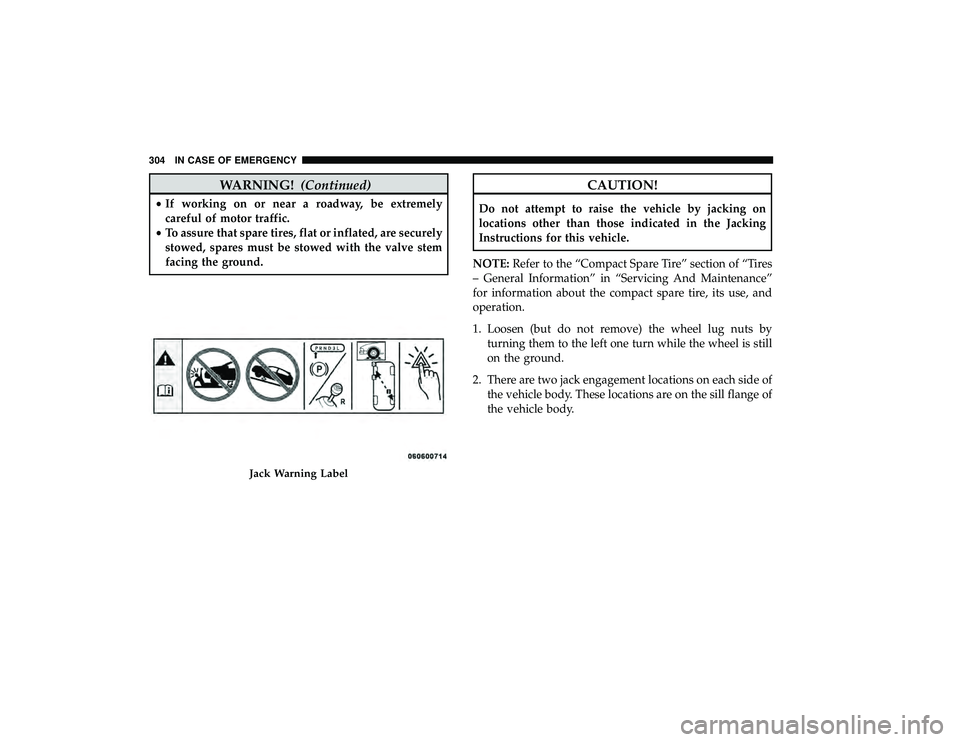
Jack Warning Label
304 IN CASE OF EMERGENCY
Page 335 of 490

SERVICING AND MAINTENANCE
CONTENTS
�SCHEDULED SERVICING .................335
▫ Maintenance Plan ...................... .336
� ENGINE COMPARTMENT .................339
▫ Engine Compartment — 3.6L ..............339
▫ Checking Oil Level .................... .340
▫ Adding Washer Fluid .................. .340
▫ Maintenance-Free Battery .................340
� DEALER SERVICE ...................... .341
▫ Engine Oil .......................... .342
▫ Engine Oil Filter ...................... .343
▫ Engine Air Cleaner Filter .................344
▫ Air Conditioner Maintenance ..............344
▫ Accessory Drive Belt Inspection ............346
▫ Body Lubrication ..................... .347▫
Windshield Wiper Blades .................348
▫ Exhaust System ....................... .348
▫ Cooling System ....................... .350
▫ Brake System ........................ .354
▫ Automatic Transmission ..................356
� RAISING THE VEHICLE ..................357
� TIRES ............................... .357
▫ Tire Safety Information ..................357
▫ Tires — General Information ..............367
▫ Tire Types ........................... .373
▫ Spare Tires — If Equipped ................374
▫ Wheel And Wheel Trim Care ..............377
▫ T
ire Chains (Traction Devices) .............378
▫ Tire Rotation Recommendations ............379
8
Page 336 of 490
�DEPARTMENT OF TRANSPORTATION UNIFORM
TIRE QUALITY GRADES ..................379
▫ Treadwear ........................... .380
▫ Traction Grades ....................... .380
▫ Temperature Grades .................... .380
� VEHICLE STORAGE .................... .381
� BODYWORK .......................... .381
▫ Protection From Atmospheric Agents ........381▫
Body And Underbody Maintenance ..........382
▫ Preserving The Bodywork .................382
� INTERIORS ........................... .383
▫ Seats And Fabric Parts .................. .383
▫ Plastic And Coated Parts ..................384
▫ Glass Surfaces ........................ .384
▫ Cleaning The Instrument Panel Cupholders . . . .385
334 SERVICING AND MAINTENANCE