Page 13 of 496
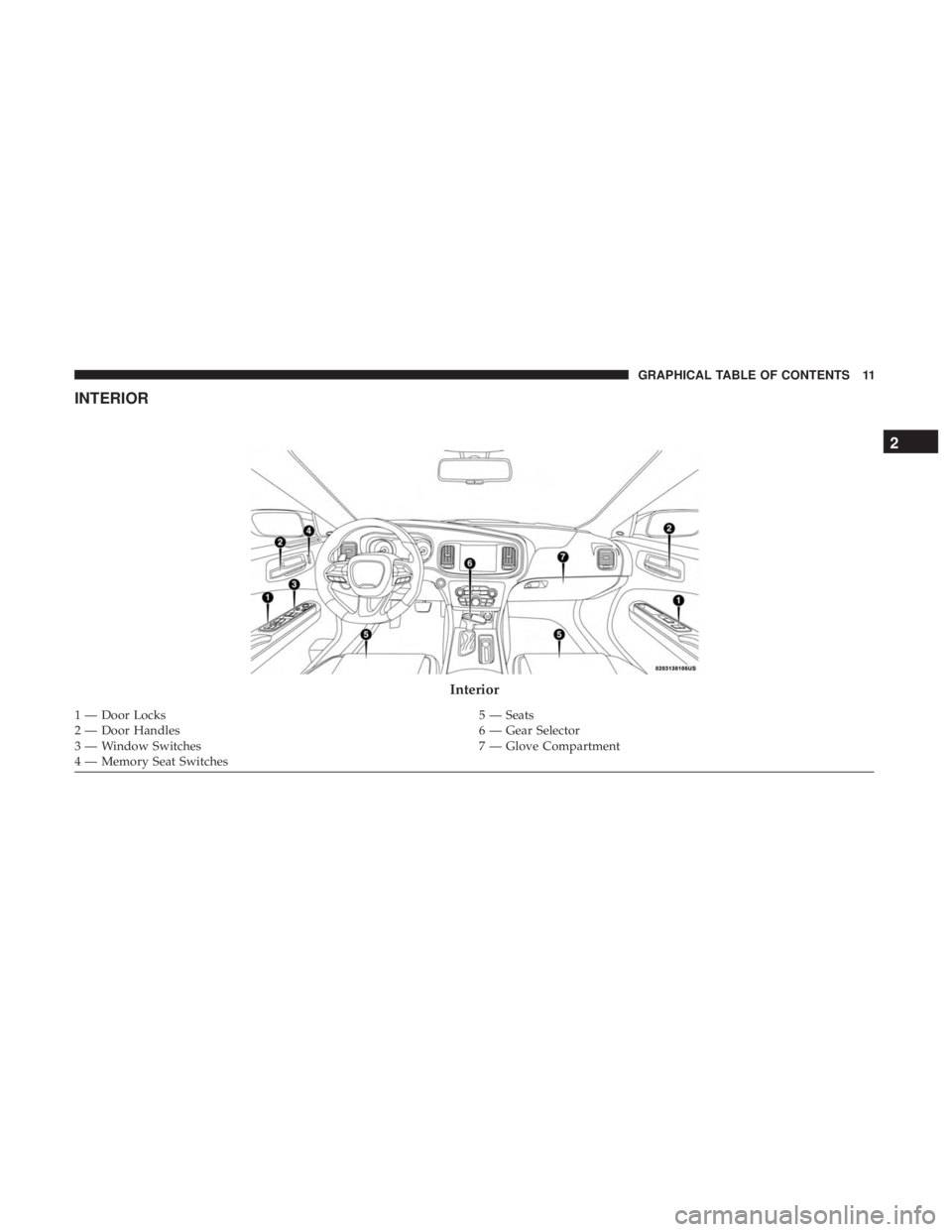
INTERIOR
Interior
1 — Door Locks5 — Seats
2 — Door Handles 6 — Gear Selector
3 — Window Switches 7 — Glove Compartment
4 — Memory Seat Switches
2
GRAPHICAL TABLE OF CONTENTS 11
Page 16 of 496
▫Keyless Enter-N-Go — Passive Entry .........38
▫ Automatic Unlock Doors On Exit ............42
▫ Automatic Door Locks — If Equipped ........42
▫ Child-Protection Door Lock System —
Rear Doors ............................42
� SEATS ................................43
▫ Manual Rear Seat Adjustment ...............44
▫ Power Seats ...........................46
▫ Driver Memory Seat — If Equipped ..........48
▫ Heated Seats — If Equipped ................51
▫ Front Ventilated Seats — If Equipped .........53
� HEAD RESTRAINTS ......................54
▫ Reactive Head Restraints — Front Seats .......54
▫ Rear Head Restraints ....................55
▫ Front Head Restraint Removal ..............56
� STEERING WHEEL .......................57
▫ Power Tilt/Telescoping Steering Column .......57▫
Heated Steering Wheel — If Equipped .........58
� MIRRORS ..............................59
▫ Automatic Dimming Mirror — If Equipped .....59
▫ Outside Mirrors ........................60
▫ Driver’s Outside Automatic Dimming Mirror — If
Equipped .............................60
▫ Outside Mirrors Approach Light — If Equipped . .60
▫ Power Mirrors .........................61
▫ Heated Mirrors — If Equipped .............61
▫ Tilt Side Mirrors In Reverse — If Equipped .....61
▫ Illuminated Vanity Mirrors — If Equipped .....62
� EXTERIOR LIGHTS .......................63
▫ Headlight Switch .......................63
▫ Multifunction Lever .....................63
▫ Daytime Running Lights (DRL) — If Equipped . .64
▫ High/Low Beam Switch ..................64
▫ Automatic High Beam — If Equipped ........64
14 GETTING TO KNOW YOUR VEHICLE
Page 44 of 496
General Information
The following regulatory statement applies to all radio
frequency (RF) devices equipped in this vehicle:
This device complies with Part 15 of the FCC Rules and
with Industry Canada license-exempt RSS standard(s).
Operation is subject to the following two conditions:
1. This device may not cause harmful interference, and
2. This device must accept any interference received, in-cluding interference that may cause undesired opera-
tion.
NOTE: Changes or modifications not expressly approved
by the party responsible for compliance could void the
user ’s authority to operate the equipment.
Automatic Unlock Doors On Exit
The doors will unlock automatically on vehicles with
power door locks if:
1. The Automatic Unlock Doors On Exit feature is enabled.
2. The vehicle was in motion, then speed returned to 0 mph (0 km/h) and the transmission is placed in PARK. 3. The driver door is opened.
4. The doors were not previously unlocked.
NOTE: Automatic Unlock Doors On Exit Programming
To change the current setting, refer to “Uconnect Settings”
in “Multimedia” for further information.
Use the Automatic Unlock Doors On Exit feature in accor-
dance with local laws.
Automatic Door Locks — If Equipped
The auto door lock feature default condition is enabled.
When enabled, the door locks will lock automatically when
the vehicle’s speed exceeds 15 mph (24 km/h). The auto
door lock feature can be enabled or disabled by an autho-
rized dealer per written request of the customer. Please see
an authorized dealer for service.
Child-Protection Door Lock System — Rear Doors
To provide a safer environment for small children riding in
the rear seats, the rear doors are equipped with Child-
Protection Door Lock system.
42 GETTING TO KNOW YOUR VEHICLE
Page 45 of 496
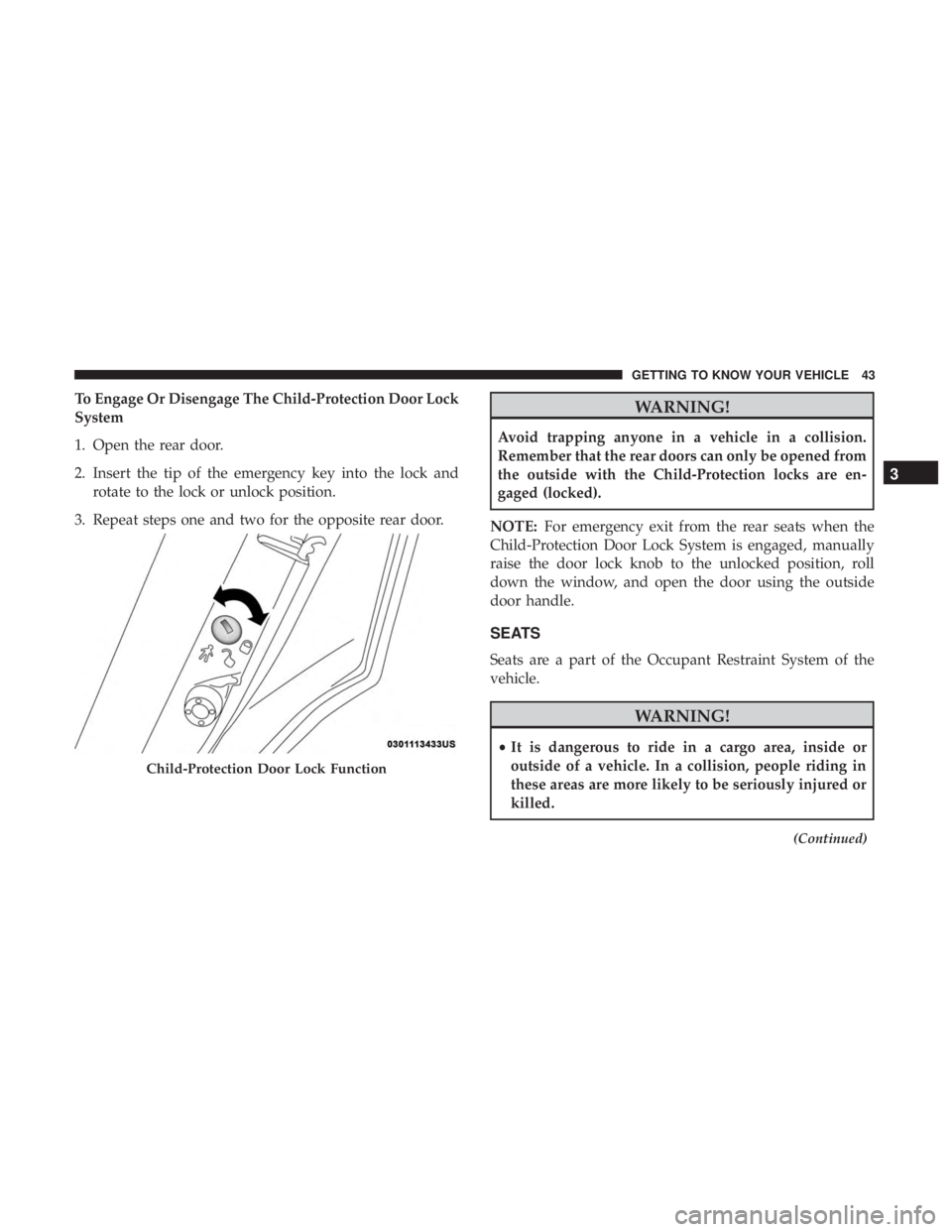
To Engage Or Disengage The Child-Protection Door Lock
System
1. Open the rear door.
2. Insert the tip of the emergency key into the lock androtate to the lock or unlock position.
3. Repeat steps one and two for the opposite rear door.WARNING!
Avoid trapping anyone in a vehicle in a collision.
Remember that the rear doors can only be opened from
the outside with the Child-Protection locks are en-
gaged (locked).
NOTE: For emergency exit from the rear seats when the
Child-Protection Door Lock System is engaged, manually
raise the door lock knob to the unlocked position, roll
down the window, and open the door using the outside
door handle.
SEATS
Seats are a part of the Occupant Restraint System of the
vehicle.
WARNING!
• It is dangerous to ride in a cargo area, inside or
outside of a vehicle. In a collision, people riding in
these areas are more likely to be seriously injured or
killed.
(Continued)
Child-Protection Door Lock Function
3
GETTING TO KNOW YOUR VEHICLE 43
Page 46 of 496
WARNING!(Continued)
•Do not allow people to ride in any area of your
vehicle that is not equipped with seats and seat belts.
In a collision, people riding in these areas are more
likely to be seriously injured or killed.
• Be sure everyone in your vehicle is in a seat and
using a seat belt properly.
Manual Rear Seat Adjustment
WARNING!
Do not pile luggage or cargo higher than the top of the
seatback. This could impair visibility or become a
dangerous projectile in a sudden stop or collision.
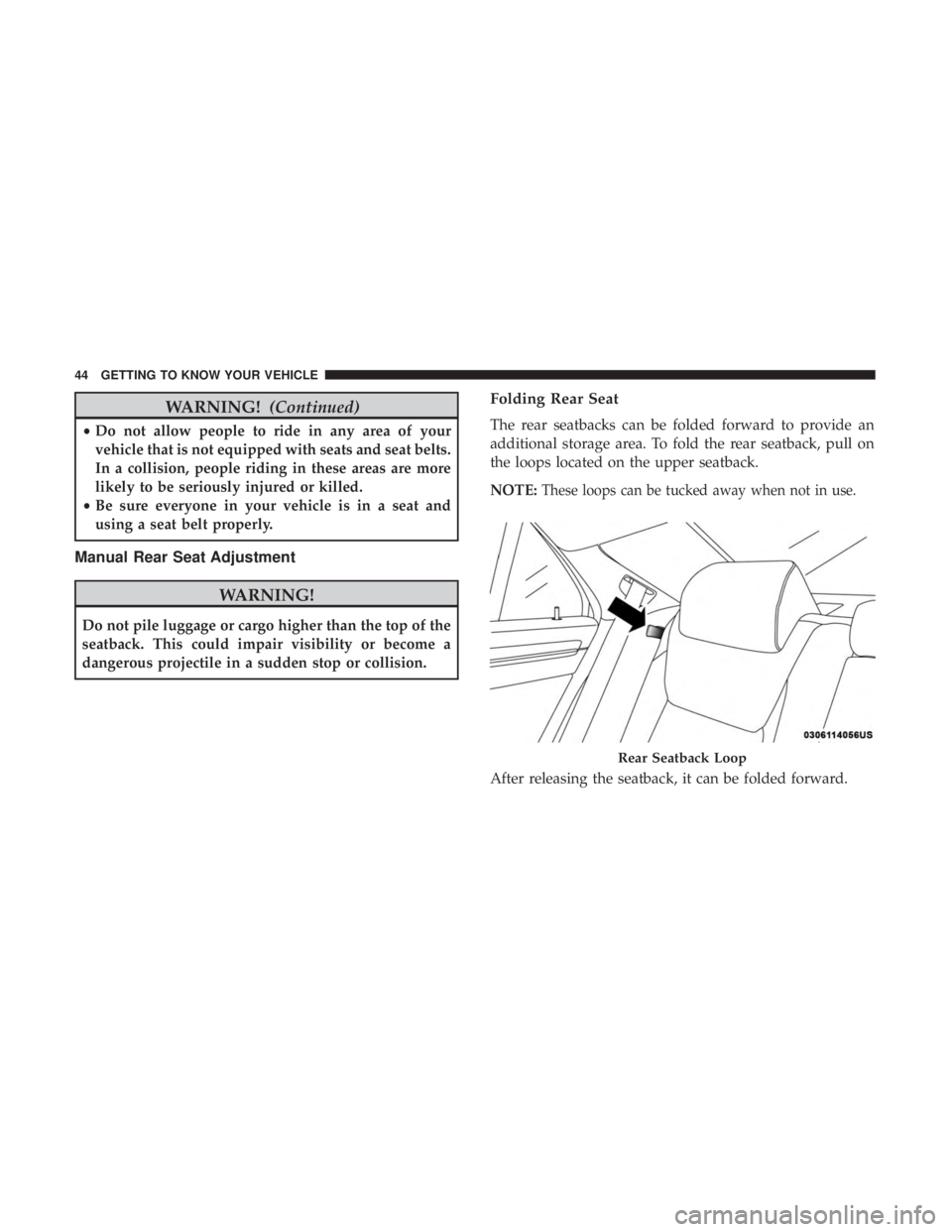
Folding Rear Seat
The rear seatbacks can be folded forward to provide an
additional storage area. To fold the rear seatback, pull on
the loops located on the upper seatback.
NOTE:
These loops can be tucked away when not in use.
After releasing the seatback, it can be folded forward.
Rear Seatback Loop
44 GETTING TO KNOW YOUR VEHICLE
Page 47 of 496
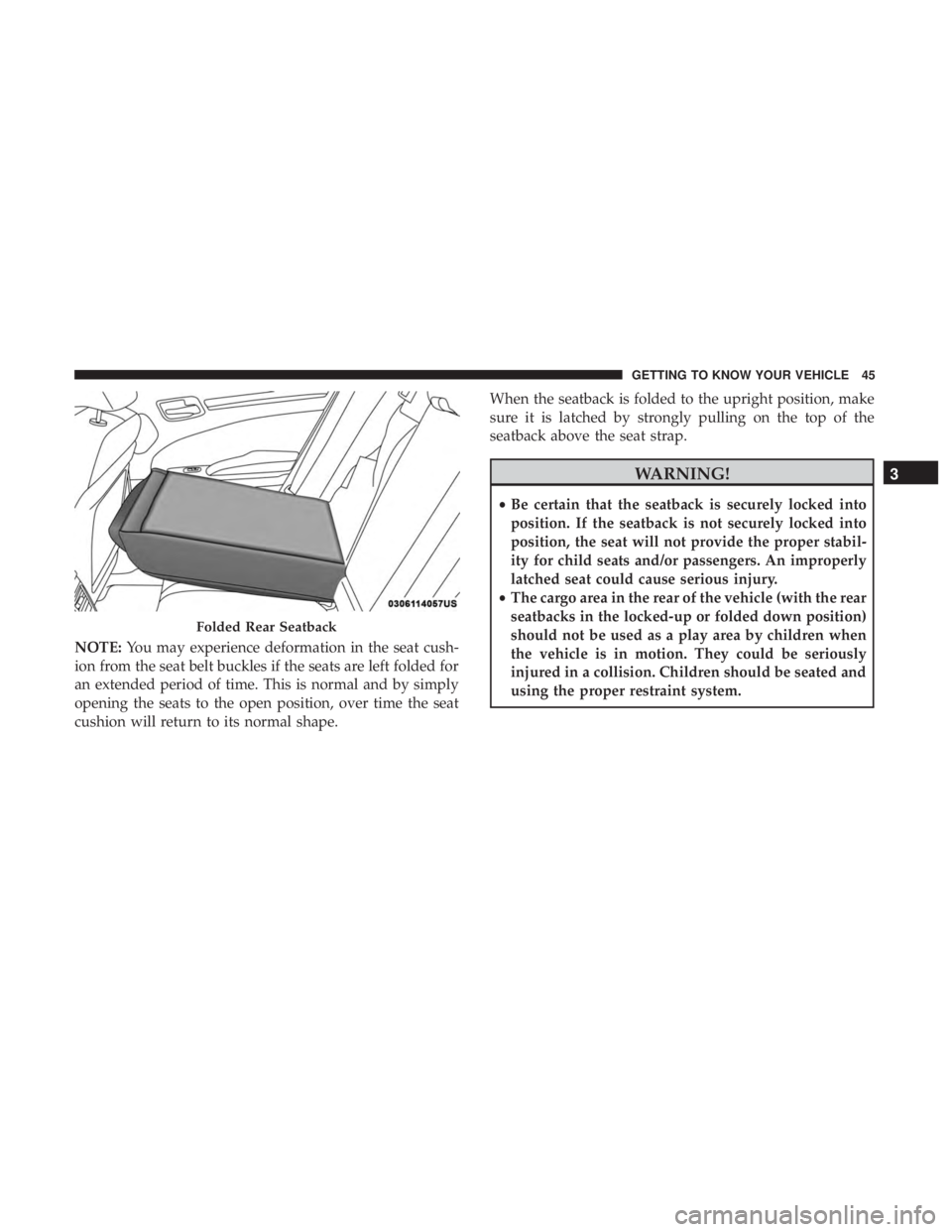
NOTE:You may experience deformation in the seat cush-
ion from the seat belt buckles if the seats are left folded for
an extended period of time. This is normal and by simply
opening the seats to the open position, over time the seat
cushion will return to its normal shape. When the seatback is folded to the upright position, make
sure it is latched by strongly pulling on the top of the
seatback above the seat strap.
WARNING!
•
Be certain that the seatback is securely locked into
position. If the seatback is not securely locked into
position, the seat will not provide the proper stabil-
ity for child seats and/or passengers. An improperly
latched seat could cause serious injury.
• The cargo area in the rear of the vehicle (with the rear
seatbacks in the locked-up or folded down position)
should not be used as a play area by children when
the vehicle is in motion. They could be seriously
injured in a collision. Children should be seated and
using the proper restraint system.
Folded Rear Seatback
3
GETTING TO KNOW YOUR VEHICLE 45
Page 48 of 496
Power Seats
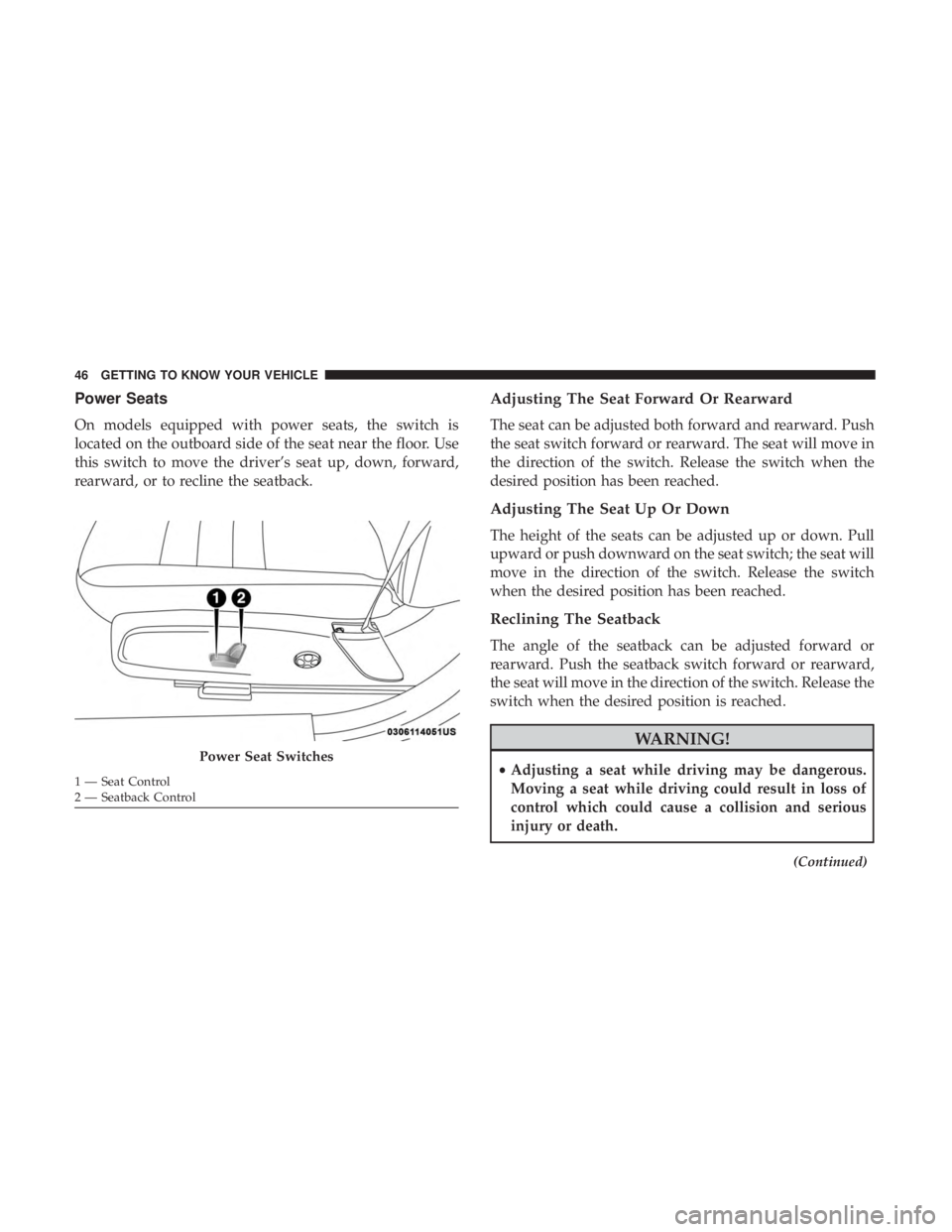
On models equipped with power seats, the switch is
located on the outboard side of the seat near the floor. Use
this switch to move the driver’s seat up, down, forward,
rearward, or to recline the seatback.
Adjusting The Seat Forward Or Rearward
The seat can be adjusted both forward and rearward. Push
the seat switch forward or rearward. The seat will move in
the direction of the switch. Release the switch when the
desired position has been reached.
Adjusting The Seat Up Or Down
The height of the seats can be adjusted up or down. Pull
upward or push downward on the seat switch; the seat will
move in the direction of the switch. Release the switch
when the desired position has been reached.
Reclining The Seatback
The angle of the seatback can be adjusted forward or
rearward. Push the seatback switch forward or rearward,
the seat will move in the direction of the switch. Release the
switch when the desired position is reached.
WARNING!
•Adjusting a seat while driving may be dangerous.
Moving a seat while driving could result in loss of
control which could cause a collision and serious
injury or death.
(Continued)
Power Seat Switches
1 — Seat Control
2 — Seatback Control 46 GETTING TO KNOW YOUR VEHICLE
Page 49 of 496
WARNING!(Continued)
•Seats should be adjusted before fastening the seat
belts and while the vehicle is parked. Serious injury
or death could result from a poorly adjusted seat belt.
• Do not ride with the seatback reclined so that the
shoulder belt is no longer resting against your chest.
In a collision you could slide under the seat belt,
which could result in serious injury or death.
CAUTION!
Do not place any article under a power seat or impede
its ability to move as it may cause damage to the seat
controls. Seat travel may become limited if movement
is stopped by an obstruction in the seat’s path.
Tilting The Seat Up Or Down
The angle of the seat cushion can be adjusted up or down.
Pull upward or push downward on the front of the seat
switch. The front of the seat cushion will move in the
direction of the switch. Release the switch when the
desired position has been reached.
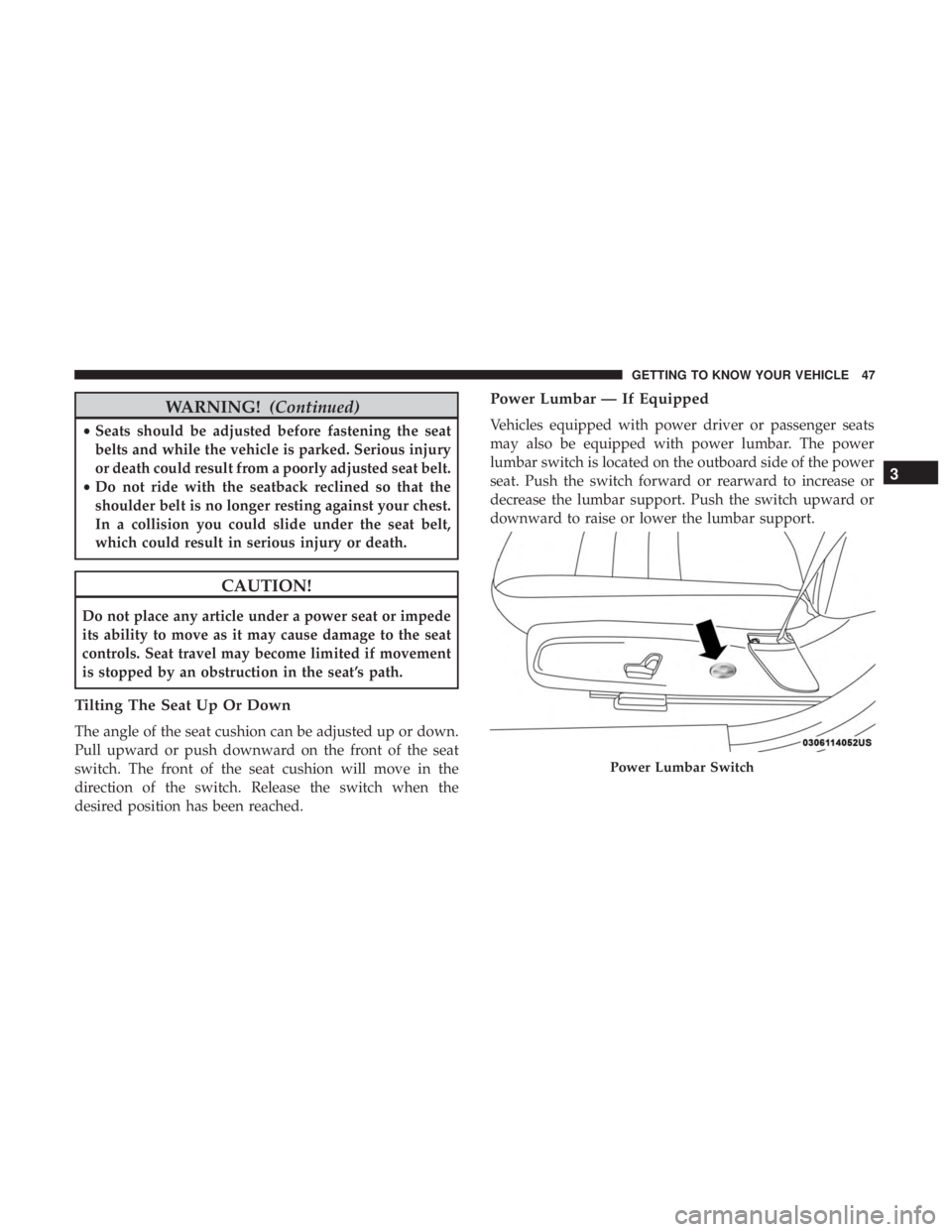
Power Lumbar — If Equipped
Vehicles equipped with power driver or passenger seats
may also be equipped with power lumbar. The power
lumbar switch is located on the outboard side of the power
seat. Push the switch forward or rearward to increase or
decrease the lumbar support. Push the switch upward or
downward to raise or lower the lumbar support.
Power Lumbar Switch
3
GETTING TO KNOW YOUR VEHICLE 47