2019 AUDI TT ROADSTER tow
[x] Cancel search: towPage 155 of 304
8S58012721BA
Media
(CO) 6/VDE 0837. The various types of audio
equipment installed conform to safety class 1.
The laser uses so little power or is shielded so
there is no danger when it is used correctly.
Media drives
SD card reader
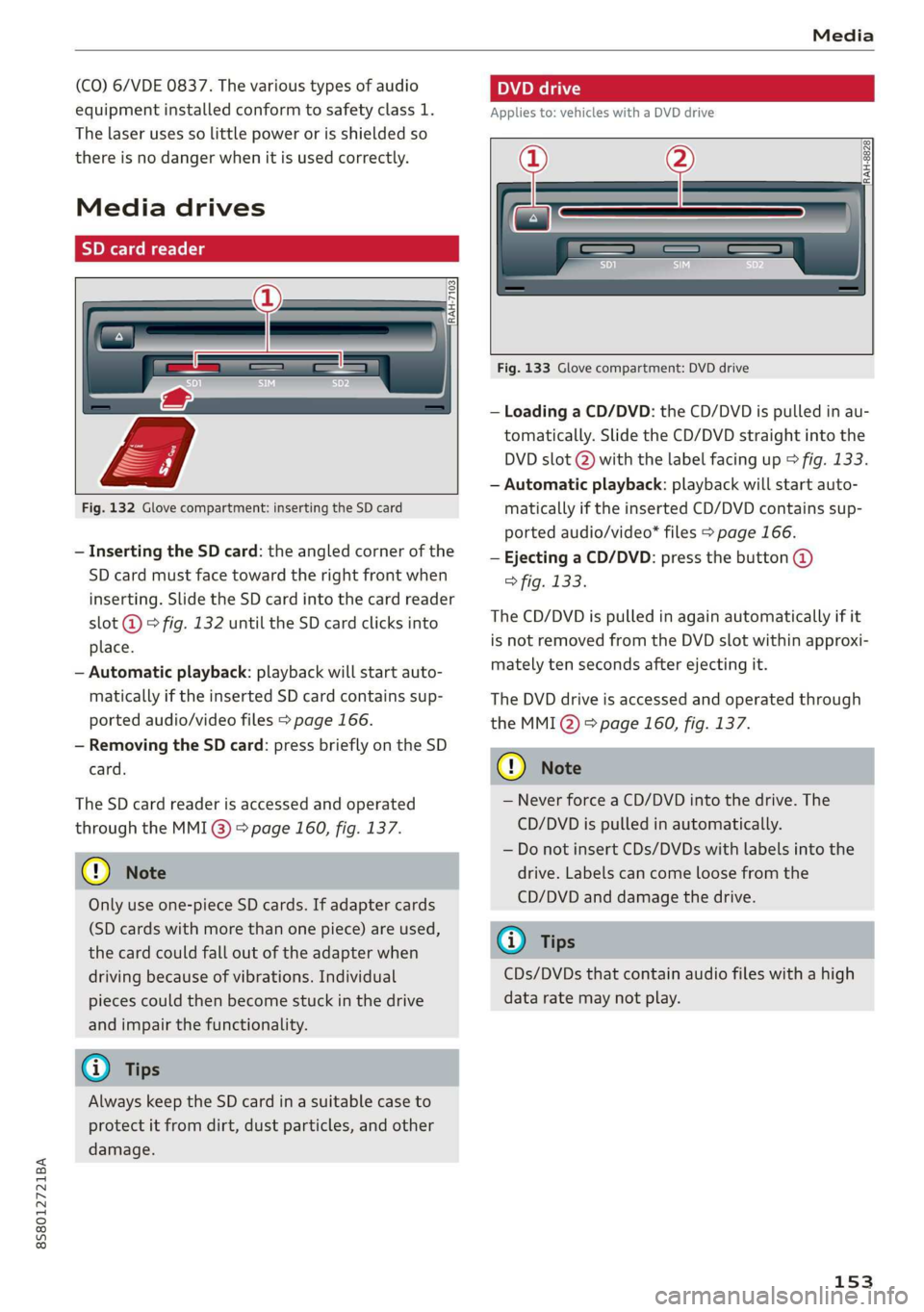
RAH-7103
Fig. 132 Glove compartment: inserting the SD card
— Inserting the SD card: the angled corner of the
SD card must face toward the right front when
inserting. Slide the SD card into the card reader
slot @ ° fig. 132 until the SD card clicks into
place.
— Automatic playback: playback will start auto-
matically if the inserted SD card contains sup-
ported audio/video files > page 166.
— Removing the SD card: press briefly on the SD
card.
The SD card reader is accessed and operated
through the MMI @) & page 160, fig. 137.
@ Note
Only use one-piece SD cards. If adapter cards
(SD cards with more than one piece) are used,
the card could fall out of the adapter when
driving because of vibrations. Individual
pieces could then become stuck in the drive
and impair the functionality.
@ Tips
Always keep the SD card in a suitable case to
protect it from dirt, dust particles, and other
damage.
Poel
Applies to: vehicles with a DVD drive
_————
RAH-8828}
Fig. 133 Glove compartment: DVD drive
— Loading a CD/DVD: the CD/DVD is pulled in au-
tomatically. Slide the CD/DVD straight into the
DVD slot @) with the label facing up > fig. 133.
— Automatic playback: playback will start auto-
matically if the inserted CD/DVD contains sup-
ported audio/video* files > page 166.
— Ejecting a CD/DVD: press the button @
> fig. 133.
The CD/DVD is pulled in again automatically if it
is not removed from the DVD slot within approxi-
mately ten seconds after ejecting it.
The DVD drive is accessed and operated through
the MMI @) > page 160, fig. 137.
@) Note
— Never force a CD/DVD into the drive. The
CD/DVD is pulled in automatically.
— Do not insert CDs/DVDs with labels into the
drive. Labels can come loose from the
CD/DVD and damage the drive.
@o Tips
CDs/DVDs that contain audio files with a high
data rate may not play.
153
Page 180 of 304
Safe driving
> Take frequent breaks on long trips. Do not drive
for more than two hours at a stretch.
> Do NOT drive when you are tired, under pres-
sure or when you are stressed.
Z\ WARNING
Impaired driving safety increases the risk of
serious personal injury and death whenever a
vehicle is being used.
> Grasp the top of the steering wheel with your
elbow(s) slightly bent.
> Fasten and wear safety belts correctly
=>page 185.
> Always keep both feet in the footwell so that
you
are in control of the vehicle at all times.
For detailed information on how to adjust the
driver's seat, see > page 46, Front seats.
Correct passenger
seating positions
Proper seating position for the driver
The proper driver seating position is important
for safe, relaxed driving.
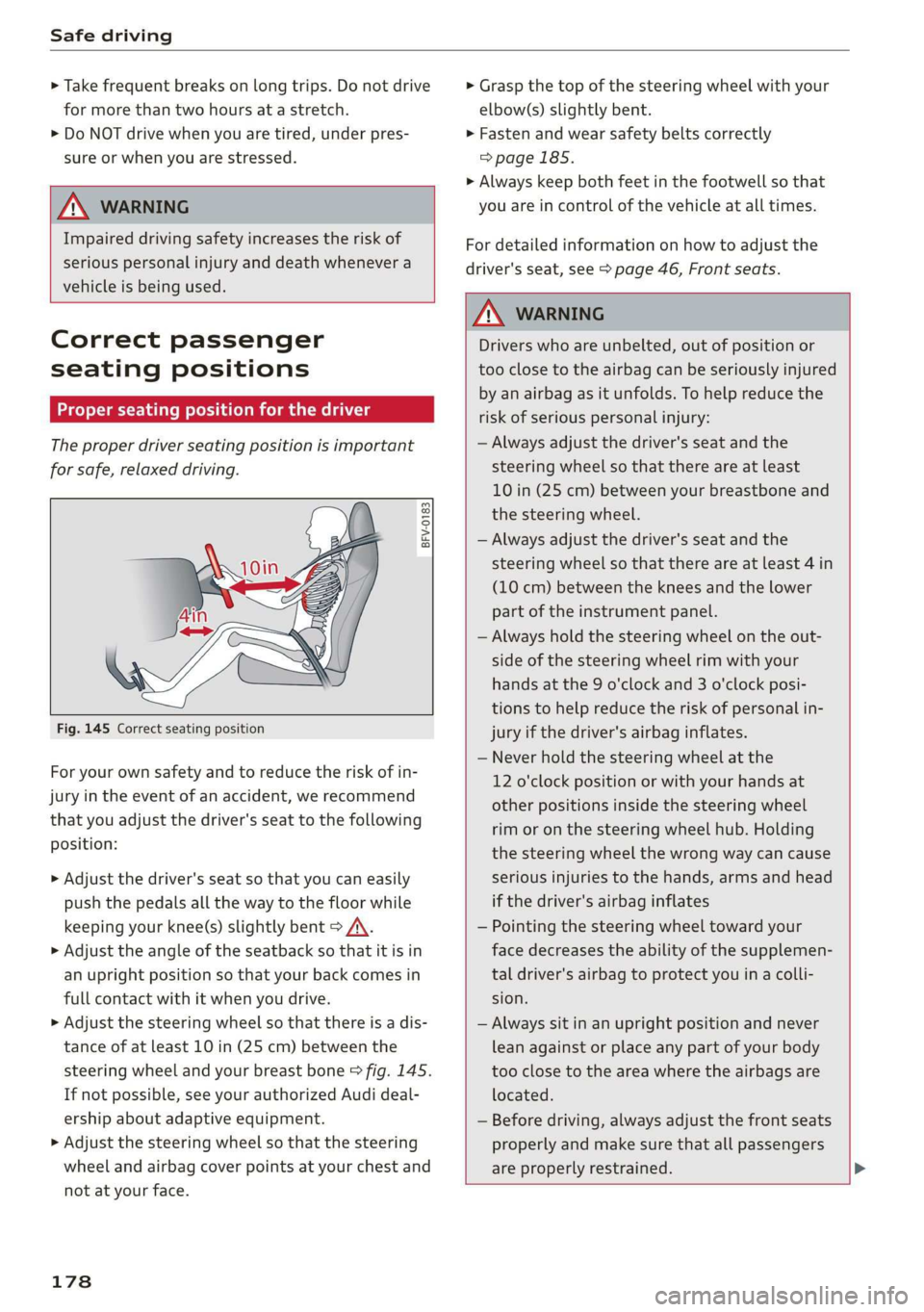
BFV-0183
Fig. 145 Correct seating position
For your own safety and to reduce the risk of in-
jury in the event of an accident, we recommend
that you adjust the driver's seat to the following
position:
> Adjust the driver's seat so that you can easily
push the pedals all the way to the floor while
keeping your knee(s) slightly bent > A\.
> Adjust the angle of the seatback so that it is in
an upright position so that your back comes in
full contact with it when you drive.
> Adjust the steering wheel so that there is a dis-
tance of at least 10 in (25 cm) between the
steering wheel and your breast bone > fig. 145.
If not possible, see your authorized Audi deal-
ership about adaptive equipment.
> Adjust the steering wheel so that the steering
wheel and airbag cover points at your chest and
not at your face.
178
Z\ WARNING
Drivers who are unbelted, out of position or
too close to the airbag can be seriously injured
by an airbag as it unfolds. To help reduce the
risk of serious personal injury:
— Always adjust the driver's seat and the
steering wheel so that there are at least
10 in (25 cm) between your breastbone and
the steering wheel.
— Always adjust the driver's seat and the
steering wheel so that there are at least 4 in
(10 cm) between the knees and the lower
part of the instrument panel.
— Always hold the steering wheel on the out-
side of the steering wheel rim with your
hands at the 9 o'clock and 3 o'clock posi-
tions to help reduce the risk of personal in-
jury if the driver's airbag inflates.
— Never hold the steering wheel at the
12 o'clock position or with your hands at
other positions inside the steering wheel
rim or on the steering wheel hub. Holding
the steering wheel the wrong way can cause
serious injuries to the hands, arms and head
if the driver's airbag inflates
— Pointing the steering wheel toward your
face decreases the ability of the supplemen-
tal driver's airbag to protect you in a colli-
sion.
— Always sit in an upright position and never
lean against or place any part of your body
too close to the area where the airbags are
located.
— Before driving, always adjust the front seats
properly and make sure that all passengers
are properly restrained.
Page 189 of 304
8S8012721BA
Safety belts
ZA\ WARNING
Improperly positioned safety belts can cause
serious personal injury in an accident.
— Expectant mothers must always wear the
lap portion of the safety belt as low as pos-
sible across the pelvis and below the round-
ing of the abdomen.
— Always read and heed all WARNINGS and
other important information > A\ in Fasten-
ing safety belts on page 186.
eet Lime
Unbuckle the safety belt with the red release
button only after the vehicle has stopped.
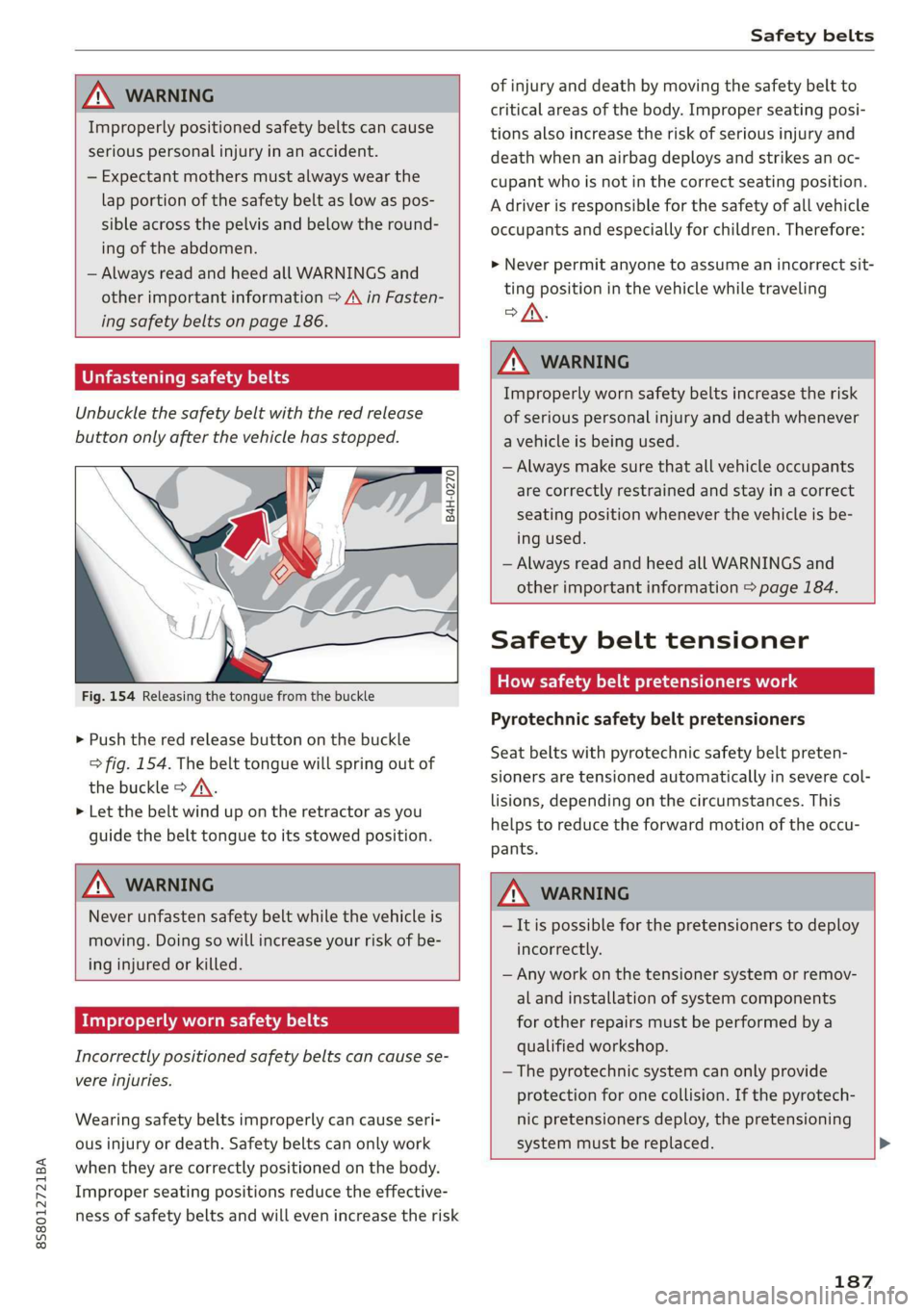
B4H-0270
Fig. 154 Releasing the tongue from the buckle
> Push the red release button on the buckle
> fig. 154. The belt tongue will spring out of
the buckle > /\.
> Let the belt wind up on the retractor as you
guide the belt tongue to its stowed position.
ZA WARNING
Never unfasten safety belt while the vehicle is
moving. Doing so will increase your risk of be-
ing injured or killed.
Improperly worn safety belts
Incorrectly positioned safety belts can cause se-
vere injuries.
Wearing safety belts improperly can cause seri-
ous injury or death. Safety belts can only work
when they are correctly positioned on the body.
Improper seating positions reduce the effective-
ness of safety belts and will even increase the risk
of injury and death by moving the safety belt to
critical areas of the body. Improper seating posi-
tions also increase the risk of serious injury and
death when an airbag deploys and strikes an oc-
cupant who is not in the correct seating position.
A driver is responsible for the safety of all vehicle
occupants and especially for children. Therefore:
> Never permit anyone to assume an incorrect sit-
ting position in the vehicle while traveling
>.
ZA WARNING
Improperly worn safety belts increase the risk
of serious personal injury and death whenever
a vehicle is being used.
— Always make sure that all vehicle occupants
are correctly restrained and stay in a correct
seating position whenever the vehicle is be-
ing used.
— Always read and heed all WARNINGS and
other important information > page 184.
Safety belt tensioner
How safety belt pretensioners work
Pyrotechnic safety belt pretensioners
Seat belts with pyrotechnic safety belt preten-
sioners are tensioned automatically in severe col-
lisions, depending on the circumstances. This
helps to reduce the forward motion of the occu-
pants.
Z\ WARNING
—It is possible for the pretensioners to deploy
incorrectly.
— Any work on the tensioner system or remov-
al and installation of system components
for other repairs must be performed by a
qualified workshop.
— The pyrotechnic system can only provide
protection for one collision. If the pyrotech-
nic pretensioners deploy, the pretensioning
system must be replaced. >
187
Page 199 of 304
8S8012721BA
Airbag system
— Never remove the upholstery from the front
passenger Seat.
— Never disassemble or remove parts from the
seat or disconnect wires from it.
— Never carry sharp objects in your pockets or
put them on the seat. The capacitive passen-
ger detection mat in the front passenger
seat will not function properly if it is punc-
tured.
— Never carry things on your lap or carry ob-
jects on the front passenger seat. Such ob-
jects can
influence the capacitance regis-
tered by the capacitive passenger detection
system, so that incorrect information is pro-
vided to the airbag control unit.
— Never store items under the front passenger
seat. Parts of the Advanced Airbag System
under the passenger seat could be dam-
aged, preventing them and the airbag sys-
tem from working properly.
— Never place seat covers or replacement up-
holstery that have not been specifically ap-
proved by Audi on the front seats.
— Seat covers can prevent the Advanced Airbag
System from recognizing child restraints or
occupants on the front passenger seat and
prevent the side airbag in the seat backrest
from deploying properly.
— If a seat heater has been retrofitted or oth-
erwise added to the front passenger seat,
never install any child restraint system on
this seat.
— Never use cushions, pillows, blankets, or
similar items on the front passenger seat.
The additional layers prevent the capacitive
passenger detection system from accurately
measuring the capacitance of the child safe-
ty seat and/or the person on the seat and
thus keep the Advanced Airbag System from
working properly.
— Never place or use any electrical device
(such as a laptop, CD player, electronic
games device, power inverter or seat heater
for child seats) on the front passenger seat
if the device is connected to the 12-volt
socket or the cigarette lighter socket. Such
devices can influence the capacitance regis-
tered by the capacitive passenger detection
system, so that incorrect information is pro-
vided to the airbag control unit.
— If you must use a child restraint on the front
passenger seat and the child restraint man-
ufacturer's instructions require the use of a
towel, foam cushion or something else to
properly position the child restraint, make
certain that the PASSENGER AIR BAG OFF
#; light comes on and stays on whenever
the child restraint is installed on the front
passenger seat.
— If the PASSENGER AIR BAG OFF %; light
does not come on and stay on, have the air-
bag system inspected by your Audi dealer.
ZA WARNING
If the front passenger seat gets wet, dry it im-
mediately.
— If liquid soaks into the front passenger seat,
this can keep the airbag system from work-
ing properly and may, for instance, deacti-
vate the passenger frontal airbag. If this
happens, the PASSENGER AIR BAG OFF ¥,
light will come on and stay on together with
the airbag indicator light ka in the instru-
ment cluster.
— If liquid is pooled on the seat, but has not
soaked in, this may also keep the airbag sys-
tem from working properly and cause the
passenger frontal airbag to be enabled
(turned on), even though there is a properly
installed child restraint system on the seat.
Wet towels or other wet things on the seat
cushion can have the same effect. If the
front passenger frontal airbag is turned on,
the PASSENGER AIR BAG OFF #; light will
turn off.
How the Advanced Airbag System
oYpa) Ma Cel (Laas
The front Advanced Airbag System and the side
airbags supplement the protection offered by the
front
three-point safety belts to help reduce the
risk of injury in a wide range of accident and crash
situations. Be sure to read the important infor-
mation about safety and heed the WARNINGS in
this chapter.
197
>
Page 204 of 304
Airbag system
the device is connected to the 12-volt socket or
the cigarette lighter socket;
— make sure that no seat heater has been retrofit-
ted or otherwise added to the front passenger
seat;
— make sure that nothing can interfere with the
safety belt buckles and that they are not ob-
structed;
— make sure that there are no wet objects (such
as a wet towel) and no water or other liquids on
the front passenger seat cushion.
If the PASSENGER AIR BAG OFF &; light still
does not come on...
If the PASSENGER AIR BAG OFF 3, light still
does not come on and does not stay on continu-
ously (when the ignition is switched on),
— take the child restraint off the front passenger
seat and have the airbag system inspected by
your Audi dealer immediately.
The PASSENGER AIR BAG OFF 3; light
should NOT come on...
The PASSENGER AIR BAG OFF 3%; light should
NOT come on when the ignition is on and an adult
is sitting in a proper seating position on the front
passenger seat. If the PASSENGER AIR BAG OFF
#¥; light comes on and stays on while driving, un-
der these circumstances, make sure that:
— the adult on the front passenger seat is proper-
ly seated on the center of the seat cushion with
his or her back up against the backrest and the
backrest is not reclined,
— the adult is not taking weight off the seat by
holding on to the passenger assist handle
above the front passenger door or supporting
their weight on the armrest,
— the safety belt is being properly worn and that
there is not a lot of slack in the safety belt web-
bing,
— there are no aftermarket seat covers or cush-
ions or other things (such as blankets) on the
front passenger seat that might cause the ca-
pacitive passenger detection system to miscal-
culate electrical capacitance.
202
Important safety instructions on
monitoring the Advanced Airbag System
ZA WARNING
— If the status of the Advanced Airbag System
has changed while the vehicle is moving, the
PASSENGER AIR BAG OFF #¥; ON ® light
blinks for about 5 seconds to catch the driv-
er's attention. If this happens, always stop
as soon as it is safe to do so and check the
steps described above.
— If the PASSENGER AIR BAG OFF %; light
does not go off when an adult who is not
very small is sitting on the front passenger
seat after taking the steps described above,
have the airbag system inspected by your
authorized Audi dealer before transporting
anyone on the front passenger seat.
ZA WARNING
An airbag system that is not functioning prop-
erly cannot provide supplemental protection
in a frontal crash.
— If the airbag indicator light > page 18
comes when the vehicle is being used, have
the system inspected immediately by your
authorized Audi dealer. It is possible that
the airbag will inflate when it is not sup-
posed to, or will not inflate when it should.
ZA\ WARNING
If the front airbag inflates, a child without a
child restraint, or in a rearward-facing child
safety seat, or in a forward-facing child re-
straint that has not been properly installed
will be seriously injured and can be killed.
— If you must install a rearward-facing child
seat on the front passenger seat because of
exceptional circumstances and the PASSEN-
GER AIR BAG OFF #¥; light does not appear
and stay on, have the airbag system inspect-
ed by your Audi dealer.
— If, in exceptional circumstances, you must
install a forward-facing child restraint on
the front passenger seat, always move the
seat into its rearmost position in the seat's
fore and aft adjustment range, as far away
Page 213 of 304
8S8012721BA
Child safety
— Never install a rearward facing child safety
seat on the front passenger seat if the PAS-
SENGER AIR BAG OFF 3%; light does not
turn on and stay on. Have the system in-
spected immediately by an authorized Audi
dealer or authorized Audi Service Facility.
ZA\ WARNING
— Forward-facing child seats installed on the
front passenger seat may interfere with the
deployment of the airbag and cause serious
personal injury to the child.
— If exceptional circumstances require the use
of a forward-facing child restraint on the
front passenger's seat, the child's safety and
well-being require the following special pre-
cautions to be taken:
— Always make sure that the forward-facing
seat has been designed and certified by its
manufacturer for use on a front passenger
seat with a front and side airbag.
— Always carefully follow the manufacturer's
instructions provided with the child seat or
infant carrier.
— Never put the forward-facing child re-
straint up against or very near the instru-
ment panel.
— Always move the front passenger seat to
the highest position in the up and down
adjustment range and move it back to the
rearmost position in the seat's fore and aft
adjustment range, as far away from the
airbag as possible, before installing the
forward-facing child restraint.
— Always make sure that the safety belt up-
per anchorage is behind the child restraint
and not next to or in front of the child re-
straint so that the safety belt will be prop-
erly positioned.
— Always make sure that nothing prevents
the front passenger's seat from being
moved to the rearmost position in its fore
and aft adjustment range.
— Never place objects on the seat (such as a
laptop, CD player, electronic games device,
power inverter or seat heater for child
seats). These may influence the electrical
capacitance measured by the capacitive
passenger detection system and can also
fly around in an accident and cause serious
personal injury.
— Never place or use any electrical device
(such as a laptop, CD player, electronic
games device, power inverter or seat heat-
er for child seats) on the front passenger
seat if the device is connected to the 12-
volt socket or the cigarette lighter socket.
— Ifa seat heater has been retrofitted or
otherwise added to the front passenger
seat, never install any child restraint sys-
tem on this seat.
— Make sure that there are no wet objects
(such as a wet towel) and no water or oth-
er liquids on the front passenger seat
cushion.
— Always make sure that the PASSENGER
AIR BAG OFF #; light comes on and stays
on all the time whenever the ignition is
switched on.
— Never install a forward-facing child safety
seat on the front passenger seat if the
PASSENGER AIR BAG OFF %; light does
not turn on and stay on. Have the system
inspected immediately by an authorized
Audi dealer or authorized Audi Service Fa-
cility.
— Always buckle the child seat firmly in place
even if a child is not sitting in it. A loose
child seat can fly around during a sudden
stop or in a collision.
— Always read and heed all WARNINGS
whenever using a child restraint in a vehi-
cle > page 182, Safety belts, > page 189,
Airbag system and > page 210, Important
information.
G) Tips
Always replace child restraints that were in-
stalled in a vehicle during a crash. Damage to
a child restraint that is not visible could cause
it to fail in another collision situation.
211
Page 217 of 304
8S58012721BA
Child safety
— If a seat heater has been retrofitted or
otherwise added to the front passenger
seat, never install any child restraint sys-
tem on this seat.
— Make sure that there are no wet objects
(such as a wet towel) and no water or oth-
er liquids on the front passenger seat
cushion.
— Never place objects on the seat (such as a
laptop, CD player, electronic games device,
power inverter or seat heater for child
seats). These may influence the electrical
capacitance measured by the capacitive
passenger detection system and can also
fly around in an accident and cause serious
personal injury.
— Always buckle the child safety seat firmly in
place even if a child is not sitting in it. A
loose child safety seat can fly around during
a sudden stop or ina collision.
— Always read and heed all WARNINGS when-
ever using a child restrained in a vehicle is
being used > page 182, Safety belts,
=> page 189, Airbag system and > page 210,
Child safety.
ZA WARNING
To reduce the risk of serious injury, make sure
that the PASSENGER AIR BAG OFF 3%; light
comes on and stays on whenever a child re-
straint is installed on the front passenger seat
and the ignition is switched on.
— Never install a reward facing child safety
seat on the front passenger seat if the PAS-
SENGER AIR BAG OFF %; light does not
turn on and stay on.
— Have the airbag system inspected by your
authorized Audi dealer immediately.
Child safety seats
Tat h
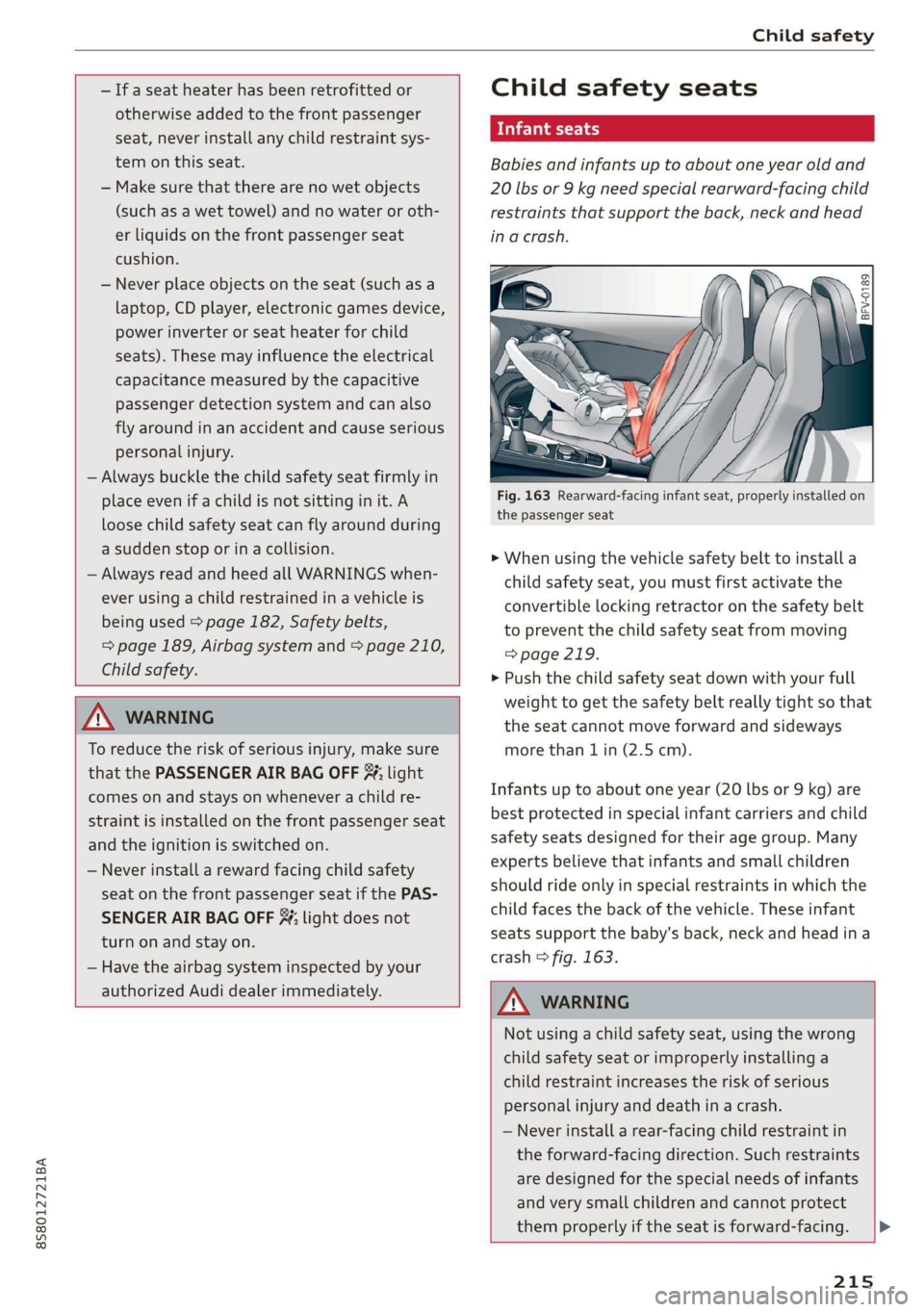
Babies and infants up to about one year old and
20 lbs or 9 kg need special rearward-facing child
restraints that support the back, neck and head
in a crash.
2 ©
S
> c a
the passenger seat
> When using the vehicle safety belt to install a
child safety seat, you must first activate the
convertible locking retractor on the safety belt
to prevent the child safety seat from moving
=> page 219.
» Push the child safety seat down with your full
weight to get the safety belt really tight so that
the seat cannot move forward and sideways
more than 1 in (2.5 cm).
Infants up to about one year (20 lbs or 9 kg) are
best protected in special infant carriers and child
safety seats designed for their age group. Many
experts believe that infants and small children
should ride only in special restraints in which the
child faces the back of the vehicle. These infant
seats support the baby's back, neck and head ina
crash > fig. 163.
ZA\ WARNING
Not using a child safety seat, using the wrong
child safety seat or improperly installing a
child restraint increases the risk of serious
personal injury and death in a crash.
— Never install a rear-facing child restraint in
the forward-facing direction. Such restraints
are designed for the special needs of infants
and
very small children and cannot protect
them properly if the seat is forward-facing.
215
Page 218 of 304
Child safety
— Never install a rearward facing child safety
seat on the front passenger seat unless the
PASSENGER AIR BAG OFF 3%; light comes
on and stays on. If the PASSENGER AIR
BAG OFF #¥; light does not come on and stay
on the inflating airbag will hit the child safe-
ty seat or infant carrier with great force and
will smash the child safety seat and child
against the backrest, center armrest, door
or roof. Have the airbag system inspected
immediately by your Audi dealer.
— Never place or use any electrical device
(such as a laptop, CD player, electronic
games device, power inverter or seat heater
for child seats) on the front passenger seat
if the device is connected to the 12-volt
socket or the cigarette lighter socket.
— If a seat heater has been retrofitted or oth-
erwise added to the front passenger seat,
never install any child restraint system on
this seat.
— Make sure that there are no wet objects
(such as a wet towel) and no water or other
liquids on the front passenger seat cushion.
— Never place objects on the seat (such as a
laptop, CD player, electronic games device,
power inverter or seat heater for child
seats). These may influence the electrical
capacitance measured by the capacitive pas-
senger detection system and can also fly
around in an accident and cause serious per-
sonal injury.
— Always read and heed all WARNINGS when-
ever using a child restrained in a vehicle is
being used > page 182, Safety belts,
=> page 189, Airbag system and > page 210,
Important information.
216
Convertible child safety seats
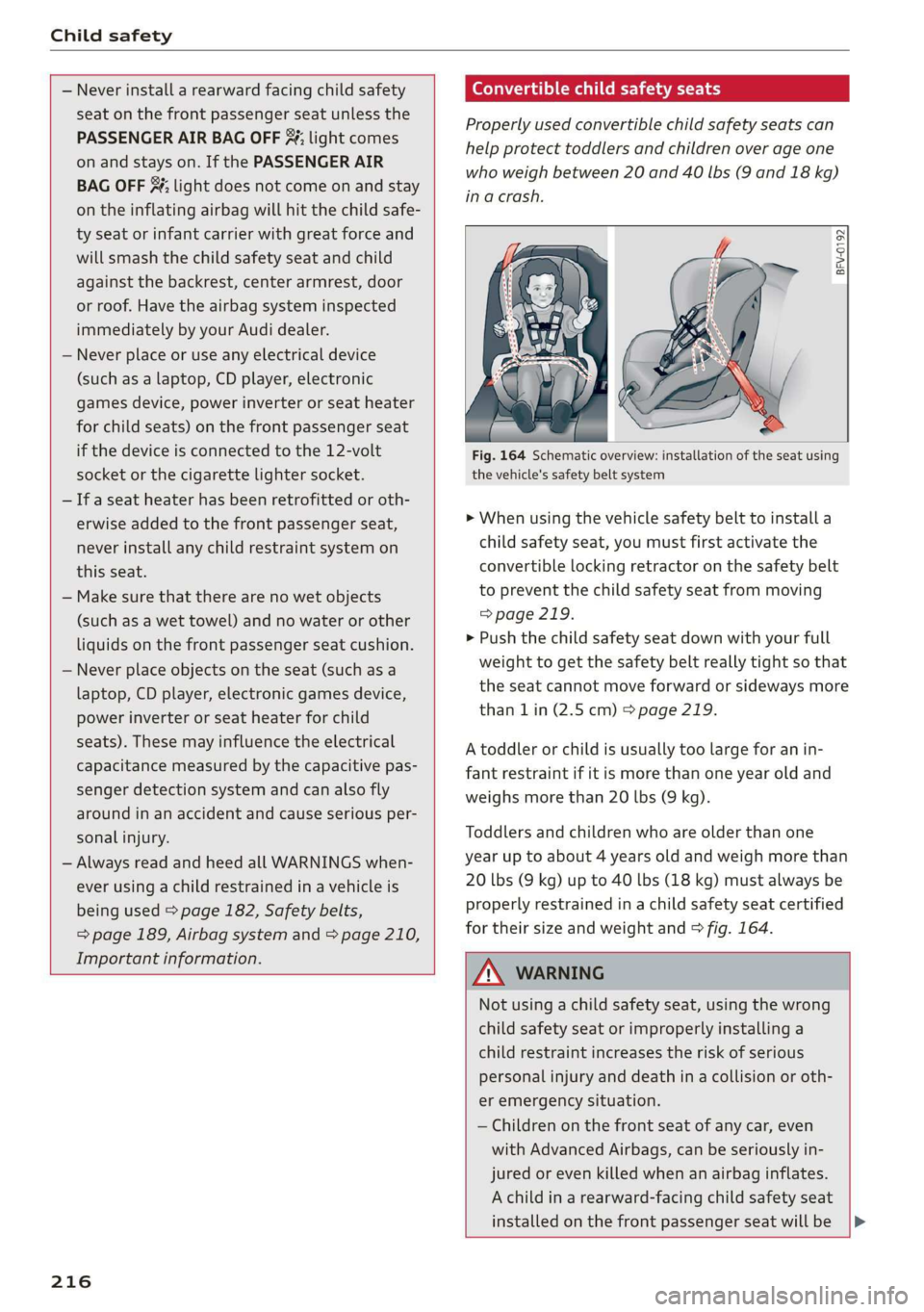
Properly used convertible child safety seats can
help protect toddlers and children over age one
who weigh between 20 and 40 lbs (9 and 18 kg)
inacrash.
BFV-0192
Fig. 164 Schematic overview: installation of the seat using
the vehicle's safety belt system
> When using the vehicle safety belt to install a
child safety seat, you must first activate the
convertible locking retractor on the safety belt
to prevent the child safety seat from moving
> page 219.
> Push the child safety seat down with your full
weight to get the safety belt really tight so that
the seat cannot move forward or sideways more
than 1 in (2.5 cm) > page 219.
A toddler or child is usually too large for an in-
fant restraint if it is more than one year old and
weighs more than 20 lbs (9 kg).
Toddlers and children who are older than one
year up to about 4 years old and weigh more than
20 lbs (9 kg) up to 40 Lbs (18 kg) must always be
properly restrained in a child safety seat certified
for their size and weight and > fig. 164.
Z\ WARNING
Not using a child safety seat, using the wrong
child safety seat or improperly installing a
child restraint increases the risk of serious
personal injury and death in a collision or oth-
er emergency situation.
— Children on the front seat of any car, even
with Advanced Airbags, can be seriously in-
jured or even killed when an airbag inflates.
A child in a rearward-facing child safety seat
installed on the front passenger seat willbe |>