Page 52 of 188
4-14
4
If you drive the vehicle with the parking
brake engaged, a buzzer will sound. EBU31441Drive select leverThe drive select lever is used to shift the
transmission into the low, high, neutral, and
reverse positions. (See page 6-3.)
EBU31451Fuel tank capRemove the fuel tank cap when refueling. To
open, turn counterclockwise. When finished
refueling, install the fuel tank cap by screwing
it down clockwise.EBU31460DoorsTo open a door, pull the latch outward. To
close a door, push or pull the door inward un-
til it is securely latched. Be sure the door is
SECURELY LATCHED AFTER CLOSING IT.
1. Drive select lever
1
1. Fuel tank cap
1
UB3D7AE0.book Page 14 Tuesday, November 7, 2017 9:38 AM
Page 73 of 188

5-1
5
EBU31574
FOR YOUR SAFETY – PRE-OPERATION CHECKS
EBU31584Before starting off, inspect the vehicle to make sure it is in safe operating condition. Use the fol-
lowing checklist and related information as a guide. Also, follow the service intervals in the peri-
odic maintenance chart to keep the vehicle in safe operating condition.
WARNING
EWB00482Failure to inspect or maintain the vehicle properly increases the possibility of an accident
or equipment damage. Do not operate the vehicle if you find any problem. If a problem can-
not be corrected by the procedures provided in this manual, have the vehicle inspected by
a Yamaha dealer. Pre-operation checklist
ITEM ROUTINE PAGE
Brakes • Check operation, free play, fluid level, and fluid leakage.
• Fill with DOT 4 brake fluid if necessary. 5-3, 8-39, 8-42
Parking brake • Check for proper operation. 8-42
Fuel • Check fuel level.
• Fill with the recommended fuel if necessary. 5-3
Engine oil • Check oil level.
• Fill with oil to proper level if necessary. 5-5, 8-14
UB3D7AE0.book Page 1 Tuesday, November 7, 2017 9:38 AM
Page 75 of 188

5-3
5
EBU31731Front and rear brakesBrake pedal
Check that there is no free play in the brake
pedal. If there is free play, have a Yamaha
dealer check the brake system. (See page
8-42.)
Check the operation of the brake pedal. It
should move smoothly and there should be
a firm feeling when the brakes are applied.
If not, have the vehicle inspected by a
Yamaha dealer.
Brake fluid level
Check the brake fluid level. Add fluid if neces-
sary. (See page 8-40.) Brake fluid leakage
Check to see if any brake fluid is leaking out
of the pipe joints or the brake fluid reservoir.
Apply the brakes firmly for one minute. If there
is any leakage, have the vehicle inspected by
a Yamaha dealer.
Brake operation
Check the operation of the brakes at the start
of every drive. Test the brakes at slow speed
after starting out to make sure they are work-
ing properly. If the brakes do not provide
proper braking performance, inspect the
brake system. (See page 8-39.)
EBU33201FuelMake sure there is suffi
cient fuel in the tank.
Specified brake fluid: DOT 4
UB3D7AE0.book Page 3 Tuesday, November 7, 2017 9:38 AM
Page 84 of 188

6-2
6
10–20 hours:
Avoid prolonged operation above three-quar-
ter throttle.
After break-in:
The vehicle may now be operated normally.EBU33081Starting the engine1. Turn the key to “ ” (on).NOTICEECB02291The coolant temperature warning light and
engine trouble warning light should come
on, then go off.
The EPS warning light should come on,
then go off when the engine is started.
To avoid possible damage, do not operate
the vehicle if a warning light does not work
as described above. 2. Apply the brake pedal.
3. Shift the drive select lever into the neutralposition.
When the drive select lever is in the
neutral position, the neutral indicator
light should come on. If the neutral indi-
cator light does not come on, ask a
Yamaha dealer to inspect the electric
circuit.
The engine can be started in any gear if
the brake pedal is applied. However, it
is recommended to shift into neutral
before starting the engine.
4. With your foot off the accelerator pedal,
start the engine by turning the key to “ ”
(start).
If the engine fails to start, release the key, and
then try starting it again. Wait a few seconds
before the next attempt. Each attempt should
be as short as possible, to preserve battery
energy. NOTICE: Do not crank the engine
more than 5 seconds on each attempt, or
starter damage could occur. Wait at least
5 seconds between each operation of the
electric starter to let it cool.
[ECB02140]
UB3D7AE0.book Page 2 Tuesday, November 7, 2017 9:38 AM
Page 85 of 188
6-3
6
Do not turn the key to the “ ” (start) position
with the engine running; otherwise, damage
to the electric starter may result.TIPFor maximum engine life, never accelerate
hard when the engine is cold! EBU31912Drive select lever operation and re-
verse drivingNOTICEECB02150Do not shift without coming to a complete
stop and waiting for the engine to return to
normal idle speed. Damage to the engine
or drive train may occur. Shifting: neutral to high and high to low1. Stop the vehicle, and take your foot off
the accelerator pedal. 2. Apply the brake pedal, then shift by mov-
ing the drive select lever along the shift
guide. Make sure that the drive select le-
ver is completely shifted into position.
3. Release the parking brake, if applied.
4. Release the brake pedal and press the accelerator pedal gradually.
1. Drive select lever
2. L (Low-range)
3. H (High-range)
4. N (Neutral)
5. R (Reverse)
1
2
5 4
3
UB3D7AE0.book Page 3 Tuesday, November 7, 2017 9:38 AM
Page 86 of 188
6-4
6
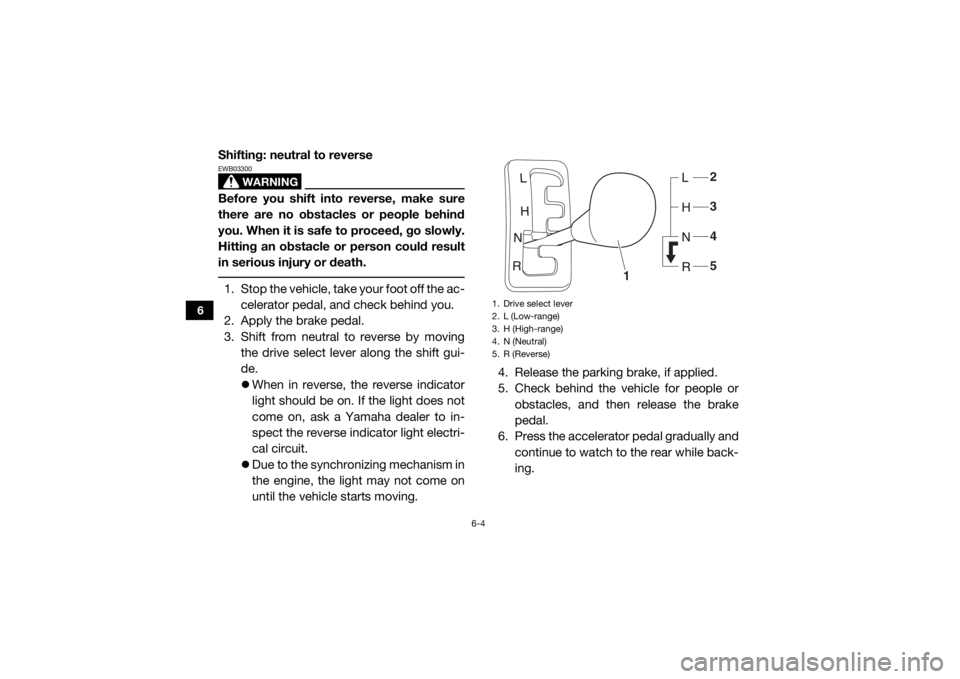
Shifting: neutral to reverse
WARNING
EWB03300Before you shift into reverse, make sure
there are no obstacles or people behind
you. When it is safe to proceed, go slowly.
Hitting an obstacle or person could result
in serious injury or death. 1. Stop the vehicle, take your foot off the ac- celerator pedal, and check behind you.
2. Apply the brake pedal.
3. Shift from neutral to reverse by moving the drive select lever along the shift gui-
de.
When in reverse, the reverse indicator
light should be on. If the light does not
come on, ask a Yamaha dealer to in-
spect the reverse indicator light electri-
cal circuit.
Due to the synchronizing mechanism in
the engine, the light may not come on
until the vehicle starts moving. 4. Release the parking brake, if applied.
5. Check behind the vehicle for people or
obstacles, and then release the brake
pedal.
6. Press the accelerator pedal gradually and
continue to watch to the rear while back-
ing.
1. Drive select lever
2. L (Low-range)
3. H (High-range)
4. N (Neutral)
5. R (Reverse)
1
2
5 4
3
UB3D7AE0.book Page 4 Tuesday, November 7, 2017 9:38 AM
Page 89 of 188

6-7
6
EBU31930ParkingWhen parking, stop the engine and shift the
drive select lever into the neutral position. Ap-
ply the parking brake to help prevent the ve-
hicle from rolling. See page 7-16 for more
information on parking and parking on a
slope.EBU31941LoadingTake extra precautions when driving with a
load or trailer. Follow these instructions and
always use common sense and good judg-
ment when carrying cargo or towing a trailer.
Prepare your load or trailer
Use the hooks equipped on the cargo bed to
tie down loads. (See page 4-20.)
Choose a trailer hitch drawbar designed for
use with a 2" (5 cm) receiver. (See page 4-32.)
WARNING
EWB04260Improper loading or towing can increase
the risk of loss of control, an overturn, or
other accident:
Keep weight in the cargo bed centered
side to side, and as low and as far for-
ward as possible. Top-heavy loads in-
crease the risk of overturn. Be sure
cargo is secured — a loose load could
change handling unexpectedly or strike
occupants.
Be sure to tie down cargo in the trailer
securely — a shifting load can cause an
accident.
Make sure the load does not interfere
with your control or ability to see where
you are going.
Do not exceed the Maximum Load Limits
for each section of the vehicle or the
Maximum Vehicle Load.
UB3D7AE0.book Page 7 Tuesday, November 7, 2017 9:38 AM
Page 104 of 188

7-13
7
Eye protection (goggles, helmet face shield,
or protective eyewear)
Over-the-ankle boots, gloves, long-sleeved
shirt or jacket, and long pants
An approved helmet and other personal pro-
tective equipment can help in a variety of
ways, including:
Reduce the severity of injuries if any part of
you is outside the vehicle cage/frame pro-
tective structure during a rollover.
Help protect you if outside objects intrude
inside the vehicle during operation.
Help protect you in the event of vehicle im-
pact with an obstacle.
Wear eye protection when operating or riding
in the vehicle to reduce the risk of a serious
accident or injury. Eye protection, such as a
face shield or goggles, may reduce the risk of
foreign material getting in your eyes and help
prevent loss of vision. Practice for new Yamaha Wolverine users
You should become familiar with the perfor-
mance characteristics of the vehicle in a lar-
ge, flat area that is free of obstacles and other
vehicles. Practice controlling the accelerator
pedal, brakes, steering, and drive select lever.
Drive at slow speeds with gradual accelera-
tion and turning. Practice smooth throttle ap-
plication. Practice slowing down before
turning. Practice maintaining a steady throttle
through the turn. Avoid higher speeds until
you are thoroughly familiar with the operation
of your vehicle. Remember, driving aggres-
sively or making abrupt maneuvers even on
flat, open areas can cause side rollovers.UB3D7AE0.book Page 13 Tuesday, November 7, 2017 9:38 AM

