2018 TOYOTA YARIS HATCHBACK tire pressure
[x] Cancel search: tire pressurePage 6 of 520

TABLE OF CONTENTS6
7-1. Maintenance and careCleaning and protecting the vehicle exterior .......... 340
Cleaning and protecting the vehicle interior ........... 344
7-2. Maintenance Maintenance requirements ................... 347
General maintenance ........ 349
Emission inspection and maintenance (I/M)
programs ......................... 352
7-3. Do-it-yourself maintenance Do-it-yourself service precautions ..................... 353
Hood.................................. 356
Positioning a floor jack ...... 358
Engine compartment ......... 360
Tires .................................. 370
Tire inflation pressure........ 378
Wheels .............................. 382
Air conditioning filter .......... 385
Wireless remote control battery ............................. 388
Checking and replacing fuses ............................... 391
Light bulbs ......................... 396 8-1. Essential information
Emergency flashers ........... 412
If your vehicle has to be stopped in
an emergency.................. 413
8-2. Steps to take in an emergency
If your vehicle needs to be towed .......................... 415
If you think something is wrong............................... 420
Fuel pump shut off system ............................. 421
If a warning light turns on or a warning buzzer
sounds ............................. 422
If you have a flat tire .......... 433
If the engine will not start ... 448
If the vehicle battery is discharged ....................... 450
If your vehicle overheats.... 453
If the vehicle becomes stuck ................................ 456
7Maintenance and care8When trouble arises
Page 15 of 520

15Pictorial index
Wipers . . . . . . . . . . . . . . . . . . . . . . . . . . . . . . . . . . . . . . . P. 162, 165
Precautions against winter season . . . . . . . . . . . . . . . . . . . . . P. 221
Fuel filler door . . . . . . . . . . . . . . . . . . . . . . . . . . . . . . . . . . . . P. 168
Refueling method . . . . . . . . . . . . . . . . . . . . . . . . . . . . . . . . . . . P. 168
Fuel type/fuel tank capacity . . . . . . . . . . . . . . . . . . . . . . . . . . . P. 464
Tires . . . . . . . . . . . . . . . . . . . . . . . . . . . . . . . . . . . . . . . . . . . . P. 370
Tire size/inflation pressure . . . . . . . . . . . . . . . . . . . . . . . . . . . . P. 469
Winter tires/tire chain . . . . . . . . . . . . . . . . . . . . . . . . . . . . . . . . P. 222
Checking/rotation/tire pressure warning system
* . . . . . . . . . . P. 370
Coping with flat tires . . . . . . . . . . . . . . . . . . . . . . . . . . . . . . . . P. 433
Hood . . . . . . . . . . . . . . . . . . . . . . . . . . . . . . . . . . . . . . . . . . . . P. 356
Opening . . . . . . . . . . . . . . . . . . . . . . . . . . . . . . . . . . . . . . . . . . P. 356
Engine oil . . . . . . . . . . . . . . . . . . . . . . . . . . . . . . . . . . . . . . . . . P. 464
Coping with overheat . . . . . . . . . . . . . . . . . . . . . . . . . . . . . . . . P. 453
Camera . . . . . . . . . . . . . . . . . . . . . . . . . . . . . . . . . . . . . . . . . . P. 205
Headlights/parking lights/front side marker lights/
daytime running lights
* . . . . . . . . . . . . . . . . . . . . . . . . . . . . P. 156
Front turn signal lights . . . . . . . . . . . . . . . . . . . . . . . . . . . . . P. 154
Fog lights
* . . . . . . . . . . . . . . . . . . . . . . . . . . . . . . . . . . . . . . . P. 160
Tail lights/rear side marker lights . . . . . . . . . . . . . . . . . . . . . P. 156
Rear turn signal lights . . . . . . . . . . . . . . . . . . . . . . . . . . . . . . P. 154
Back-up lights
Shifting the shift lever to R . . . . . . . . . . . . . . . . . . . . . . . . P. 149, 153
License plate lights . . . . . . . . . . . . . . . . . . . . . . . . . . . . . . . . P. 156
4
5
6
7
8
Light bulbs of the exterior lights for driving
(Replacing method: P. 396, Watts: P. 470)
*: If equipped
9
10
11
12
13
Page 19 of 520
19Pictorial index
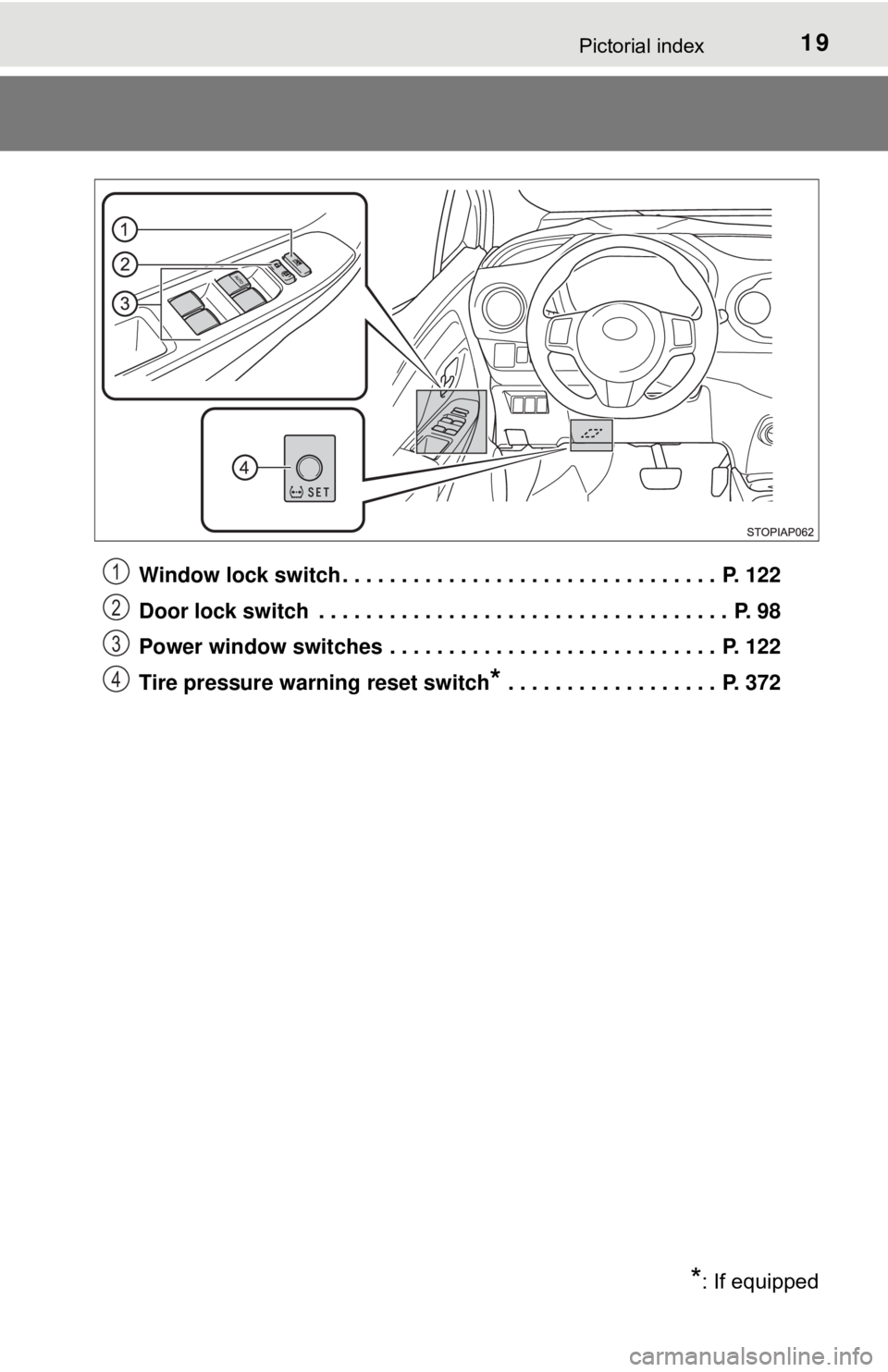
Window lock switch . . . . . . . . . . . . . . . . . . . . . . . . . . . . . . . . P. 122
Door lock switch . . . . . . . . . . . . . . . . . . . . . . . . . . . . . . . . . . . P. 98
Power window switches . . . . . . . . . . . . . . . . . . . . . . . . . . . . P. 122
Tire pressure warning reset switch
* . . . . . . . . . . . . . . . . . . P. 372
*: If equipped
1
2
3
4
Page 80 of 520

802. Instrument cluster
*1: These lights turn on when the engine switch is turned to the “ON” positionto indicate that a system check is being performed. They will turn off after
the engine is started, or after a few seconds. There may be a malfunction
in a system if a light does not come on, or if the lights do not turn off. Have
the vehicle inspected by your Toyota dealer.
*2: If equipped
*3: The light flashes to indicate that the system is operating and come on toindicate a malfunction.
*4: The lights turn on with LDA indicator to indicate a malfunction.
*5: The light flashes to indicate a malfunction.
The indicators inform the driver of the operating state of the vehicle’s
various systems.
*1
(Except Canada)
Tire pressure warning
light ( →P. 426)
*1
(Except Canada)
Maintenance required
reminder light ( →P. 426)
(If equipped)
Low windshield washer
fluid warning light
(→P. 426)
Indicators
Turn signal indicator
(→P. 154)*1, 4Eco Driving Indicator
Light ( →P. 130)
Headlight high beam
indicator ( →P. 158)
*2
(Green)
Cruise control indicator
(→P. 201)
*2
(Green)
Automatic High Beam
indicator ( →P. 196)
*2
“SET” indicator
(→P. 201)
*2
Front fog light indicator
(→P. 160)
*2
(Green)
LDA indicator
(→P. 191)
*3
(Blue)
Low engine coolant tem-
perature indicator
*2, 9
(Green)
Lane marker indicators
(→P. 192)
Page 189 of 520

1894-5. Toyota Safety Sense C
4
Driving
• If the wheels are misaligned
• If a wiper blade is blocking the front sensor
• The vehicle is wobbling.
• The vehicle is being driven at extremely high speeds.
• When driving on roads with sharp bends or uneven surfaces
• When a preceding vehicle is a poor reflector of laser
● In some situations such as the following, sufficient braking force may not be
obtained, preventing the system from performing properly:
• If the braking functions cannot operate to their full extent, such as when
the brake parts are extremely cold, extremely hot, or wet
• If the vehicle is not properly maintained (brakes or tires are excessively worn, improper tire inflation pressure, etc.)
• When the vehicle is being driven on a gravel road or other slippery sur-
face
• If your vehicle is skidding
• When the front part of the vehicle is
raised or lowered
• When the sensor is misaligned due to a strong impact being applied to the
sensor, etc.
Page 193 of 520

1934-5. Toyota Safety Sense C
4
Driving
■Temporary cancelation of the LDA system functions
If any of the following occurs, the LDA system functions will be temporarily
canceled. The functions will resume after the necessary operating conditions
have returned.
●The turn signal lever is operated.
● The vehicle speed deviates from the operating range of the LDA system
functions.
● When the lane lines cannot be recognized while driving.
● When the lane departure warning sounds.
The lane departure warning function will not operate again for a several sec-
onds after it has been activated, even if the vehicle leaves the lane again.
■ The lane departure warning
Depending on the audio system sound level or air conditioning fan noise
while the audio system or air conditioning system is in use, it may be difficult
to hear the warning sound.
■ After the vehicle has been parked in the sun
The LDA system may not be immediately available. When the temperature in
the cabin decreases and the temperature around the front sensor ( →P. 173)
becomes suitable for its operation, the functions will begin to operate.
■ If there are lane markers on only one side of the vehicle
The lane departure warning will not operate for the side on which lane mark-
ers could not be recognized.
■ Conditions in which the function may not operate correctly
In the following situations, the front sensor may be unable to recognize lane
markers causing the lane departure warning function to operate incorrectly.
However, this does not indicate a malfunction.
●When driving through an area, such as a tollbooth, a crossing or before a
ticket checkpoint
● When driving on a sharp curve
● When lane markers are extremely narrow or extremely wide
● When the vehicle leans to one side an unusual amount due to a heavy load
or improper tire inflation pressure
● When the following distance between your vehicle and the vehicle ahead is
extremely short
● When the lane markers are yellow (These may be more difficult for the sys-
tem to recognize compared to white markers.)
● When the lane markers are broken, Botts’ dots (raised pavement markers)
or stones
Page 213 of 520

2134-6. Using the driving support systems
4
Driving
The fixed guide lines are very far out of alignment
The camera position is out of align-
ment.Have the vehicle inspected by your
Toyota dealer.
• The vehicle is tilted (there is a
heavy load on the vehicle, tire
pressure is low due to a tire punc-
ture, etc.)
• The vehicle is used on an incline.If this happens due to these causes,
it does not indicate a malfunction.
Back up while visually checking the
vehicle’s surroundings.
WARNING
■ When using the rear view monitor system
The rear view monitor system is a supplemental device intended to assist
the driver when backing up. When backing up, be sure to check visually
behind and all around the vehicle before proceeding.
Observe the following precautions to avoid an accident that could result in
death or serious injuries.
● Never depend on the rear view monitor system entirely when backing up.
The image and the position of the guide lines displayed on the screen may
differ from the actual state.
Use caution, just as you would when backing up any vehicle.
● Be sure to back up slowly, depressing the brake pedal to control vehicle
speed.
● The instructions given are only guide lines.
When and how much to turn the steering wheel will vary according to traf-
fic conditions, road surface conditions, vehicle condition, etc., when park-
ing. It is necessary to be fully aware of this before using the rear view
monitor system.
● When parking, be sure to check that the parking space will accommodate
your vehicle before maneuvering into it.
Likely causeSolution
Page 220 of 520

2204-6. Using the driving support systems
WARNING
■Hill-start assist control does not operate effectively when
● Do not overly rely on hill-start assist control. Hill-start assist control may
not operate effectively on steep inclines and roads covered with ice.
● Unlike the parking brake, hill-start assist control is not intended to hold the
vehicle stationary for an extended period of time. Do not attempt to use
hill-start assist control to hold the vehicle on an incline, as doing so may
lead to an accident.
■ When the VSC is activated
The slip indicator light flashes. Always drive carefully. Reckless driving may
cause an accident. Exercise particular care when the indicator light flashes.
■ When the TRAC/VSC syst ems are turned off
Be especially careful and drive at a speed appropriate to the road condi-
tions. As these are the systems to help ensure vehicle stability and driving
force, do not turn the TRAC/VSC systems off unless necessary.
■
Replacing tires
Make sure that all tires are of the specified size, brand, tread pattern
and total load capacity. In addition, make sure that the tires are inflated
to the recommended tire inflation pressure level.
The ABS, TRAC and VSC systems will not function correctly if different
tires are installed on the vehicle.
Contact your Toyota dealer for furt her information when replacing tires
or wheels.
■Handling of tires and the suspension
Using tires with any kind of problem or modifying the suspension will
affect the driving assist systems, and may cause a system to malfunc-
tion.