2018 TOYOTA PROACE eco
[x] Cancel search: ecoPage 282 of 516

282
Manual gearbox
The gearbox does not require any maintenance (no oil change).Refer to the manufacturer's service schedule for the checking interval for this component.
Brake wear depends on the style of driving, particularly in the case of vehicles used in town, over short distances. It may be necessary to
Brake pads
For information on checking brake disc wear, contact an authorized Toyota dealer or repairer, or another duly qualified and equipped professional.
Brake disc wear
Only use products recommended by Toyota or products of equivalent quality and specification.In order to optimise the operation of units as important as those in the braking system, Toyota selects and offers very specific products.After washing the vehicle, dampness, or in wintry conditions, ice can form on the brake discs and pads: braking efficiency may be reduced. Make light brake applications to dry and defrost the brakes.
Parking brake
If excessive travel or a loss of effectiveness of this system is noticed, the parking brake must be checked, even between two services.
Checking this system must be done by an authorized Toyota dealer or repairer, or another duly qualified and equipped professional.
have the condition of the brakes checked, even between vehicle services.Unless there is a leak in the circuit, a drop in the brake fluid level indicates that the brake pads are worn.
Automatic
gearbox
The gearbox does not require any maintenance (no oil change).Refer to the manufacturer's service schedule for the checking interval for this component.
Electronic gearbox
The gearbox does not require any maintenance (no oil change).Refer to the manufacturer's service schedule for the checking interval for this component.
Practical information
Page 283 of 516
283
AdBlue® and SCR system
for Diesel engines
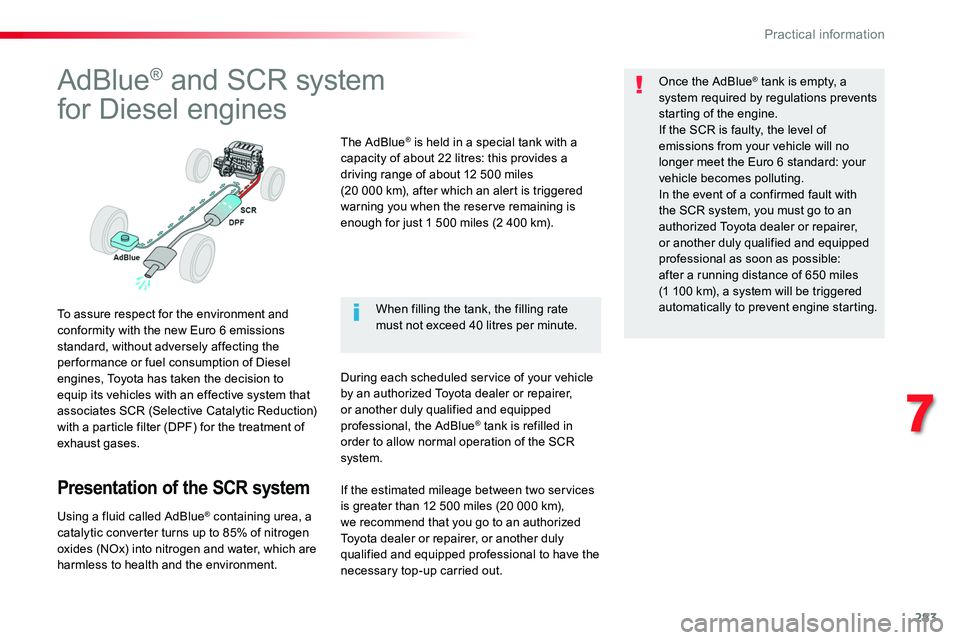
To assure respect for the environment and conformity with the new Euro 6 emissions standard, without adversely affecting the per formance or fuel consumption of Diesel engines, Toyota has taken the decision to equip its vehicles with an effective system that associates SCR (Selective Catalytic Reduction) with a particle filter (DPF) for the treatment of exhaust gases.
Presentation of the SCR system
Using a fluid called AdBlue® containing urea, a catalytic converter turns up to 85% of nitrogen
oxides (NOx) into nitrogen and water, which are harmless to health and the environment.
The AdBlue® is held in a special tank with a capacity of about 22 litres: this provides a driving range of about 12 500 miles (20 000 km), after which an alert is triggered warning you when the reserve remaining is enough for just 1 500 miles (2 400 km).
During each scheduled service of your vehicle by an authorized Toyota dealer or repairer, or another duly qualified and equipped professional, the AdBlue® tank is refilled in order to allow normal operation of the SCR system.
Once the AdBlue® tank is empty, a system required by regulations prevents starting of the engine.If the SCR is faulty, the level of emissions from your vehicle will no longer meet the Euro 6 standard: your vehicle becomes polluting.In the event of a confirmed fault with the SCR system, you must go to an authorized Toyota dealer or repairer, or another duly qualified and equipped professional as soon as possible: after a running distance of 650 miles (1 100 km), a system will be triggered automatically to prevent engine starting.When filling the tank, the filling rate must not exceed 40 litres per minute.
If the estimated mileage between two services is greater than 12 500 miles (20 000 km), we recommend that you go to an authorized Toyota dealer or repairer, or another duly qualified and equipped professional to have the necessary top-up carried out.
7
Practical information
Page 285 of 516
285
Recommendations on storage
Never store bottles of AdBlue® in your vehicle.
AdBlue® freezes at about -11°C and deteriorates above 25°C. It is recommended that bottles be stored in a cool area and protected from direct sunlight.Under these conditions, the fluid can be kept for at least a year.If the additive has frozen, it can be used once it has completely thawed out.
Procedure
Before starting the top-up procedure, ensure that the vehicle is parked on a flat and level sur face.
F Switch off the ignition and remove the key, or if your vehicle has one, press the START/STOP button to switch off the engine.
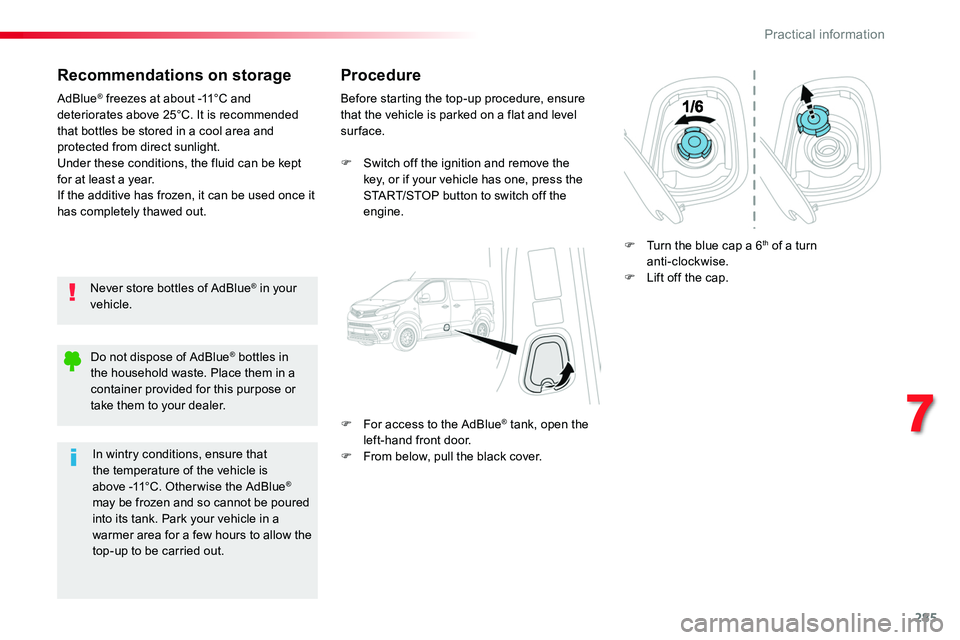
F For access to the AdBlue® tank, open the left-hand front door.F From below, pull the black cover.
F Turn the blue cap a 6th of a turn anti-clockwise.F Lift off the cap.
Do not dispose of AdBlue® bottles in the household waste. Place them in a container provided for this purpose or take them to your dealer.
In wintry conditions, ensure that the temperature of the vehicle is above -11°C. Other wise the AdBlue® may be frozen and so cannot be poured into its tank. Park your vehicle in a warmer area for a few hours to allow the top-up to be carried out.
7
Practical information
Page 286 of 516

286
F After emptying the bottle, wipe away any spillage around the tank filler using a damp cloth.
If any additive is split or splashed, wash immediately with cold water or wipe with a damp cloth.If the additive has crystallised, clean it off using a sponge and hot water.
F Refit the blue cap to the tank and turn it a 6th of a turn clockwise, to its stop.
Important: when topping-up after running out of additive, signalled by the message "Top up emissions additive: Starting prevented", you must wait for about 5 minutes before switching the ignition on again, without opening the driver's door, unlocking the vehicle, introducing the remote control key into the ignition switch, or placing the electronic key of the "Smar t Entr y & Star t System" system inside the vehicle.Switch on the ignition, then wait for 10 seconds before starting the engine.
F Obtain a bottle of AdBlue®. After first checking the use-by date, read carefully the instructions on use on the label before pouring the contents of the bottle into your vehicle's AdBlue® tank.
Freezing of the AdBlue®
AdBlue® freezes at temperatures below around -11°C.
The SCR system includes a heater for the AdBlue® tank, allowing you to continue driving in very cold conditions.F Refit the black cover, starting at the top.F Close the door.
Practical information
Page 308 of 516
308
Dipped beam headlamps
(xenon headlamps)
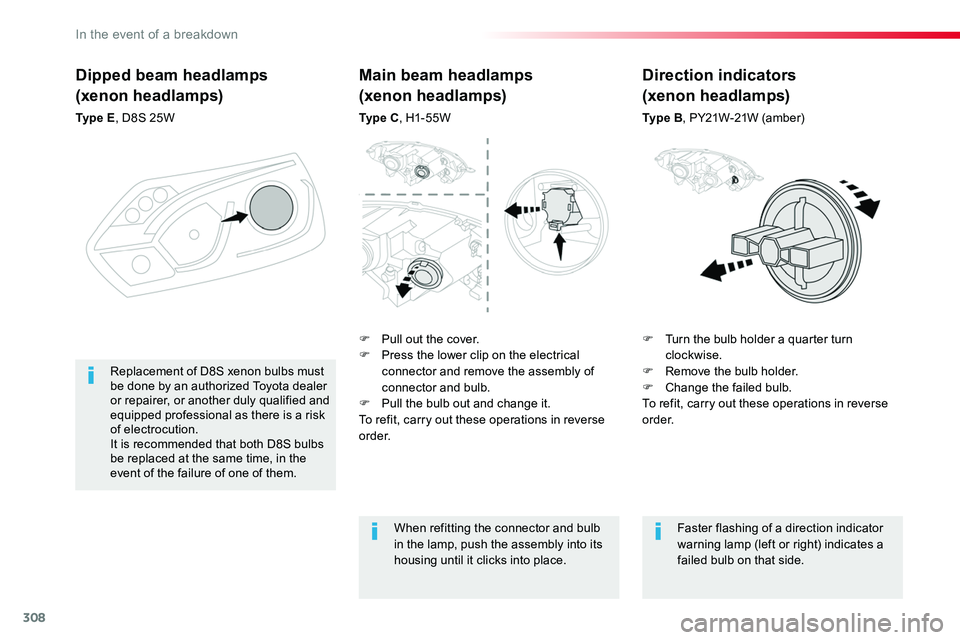
Ty p e E, D8S 25W
F Turn the bulb holder a quarter turn clockwise.F Remove the bulb holder.F Change the failed bulb.To refit, carry out these operations in reverse o r d e r.
Replacement of D8S xenon bulbs must be done by an authorized Toyota dealer or repairer, or another duly qualified and equipped professional as there is a risk of electrocution.It is recommended that both D8S bulbs be replaced at the same time, in the event of the failure of one of them.
Main beam headlamps
(xenon headlamps)
Ty p e C, H1-55W
When refitting the connector and bulb in the lamp, push the assembly into its housing until it clicks into place.
Faster flashing of a direction indicator warning lamp (left or right) indicates a failed bulb on that side.
Direction indicators
(xenon headlamps)
Ty p e B, PY21W-21W (amber)
F Pull out the cover.F Press the lower clip on the electrical connector and remove the assembly of connector and bulb.F Pull the bulb out and change it.To refit, carry out these operations in reverse
o r d e r.
In the event of a breakdown
Page 317 of 516

317
Toyota will not accept responsibility for the cost incurred in repairing your vehicle or for rectifying malfunctions resulting from the installation of accessories not supplied and not recommended by Toyota and not installed in accordance with its instructions, in particular when the combined consumption of all of the additional equipment connected exceeds 10 milliamperes.
Installing electrical accessories
Your vehicle's electrical system is designed to operate with standard or optional equipment.Before installing other electrical equipment or accessories on your vehicle, contact an authorized Toyota dealer or repairer, or another duly qualified and equipped professional.
For more information on installing a towbar or equipment of the TA XI type, contact a Toyota dealer.
Dashboard fuses
The fusebox is located in the left-hand part of the glove box.
Access to the fuses
F Unclip the cover by pulling at top left, then right.
8
In the event of a breakdown
Page 318 of 516

318
FuseN°Rating(A)Functions
F110Electric power steering, clutch switch
F415Horn.
F520Front/rear screenwash pump.
F620Front/rear screenwash pump.
F710Rear 12 V accessory socket.
F820Single or double rear wipers.
F10/F1130Front and rear, exterior, interior locks.
F1310Front air conditioning controls, radio controls, gear lever, head-up display.
F145Alarm, ER A-GLONASS emergency call system.
F175Instrument panel.
F193Steering mounted controls.
F213"Smart Entry & Start System" system or ignition switch.
F223Rain and sunshine sensor, multifunction detection camera.
F235Seat belt unfastened or not fastened display screen.
F245Touch screen, reversing camera and parking sensors.
F255Airbags.
F2920Audio system, touch screen, CD player, navigation.
F3115Audio system (battery +).
F3215Front 12 V accessory socket.
F345Blind spot monitoring system, door mirror electric controls.
F355Heated washer jets, headlamp beam height control.
F365Torch charger, rear courtesy lamp.
Version 1 (Eco)
The fuses described hereafter vary according to the equipment in your vehicle.
In the event of a breakdown
Page 324 of 516

324
Do not force the lever as locking will not be possible if the clamp is not
positioned correctly; start the procedure again.
Disconnecting the battery
In order to maintain an adequate state of charge for starting the engine, it is recommended that the battery be disconnected if the vehicle is taken out of service for a long period.Wait 2 minutes after switching off the ignition before disconnecting the battery.F close the windows and the doors before disconnecting the battery,F switch off all electrical consumers (audio system, wipers, lighting, ...),F switch off the ignition and wait for four minutes.Having exposed the battery, it is only necessary to disconnect the (+) terminal.
Quick release terminal
Disconnecting the (+) terminal
F Raise the lever A fully to release the clamp B.
Following reconnection of the battery
Reconnecting the (+) terminal
F Position the open clamp B of the cable on the positive post (+) of the battery.F Press down on the clamp to position it correctly on the battery post.F Lock the clamp by lowering the lever A.
After reconnecting the battery, switch on the ignition and wait 1 minute before starting to allow initialisation of the electronic systems.However, if minor problems persist following this operation, contact an authorized Toyota dealer or repairer, or another duly qualified and equipped professional.Referring to the corresponding section, you must yourself reinitialise or reset certain systems, such as:- the remote control or electronic key (depending on version),- the electric windows,- the date and time,- the radio preset stations.
The Stop & Start system may not be operational during the trip following the first engine start.In this case, the system will only be available again after a continuous period of immobilisation of the vehicle, a period which depends on the ambient temperature and the state of charge of the battery (up to about 8 hours).
In the event of a breakdown