2018 SUBARU WRX lock
[x] Cancel search: lockPage 61 of 578
(62,1)
北米Model "A1700BE-B" EDITED: 2017/ 10/ 11
&Installation of child restraint
systems by use of lower and
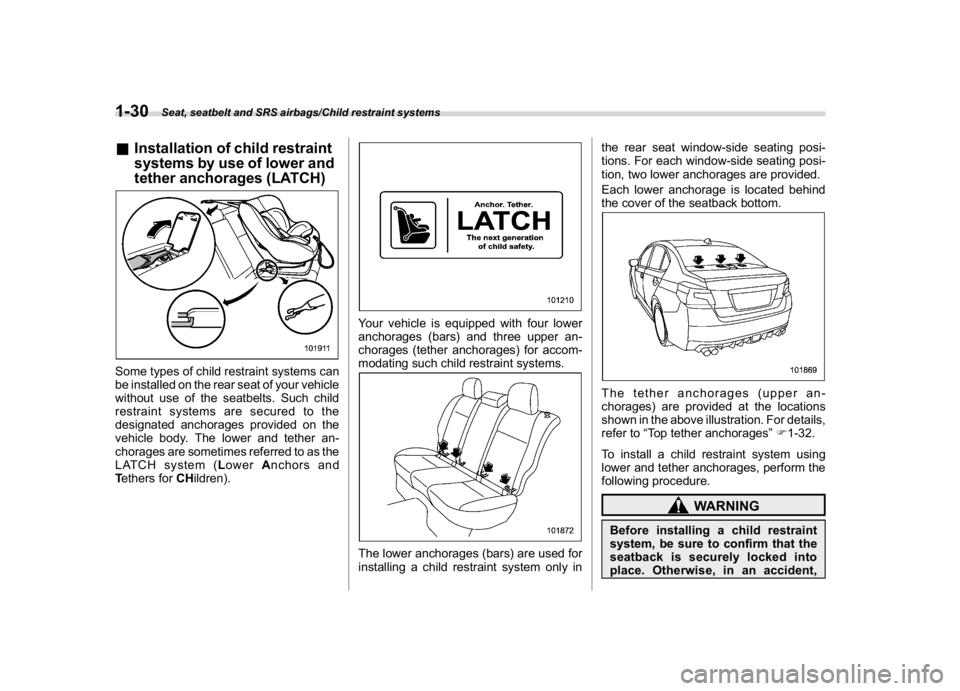
tether anchorages (LATCH)Some types of child restraint systems can
be installed on the rear seat of your vehicle
without use of the seatbelts. Such child
restraint systems are secured to the
designated anchorages provided on the
vehicle body. The lower and tether an-
chorages are sometimes referred to as the
LATCH system (LowerAnchors and
Tethers forCHildren).
Your vehicle is equipped with four lower
anchorages (bars) and three upper an-
chorages (tether anchorages) for accom-
modating such child restraint systems.The lower anchorages (bars) are used for
installing a child restraint system only inthe rear seat window-side seating posi-
tions. For each window-side seating posi-
tion, two lower anchorages are provided.
Each lower anchorage is located behind
the cover of the seatback bottom.
The tether anchorages (upper an-
chorages) are provided at the locations
shown in the above illustration. For details,
refer to“Top tether anchorages”F1-32.
To install a child restraint system using
lower and tether anchorages, perform the
following procedure.
WARNING
Before installing a child restraint
system, be sure to confirm that the
seatback is securely locked into
place. Otherwise, in an accident,
Seat, seatbelt and SRS airbags/Child restraint systems
1-30
Page 62 of 578

(63,1)
北米Model "A1700BE-B" EDITED: 2017/ 10/ 11
serious injury or death could result.
1. Shake the seatback to confirm that it is
securely locked into place.
–Check the red colored unlocking
marker which is attached to the bottom
of the lock release knob is not visible.
For details, refer to“Folding down the
rear seatback”F1-10.2. You will find marks“
”at the bottom of
the rear seat seatbacks. These marks
indicate the positions of the lower an-
chorages (bars).
Remove the covers and locate the lower
anchorages (bars).
3. Remove the rear seat head restraint.
For details, refer to“Head restraint adjust-
ment”F1-8.
CAUTION
Store the head restraint that has
been removed in the trunk. Avoid
placing the head restraint in the
passenger compartment to prevent
it from being thrown around in the
passenger compartment in a sud-
den stop or a sharp turn.
4. While following the instructions sup-
plied by the child restraint system manu-
facturer, connect the lower hooks onto the
lower anchorages located at“
”marks on
the bottom of the rear seatback. When the
hooks are connected, make sure the
adjacent seatbelts are not caught.
–CONTINUED–
Seat, seatbelt and SRS airbags/Child restraint systems
1-31
1
Page 75 of 578
(76,1)
北米Model "A1700BE-B" EDITED: 2017/ 10/ 11
monitors the physique and posture of the
front passenger. Using this information,
the occupant detection system determines
whether the front passenger’s SRS frontal
airbag should be deployed or not.
The occupant detection system may not
inflate the front passenger’s SRS frontal
airbag even when the driver’s SRS frontal
airbag deploys. This is normal. In this
case, although the front passenger’s SRS
frontal airbag does not operate, the front
passenger’s seatbelt pretensioner oper-
ates with the driver’s seatbelt preten-
sioner. For details about the seatbelt
pretensioner, refer to“Front seatbelt pre-
tensioners”F1-17.
CAUTION
Observe the following precautions.
Failure to do so may prevent the
SUBARU advanced frontal airbag
system from functioning correctly
or cause the system to fail.
.Do not apply any strong impact to
the front passenger’s seat such
as by kicking.
.Do not let rear passengers rest
their feet between the front seat-
back and seat cushion.
.Do not spill liquid on the front
passenger’s seat. If liquid isspilled, wipe it off immediately.
.Do not remove or disassemble
the front passenger’s seat.
.Do not install any accessory
(such as an audio amplifier) other
than a genuine SUBARU acces-
sory under the front passenger’s
seat.
.Do not place anything (shoes,
umbrella, etc.) under the front
passenger’s seat.
.Do not use the front passenger’s
seat with the head restraint re-
moved.
.Do not leave any articles on the
front passenger’s seat or the
seatbelt tongue and buckle en-
gaged when you leave your vehi-
cle.
.Do not put sharp object(s) on the
seat or pierce the seat uphols-
tery.
.Do not place a magnet near the
seatbelt buckle and the seatbelt
retractor.
.Do not use front seats with their
backward-forward position and
seatback not being locked into
place securely. If any of them are
not locked securely, adjust themagain. For adjusting procedure,
refer to“Manual seat”F1-4
(models equipped with manual
seats only).
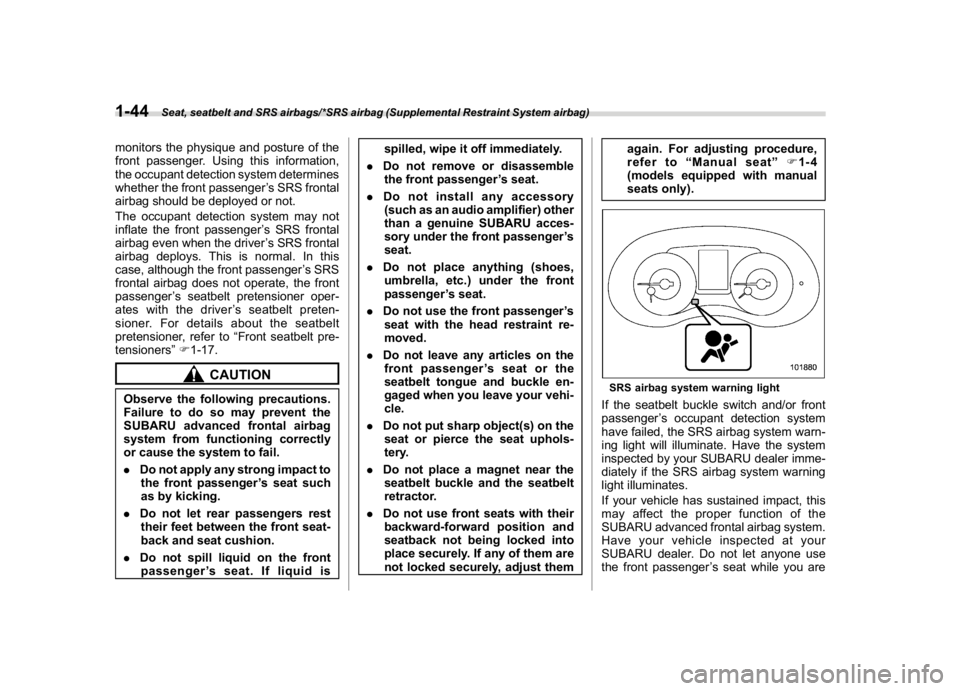
SRS airbag system warning lightIf the seatbelt buckle switch and/or front
passenger’s occupant detection system
have failed, the SRS airbag system warn-
ing light will illuminate. Have the system
inspected by your SUBARU dealer imme-
diately if the SRS airbag system warning
light illuminates.
If your vehicle has sustained impact, this
may affect the proper function of the
SUBARU advanced frontal airbag system.
Have your vehicle inspected at your
SUBARU dealer. Do not let anyone use
the front passenger’s seat while you are
Seat, seatbelt and SRS airbags/*SRS airbag (Supplemental Restraint System airbag)
1-44
Page 78 of 578

(79,1)
北米Model "A1700BE-B" EDITED: 2017/ 10/ 11
.Do not place more than one infant
in the child restraint system.
!If the front passenger’s frontal
airbag ON indicator illuminates
and the OFF indicator turns off
even when an infant or a small
child is in a child restraint sys-
tem (including booster seat)
1. Turn the ignition switch to the“LOCK”/
“OFF”position.
2. Remove the child restraint system from
the seat.
3. By referring to the child restraint
manufacturer’s recommendations as well
as the child restraint system installation
procedures in“Child restraint systems”
F1-21, correctly install the child restraint
system.
4. Turn the ignition switch to the“ON”
position and make sure that the front
passenger’s frontal airbag ON indicator
turns off and the OFF indicator illuminates.
If still the ON indicator remains illuminated
while the OFF indicator turns off, take the
following actions.
.Ensure that no article is placed on the
seat other than the child restraint system
and the child occupant.
.Ensure that the backward-forward po-sition and seatback of front passenger’s
seat are locked into place securely by
moving the seat back and forth.
If the ON indicator still remains illuminated
while the OFF indicator turns off after
taking relevant corrective actions de-
scribed above, relocate the child restraint
system to the rear seat and immediately
contact your SUBARU dealer for an
inspection.
NOTEWhen a child who has outgrown a child
restraint system or a small adult is
seated in the front passenger’s seat,
the SUBARU advanced frontal airbag
system may or may not activate the
front passenger’s SRS frontal airbag
depending on the occupant’s seating
posture. Children should always wear a
seatbelt when sitting in the seat irre-
spective of whether the airbag is deac-
tivated or activated. If the front passen-
ger’s SRS frontal airbag is activated
(the ON indicator remains illuminated
while the OFF indicator turns off),
ensure that no article is placed on the
seat other than the occupant.
If the ON indicator still remains illumi-
nated while the OFF indicator turns off
despite the fact that the actions noted
above have been taken, seat the child/small adult in the rear seat and imme-
diately contact your SUBARU dealer for
an inspection. Even if the system has
passed the dealer inspection, it is
recommended that on subsequent trips
the child/small adult always take the
rear seat.
Children who have outgrown a child
restraint system should always wear the
seatbelt irrespective of whether the airbag
is deactivated or activated.
!Conditions in which front passen-
ger’s SRS frontal airbag is activated
The front passenger’s SRS frontal airbag
will be activated for deployment upon
impact when any of the following condi-
tions are met regarding the front passen-
ger’s seat.
.When the seat is occupied by an adult.
.When certain items (e.g. jug of water)
are placed on the seat.
–CONTINUED–
Seat, seatbelt and SRS airbags/*SRS airbag (Supplemental Restraint System airbag)
1-47
1
Page 79 of 578

(80,1)
北米Model "A1700BE-B" EDITED: 2017/ 10/ 11
!If the passenger’s frontal airbag
OFF indicator illuminates and the
ON indicator turns off even when
the front passenger’s seat is
occupied by an adult
This can be caused by the adult incorrectly
sitting in the front passenger’s seat.
1. Turn the ignition switch to the“LOCK”/
“OFF”position.
2. Ask the front passenger to set the
seatback to the upright position, sit up
straight in the center of the seat cushion,
correctly fasten the seatbelt, position his/
her legs out forward, and adjust the seat to
the rearmost position.
3. Turn the ignition switch to the“ON”
position.
If the OFF indicator remains illuminated
while the ON indicator remains off, take the
following actions.
1. Turn the ignition switch to the“LOCK”/
“OFF”position.
2. Make sure that the front passenger
does not use a blanket, seat cushion, seat
cover, seat heater or massager, etc.
3. If wearing excessive layers of clothing,
the front passenger should remove any
unnecessary items before sitting in the
front passenger’s seat, or should sit in a
rear seat.
4. Turn the ignition switch to the“ON”position and wait 6 seconds to allow the
system to complete self-checking. Follow-
ing the system check, both indicators turn
off for 2 seconds. Now, the ON indicator
should illuminate while the OFF indicator
remains off.
If the OFF indicator still remains illumi-
nated while the ON indicator remains off,
ask the occupant to move to the rear seat
and immediately contact your SUBARU
dealer for an inspection.
Seat, seatbelt and SRS airbags/*SRS airbag (Supplemental Restraint System airbag)
1-48
Page 98 of 578

(101,1)
北米Model "A1700BE-B" EDITED: 2017/ 10/ 11
Keys.........................................................................2-2
Models without“keyless access with push-button
start system”....................................................... 2-2
Models with“keyless access with push-button
start system”....................................................... 2-2
Key number plate................................................... 2-3
Door locks...............................................................2-4
Locking and unlocking from the outside................. 2-4
Locking and unlocking from the inside................... 2-5
Battery drainage prevention function...................... 2-6
Power door lockingswitches................................2-7
Key lock-in prevention function.............................. 2-7
Keyless access with push-button start system
(if equipped).........................................................2-8
Safety precautions................................................. 2-8
Locking and unlocking by holding the access key
fob......................................................................2-10
Unlock using PIN Code Access.............................2-12
Power saving function..........................................2-13
Selecting audible signal operation.........................2-14
Warning chimes and warning indicator..................2-14
Disabling keyless access function.........................2-14
When access key fob does not operate properly ... 2-16
Replacing battery of access key fob......................2-16
Replacing access key fob.....................................2-16
Certification for keyless access with push-button
start system........................................................2-16
Tips......................................................................2-17
Remote keyless entrysystem.............................2-18
Locking the doors................................................2-19
Unlocking the doors.............................................2-19
Opening the trunk lid............................................2-20
Vehicle finder function..........................................2-20
Sounding a panic alarm........................................2-20
Selecting audible signal operation (models
without“keyless access with push-button start
system”)............................................................2-20
Replacing the battery............................................2-21
Replacing lost transmitters...................................2-21
Certification for Remote keyless entry system.......2-21
Anti-theft system..................................................2-22
Immobilizer...........................................................2-22
Alarm system.......................................................2-24
Child safety locks.................................................2-31
Windows................................................................2-31
Power window operation by driver........................2-32
Power window operation by passengers...............2-34
Off delay function.................................................2-35
Initialization of power window ...............................2-35
Trunk lid................................................................2-35
To open and close the trunk lid from outside........2-36
To open the trunk lid from inside..........................2-36
Internal trunk lid release handle............................2-36
Moonroof (if equipped).........................................2-38
Moonroof switches...............................................2-39
Sun shade............................................................2-40
Keys and doors
2
Page 99 of 578

(102,1)
北米Model "A1700BE-B" EDITED: 2017/ 10/ 11
Keys
CAUTION
When traveling in an airplane, do not
press the button of the key. If any
button of the key is pressed, radio
waves are emitted and may affect
the operation of the airplane. When
carrying the key in a bag, take
measures to prevent the buttons
from being pressed accidentally.NOTEPress the buttons of the key to lock/
unlock with the remote keyless entry
system. For details, refer to“Remote
keyless entry system”F2-18.
&Models without“keyless ac-
cess with push-button start
system”1) Master key
2) Submaster key
3) Sub key
4) Key number plateThree types of keys are provided for your
vehicle.
CAUTION
Do not attach a large key holder or
key case to either key. If it bangs
against your knees while you are
driving, it could turn the ignition
switch from the“ON”position to
the“ACC”or“LOCK”position,
thereby stopping the engine.&Models with“keyless access
with push-button start sys-
tem”1) Access key fob (main)
2) Access key fob (sub)
3) Key number plateThe vehicle has two access key fobs and a
Keys and doors/Keys
2-2
Page 100 of 578

(103,1)
北米Model "A1700BE-B" EDITED: 2017/ 10/ 11
key number plate. For details about the
key number plate, refer to“Key number
plate”F2-3.
An emergency key is attached to each
access key fob. The emergency key is
used for the following operations.
.Locking and unlocking the driver’s door
.Locking and unlocking the glove box
You cannot unlock the glove box without
using the emergency key. You can keep
the glove box locked when you leave your
vehicle and the access key fob (with the
emergency key removed) at a parking
facility.1) Release button
2) Emergency keyWhile pressing the release button of theaccess key fob, take out the emergency
key.
CAUTION
If the access key fob is dropped, the
integrated emergency key inside
may become loose. Be careful not
to lose the emergency key.NOTE.The access key fob is always com-
municating with the vehicle and is
continuously using the battery.
Although the life of the battery varies
depending on the operating conditions,
it is approximately 1 to 2 years. If the
battery becomes fully discharged, re-
place it with a new one.
.If an access key fob is lost, it is
recommended that the remaining ac-
cess key fobs be reregistered. For
reregistration of an access key fob,
contact a SUBARU dealer.
.Up to 7 access key fobs can be
registered for one vehicle. For a spare
access key fob, contact a SUBARU
dealer.
.Do not leave the access key fob in
the storage spaces inside the vehicle.
Vibrations can damage the key or turn
on the switch, possibly resulting in alockout.
&Key number plate
CAUTION
Carefully store the key number
plate. It is necessary for vehicle
repair and additional registration of
access key fobs.
The key number is stamped on the key
number plate attached to the key set. Write
down the key number and keep it in
another safe place, not in the vehicle. This
number is needed to make a replacement
key if you lose your key or lock it inside the
vehicle. Refer to“Key replacement”F2-
23.
Keys and doors/Keys
2-3
2