2018 SUBARU CROSSTREK control arms
[x] Cancel search: control armsPage 7 of 474

(6,1)
北米Model "A1320BE-C" EDITED: 2017/ 10/ 10
Vehicle symbolsThere are some of the symbols you may
see on your vehicle.
For warning and indicator lights, refer to
“Warning and indicator lights”F23.
Mark Name
WARNINGCAUTIONRead these instructions care-
fullyWear eye protectionBattery fluid contains sulfuric
acidKeep children awayKeep flames awayPrevent explosions
Safety precautions when
driving&Seatbelt and SRS airbag
WARNING
.All persons in the vehicle must
fasten their seatbelts BEFORE
the vehicle starts to move. Other-
wise, the possibility of serious
injury becomes greater in the
event of a sudden stop or acci-
dent.
.To obtain maximum protection in
the event of an accident, the
driver and all passengers must
always wear seatbelts when in
the vehicle. The SRS (Supple-
mental Restraint System) airbag
does not do away with the need to
fasten seatbelts. In combination
with the seatbelts, it offers the
best combined protection in case
of a serious accident.
Not wearing a seatbelt increases
the chance of severe injury or
death in a crash even when the
vehicle has the SRS airbag..The SRS airbags deploy with
considerable speed and force.
Occupants who are out of proper
position when the SRS airbag
deploys could suffer very serious
injuries. Because the SRS airbag
needs enough space for deploy-
ment, the driver should always sit
upright and well back in the seat
as far from the steering wheel as
practical while still maintaining
full vehicle control and the front
passenger should move the seat
as far back as possible and sit
upright and well back in the seat.
For instructions and precautions, carefully
read the following sections.
.For the seatbelt system, refer to“Seat-
belts”F1-12.
.For the SRS airbag system, refer to
“SRS airbag (Supplemental Restraint Sys-
tem airbag)”F1-37.
&Child safety
WARNING
.Never hold a child on your lap or
in your arms while the vehicle is
moving. The passenger cannot
protect the child from injury in a
4
Page 127 of 474
(130,1)
北米Model "A1320BE-C" EDITED: 2017/ 10/ 10
Child safety locksEach rear door has a child safety lock.
When the child safety lock lever is in the
lock position, the door cannot be opened
from inside. The door can only be opened
from the outside.
WARNING
Always turn the child safety locks to
the“LOCK”position when children
sit in the rear seat. Serious injury
could result if a child accidentally
opens the door and falls out.
Windows
WARNING
To avoid serious personal injury
caused by entrapment, always con-
form to the following instructions
without exception.
.When operating the power win-
dows, be extremely careful to
prevent anyone’s fingers, arms,
neck, head or other objects from
being caught in the window.
.Always lock the passengers’win-
dows using the lock switch when
children are riding in the vehicle.
.Always carry the key when you
leave the vehicle for safety rea-
sons and never allow an unat-
tended child to remain in the
vehicle. Failure to follow this
procedure could result in injury
to a child operating the power
window.
The power windows operate only when the
ignition switch is in the“ON”position.
&Power window operation!Power window switches
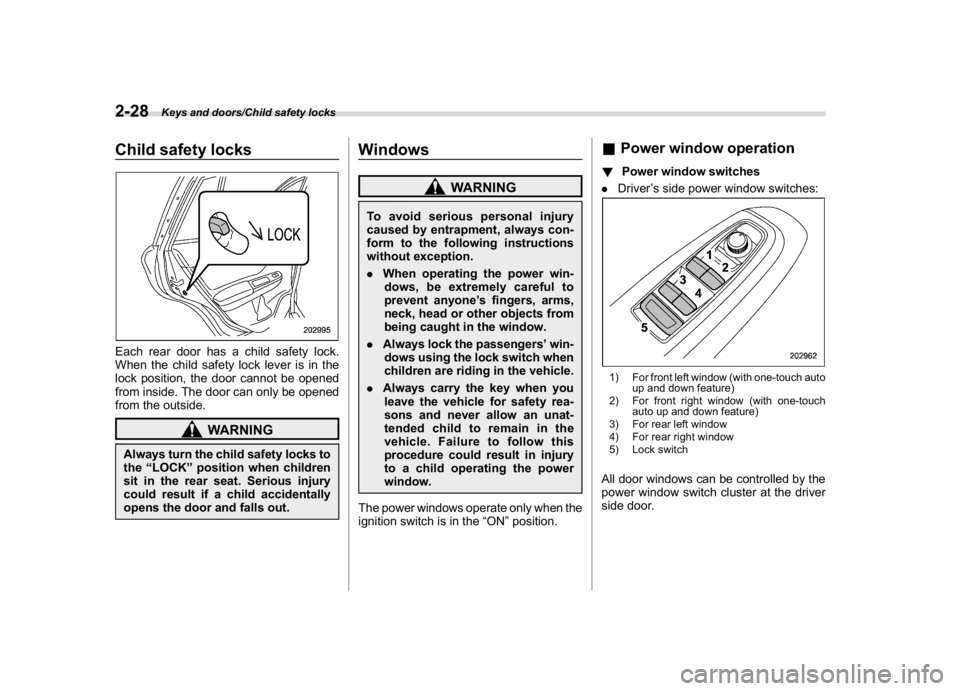
.Driver’s side power window switches:1) For front left window (with one-touch auto
up and down feature)
2) For front right window (with one-touch
auto up and down feature)
3) For rear left window
4) For rear right window
5) Lock switchAll door windows can be controlled by the
power window switch cluster at the driver
side door.
Keys and doors/Child safety locks
2-28
Page 224 of 474
(229,1)
北米Model "A1320BE-C" EDITED: 2017/ 10/ 10
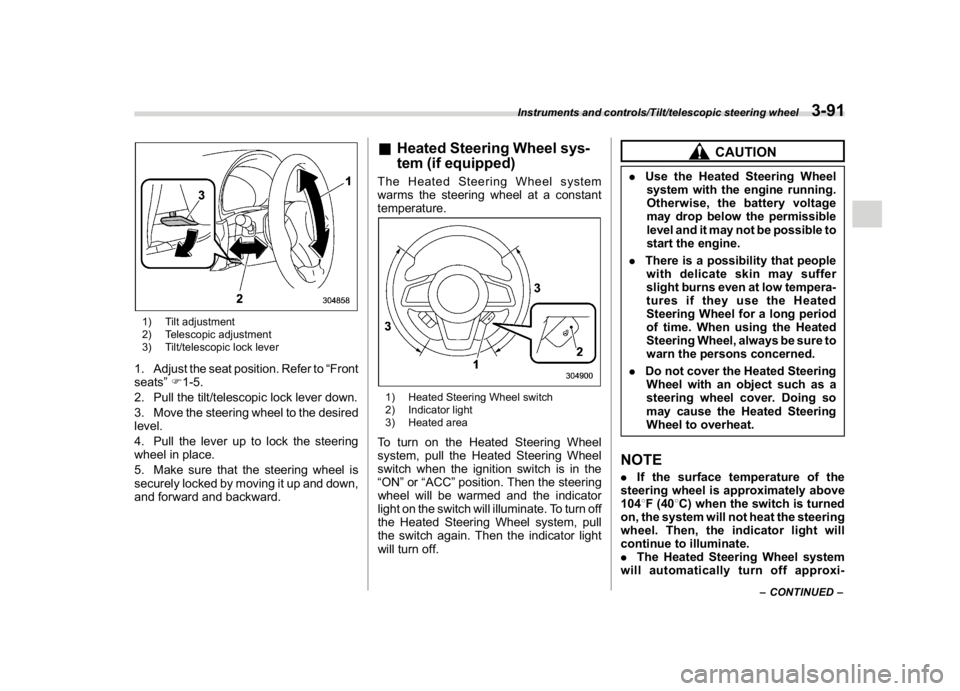
1) Tilt adjustment
2) Telescopic adjustment
3) Tilt/telescopic lock lever1. Adjust the seat position. Refer to“Front
seats”F1-5.
2. Pull the tilt/telescopic lock lever down.
3. Move the steering wheel to the desired
level.
4. Pull the lever up to lock the steering
wheel in place.
5. Make sure that the steering wheel is
securely locked by moving it up and down,
and forward and backward.
&Heated Steering Wheel sys-
tem (if equipped)The Heated Steering Wheel system
warms the steering wheel at a constant
temperature.1) Heated Steering Wheel switch
2) Indicator light
3) Heated areaTo turn on the Heated Steering Wheel
system, pull the Heated Steering Wheel
switch when the ignition switch is in the
“ON”or“ACC”position. Then the steering
wheel will be warmed and the indicator
light on the switch will illuminate. To turn off
the Heated Steering Wheel system, pull
the switch again. Then the indicator light
will turn off.
CAUTION
.Use the Heated Steering Wheel
system with the engine running.
Otherwise, the battery voltage
may drop below the permissible
level and it may not be possible to
start the engine.
.There is a possibility that people
with delicate skin may suffer
slight burns even at low tempera-
tures if they use the Heated
Steering Wheel for a long period
of time. When using the Heated
Steering Wheel, always be sure to
warn the persons concerned.
.Do not cover the Heated Steering
Wheel with an object such as a
steering wheel cover. Doing so
may cause the Heated Steering
Wheel to overheat.NOTE.If the surface temperature of the
steering wheel is approximately above
1048F (408C) when the switch is turned
on, the system will not heat the steering
wheel. Then, the indicator light will
continue to illuminate.
.The Heated Steering Wheel system
will automatically turn off approxi-
–CONTINUED–
Instruments and controls/Tilt/telescopic steering wheel
3-91
3
Page 448 of 474

(465,1)
北米Model "A1320BE-C" EDITED: 2017/ 10/ 10
crease in temperature could cause
tread separation, and failure of the
tire(s). Possible resulting loss of
vehicle control could lead to an
accident.!Measuring and adjusting air
pressure to achieve proper in-
flationCheck and, if necessary, adjust the
pressure of each tire (including the
spare) at least once a month and
before any long journey. Check the
tire pressures when the tires are
cold. Use a pressure gauge to
adjust the tire pressures to the
specific values. Driving even a short
distance warms up the tires and
increases the tire pressures. Also,
the tire pressures are affected by
the outside temperature. It is best to
check tire pressure outdoors before
driving the vehicle. When a tire
becomes warm, the air inside it
expands, causing the tire pressure
to increase. Be careful not to mis-
takenly release air from a warm tire
to reduce its pressure.
&Glossary of tire terminology.
Accessory weight
The combined weight (in excess of
those standard items which may be
replaced) of automatic transmis-
sion, power steering, power brakes,
power windows, power seats, radio,
and heater, to the extent that these
items are available as factory-in-
stalled equipment (whether in-
stalled or not)..
Bead
The part of the tire that is made of
steel wires, wrapped or reinforced
by ply cords and that is shaped to fit
the rim..
Bead separation
A breakdown of the bond between
components in the bead..
Bias ply tire
A pneumatic tire in which the ply
cords that extend to the beads are
laid at alternate angles substantially
less than 90 degrees to the center-
line of the tread..
Carcass
The tire structure, except tread andsidewall rubber which, when in-
flated, bears the load.
.
Chunking
The breaking away of pieces of the
tread or sidewall..
Cold tire pressure
The pressure in a tire that has been
driven less than 1 mile or has been
standing for three hours or more..
Cord
The strands forming the plies in the
tire..
Cord separation
The parting of cords from adjacent
rubber compounds..
Cracking
Any parting within the tread, side-
wall, or inner liner of the tire
extending to cord material..
Curb weight
The weight of a motor vehicle with
standard equipment including the
maximum capacity of fuel, oil and
coolant, and if so equipped, air
conditioning and additional weight
optional engine.
–CONTINUED–
Consumer information and Reporting safety defects/Tire information
13-5
13