2018 SUBARU CROSSTREK CVT fluid
[x] Cancel search: CVT fluidPage 134 of 474

(139,1)
北米Model "A1320BE-C" EDITED: 2017/ 10/ 10
Ignition switch (models without“keyless
access with push-button start system”) ............ 3-4
Key positions......................................................... 3-4
Key reminder chime............................................... 3-5
Ignition switch light (if equipped)........................... 3-5
Push-button ignition switch (models with
“keyless access with push-button start
system”) ............................................................... 3-6
Safety precautions................................................. 3-6
Operating range for push-button start system........ 3-6
Switching power status.......................................... 3-7
When access key fob does not operate properly.... 3-8
Hazard warning flasher..........................................3-8
Meters and gauges.................................................3-8
Speedometer......................................................... 3-8
Tachometer............................................................ 3-8
Odometer............................................................... 3-9
Double trip meter................................................... 3-9
Fuel gauge............................................................3-10
ECO gauge (if equipped).......................................3-10
Combination meter settings.................................. 3-11
Illumination brightness control............................3-12
Auto dimmer cancel function (if equipped)............3-12
Warning andindicator..........................................3-12
Initial illumination for system check......................3-12
Seatbelt warning light and chime..........................3-13
SRS airbag system warning light...........................3-15
Front passenger’s frontal airbag ON and OFF
indicators...........................................................3-15
CHECK ENGINE warning light/Malfunction
indicator light.....................................................3-15Coolant temperature low indicator light/Coolant
temperature high warning light..........................3-16
Charge warning light............................................3-17
Oil pressure warning light.....................................3-17
Engine low oil level warning light..........................3-18
Windshield washer fluid warning light...................3-18
AT OIL TEMP warning light (CVT models)..............3-18
Low tire pressure warning light
(U.S.-spec. models)............................................3-18
ABS warning light.................................................3-20
Brake system warning light (red)..........................3-21
Low fuel warning light..........................................3-22
Hill start assist warning light/Hill start assist
OFF indicator light.............................................3-22
Door open warning light.......................................3-22
All-Wheel Drive warning light (CVT models)..........3-22
Power steering warning light ................................3-23
Vehicle Dynamics Control warning light/Vehicle
Dynamics Control operation indicator light........3-23
Vehicle Dynamics Control OFF indicator light.......3-24
Warning chimes and warning indicator of the
keyless access with push-button start system
(if equipped)......................................................3-25
Security indicator light..........................................3-29
Select lever/gear position indicator
(CVT models).....................................................3-30
Turn signal indicator lights...................................3-30
High beam indicator light......................................3-30
High beam assist indicator light (green)
(if equipped)......................................................3-30
High beam assist warning indicator (yellow)
(if equipped)......................................................3-30
Instruments and controls
3
Page 146 of 474
(151,1)
北米Model "A1320BE-C" EDITED: 2017/ 10/ 10
: CHECK ENGINE warning light/Mal-
function indicator light: Coolant temperature low indicator
light/Coolant temperature high warn-
ing light: Charge warning light: Oil pressure warning light: Engine low oil level warning light: Windshield washer fluid warning light: AT OIL TEMP warning light
(CVT models): Low tire pressure warning light
(U.S.- spec. models)/
: ABS warning light
/
: Brake system warning light
: Low fuel warning light: Hill start assist warning light/Hill start
assist OFF indicator light: Door open warning light: AWD warning light (CVT models): Power steering warning light: Vehicle Dynamics Control warning light/
Vehicle Dynamics Control operation
indicator light
: Vehicle Dynamics Control OFF indicator
light: Automatic headlight beam leveler
warning light (models with LED head-
lights): Hill descent control indicator light (if
equipped)
If any lights fail to illuminate, it indicates a
burned-out bulb or a malfunction of the
corresponding system.
Consult your authorized SUBARU dealer
for repair.
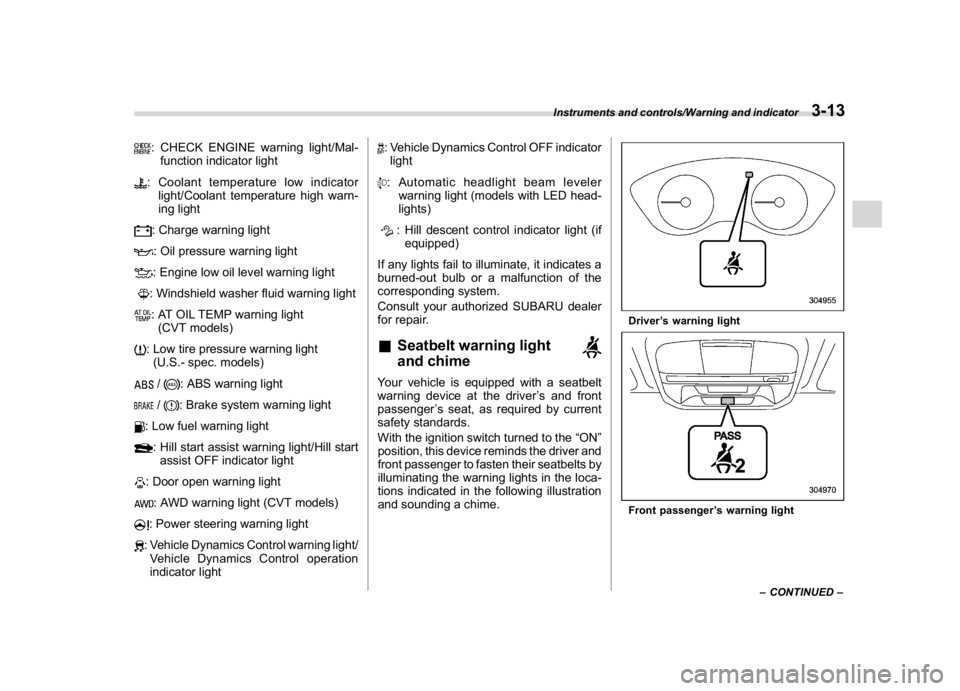
&Seatbelt warning light
and chimeYour vehicle is equipped with a seatbelt
warning device at the driver’s and front
passenger’s seat, as required by current
safety standards.
With the ignition switch turned to the“ON”
position, this device reminds the driver and
front passenger to fasten their seatbelts by
illuminating the warning lights in the loca-
tions indicated in the following illustration
and sounding a chime.
Driver’s warning lightFront passenger’s warning light
–CONTINUED–
Instruments and controls/Warning and indicator
3-13
3
Page 151 of 474

(156,1)
北米Model "A1320BE-C" EDITED: 2017/ 10/ 10
CAUTION
Do not operate the engine with the
oil pressure warning light illumi-
nated. This may cause serious en-
gine damage.&Engine low oil level
warning lightThis light illuminates when the engine oil
level decreases to the lower limit.
If the engine low oil level warning light
illuminates while driving, park the vehicle
in a safe and level location, and then check
the engine oil level. When the engine oil
level is not within the normal range, refill
with engine oil. Refer to“Engine oil”F11 -
8.
If the warning light does not turn off after
refilling the engine oil, or the warning light
illuminates even though the engine oil
level is within the normal range, have the
vehicle checked by a SUBARU dealer.
NOTE.The warning light may stay illumi-
nated when the engine is started
straight after topping up or changing
the engine oil. In such cases, park the
vehicle on a level surface and wait for
more than a minute until the oil level
settles, after which the warning light
will turn off.
.The warning light may illuminate
temporarily in the following conditions
because a low oil level may be detected
as a result of significant oil movement
in the engine.
–when the vehicle is considerably
inclined on an uphill or steep slope
–when the vehicle has continu-
ously accelerated and decelerated
–when the vehicle is continuously
turned
–when the vehicle is driven on a
road that alternates continuously
between uphill and downhill&Windshield washer
fluid warning lightThis light illuminates when the fluid level in
the windshield washer fluid tank de-
creases to the lower limit (approximately
0.6 US qt, 0.6 liter, 0.5 Imp qt).
&AT OIL TEMP warning
light (CVT models)If this light illuminates when the engine is
running, it may indicate that the transmis-
sion fluid temperature is too hot.
If the light illuminates while driving, im-
mediately stop the vehicle in a safe place
and let the engine idle until the warning
light turns off.
!Transmission control system warn-
ing
If the“AT OIL TEMP”warning light flashes
after the engine has started, it may indicate
that the transmission control system is not
working properly. Contact your nearest
SUBARU dealer for service immediately.&Low tire pressure
warning light (U.S.-spec.
models)When the ignition switch is turned to the
“ON”position, the low tire pressure warn-
ing light will illuminate for approximately 2
seconds to check that the tire pressure
monitoring system (TPMS) is functioning
properly. If there is no problem and all tires
are properly inflated, the light will turn off.
Each tire, including the spare (if provided),
should be checked monthly when cold and
Instruments and controls/Warning and indicator
3-18
Page 212 of 474
(217,1)
北米Model "A1320BE-C" EDITED: 2017/ 10/ 10
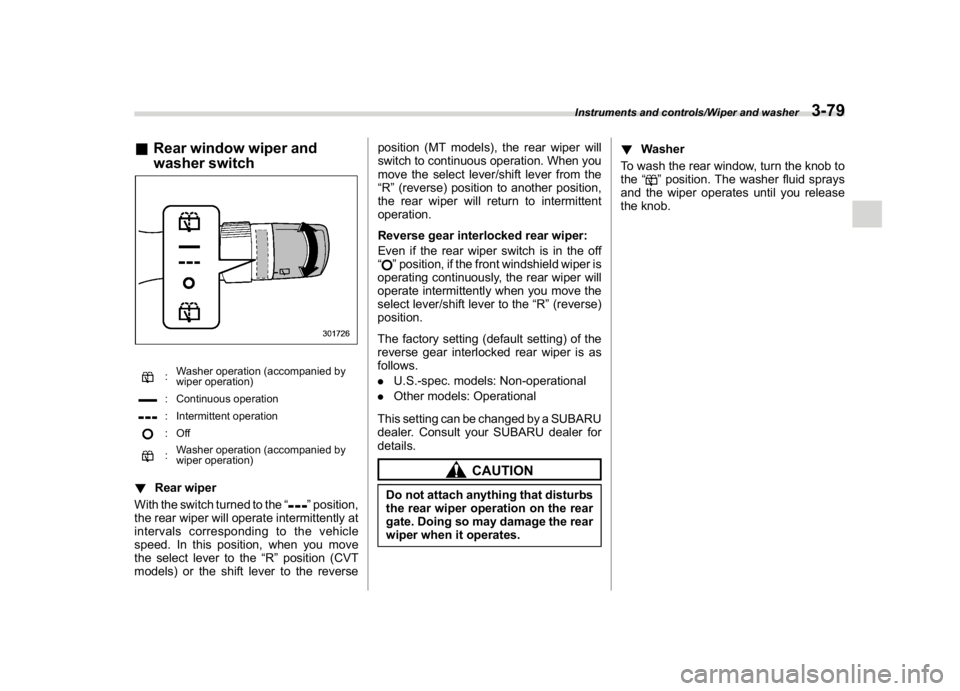
&Rear window wiper and
washer switch
:Washer operation (accompanied by
wiper operation): Continuous operation: Intermittent operation:Off:Washer operation (accompanied by
wiper operation)
!Rear wiper
With the switch turned to the“
”position,
the rear wiper will operate intermittently at
intervals corresponding to the vehicle
speed. In this position, when you move
the select lever to the“R”position (CVT
models) or the shift lever to the reverseposition (MT models), the rear wiper will
switch to continuous operation. When you
move the select lever/shift lever from the
“R”(reverse) position to another position,
the rear wiper will return to intermittent
operation.
Reverse gear interlocked rear wiper:
Even if the rear wiper switch is in the off
“
”position, if the front windshield wiper is
operating continuously, the rear wiper will
operate intermittently when you move the
select lever/shift lever to the“R”(reverse)
position.
The factory setting (default setting) of the
reverse gear interlocked rear wiper is as
follows.
.U.S.-spec. models: Non-operational
.Other models: Operational
This setting can be changed by a SUBARU
dealer. Consult your SUBARU dealer for
details.
CAUTION
Do not attach anything that disturbs
the rear wiper operation on the rear
gate. Doing so may damage the rear
wiper when it operates.!Washer
To wash the rear window, turn the knob to
the“
”position. The washer fluid sprays
and the wiper operates until you release
the knob.
Instruments and controls/Wiper and washer
3-79
3
Page 281 of 474

(290,1)
北米Model "A1320BE-C" EDITED: 2017/ 10/ 10
Continuously variable trans-
mission
WARNING
Do not shift from the“P”or“N”
position into the“D”or“R”position
while depressing the accelerator
pedal. This may cause the vehicle
to jump forward or backward.
CAUTION
.Shift into the“P”or“R”position
only after the vehicle is comple-
tely stopped. Shifting while the
vehicle is moving may cause
damage to the transmission.
.Do not race the engine for more
than 5 seconds in any position
except the“N”or“P”position
when the brake is applied or
when chocks are used in the
wheels. This may cause the
transmission fluid to overheat.
.Never move the vehicle rearward
by inertia with the select lever set
in a forward driving position or
move the vehicle forward by
inertia with the select lever setin the“R”position. Doing so may
result in an unexpected accident
or malfunction.
.Do not shift from the“D”position
into the“R”position or vice versa
until the vehicle has completely
stopped. Such shifting may
cause damage to the transmis-
sion.
.When parking the vehicle, first
securely apply the parking brake
and then place the select lever in
the“P”position. Do not park for a
long time with the select lever in
any other position as doing so
could result in a dead battery.
&Continuously variable trans-
mission featuresThe continuously variable transmission is
electronically controlled and provides an
infinite number of forward speeds and 1
reverse speed. For some models, it also
has a manual mode or an“L”position.NOTE.When the engine coolant tempera-
ture is still low, the transmission will
upshift or downshift at higher engine
speeds than when the coolant tempera-
ture is sufficiently high in order toshorten the warm-up time and improve
driveability. The gearshift timing will
automatically shift to the normal timing
after the engine has warmed up.
.Immediately after transmission fluid
is replaced, you may feel that the
transmission operation is somewhat
unusual. This results from invalidation
of data which the on-board computer
has collected and stored in memory to
allow the transmission to shift at the
most appropriate times for the current
condition of your vehicle. Optimized
shifting will be restored as the vehicle
continues to be driven for a while.
.When driving a CVT model under
continuous heavy load conditions such
as when towing a camper or climbing a
long, steep hill, the engine speed or the
vehicle speed may automatically be
reduced. This is not a malfunction. This
phenomenon results from the engine
control function maintaining the cool-
ing performance of the vehicle. The
engine and vehicle speed will return to
a normal speed when the engine is able
to maintain the optimum cooling per-
formance after the heavy load de-
creases. Driving under a heavy load
must be performed with extreme care.
Do not try to pass a vehicle in front
when driving on an uphill slope while
towing.
Starting and operating/Continuously variable transmission
7-24
Page 334 of 474

(345,1)
北米Model "A1320BE-C" EDITED: 2017/ 10/ 10
stops. This could create a fire hazard.
Precautions when driving under espe-
cially dangerous situations:
.If driving through water, such as when
crossing shallow streams, first check the
depth of the water and the bottom of the
stream bed for firmness and ensure that
the bed of the stream is flat. Drive slowly
and cross the stream without stopping.
The water should be shallow enough that it
does not reach the vehicle’s undercar-
riage. Water entering the engine air intake
or the exhaust pipe or water splashing onto
electrical parts may damage your vehicle
and may cause it to stall. Never attempt to
drive through rushing water; regardless of
its depth, it can wash away the ground
from under your tires, resulting in possible
loss of traction and even vehicle rollover.
.If you must rock the vehicle to free it
from sand or mud, depress the accelerator
pedal slightly and move the shift lever/
select lever back and forth between“1”/“D”
and“R”repeatedly. Do not race the
engine. For the best possible traction,
avoid spinning the wheels when trying to
free the vehicle.
.When the road surface is extremely
slippery, you can obtain better traction by
starting the vehicle with the transmission in
2nd than 1st (both for MT and CVT). For
CVT models, refer to“Selection of manualmode”F7-26.
&After driving.Always check your brakes for effective-
ness immediately after driving in sand,
mud or water. Do this by driving slowly and
stepping on the brake pedal. Repeat that
process several times to dry out the brake
discs and brake pads.
.After driving through tall grass, mud,
rocks, sand, rivers, etc., check that there is
no grass, bush, paper, rags, stones, sand,
etc. adhering to or trapped on the under-
body. Clear off any such matter from the
underbody. If the vehicle is used with these
materials trapped or adhering to the
underbody, a mechanical breakdown or
fire could occur.
.Wash the vehicle’s underbody after off-
road driving. Suspension components are
particularly prone to dirt buildup, so they
need to be washed thoroughly.
Winter driving&Operation during cold weath-
er!Maintenance
Carry some emergency equipment, such
as a window scraper, a bag of sand, flares,
a small shovel and jumper cables.
Check the battery and cables. Cold tem-
peratures reduce battery capacity. The
battery must be in good condition to
provide enough power for cold winter
starts.
It normally takes longer to start the engine
in very cold weather conditions. Use an
engine oil of a proper grade and viscosity
for cold weather. Using heavy summer oil
will make it harder to start the engine.
Keep the door locks from freezing by
squirting them with deicer or glycerin.
Forcing a frozen door open may damage
or separate the rubber weather strips
around the door. If the door is frozen, use
hot water to melt the ice, and afterwards
thoroughly wipe the water away.
Use a windshield washer fluid that con-
tains an antifreeze solution. Do not use
engine antifreeze or other substitutes
because they may damage the paint of
–CONTINUED–
Driving tips/Winter driving
8-7
8
Page 351 of 474
(362,1)
北米Model "A1320BE-C" EDITED: 2017/ 10/ 10
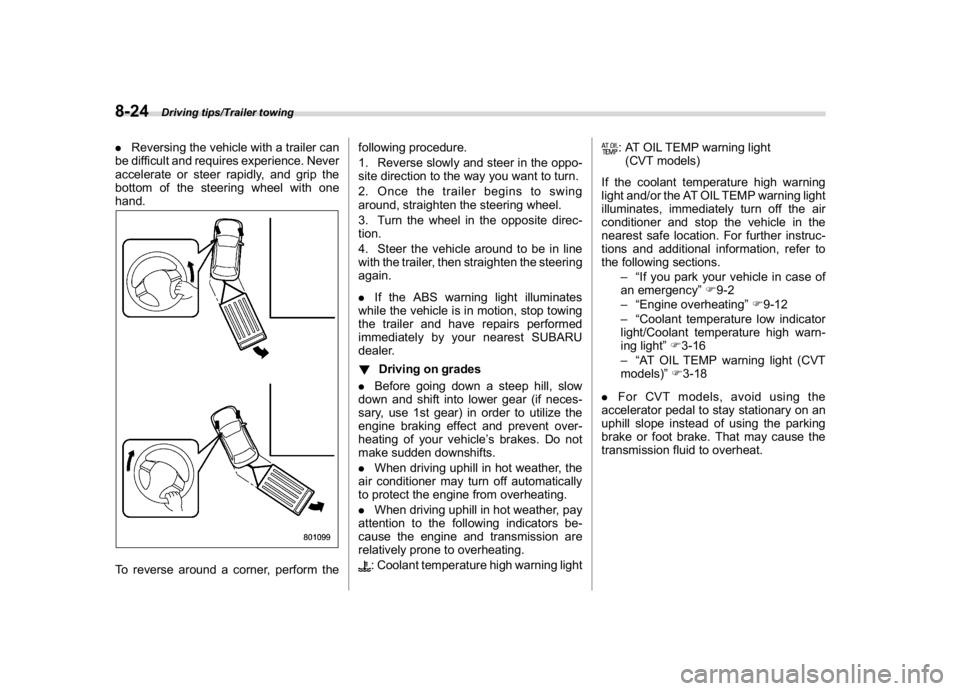
.Reversing the vehicle with a trailer can
be difficult and requires experience. Never
accelerate or steer rapidly, and grip the
bottom of the steering wheel with one
hand.To reverse around a corner, perform thefollowing procedure.
1. Reverse slowly and steer in the oppo-
site direction to the way you want to turn.
2. Once the trailer begins to swing
around, straighten the steering wheel.
3. Turn the wheel in the opposite direc-
tion.
4. Steer the vehicle around to be in line
with the trailer, then straighten the steering
again.
.If the ABS warning light illuminates
while the vehicle is in motion, stop towing
the trailer and have repairs performed
immediately by your nearest SUBARU
dealer.
!Driving on grades
.Before going down a steep hill, slow
down and shift into lower gear (if neces-
sary, use 1st gear) in order to utilize the
engine braking effect and prevent over-
heating of your vehicle’s brakes. Do not
make sudden downshifts.
.When driving uphill in hot weather, the
air conditioner may turn off automatically
to protect the engine from overheating.
.When driving uphill in hot weather, pay
attention to the following indicators be-
cause the engine and transmission are
relatively prone to overheating.
: Coolant temperature high warning light
: AT OIL TEMP warning light
(CVT models)
If the coolant temperature high warning
light and/or the AT OIL TEMP warning light
illuminates, immediately turn off the air
conditioner and stop the vehicle in the
nearest safe location. For further instruc-
tions and additional information, refer to
the following sections.
–“If you park your vehicle in case of
an emergency”F9-2
–“Engine overheating”F9-12
–“Coolant temperature low indicator
light/Coolant temperature high warn-
ing light”F3-16
–“AT OIL TEMP warning light (CVT
models)”F3-18
.For CVT models, avoid using the
accelerator pedal to stay stationary on an
uphill slope instead of using the parking
brake or foot brake. That may cause the
transmission fluid to overheat.
Driving tips/Trailer towing
8-24
Page 382 of 474

(395,1)
北米Model "A1320BE-C" EDITED: 2017/ 10/ 10
Maintenance schedule.......................................... 11-3
Maintenance precautions..................................... 11-3
Before checking or servicing in the engine
compartment...................................................... 11-4
When checking or servicing in the engine
compartment...................................................... 11-4
When checking or servicing in the engine
compartment while the engine is running............ 11-5
Engine hood.......................................................... 11-5
Engine compartment overview............................ 11-7
Engine oil............................................................... 11-8
Engine oil consumption........................................ 11-8
Locations of the oil level gauge, oil filler cap
and oil filter........................................................ 11-8
Checking the oil level............................................ 11-8
Changing the oil and oil filter................................ 11-9
Recommended grade and viscosity..................... 11-10
Synthetic oil........................................................ 11-10
Cooling system................................................... 11-10
Safety precautions.............................................. 11-10
Cooling fan, hose and connections..................... 11-11
Engine coolant.................................................... 11-11
Air cleaner element............................................. 11-12
Replacing the air cleaner element........................ 11-13
Spark plugs......................................................... 11-14
Recommended spark plugs................................. 11-14
Drive belts........................................................... 11-14
Manual transmission oil..................................... 11-14
Recommended grade and viscosity..................... 11-14
Continuously variable transmission fluid..........11-15
Front differential gear oil (CVT models) and
rear differential gear oil....................................11-15
Recommended grade and viscosity..................... 11-15
Brake fluid............................................................11-15
Checking the fluid level...................................... 11-15
Recommended brake fluid.................................. 11-16
Clutch fluid (MT models).....................................11-16
Checking the fluid level...................................... 11-16
Recommended clutch fluid................................. 11-17
Brake booster......................................................11-17
Brake pedal..........................................................11-18
Checking the brake pedal free play..................... 11-18
Checking the brake pedal reserve distance ......... 11-18
Clutch pedal (MT models)...................................11-18
Checking the clutch function .............................. 11-18
Checking the clutch pedal free play.................... 11-19
Hill start assist system.......................................11-19
Replacement of brake pad andlining................11-19
Breaking-in of new brake pads and linings .......... 11-20
Parking brake stroke...........................................11-20
Tires and wheels.................................................11-21
Types of tires..................................................... 11-21
Tire pressure monitoring system (TPMS)
(if equipped).................................................... 11-21
Tire inspection.................................................... 11-22
Tire pressures and wear..................................... 11-23
Wheel balance.................................................... 11-24
Wear indicators.................................................. 11-25
Maintenance and service
11