2018 SUBARU CROSSTREK stop start
[x] Cancel search: stop startPage 324 of 474
(333,1)
北米Model "A1320BE-C" EDITED: 2017/ 10/ 10
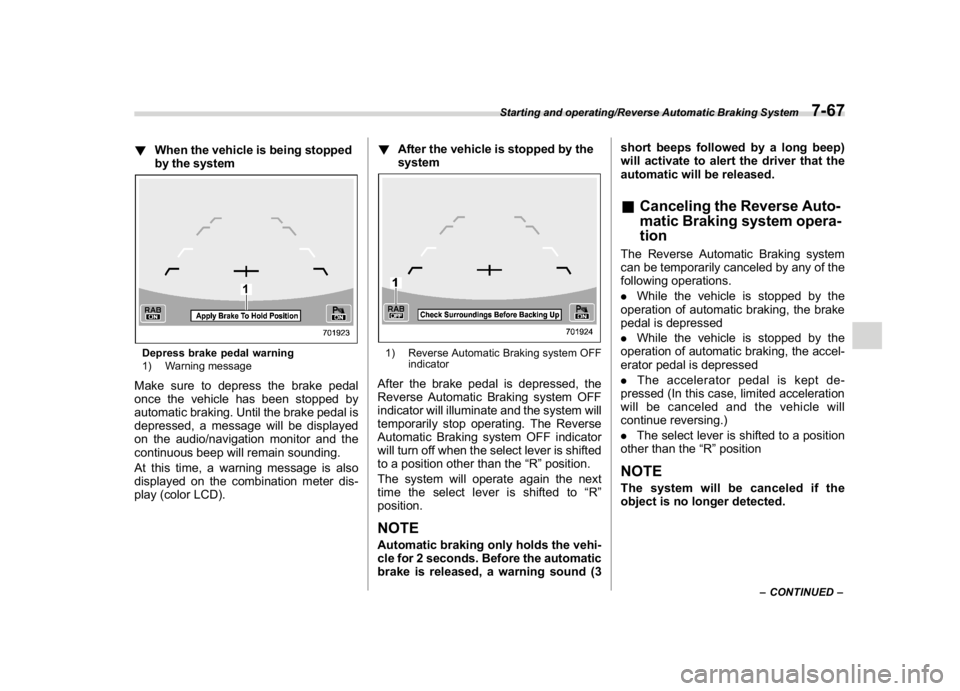
!When the vehicle is being stopped
by the systemDepress brake pedal warning
1) Warning messageMake sure to depress the brake pedal
once the vehicle has been stopped by
automatic braking. Until the brake pedal is
depressed, a message will be displayed
on the audio/navigation monitor and the
continuous beep will remain sounding.
At this time, a warning message is also
displayed on the combination meter dis-
play (color LCD).!After the vehicle is stopped by the
system
1) Reverse Automatic Braking system OFF
indicatorAfter the brake pedal is depressed, the
Reverse Automatic Braking system OFF
indicator will illuminate and the system will
temporarily stop operating. The Reverse
Automatic Braking system OFF indicator
will turn off when the select lever is shifted
to a position other than the“R”position.
The system will operate again the next
time the select lever is shifted to“R”
position.NOTEAutomatic braking only holds the vehi-
cle for 2 seconds. Before the automatic
brake is released, a warning sound (3short beeps followed by a long beep)
will activate to alert the driver that the
automatic will be released.
&Canceling the Reverse Auto-
matic Braking system opera-
tionThe Reverse Automatic Braking system
can be temporarily canceled by any of the
following operations.
.While the vehicle is stopped by the
operation of automatic braking, the brake
pedal is depressed
.While the vehicle is stopped by the
operation of automatic braking, the accel-
erator pedal is depressed
.The accelerator pedal is kept de-
pressed (In this case, limited acceleration
will be canceled and the vehicle will
continue reversing.)
.The select lever is shifted to a position
other than the“R”positionNOTEThe system will be canceled if the
object is no longer detected.
–CONTINUED–
Starting and operating/Reverse Automatic Braking System
7-67
7
Page 334 of 474

(345,1)
北米Model "A1320BE-C" EDITED: 2017/ 10/ 10
stops. This could create a fire hazard.
Precautions when driving under espe-
cially dangerous situations:
.If driving through water, such as when
crossing shallow streams, first check the
depth of the water and the bottom of the
stream bed for firmness and ensure that
the bed of the stream is flat. Drive slowly
and cross the stream without stopping.
The water should be shallow enough that it
does not reach the vehicle’s undercar-
riage. Water entering the engine air intake
or the exhaust pipe or water splashing onto
electrical parts may damage your vehicle
and may cause it to stall. Never attempt to
drive through rushing water; regardless of
its depth, it can wash away the ground
from under your tires, resulting in possible
loss of traction and even vehicle rollover.
.If you must rock the vehicle to free it
from sand or mud, depress the accelerator
pedal slightly and move the shift lever/
select lever back and forth between“1”/“D”
and“R”repeatedly. Do not race the
engine. For the best possible traction,
avoid spinning the wheels when trying to
free the vehicle.
.When the road surface is extremely
slippery, you can obtain better traction by
starting the vehicle with the transmission in
2nd than 1st (both for MT and CVT). For
CVT models, refer to“Selection of manualmode”F7-26.
&After driving.Always check your brakes for effective-
ness immediately after driving in sand,
mud or water. Do this by driving slowly and
stepping on the brake pedal. Repeat that
process several times to dry out the brake
discs and brake pads.
.After driving through tall grass, mud,
rocks, sand, rivers, etc., check that there is
no grass, bush, paper, rags, stones, sand,
etc. adhering to or trapped on the under-
body. Clear off any such matter from the
underbody. If the vehicle is used with these
materials trapped or adhering to the
underbody, a mechanical breakdown or
fire could occur.
.Wash the vehicle’s underbody after off-
road driving. Suspension components are
particularly prone to dirt buildup, so they
need to be washed thoroughly.
Winter driving&Operation during cold weath-
er!Maintenance
Carry some emergency equipment, such
as a window scraper, a bag of sand, flares,
a small shovel and jumper cables.
Check the battery and cables. Cold tem-
peratures reduce battery capacity. The
battery must be in good condition to
provide enough power for cold winter
starts.
It normally takes longer to start the engine
in very cold weather conditions. Use an
engine oil of a proper grade and viscosity
for cold weather. Using heavy summer oil
will make it harder to start the engine.
Keep the door locks from freezing by
squirting them with deicer or glycerin.
Forcing a frozen door open may damage
or separate the rubber weather strips
around the door. If the door is frozen, use
hot water to melt the ice, and afterwards
thoroughly wipe the water away.
Use a windshield washer fluid that con-
tains an antifreeze solution. Do not use
engine antifreeze or other substitutes
because they may damage the paint of
–CONTINUED–
Driving tips/Winter driving
8-7
8
Page 337 of 474
(348,1)
北米Model "A1320BE-C" EDITED: 2017/ 10/ 10
use the rear window defogger. Refer to
“Defogger and deicer”F3-89.
When driving in snow, if frozen snow starts
to stick on the surface of the windshield
despite wiper operation, use the defroster
with the airflow selection in“
”and the
temperature set for maximum warmth.
After the windshield gets warmed enough
to melt the frozen snow on it, wash it away
using the windshield washer. Refer to
“Windshield washer”F3-78.
Snow stuck on the wiper arm prevents the
wiper from working effectively. If snow is
stuck on the wiper arm, pull off the road to
a safe place, then remove it. If you stop the
vehicle at road side, use the hazard
warning flasher to alert other drivers. Refer
to“Hazard warning flasher”F3-8.
&Corrosion protectionRefer to“Corrosion protection”F10-4.&Snow tires
WARNING
.When replacing or installing win-
ter tire(s), all four tires must be
the same for following items.
(a) Size(b) Circumference
(c) Speed symbol
(d) Load index
(e) Construction
(f) Manufacturer
(g) Brand (tread pattern)
(h) Degrees of wear
For the items (a) to (d), you must
obey the specification that is
printed on the tire placard. The
tire placard is located on the
driver’s door pillar.
If all of four winter tires are not
the same for items (a) to (h),
serious mechanical damage
could occur to the drive train of
your car, and affect the following.
—Ride
—Handling
—Braking
—Speedometer/Odometer
calibration
—Clearance between the body
and tires
It also may be dangerous and
lead to loss of vehicle control,
and it can lead to an accident.
.Do not use a combination ofradial, belted bias or bias tires
since it may cause dangerous
handling characteristics and lead
to an accident.
Your vehicle is equipped with“all season
tires”as original equipment, which are
designed to provide an adequate measure
of traction, handling and braking perfor-
mance in year-round driving. In winter, it
may be possible to enhance performance
through use of tires designed specifically
for winter driving conditions.
When you choose to install winter tires on
your vehicle, be sure to use the correct tire
size and type. You must install four winter
tires that are of the same size, construc-
tion, brand and load range and you should
never mix radial, belted bias or bias tires
since this may result in dangerous hand-
ling characteristics. When you choose a
tire, make sure that there is enough
clearance between the tire and vehicle
body.
Remember to drive with care at all times
regardless of the type of tires on your
vehicle.
Driving tips/Winter driving
8-10
Page 338 of 474
(349,1)
北米Model "A1320BE-C" EDITED: 2017/ 10/ 10
&Tire chains
CAUTION
Tire chains cannot be used on your
vehicle because of the lack of clear-
ance between the tires and vehicle
body.NOTEWhen tire chains cannot be used, use of
another type of traction device (such as
spring chains) may be acceptable if use
on your vehicle is recommended by the
device manufacturer, taking into ac-
count tire size and road conditions.
Follow the device manufacturer’s in-
structions, especially regarding max-
imum vehicle speed.
To help avoid damage to your vehicle,
drive slowly, readjust or remove the
device if it is contacting your vehicle,
and do not spin your wheels. Damage
caused to your vehicle by use of a
traction device is not covered under
warranty.
Make certain that any traction device
you use is an SAE class S device, and
use it on the front wheels only. Always
use the utmost care when driving with a
traction device. Overconfidence be-cause you are using a traction device
could easily lead to a serious accident.
&Rocking the vehicleIf you must rock the vehicle to free it from
snow, sand, or mud, depress the accel-
erator pedal slightly and move the shift
lever/select lever back and forth between
“1”/“D”and“R”repeatedly. Do not race the
engine. For the best possible traction,
avoid spinning the wheels when trying to
free the vehicle.
When the road surface is extremely
slippery, you can obtain better traction by
starting the vehicle with the transmission in
2nd than 1st (both for MT and CVT
models).
If your vehicle is a CVT model, for
information about holding the transmission
in the 2nd position, refer to“Selection of
manual mode”F7-26.
Loading your vehicle
WARNING
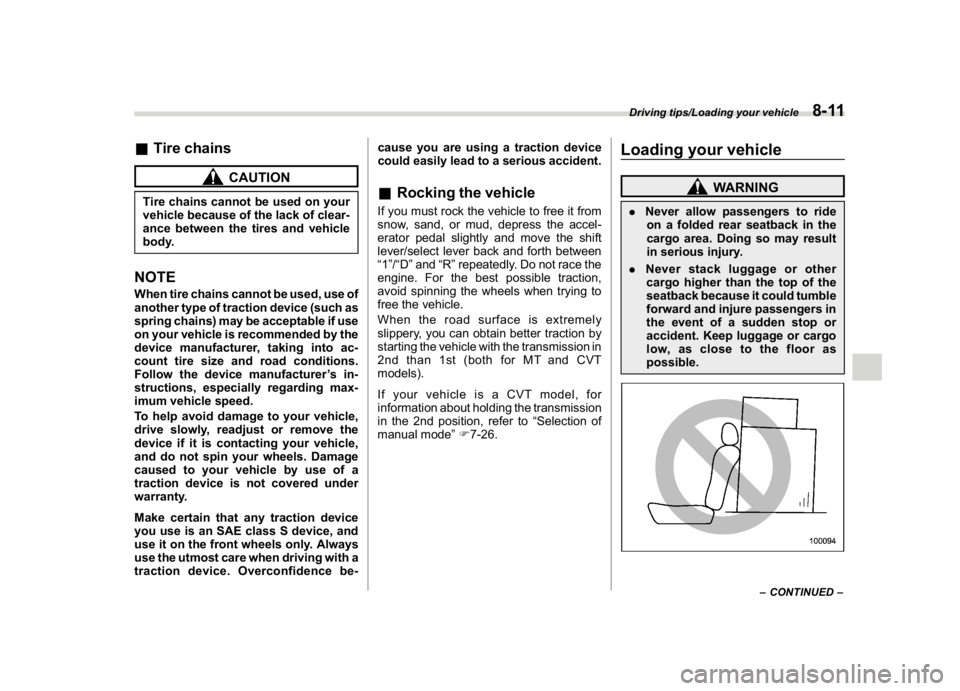
.Never allow passengers to ride
on a folded rear seatback in the
cargo area. Doing so may result
in serious injury.
.Never stack luggage or other
cargo higher than the top of the
seatback because it could tumble
forward and injure passengers in
the event of a sudden stop or
accident. Keep luggage or cargo
low, as close to the floor as
possible.
–CONTINUED–
Driving tips/Loading your vehicle
8-11
8
Page 341 of 474
(352,1)
北米Model "A1320BE-C" EDITED: 2017/ 10/ 10
does not exceed 150 lbs (68 kg).
Overloading may cause damage
to the vehicle.
.For cargo carrying purposes, the
roof rails must be used together
with the crossbars and any ap-
propriate carrying attachment
that may be needed. The roof
rails must never be used alone
to carry cargo. Otherwise, da-
mage to the roof or paint, or a
dangerous road hazard due to
loss of cargo could result.
NOTERemember that the vehicle’s center of
gravity is altered with the weight of the
load on the roof, thus affecting driving
characteristics.
Drive carefully. Avoid rapid starts, hard
cornering and abrupt stops. Crosswind
effects will be increased.
Trailer hitch (dealer option)
WARNING
.Never exceed the maximum
weight specified for the trailer
hitch. Exceeding the maximum
weight could cause an accident
resulting in serious personal in-
juries. Permissible trailer weight
changes depending on the situa-
tion. For possible recommenda-
tions and limitations, refer to
“Trailer towing”F8-16.
.Trailer brakes are required when
the towing load exceeds 1,000 lbs
(453 kg). Be sure your trailer has
safety chains and that each chain
will hold the trailer’s maximum
gross weight. Towing trailers
without safety chains could cre-
ate a traffic safety hazard if the
trailer separates from the hitch
due to coupling damage or hitch
ball damage.
.Be sure to check the hitch pin and
safety pin for positive locking
placement before towing a trailer.
If the ball mount comes off the
hitch receiver, the trailer could
get loose and create a trafficsafety hazard.
.Although towing regulations for
trailer or caravan vehicles vary
by state/region, all regulations
agree that specifications such
as the maximum gross trailer
weight must not exceed the les-
ser of the following:
–Maximum gross trailer weight
–Maximum gross tongue
weight
–GVWR
–GAWR
.Failure to comply with the proce-
dures set forth will not only
compromise your safety, but will
also negate your insurance cov-
erage and/or may violate the state
road and traffic acts and regula-
tions.
.Use only the ball mount supplied
with this hitch. Use the hitch only
as a weight carrying hitch. Do not
use with any type of weight dis-
tributing hitch.
.The standard bumper beam must
be installed after you remove the
trailer hitch. Consult a SUBARU
dealer for purchase of a standard
bumper beam if you do not have
Driving tips/Trailer hitch (dealer option)
8-14
Page 350 of 474

(361,1)
北米Model "A1320BE-C" EDITED: 2017/ 10/ 10
when towing a trailer in hilly
country on hot days.
.When towing a trailer, steering,
stability, stopping distance and
braking performance will be dif-
ferent when compared to normal
operation. For safety’s sake, you
should employ extra caution
when towing a trailer and you
should never drive at excessive
speeds. You should also keep the
following tips in mind:
.The braking power of the parking
brake may not be sufficient when
stronger braking power is
needed (e.g., when parking on a
steep slope while towing a trai-
ler).
!Before starting out on a trip
.Check the towing regulations for trailer
or caravan vehicles that vary by state/
region. Failure to comply with the proce-
dures set forth will not only compromise
your safety, but will also negate your
insurance coverage and/or may violate
the state road and traffic acts and regula-
tions.
.Check that the vehicle and vehicle-to-
hitch mounting are in good condition. If any
problems are apparent, do not tow thetrailer.
.Check that the vehicle rests horizon-
tally with the trailer attached. If the vehicle
is tipped sharply up at the front and down
at the rear, check the total trailer weight,
GVW, GAWs and tongue load again, then
confirm that the load and its distribution are
acceptable.
.Check that the tire rating and pressures
are correct.
.Check that the vehicle and trailer are
connected properly. Confirm that:
–the trailer tongue is connected
properly to the hitch ball.
–the trailer lights connector is con-
nected properly and trailer’sbrake
lights illuminate when the vehicle’s
brake pedal is pressed, and that the
trailer’s turn signal lights flash when
the vehicle’s turn signal lever is oper-
ated.
–the safety chains are connected
properly.
–all cargo in the trailer is secured
safely in position.
–the side mirrors provide a good
rearward field of view without a sig-
nificant blind spot.
.Sufficient time should be taken to learn
the“feel”of the vehicle/trailer combination
before starting out on a trip. In an area free
of traffic, practice turning, stopping andbacking up.
!Driving with a trailer
.You should allow for considerably more
stopping distance when towing a trailer.
Avoid sudden braking because it may
result in skidding or jackknifing and loss
of control.
.Avoid abrupt starts and sudden accel-
erations. If your vehicle has a manual
transmission, always start out in first gear
and release the clutch at moderate engine
revolution.
.Avoid uneven steering, sharp turns and
rapid lane changes.
.Slow down before turning. Make a
longer than normal turning radius because
the trailer wheels will be closer than the
vehicle wheels to the inside of the turn. In a
tight turn, the trailer could hit your vehicle.
.Crosswinds will adversely affect the
handling of your vehicle and trailer, caus-
ingsway.Crosswindscanbedueto
weather conditions or the passing of large
trucks or buses. If swaying occurs, firmly
grip the steering wheel and promptly begin
decelerating your vehicle at a gradual
pace.
.When passing other vehicles, consider-
able distance is required because of the
added weight and length caused by
attaching the trailer to your vehicle.
–CONTINUED–
Driving tips/Trailer towing
8-23
8
Page 373 of 474

(384,1)
北米Model "A1320BE-C" EDITED: 2017/ 10/ 10
If your vehicle is involved in
an accident
CAUTION
If your vehicle is involved in an
accident, be sure to inspect the
ground under the vehicle before
restarting the engine. If you find that
fuel has leaked on the ground, do
not try to restart the engine. The fuel
system has been damaged and is in
need of repair. Immediately contact
the nearest automotive service facil-
ity. We recommend that you consult
your SUBARU dealer.
Your vehicle has a fuel pump shut off
system. When the vehicle sustains an
impact in an accident, etc., the fuel pump
shut off system stops supplying the fuel in
order to minimize fuel leakage. However,
depending on the impact conditions at the
time of collision, the fuel pump shut-off
system may not operate.
Perform the following procedures to restart
the engine after the system is activated.Models without“keyless access with
push-button start system”:
1. Turn the ignition switch to the“LOCK”
or“ACC”position.
2. Restart the engine.
Models with“keyless access with
push-button start system”:
1. Turn the push-button ignition switch to
the“ACC”or“OFF”position.
2. Restart the engine.
In case of emergency/If your vehicle is involved in an accident
9-20
Page 385 of 474

(398,1)
北米Model "A1320BE-C" EDITED: 2017/ 10/ 10
erative. NEVER use a circuit tes-
ter for this wiring. If your SRS
airbag or seatbelt pretensioner
needs service, consult your near-
est SUBARU dealer.
NOTESUBARU does not endorse the use of
non-SUBARU approved flushing sys-
tems and strongly advises against
performing these services on a
SUBARU vehicle. Non-SUBARU ap-
proved flushing systems use chemi-
cals and/or solvents which have not
been tested or approved by SUBARU.
SUBARU warranties do not cover any
part of the vehicle which is damaged by
adding or applying chemicals and/or
solvents other than those approved or
recommended by SUBARU.&Before checking or servicing
in the engine compartment
WARNING
.Always stop the engine and apply
the parking brake firmly to pre-
vent the vehicle from moving.
.Always let the engine cool down.
Engine parts become very hotwhen the engine is running and
remain hot for some time after the
engine has stopped.
.Do not spill engine oil, engine
coolant, brake fluid or any other
fluid on hot engine components.
This may cause a fire.
.When the ignition switch is in the
“ON”position, the cooling fan
may operate suddenly even when
the engine is stopped. If your
body or clothes come into con-
tact with a rotating fan, that could
result in serious injury. To avoid
risk of injury, perform the follow-
ing precautions.
–Models with push-button start
system:
Always turn the push-button
ignition switch to the“OFF”
position and confirm that the
operation indicator on the
switch is turned off. Then take
the access key fob out from
the vehicle.
–Models without push-button
start system:
Always remove the key from
the ignition switch.
.Before performing any servicing
on a vehicle equipped with aremote engine start system (a
dealer option), temporarily place
the remote engine start system in
service mode to prevent it from
unexpectedly starting the engine.
&When checking or servicing
in the engine compartment
CAUTION
.Do not contact the drive belt
cover while checking the compo-
nents in the engine compartment.
Doing so may cause your hand to
slip off the cover and result in an
unexpected injury.
.Do not touch the oil filter until the
Maintenance and service/Maintenance precautions
11-4