2018 SUBARU CROSSTREK gasoline
[x] Cancel search: gasolinePage 210 of 474

(215,1)
北米Model "A1320BE-C" EDITED: 2017/ 10/ 10
Refer to“Windshield washer
fluid”F11-28.
.Do not clean the blade rubbers
with gasoline or a solvent, such
as paint thinner or benzine. This
will cause deterioration of the
blade rubbers.
NOTE.The windshield wiper motor is pro-
tected against overloads by a circuit
breaker. If the motor operates continu-
ously under an unusually heavy load,
the circuit breaker may trip to stop the
motor temporarily. If this happens, park
your vehicle in a safe place, turn off the
wiper switch, and wait for approxi-
mately 10 minutes. The circuit breaker
will reset itself, and the wipers will
again operate normally.
.Clean your blade rubbers and win-
dow glass periodically with a washer
solution to prevent streaking, and to
remove accumulations of road salt or
road film. Operate the windshield
washer for at least 1 second so that
washer solution will be sprinkled all
over the windshield or rear window.
.Grease, wax, insects or other mate-
rial on the windshield or the blade
rubbers results in jerky wiper operationand streaking on the glass. If you
cannot remove those streaks after
operating the washer or if the wiper
operation is jerky, clean the outer sur-
face of the windshield or rear window
and the blade rubbers using a sponge
or soft cloth with a neutral detergent or
mild-abrasive cleaner. After cleaning,
rinse the window glass and blade
rubbers with clean water. The glass is
clean if no beads form on the glass
when you rinse with water.
.If you cannot eliminate the streaking
even after following this procedure,
replace the blade rubbers with new
ones. For replacement instructions,
refer to“Replacement of wiper blades”
F11-29.
&Windshield wiper and washer
switchesThe wiper operates only when the ignition
switch is in the“ON”or“ACC”position.
!Operating the wiper lever
: Mist operation (for a single wipe): Off: Intermittent operation: Low speed operation:High speed operation
For a single wipe of the wipers, push the
lever up. The wipers operate until you
release the lever.
–CONTINUED–
Instruments and controls/Wiper and washer
3-77
3
Page 260 of 474

(269,1)
北米Model "A1320BE-C" EDITED: 2017/ 10/ 10
Fuel
CAUTION
Use of a fuel which is low in quality
or use of an inappropriate fuel
additive may cause damage to the
engine and/or fuel system.&Fuel requirementsThe engine is designed to operate using
unleaded gasolinewith an octane rating
of87 AKI (90 RON) or higher.
!Mexico only
Add a bottle of genuine SUBARU fuel
additive to the fuel every 15,000 km (9,000
miles). Refer to an authorized SUBARU
dealer for details.
!Fuel octane rating
Using a gasoline with a lower octane rating
can cause persistent and heavy knocking,
which can damage the engine. Do not be
concerned if your vehicle sometimes
knocks lightly when you drive up a hill or
when you accelerate. Contact your
SUBARU dealer if you use a fuel with the
specified octane rating and your vehicle
knocks heavily or persistently.!RON
This octane rating is the Research Octane
Number.
!AKI
This octane rating is the average of the
Research Octane and Motor Octane num-
bers and is commonly referred to as the
Anti Knock Index (AKI).
!Unleaded gasoline
The neck of the fuel filler pipe is designed
to accept only an unleaded gasoline filler
nozzle. Under no circumstances should
leaded gasoline be used because it will
damage the emission control system and
may impair driveability and fuel economy.
!Gasoline for California-certified
LEV
If your vehicle was certified to California’s
low emission vehicle (LEV) standards as
indicated on the underhood tune-up label,
it is designed to optimize engine and
emission performance with gasoline that
meets the clean burning low-sulfur Cali-
fornia gasoline specifications. If you live in
any other state than California, your
vehicle will operate on gasoline meeting
Federal specifications. Gasoline sold out-
side California is permitted to have higher
sulfur levels, which may affect the perfor-
mance of your vehicle’s catalytic converterand may produce a sulfur exhaust odor or
smell. SUBARU recommends that you try
a different brand of unleaded gasoline
having lower sulfur to determine if the
problem is fuel related before returning
your vehicle to an authorized dealer for
service.
!MMT
Some gasoline contains an octane-enhan-
cing additive called MMT (Methylcyclo-
pentadienyl Manganese Tricarbonyl). If
you use such fuels, your emission control
system performance may deteriorate and
the CHECK ENGINE warning light/Mal-
function indicator light may turn on. If this
happens, return to your authorized
SUBARU Dealer for service. If it is
determined that the condition is caused
by the type of fuel used, repairs may not be
covered by your warranty.
!Gasoline for cleaner air
Your use of gasoline with detergent ad-
ditives will help prevent deposits from
forming in your engine and fuel system.
This helps keep your engine in tune and
your emission control system working
properly, and is a way of doing your part
for cleaner air. If you continuously use a
high quality fuel with the proper detergent
and other additives, you should never
need to add any fuel system cleaning
–CONTINUED–
Starting and operating/Fuel
7-3
7
Page 261 of 474

(270,1)
北米Model "A1320BE-C" EDITED: 2017/ 10/ 10
agents to your fuel tank.
Many gasolines are now blended with
materials called oxygenates. Use of these
fuels can also help keep the air cleaner.
Oxygenated blend fuels, such as ethanol
(ethyl or grain alcohol) may be used in your
vehicle, but should contain no more than
10% ethanol for the proper operation of
your SUBARU.
Do not use any gasoline that contains
more than 10% ethanol, including from any
pump labeled E15, E30, E50 or E85 (which
are only some examples of fuel containing
more than 10% ethanol).
In addition, some gasoline suppliers are
now producing reformulated gasolines,
which are designed to reduce vehicle
emissions. SUBARU approves the use of
reformulated gasoline.
If you are not sure what the fuel contains,
you should ask your service station op-
erators if their gasolines contain deter-
gents and oxygenates and if they have
been reformulated to reduce vehicle emis-
sions.
As additional guidance, only use fuels
suited for your vehicle as explained in the
following description.
.Fuel should be unleaded and have anoctane rating no lower than that specified
in this manual.
.Methanol (methyl or wood alcohol) is
sometimes mixed with unleaded gasoline.
Methanol can be used in your vehicle
ONLYif it does not exceed 5% of the fuel
mixtureANDif it is accompanied by
sufficient quantities of the proper cosol-
vents and corrosion inhibitors required to
prevent damage to the fuel system. Do not
use fuel containing methanolEXCEPT
under these conditions.
.If undesirable driveability problems are
experienced and you suspect they may be
fuel related, try a different brand of gaso-
line before seeking service at your
SUBARU dealer.
.Fuel system damage or driveability
problems which result from the use of
improper fuel are not covered under the
SUBARU Limited Warranty.
CAUTION
Do not let fuel spill on the exterior
surfaces of the vehicle. Because fuel
may damage the paint, be sure to
wipe off any spilled fuel quickly.
Paint damage caused by spilled fuel
is not covered under the SUBARU
Limited Warranty.
&Fuel filler lid and cap!Locations of the fuel filler lid and the
lid release leverFuel filler lidFuel filler lid release lever
Starting and operating/Fuel
7-4
Page 262 of 474
(271,1)
北米Model "A1320BE-C" EDITED: 2017/ 10/ 10
!Refueling
Only one person should be involved in
refueling. Do not allow others to approach
the area of the vehicle near the fuel filler
pipe while refueling is in progress.
Be sure to observe any other precautions
that are posted at the service station.
1. Stop the vehicle and turn the ignition
switch to the“LOCK”/“OFF”position and
turn off all the other electrical components.
2. To open the fuel filler lid, pull the lid
release lever up. The lever is on the floor at
the left of the driver’s seat.
WARNING
Before opening the fuel filler cap,
first touch the vehicle body or a
metal portion of the fuel pump or
similar object to discharge any sta-
tic electricity that may be present on
your body. If your body is carrying
an electrostatic charge, there is a
possibility that an electric spark
could ignite the fuel, which could
burn you. To avoid acquiring a new
static electric charge, do not get
back into the vehicle while refueling
is in progress.
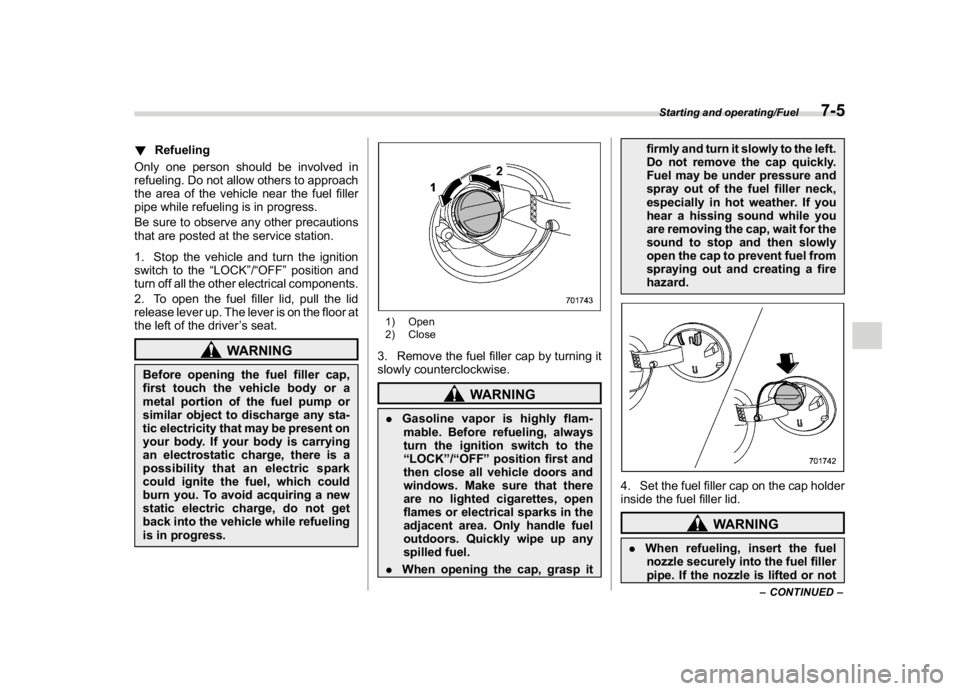
1) Open
2) Close3. Remove the fuel filler cap by turning it
slowly counterclockwise.
WARNING
.Gasoline vapor is highly flam-
mable. Before refueling, always
turn the ignition switch to the
“LOCK”/“OFF”position first and
then close all vehicle doors and
windows. Make sure that there
are no lighted cigarettes, open
flames or electrical sparks in the
adjacent area. Only handle fuel
outdoors. Quickly wipe up any
spilled fuel.
.When opening the cap, grasp itfirmly and turn it slowly to the left.
Do not remove the cap quickly.
Fuel may be under pressure and
spray out of the fuel filler neck,
especially in hot weather. If you
hear a hissing sound while you
are removing the cap, wait for the
sound to stop and then slowly
open the cap to prevent fuel from
spraying out and creating a fire
hazard.
4. Set the fuel filler cap on the cap holder
inside the fuel filler lid.
WARNING
.When refueling, insert the fuel
nozzle securely into the fuel filler
pipe. If the nozzle is lifted or not
–CONTINUED–
Starting and operating/Fuel
7-5
7
Page 410 of 474
(423,1)
北米Model "A1320BE-C" EDITED: 2017/ 10/ 10
nozzles.
CAUTION
.Adjust the washer fluid concen-
tration appropriately for the out-
side temperature. If the concen-
tration is inappropriate, sprayed
washer fluid may freeze on the
windshield and obstruct your
view, and the fluid may freeze in
the reservoir tank.
.State or local regulations on
volatile organic compounds may
restrict the use of methanol, a
common windshield washer anti-
freeze additive. Washer fluids
containing non-methanol anti-
freeze agents should be used
only if they provide cold weather
protection without damaging
your vehicle’s paint, wiper blades
or washer system.
Replacement of wiper bladesGrease, wax, insects, or other material on
the windshield or the wiper blade results in
jerky wiper operation and streaking on the
glass. If you cannot remove the streaks
after operating the windshield washer or if
the wiper operation is jerky, clean the outer
surface of the windshield (or rear window)
and the wiper blades using a sponge or
soft cloth with a neutral detergent or mild-
abrasive cleaner. After cleaning, rinse the
windshield and wiper blades with clean
water. The windshield is clean if beads do
not form when you rinse the windshield
with water.
CAUTION
.Do not clean the wiper blades
with gasoline or a solvent, such
as paint thinner or benzine. This
will cause deterioration of the
wiper blades.
.While removing the wiper blades
from the wiper arms, do not
return the wiper arms to the
original positions. Otherwise,
the windshield surface may be
scratched.
.When returning the raised wiper
arms to the original positions,carefully return the wiper arms on
the windshield by hand. You
should not return the wiper arms
to the windshield only by the
return spring. Otherwise, the wi-
per arms may be deformed and/or
the windshield surface may be
scratched.
If you cannot eliminate the streaking even
after following this method, replace the
wiper blades using the following proce-
dures.
&Windshield wiper blade as-
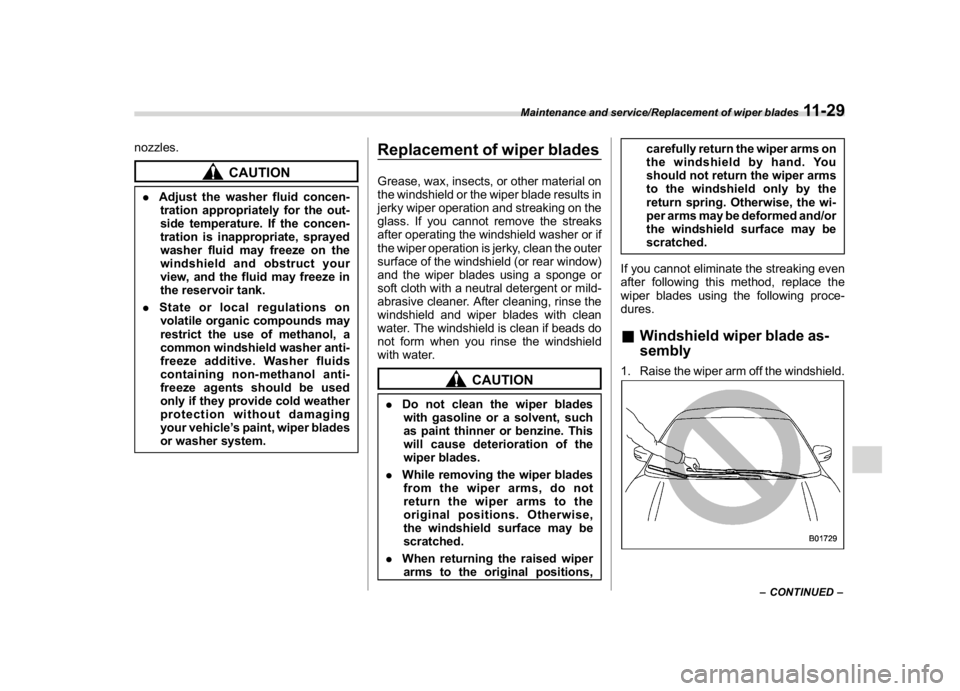
sembly1. Raise the wiper arm off the windshield.
–CONTINUED–
Maintenance and service/Replacement of wiper blades
11-29
11
Page 428 of 474

(443,1)
北米Model "A1320BE-C" EDITED: 2017/ 10/ 10
&EngineEngine model
FB20
(2.0 L, DOHC, non-turbo)
Engine type Horizontally opposed, liquid cooled 4 cylinder, 4-stroke direct injection gasoline engine
Displacement cu-in (cc) 121.7 (1,995)
Bore6Stroke in (mm) 3.3163.54 (84.0690.0)
Compression ratio12.5 : 1
Firing order1–3–2–4&Fuel
Fuel requirement Fuel tank capacity
Unleaded gasoline with 87 AKI (90 RON) or higher16.6 US gal (63 liters, 13.9 Imp gal)
For more details, refer to“Fuel”F7-3.
–CONTINUED–
Specifications/Specifications
12-3
12