2018 SUBARU CROSSTREK transmission
[x] Cancel search: transmissionPage 300 of 474
(309,1)
北米Model "A1320BE-C" EDITED: 2017/ 10/ 10
NOTEThis device complies with part 15 of the
FCC Rules. Operation is subject to the
following two conditions: (1) This de-
vice may not cause harmful interfer-
ence, and (2) this device must accept
any interference received, including
interference that may cause undesired
operation.
FCC CAUTION
Changes or modifications not ex-
pressly approved by the party respon-
sible for compliance could void the
user’s authority to operate the equip-
ment.
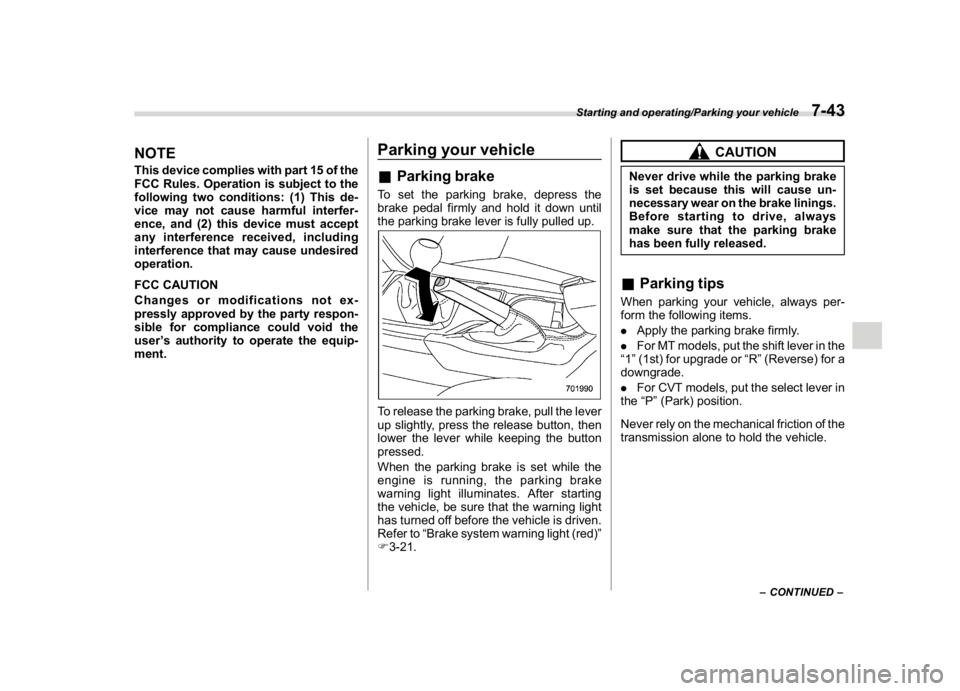
Parking your vehicle&Parking brakeTo set the parking brake, depress the
brake pedal firmly and hold it down until
the parking brake lever is fully pulled up.To release the parking brake, pull the lever
up slightly, press the release button, then
lower the lever while keeping the button
pressed.
When the parking brake is set while the
engine is running, the parking brake
warning light illuminates. After starting
the vehicle, be sure that the warning light
has turned off before the vehicle is driven.
Refer to“Brake system warning light (red)”
F3-21.
CAUTION
Never drive while the parking brake
is set because this will cause un-
necessary wear on the brake linings.
Before starting to drive, always
make sure that the parking brake
has been fully released.&Parking tipsWhen parking your vehicle, always per-
form the following items.
.Apply the parking brake firmly.
.For MT models, put the shift lever in the
“1”(1st) for upgrade or“R”(Reverse) for a
downgrade.
.For CVT models, put the select lever in
the“P”(Park) position.
Never rely on the mechanical friction of the
transmission alone to hold the vehicle.
–CONTINUED–
Starting and operating/Parking your vehicle
7-43
7
Page 334 of 474

(345,1)
北米Model "A1320BE-C" EDITED: 2017/ 10/ 10
stops. This could create a fire hazard.
Precautions when driving under espe-
cially dangerous situations:
.If driving through water, such as when
crossing shallow streams, first check the
depth of the water and the bottom of the
stream bed for firmness and ensure that
the bed of the stream is flat. Drive slowly
and cross the stream without stopping.
The water should be shallow enough that it
does not reach the vehicle’s undercar-
riage. Water entering the engine air intake
or the exhaust pipe or water splashing onto
electrical parts may damage your vehicle
and may cause it to stall. Never attempt to
drive through rushing water; regardless of
its depth, it can wash away the ground
from under your tires, resulting in possible
loss of traction and even vehicle rollover.
.If you must rock the vehicle to free it
from sand or mud, depress the accelerator
pedal slightly and move the shift lever/
select lever back and forth between“1”/“D”
and“R”repeatedly. Do not race the
engine. For the best possible traction,
avoid spinning the wheels when trying to
free the vehicle.
.When the road surface is extremely
slippery, you can obtain better traction by
starting the vehicle with the transmission in
2nd than 1st (both for MT and CVT). For
CVT models, refer to“Selection of manualmode”F7-26.
&After driving.Always check your brakes for effective-
ness immediately after driving in sand,
mud or water. Do this by driving slowly and
stepping on the brake pedal. Repeat that
process several times to dry out the brake
discs and brake pads.
.After driving through tall grass, mud,
rocks, sand, rivers, etc., check that there is
no grass, bush, paper, rags, stones, sand,
etc. adhering to or trapped on the under-
body. Clear off any such matter from the
underbody. If the vehicle is used with these
materials trapped or adhering to the
underbody, a mechanical breakdown or
fire could occur.
.Wash the vehicle’s underbody after off-
road driving. Suspension components are
particularly prone to dirt buildup, so they
need to be washed thoroughly.
Winter driving&Operation during cold weath-
er!Maintenance
Carry some emergency equipment, such
as a window scraper, a bag of sand, flares,
a small shovel and jumper cables.
Check the battery and cables. Cold tem-
peratures reduce battery capacity. The
battery must be in good condition to
provide enough power for cold winter
starts.
It normally takes longer to start the engine
in very cold weather conditions. Use an
engine oil of a proper grade and viscosity
for cold weather. Using heavy summer oil
will make it harder to start the engine.
Keep the door locks from freezing by
squirting them with deicer or glycerin.
Forcing a frozen door open may damage
or separate the rubber weather strips
around the door. If the door is frozen, use
hot water to melt the ice, and afterwards
thoroughly wipe the water away.
Use a windshield washer fluid that con-
tains an antifreeze solution. Do not use
engine antifreeze or other substitutes
because they may damage the paint of
–CONTINUED–
Driving tips/Winter driving
8-7
8
Page 338 of 474
(349,1)
北米Model "A1320BE-C" EDITED: 2017/ 10/ 10
&Tire chains
CAUTION
Tire chains cannot be used on your
vehicle because of the lack of clear-
ance between the tires and vehicle
body.NOTEWhen tire chains cannot be used, use of
another type of traction device (such as
spring chains) may be acceptable if use
on your vehicle is recommended by the
device manufacturer, taking into ac-
count tire size and road conditions.
Follow the device manufacturer’s in-
structions, especially regarding max-
imum vehicle speed.
To help avoid damage to your vehicle,
drive slowly, readjust or remove the
device if it is contacting your vehicle,
and do not spin your wheels. Damage
caused to your vehicle by use of a
traction device is not covered under
warranty.
Make certain that any traction device
you use is an SAE class S device, and
use it on the front wheels only. Always
use the utmost care when driving with a
traction device. Overconfidence be-cause you are using a traction device
could easily lead to a serious accident.
&Rocking the vehicleIf you must rock the vehicle to free it from
snow, sand, or mud, depress the accel-
erator pedal slightly and move the shift
lever/select lever back and forth between
“1”/“D”and“R”repeatedly. Do not race the
engine. For the best possible traction,
avoid spinning the wheels when trying to
free the vehicle.
When the road surface is extremely
slippery, you can obtain better traction by
starting the vehicle with the transmission in
2nd than 1st (both for MT and CVT
models).
If your vehicle is a CVT model, for
information about holding the transmission
in the 2nd position, refer to“Selection of
manual mode”F7-26.
Loading your vehicle
WARNING
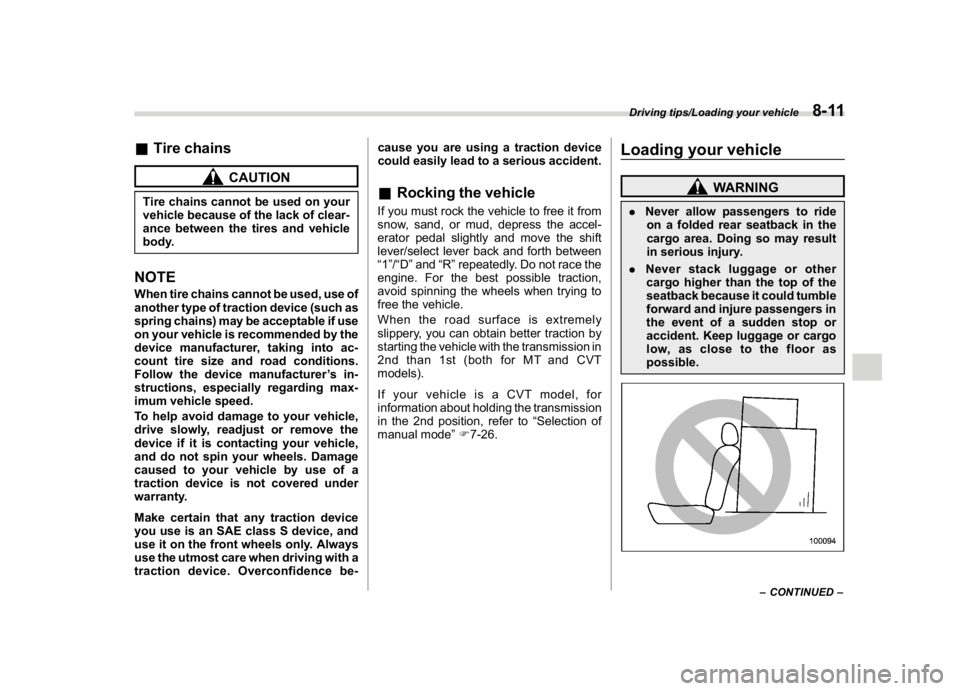
.Never allow passengers to ride
on a folded rear seatback in the
cargo area. Doing so may result
in serious injury.
.Never stack luggage or other
cargo higher than the top of the
seatback because it could tumble
forward and injure passengers in
the event of a sudden stop or
accident. Keep luggage or cargo
low, as close to the floor as
possible.
–CONTINUED–
Driving tips/Loading your vehicle
8-11
8
Page 344 of 474

(355,1)
北米Model "A1320BE-C" EDITED: 2017/ 10/ 10
&Warranties and maintenanceSUBARU warranties do not apply to
vehicle damage or malfunction caused by
trailer towing. If you use your vehicle to tow
a trailer, more frequent maintenance will
be required due to the additional load.
(Refer to“Maintenance schedule under
severe driving conditions”in the“Warranty
and Maintenance Booklet”.)
Under no circumstances should a trailer be
towed with a new vehicle or a vehicle with
any new powertrain component (engine,
transmission, differential, wheel bearings,
etc.) for the first 1,000 miles (1,600 km) of
driving.
&Maximum load limits
WARNING
Never exceed the maximum load
limits explained in the following.
Exceeding the maximum load limits
could cause personal injury and/or
vehicle damage.
CAUTION
.Adequate size trailer brakes are
required when the trailer and its
cargo exceed 1,000 lbs (453 kg)
total weight.
.Before towing a trailer, check the
trailer total weight, GVW, GAWs
and tongue load. Make sure the
load and its distribution in your
vehicle and trailer are acceptable.!Total trailer weight
Total trailer weightThe total trailer weight (trailer weight plus
its cargo load) must never exceed the
maximum total trailer weight in the follow-
ing table.
–CONTINUED–
Driving tips/Trailer towing
8-17
8
Page 350 of 474
(361,1)
北米Model "A1320BE-C" EDITED: 2017/ 10/ 10
when towing a trailer in hilly
country on hot days.
.When towing a trailer, steering,
stability, stopping distance and
braking performance will be dif-
ferent when compared to normal
operation. For safety’s sake, you
should employ extra caution
when towing a trailer and you
should never drive at excessive
speeds. You should also keep the
following tips in mind:
.The braking power of the parking
brake may not be sufficient when
stronger braking power is
needed (e.g., when parking on a
steep slope while towing a trai-
ler).
!Before starting out on a trip
.Check the towing regulations for trailer
or caravan vehicles that vary by state/
region. Failure to comply with the proce-
dures set forth will not only compromise
your safety, but will also negate your
insurance coverage and/or may violate
the state road and traffic acts and regula-
tions.
.Check that the vehicle and vehicle-to-
hitch mounting are in good condition. If any
problems are apparent, do not tow thetrailer.
.Check that the vehicle rests horizon-
tally with the trailer attached. If the vehicle
is tipped sharply up at the front and down
at the rear, check the total trailer weight,
GVW, GAWs and tongue load again, then
confirm that the load and its distribution are
acceptable.
.Check that the tire rating and pressures
are correct.
.Check that the vehicle and trailer are
connected properly. Confirm that:
–the trailer tongue is connected
properly to the hitch ball.
–the trailer lights connector is con-
nected properly and trailer’sbrake
lights illuminate when the vehicle’s
brake pedal is pressed, and that the
trailer’s turn signal lights flash when
the vehicle’s turn signal lever is oper-
ated.
–the safety chains are connected
properly.
–all cargo in the trailer is secured
safely in position.
–the side mirrors provide a good
rearward field of view without a sig-
nificant blind spot.
.Sufficient time should be taken to learn
the“feel”of the vehicle/trailer combination
before starting out on a trip. In an area free
of traffic, practice turning, stopping andbacking up.
!Driving with a trailer
.You should allow for considerably more
stopping distance when towing a trailer.
Avoid sudden braking because it may
result in skidding or jackknifing and loss
of control.
.Avoid abrupt starts and sudden accel-
erations. If your vehicle has a manual
transmission, always start out in first gear
and release the clutch at moderate engine
revolution.
.Avoid uneven steering, sharp turns and
rapid lane changes.
.Slow down before turning. Make a
longer than normal turning radius because
the trailer wheels will be closer than the
vehicle wheels to the inside of the turn. In a
tight turn, the trailer could hit your vehicle.
.Crosswinds will adversely affect the
handling of your vehicle and trailer, caus-
ingsway.Crosswindscanbedueto
weather conditions or the passing of large
trucks or buses. If swaying occurs, firmly
grip the steering wheel and promptly begin
decelerating your vehicle at a gradual
pace.
.When passing other vehicles, consider-
able distance is required because of the
added weight and length caused by
attaching the trailer to your vehicle.
–CONTINUED–
Driving tips/Trailer towing
8-23
8
Page 351 of 474
(362,1)
北米Model "A1320BE-C" EDITED: 2017/ 10/ 10
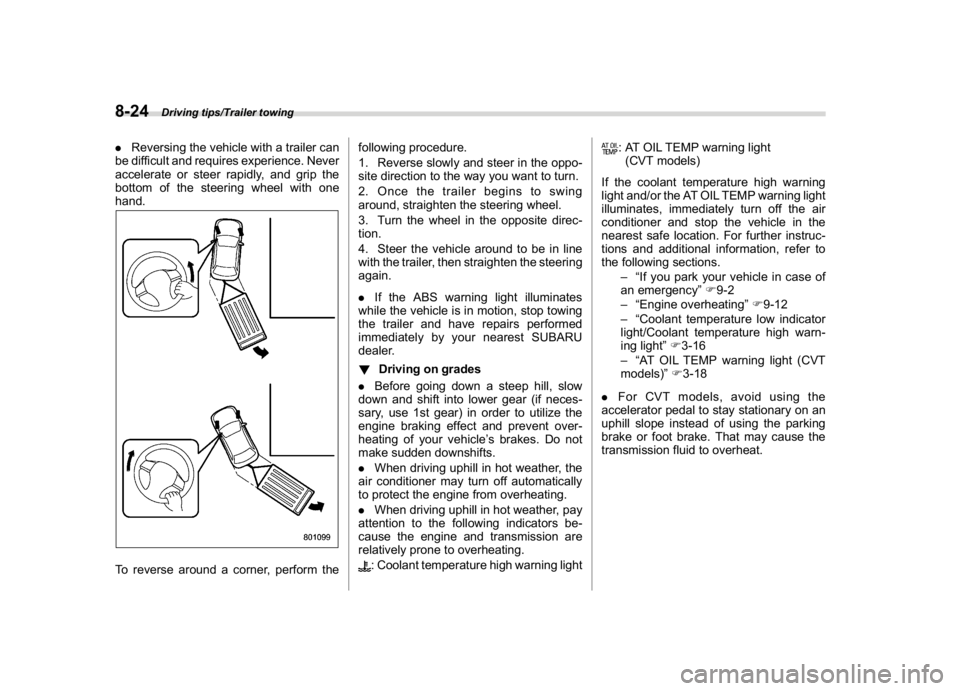
.Reversing the vehicle with a trailer can
be difficult and requires experience. Never
accelerate or steer rapidly, and grip the
bottom of the steering wheel with one
hand.To reverse around a corner, perform thefollowing procedure.
1. Reverse slowly and steer in the oppo-
site direction to the way you want to turn.
2. Once the trailer begins to swing
around, straighten the steering wheel.
3. Turn the wheel in the opposite direc-
tion.
4. Steer the vehicle around to be in line
with the trailer, then straighten the steering
again.
.If the ABS warning light illuminates
while the vehicle is in motion, stop towing
the trailer and have repairs performed
immediately by your nearest SUBARU
dealer.
!Driving on grades
.Before going down a steep hill, slow
down and shift into lower gear (if neces-
sary, use 1st gear) in order to utilize the
engine braking effect and prevent over-
heating of your vehicle’s brakes. Do not
make sudden downshifts.
.When driving uphill in hot weather, the
air conditioner may turn off automatically
to protect the engine from overheating.
.When driving uphill in hot weather, pay
attention to the following indicators be-
cause the engine and transmission are
relatively prone to overheating.
: Coolant temperature high warning light
: AT OIL TEMP warning light
(CVT models)
If the coolant temperature high warning
light and/or the AT OIL TEMP warning light
illuminates, immediately turn off the air
conditioner and stop the vehicle in the
nearest safe location. For further instruc-
tions and additional information, refer to
the following sections.
–“If you park your vehicle in case of
an emergency”F9-2
–“Engine overheating”F9-12
–“Coolant temperature low indicator
light/Coolant temperature high warn-
ing light”F3-16
–“AT OIL TEMP warning light (CVT
models)”F3-18
.For CVT models, avoid using the
accelerator pedal to stay stationary on an
uphill slope instead of using the parking
brake or foot brake. That may cause the
transmission fluid to overheat.
Driving tips/Trailer towing
8-24
Page 369 of 474

(380,1)
北米Model "A1320BE-C" EDITED: 2017/ 10/ 10
2. Pull up the parking brake lever firmly.
3. Secure the vehicle onto the carrier
properly with safety chains. Each safety
chain should be equally tightened and care
must be taken not to pull the chains so
tightly that the suspension bottoms out.
CAUTION
If your vehicle has a bumper under
guard (optional), be careful not to
scrape it when placing the vehicle
on the carrier and when removing
the vehicle from the carrier.
&Towing with all wheels on the
ground1. Release the parking brake and put the
transmission in the neutral position (CVT
and MT).
2. The ignition switch should be in the
“ON”position while the vehicle is being
towed.
3. Take up slack in the towline slowly to
prevent damage to the vehicle.
WARNING
.Never turn the ignition switch to
the“LOCK”/“OFF”position while
the vehicle is being towed be-
cause the steering wheel and the
direction of the wheels will belocked.
.Remember that the brake booster
and power steering do not func-
tion when the engine is not run-
ning. Because the engine is
turned off, it will take greater
effort to operate the brake pedal
and steering wheel.
CAUTION
.If transmission failure occurs,
transport your vehicle on a flat-
bed truck.
.For CVT models, the traveling
speed must be limited to less
than 20 mph (30 km/h) and the
traveling distance to less than 31
miles (50 km). For greater speeds
and distances, transport your
vehicle on a flat-bed truck.
In case of emergency/Towing
9-16
Page 382 of 474

(395,1)
北米Model "A1320BE-C" EDITED: 2017/ 10/ 10
Maintenance schedule.......................................... 11-3
Maintenance precautions..................................... 11-3
Before checking or servicing in the engine
compartment...................................................... 11-4
When checking or servicing in the engine
compartment...................................................... 11-4
When checking or servicing in the engine
compartment while the engine is running............ 11-5
Engine hood.......................................................... 11-5
Engine compartment overview............................ 11-7
Engine oil............................................................... 11-8
Engine oil consumption........................................ 11-8
Locations of the oil level gauge, oil filler cap
and oil filter........................................................ 11-8
Checking the oil level............................................ 11-8
Changing the oil and oil filter................................ 11-9
Recommended grade and viscosity..................... 11-10
Synthetic oil........................................................ 11-10
Cooling system................................................... 11-10
Safety precautions.............................................. 11-10
Cooling fan, hose and connections..................... 11-11
Engine coolant.................................................... 11-11
Air cleaner element............................................. 11-12
Replacing the air cleaner element........................ 11-13
Spark plugs......................................................... 11-14
Recommended spark plugs................................. 11-14
Drive belts........................................................... 11-14
Manual transmission oil..................................... 11-14
Recommended grade and viscosity..................... 11-14
Continuously variable transmission fluid..........11-15
Front differential gear oil (CVT models) and
rear differential gear oil....................................11-15
Recommended grade and viscosity..................... 11-15
Brake fluid............................................................11-15
Checking the fluid level...................................... 11-15
Recommended brake fluid.................................. 11-16
Clutch fluid (MT models).....................................11-16
Checking the fluid level...................................... 11-16
Recommended clutch fluid................................. 11-17
Brake booster......................................................11-17
Brake pedal..........................................................11-18
Checking the brake pedal free play..................... 11-18
Checking the brake pedal reserve distance ......... 11-18
Clutch pedal (MT models)...................................11-18
Checking the clutch function .............................. 11-18
Checking the clutch pedal free play.................... 11-19
Hill start assist system.......................................11-19
Replacement of brake pad andlining................11-19
Breaking-in of new brake pads and linings .......... 11-20
Parking brake stroke...........................................11-20
Tires and wheels.................................................11-21
Types of tires..................................................... 11-21
Tire pressure monitoring system (TPMS)
(if equipped).................................................... 11-21
Tire inspection.................................................... 11-22
Tire pressures and wear..................................... 11-23
Wheel balance.................................................... 11-24
Wear indicators.................................................. 11-25
Maintenance and service
11