2018 SUBARU CROSSTREK wheel size
[x] Cancel search: wheel sizePage 344 of 474

(355,1)
北米Model "A1320BE-C" EDITED: 2017/ 10/ 10
&Warranties and maintenanceSUBARU warranties do not apply to
vehicle damage or malfunction caused by
trailer towing. If you use your vehicle to tow
a trailer, more frequent maintenance will
be required due to the additional load.
(Refer to“Maintenance schedule under
severe driving conditions”in the“Warranty
and Maintenance Booklet”.)
Under no circumstances should a trailer be
towed with a new vehicle or a vehicle with
any new powertrain component (engine,
transmission, differential, wheel bearings,
etc.) for the first 1,000 miles (1,600 km) of
driving.
&Maximum load limits
WARNING
Never exceed the maximum load
limits explained in the following.
Exceeding the maximum load limits
could cause personal injury and/or
vehicle damage.
CAUTION
.Adequate size trailer brakes are
required when the trailer and its
cargo exceed 1,000 lbs (453 kg)
total weight.
.Before towing a trailer, check the
trailer total weight, GVW, GAWs
and tongue load. Make sure the
load and its distribution in your
vehicle and trailer are acceptable.!Total trailer weight
Total trailer weightThe total trailer weight (trailer weight plus
its cargo load) must never exceed the
maximum total trailer weight in the follow-
ing table.
–CONTINUED–
Driving tips/Trailer towing
8-17
8
Page 348 of 474
(359,1)
北米Model "A1320BE-C" EDITED: 2017/ 10/ 10
equipment.
.Do not use axle-mounted hitches
as they can cause damage to the
axle housing, wheel bearings,
wheels or tires.
Do not use a trailer hitch other than
genuine SUBARU trailer hitch. A genuine
SUBARU hitch is available from your
SUBARU dealer.
&When you do not tow a trailer
CAUTION
.The housing should be kept dirt
and corrosion-free at the points
of contact. The surfaces only
require cleaning with a cloth.
Grease or other lubricants
should never be used.
.If the ball is not installed, the
plastic insert should then be
inserted for protection and to
prevent dirt.
When the ball is not used, place the ball
cap and store securely.
&Connecting a trailer!Trailer brakes
WARNING
.Adequate size trailer brakes are
required when the trailer and its
cargo exceed 1,000 lbs (453 kg)
total weight.
.Do not directly connect your
trailer’s hydraulic brake system
to the hydraulic brake system in
your vehicle. Direct connection
would cause the vehicle’s brake
performance to deteriorate and
could lead to an accident.
If your trailer’s total weight (trailer weight
plus its cargo weight) exceeds 1,000 lbs
(453 kg), the trailer is required to be
equipped with its own brake system.
Electric brakes or surge brakes are re-
commended, and must be installed prop-
erly. Check that your trailer’s brakes con-
form with Federal, state/province and/or
other applicable regulations. Your
SUBARU’s brake system is not designed
to be tapped into the trailer’s hydraulic
brake system. Please ask your SUBARU
dealer and professional trailer supplier for
more information about the trailer’s brake
system.!Trailer safety chains
WARNING
Always use safety chains between
your vehicle and the trailer. Towing
trailer without safety chains could
create a traffic safety hazard if the
trailer separates from the hitch due
to coupling damage or hitch ball
damage.
In case the trailer hitch connector or hitch
ball should break or become discon-
nected, the trailer could get loose and
create a traffic safety hazard.
For safety, always connect the towing
vehicle and trailer with trailer safety
chains. Two chains should be used in
total, one to the right side and the other to
the left side trailer tongue. Pass the chains
crossing each other under the trailer
tongue to prevent the trailer from dropping
onto the ground in case the trailer tongue
should disconnect from the hitch ball.
Allow sufficient slack in the chains taking
tight turn situations into account; however,
be careful not to let them drag on the
ground.
–CONTINUED–
Driving tips/Trailer towing
8-21
8
Page 356 of 474

(367,1)
北米Model "A1320BE-C" EDITED: 2017/ 10/ 10
CAUTION
Never use any temporary spare tire
other than the original. Using other
sizes may result in severe mechan-
ical damage to the drive train of your
vehicle.
The temporary spare tire is smaller and
lighter than a conventional tire and is
designed for emergency use only. Re-
move the temporary spare tire and re-
install the conventional tire as soon as
possible because the spare tire is de-
signed only for temporary use.
Check the inflation pressure of the tem-
porary spare tire periodically to keep the
tire ready for use. The correct pressure is
60 psi (420 kPa, 4.2 kg/cm
2).
When using the temporary spare tire, note
the following.
.Drive with caution when the temporary
spare tire is installed. Avoid hard accel-
eration and braking, or fast cornering, as
control of the vehicle may be lost.
.Do not exceed 50 mph (80 km/h).
.Do not put a tire chain on the temporary
spare tire. Because of the smaller tire size,
a tire chain will not fit properly.
.Do not use two or more temporary
spare tires at the same time..Do not drive over obstacles. This tire
has a smaller diameter, so road clearance
is reduced.
1) Tread wear indicator bar
2) Indicator location mark.When the wear indicator appears on
the tread, replace the tire.
.The temporary spare tire must be used
only on a rear wheel. If a front wheel tire
gets punctured, replace the wheel with a
rear wheel and install the temporary spare
tire in place of the removed rear wheel.
Maintenance toolsYour vehicle is equipped with the following
maintenance tools.
.Jack
.Jack handle
.Screwdriver
.Towing hook (eye bolt)
.Wheel nut wrench
–CONTINUED–
In case of emergency/Maintenance tools
9-3
9
Page 402 of 474

(415,1)
北米Model "A1320BE-C" EDITED: 2017/ 10/ 10
Tires and wheels&Types of tiresYou should be familiar with type of tires
present on your vehicle.
!All season tires
All season tires are designed to provide an
adequate measure of traction, handling
and braking performance in year-round
driving including snowy and icy road
conditions. However all season tires do
not offer as much traction performance as
winter (snow) tires in heavy or loose snow
or on icy roads.
All season tires are identified by“ALL
SEASON”and/or“M+S”(Mud & Snow) on
the tire sidewall.
!Summer tires
Summer tires are high-speed capability
tires best suited for highway driving under
dry conditions.
Summer tires are inadequate for driving on
slippery roads such as on snow-covered or
icy roads.
If you drive your vehicle on snow-covered
or icy roads, we strongly recommend the
use of winter (snow) tires.
When installing winter tires, be sure to
replace all four tires.!Winter (snow) tires
Winter tires are best suited for driving on
snow-covered and icy roads. However
winter tires do not perform as well as
summer tires and all season tires on roads
other than snow-covered and icy roads.
&Tire pressure monitoring
system (TPMS) (if equipped)The tire pressure monitoring system pro-
vides the driver with a warning message by
sending a signal from a sensor that is
installed in each wheel when tire pressure
is severely low. The tire pressure monitor-
ing system will activate only when the
vehicle is driven. Also, this system may not
react immediately to a sudden drop in tire
pressure (for example, a blow-out caused
by running over a sharp object).
If you adjust the tire pressures in a warm
garage and will then drive the vehicle in
cold outside air, the resulting drop in tire
pressures may cause the low tire pressure
warning light to illuminate. To avoid this
problem when adjusting the tire pressures
in a warm garage, inflate the tires to
pressures higher than those shown on
the tire placard. Specifically, inflate them
by an extra 1 psi (6.9 kPa, 0.07 kgf/cm
2) for
every difference of 108F (5.68C) between
the temperature in the garage and thetemperature outside. By way of example,
the following table shows the required tire
pressures that correspond to various out-
side temperatures when the temperature
in the garage is 608F (15.68C).
Example:
Tire size: P225/60R17 98H and
P225/55R18 97H
Standard tire pressures:
Front: 33 psi (230 kPa, 2.3 kgf/cm
2)
Rear: 32 psi (220 kPa, 2.2 kgf/cm2)
Garage temperature: 608F (15.68C)
Outside
temperatureAdjusted pressure
[psi (kPa, kgf/cm
2)]
Front Rear
308F(18C) 36 (250, 2.5) 35 (240, 2.4)
108F(128C)38
(265, 2.65)37
(255, 2.55)
108F(238C) 40 (280, 2.8)39 (270, 2.7)
If the low tire pressure warning light
illuminates when you drive the vehicle in
cold outside air after adjusting the tire
pressures in a warm garage, re-adjust the
tire pressures using the method described
above. Then, increase the vehicle speed
to at least 20 mph (32 km/h) and check to
see that the low tire pressure warning light
turns off a few minutes later. If the low tire
pressure warning light does not turn off,
–CONTINUED–
Maintenance and service/Tires and wheels
11-21
11
Page 407 of 474
(420,1)
北米Model "A1320BE-C" EDITED: 2017/ 10/ 10
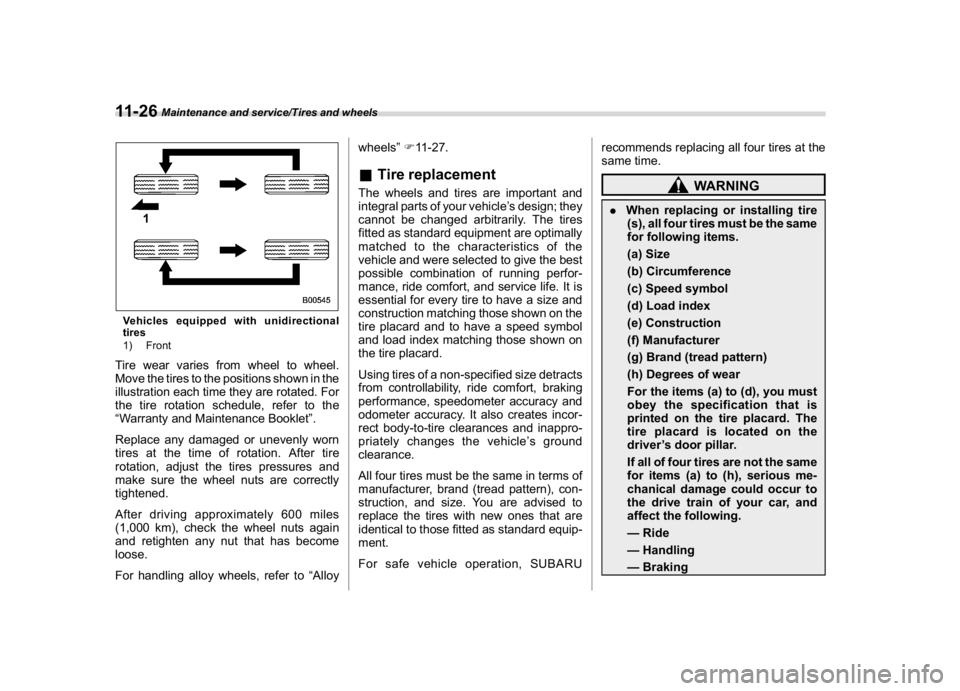
Vehicles equipped with unidirectional
tires
1) FrontTire wear varies from wheel to wheel.
Move the tires to the positions shown in the
illustration each time they are rotated. For
the tire rotation schedule, refer to the
“Warranty and Maintenance Booklet”.
Replace any damaged or unevenly worn
tires at the time of rotation. After tire
rotation, adjust the tires pressures and
make sure the wheel nuts are correctly
tightened.
After driving approximately 600 miles
(1,000 km), check the wheel nuts again
and retighten any nut that has become
loose.
For handling alloy wheels, refer to“Alloywheels”F11-27.
&Tire replacementThe wheels and tires are important and
integral parts of your vehicle’s design; they
cannot be changed arbitrarily. The tires
fitted as standard equipment are optimally
matched to the characteristics of the
vehicle and were selected to give the best
possible combination of running perfor-
mance, ride comfort, and service life. It is
essential for every tire to have a size and
construction matching those shown on the
tire placard and to have a speed symbol
and load index matching those shown on
the tire placard.
Using tires of a non-specified size detracts
from controllability, ride comfort, braking
performance, speedometer accuracy and
odometer accuracy. It also creates incor-
rect body-to-tire clearances and inappro-
priately changes the vehicle’s ground
clearance.
All four tires must be the same in terms of
manufacturer, brand (tread pattern), con-
struction, and size. You are advised to
replace the tires with new ones that are
identical to those fitted as standard equip-
ment.
For safe vehicle operation, SUBARUrecommends replacing all four tires at the
same time.
WARNING
.When replacing or installing tire
(s), all four tires must be the same
for following items.
(a) Size
(b) Circumference
(c) Speed symbol
(d) Load index
(e) Construction
(f) Manufacturer
(g) Brand (tread pattern)
(h) Degrees of wear
For the items (a) to (d), you must
obey the specification that is
printed on the tire placard. The
tire placard is located on the
driver’s door pillar.
If all of four tires are not the same
for items (a) to (h), serious me-
chanical damage could occur to
the drive train of your car, and
affect the following.
—Ride
—Handling
—Braking
Maintenance and service/Tires and wheels
11-26
Page 433 of 474

(448,1)
北米Model "A1320BE-C" EDITED: 2017/ 10/ 10
&Electrical systemBattery type
75D23L
Alternator12V-130A
Spark plugsDILKAR7B8 (NGK)&TiresTire size P225/60R17 98H 225/55R18 98H
Wheel size
1767J 1867J
Pressure Front
33 psi (230 kPa, 2.3 kgf/cm
2)
Rear
32 psi (220 kPa, 2.2 kgf/cm2)
Wheel nut tightening torque
89 lbf·ft (120 N·m, 12 kgf·m)*1
*1: This torque is equivalent to applying approximately 88 to 110 lbf (40 to 50 kgf) at the end of the wheel nut wrench. If you have tightened the wheel nuts
by yourself, have the tightening torque checked at the nearest automotive service facility as soon as possible. For the wheel nut tightening procedure,
refer to“
Changing a flat tire”F9-5.Specifications/Specifications
12-8
Page 450 of 474

(467,1)
北米Model "A1320BE-C" EDITED: 2017/ 10/ 10
.
Passenger car tire
A tire intended for use on passen-
ger cars, multipurpose passenger
vehicles, and trucks, that have a
gross vehicle weight rating (GVWR)
of 10,000 lbs (4,535 kg) or less..
Ply
A layer of rubber-coated parallel
cords..
Ply separation
A parting of rubber compound
between adjacent plies..
Pneumatic tire
A mechanical device made of rub-
ber, chemicals, fabric and steel or
other materials, that, when
mounted on an automotive wheel,
provides the traction and contains
the gas or fluid that sustains the
load..
Production options weight
The combined weight of those
installed regular production options
weighing over 5.1 lbs (2.3 kg) in
excess of those standard items
which they replace, not previously
considered in curb weight or acces-sory weight, including heavy duty
brakes, ride levelers, roof rack,
heavy duty battery, and special trim.
.
Radial ply tire
A pneumatic tire in which the ply
cords that extend to the beads are
laid at substantially 90 degrees to
the centerline of the tread..
Recommended inflation pres-
sure
The cold inflation pressure recom-
mended by a vehicle manufacturer..
Reinforced tire
A tire designed to operate at higher
loads and at higher inflation pres-
sures than the corresponding stan-
dard tire..
Rim
A metal support for a tire or a tire
and tube assembly upon which the
tire beads are seated..
Rim diameter
Nominal diameter of the bead seat..
Rim size designation
Rim diameter and width.
.
Rim type designation
The industry of manufacturer’s des-
ignation for a rim by style or code..
Rim width
Nominal distance between rim
flanges..
Section width
The linear distance between the
exteriors of the sidewalls of an
inflated tire, excluding elevations
due to labeling, decoration, or pro-
tective bands..
Sidewall
That portion of a tire between the
tread and bead..
Sidewall separation
The parting of the rubber compound
from the cord material in the side-
wall..
Test rim
The rim on which a tire is fitted for
testing, and it may be any rim listed
as appropriate for use with that tire..
Tread
That portion of a tire that comes into
contact with the road.
–CONTINUED–
Consumer information and Reporting safety defects/Tire information
13-7
13