2018 SUBARU CROSSTREK ECO mode
[x] Cancel search: ECO modePage 31 of 474
(32,1)
北米Model "A1320BE-C" EDITED: 2017/ 10/ 10
Seats&Safety tips!Safety tips for seat
WARNING
.Never adjust the seat while driv-
ing to avoid loss of vehicle con-
trol and personal injury.
.Before adjusting the seat, make
sure the hands and feet of rear
seat passengers and cargo are
clear of the adjusting mechan-
ism.
.After adjusting the seat, push it
slightly to make sure it is se-
curely locked. If the seat is not
securely locked, it may move or
the seatbelt may not operate
properly.
.Do not put objects under the front
seats. They may interfere with
front seat locking and cause an
accident.
.Seatbelts provide maximum re-
straint when the occupant sits
well back and upright in the seat.
To reduce the risk of sliding
under the seatbelt in a collision,
the front seatbacks should bealways used in the upright posi-
tion while the vehicle is running.
If the front seatbacks are not
used in the upright position in a
collision, the risk of sliding under
the lap belt and of the lap belt
sliding up over the abdomen will
increase, and both can result in
serious internal injury or death.
.The SRS airbags deploy with
considerable speed and force.
Occupants who are out of proper
position when the SRS airbag
deploys could suffer very serious
injuries. Because the SRS airbag
needs enough space for deploy-
ment, the driver should always sit
upright and well back in the seat
as far from the steering wheel as
practical while still maintaining
full vehicle control and the front
passenger should move the seat
as far back as possible and sit
upright and well back in the seat.
WARNING
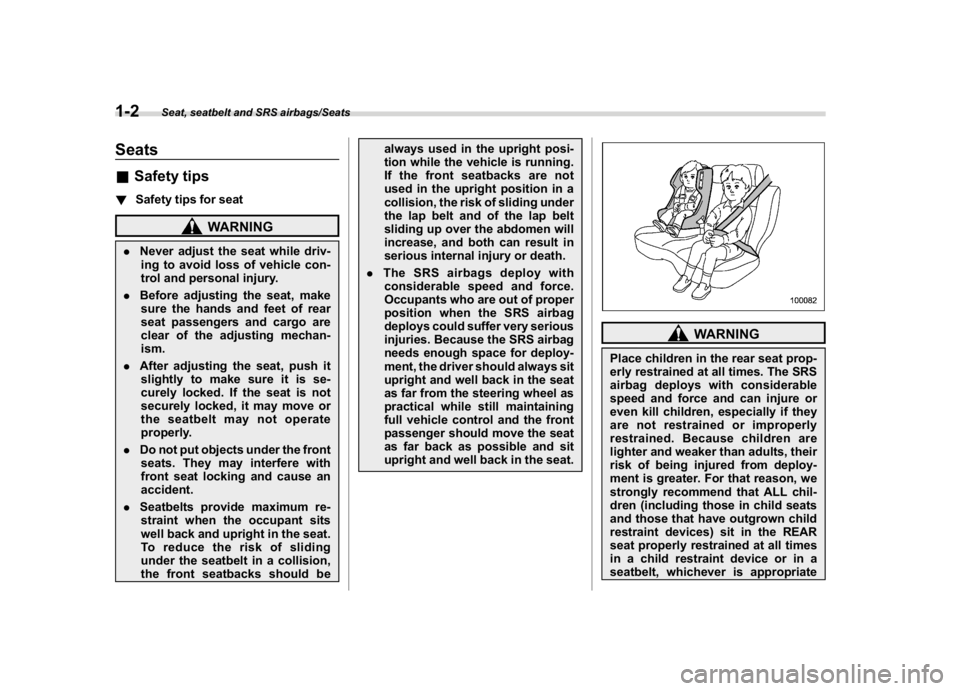
Place children in the rear seat prop-
erly restrained at all times. The SRS
airbag deploys with considerable
speed and force and can injure or
even kill children, especially if they
are not restrained or improperly
restrained. Because children are
lighter and weaker than adults, their
risk of being injured from deploy-
ment is greater. For that reason, we
strongly recommend that ALL chil-
dren (including those in child seats
and those that have outgrown child
restraint devices) sit in the REAR
seat properly restrained at all times
in a child restraint device or in a
seatbelt, whichever is appropriate
Seat, seatbelt and SRS airbags/Seats
1-2
Page 41 of 474

(42,1)
北米Model "A1320BE-C" EDITED: 2017/ 10/ 10
Seatbelts&Seatbelt safety tips
WARNING
.All persons in the vehicle should
fasten their seatbelts BEFORE
the vehicle starts to move. Other-
wise, the possibility of serious
injury becomes greater in the
event of a sudden stop or acci-
dent.
.All belts should fit snugly in order
to provide full restraint. Loose
fitting belts are not as effective in
preventing or reducing injury.
.Each seatbelt is designed to sup-
port only one person. Never use a
single belt for two or more per-
sons–even children. Otherwise,
in an accident, serious injury or
death could result.
.Replace all seatbelt assemblies
including retractors and attach-
ing hardware worn by occupants
of a vehicle that has been in a
serious accident. The entire as-
sembly should be replaced even
if damage is not obvious.
.Never use a belt that is twisted orreversed. In an accident, this can
increase the risk or severity of
injury.
.Keep the lap belt as low as
possible on your hips. In a colli-
sion, this spreads the force of the
lap belt over stronger hip bones
instead of across the weaker
abdomen.
.Seatbelts provide maximum re-
straint when the occupant sits
well back and upright in the seat.
To reduce the risk of sliding
under the seatbelt in a collision,
the front seatbacks should be
always used in the upright posi-
tion while the vehicle is running.
If the front seatbacks are not
used in the upright position in a
collision, the risk of sliding under
the lap belt and of the lap belt
sliding up over the abdomen will
increase, and both can result in
serious internal injury or death.
.Do not put cushions or any other
materials between occupants
and seatbacks or seat cushions.
If you do so, the risk of sliding
under the lap belt and of the lap
belt sliding up over the abdomen
will increase, and both can result
in serious internal injury or death.
WARNING
Never place the shoulder belt under
the arm or behind the back. If an
accident occurs, this can increase
the risk or severity of injury.
CAUTION
Metallic parts of the seatbelt can
become very hot in a vehicle that has
been closed up in sunny weather;
they could burn an occupant. Do not
touch such hot parts until they cool.
Your vehicle is equipped with a crash
sensing and diagnostic module, which will
record the use of the seatbelt by the front
Seat, seatbelt and SRS airbags/Seatbelts
1-12
Page 42 of 474
(43,1)
北米Model "A1320BE-C" EDITED: 2017/ 10/ 10
passenger when any of the SRS frontal,
side and curtain airbags deploy.
!Infants or small children
Use a child restraint system that is suitable
for your vehicle. Refer to“Child restraint
systems”F1-25.
!Children
WARNING
Place children in the rear seat prop-
erly restrained at all times. The SRS
airbag deploys with considerable
speed and force and can injure or
even kill children, especially if they
are not restrained or improperly
restrained. Because children are
lighter and weaker than adults, their
risk of being injured from deploy-
ment is greater. For that reason, we
strongly recommend that ALL chil-
dren (including those in child seats
and those that have outgrown child
restraint devices) sit in the REAR
seat properly restrained at all times
in a child restraint device or in a
seatbelt, whichever is appropriate
for the child’s height and weight.
Secure ALL types of child restraint
devices (including forward facing
child seats) in the REAR seats at alltimes.
NEVER INSTALL A FORWARD OR
REARWARD FACING CHILD SEAT IN
THE FRONT SEAT. DOING SO RISKS
SERIOUS INJURY OR DEATH TO
THE CHILD BY PLACING THE
CHILD’SHEADTOOCLOSETO
THE SRS AIRBAG.
According to accident statistics,
children are safer when properly
restrained in the rear seating posi-
tions than in the front seating posi-
tions. For instructions and precau-
tions concerning the child restraint
system, refer to“Child restraint
systems”F1-25.
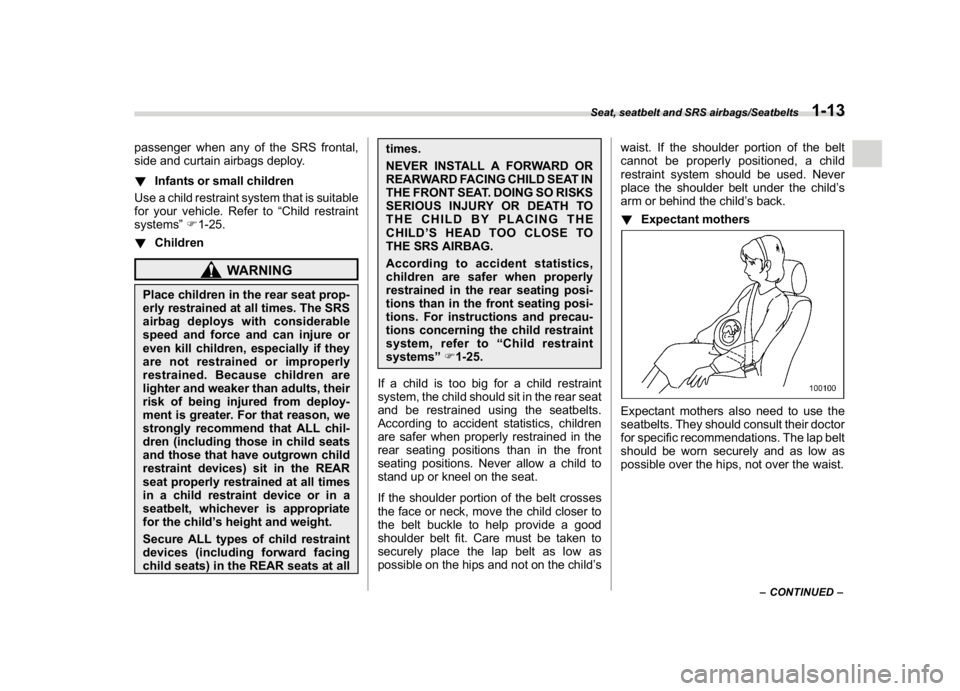
If a child is too big for a child restraint
system, the child should sit in the rear seat
and be restrained using the seatbelts.
According to accident statistics, children
are safer when properly restrained in the
rear seating positions than in the front
seating positions. Never allow a child to
stand up or kneel on the seat.
If the shoulder portion of the belt crosses
the face or neck, move the child closer to
the belt buckle to help provide a good
shoulder belt fit. Care must be taken to
securely place the lap belt as low as
possible on the hips and not on the child’swaist. If the shoulder portion of the belt
cannot be properly positioned, a child
restraint system should be used. Never
place the shoulder belt under the child’s
arm or behind the child’s back.
!Expectant mothers
Expectant mothers also need to use the
seatbelts. They should consult their doctor
for specific recommendations. The lap belt
should be worn securely and as low as
possible over the hips, not over the waist.
–CONTINUED–
Seat, seatbelt and SRS airbags/Seatbelts
1-13
1
Page 55 of 474
(56,1)
北米Model "A1320BE-C" EDITED: 2017/ 10/ 10
seat. Unrestrained children will be
thrown forward during sudden stop
or in an accident and can be injured
seriously.
Additionally, children standing up or
kneeling on or in front of the front
seat are exposed another serious
danger. Since the SRS airbag de-
ploys with considerable speed and
force, the child could be injured or
even killed.&Safety tips for installing child
restraint systems
WARNING
.Child restraint systems and seat-
belts can become hot in a vehicle
that has been closed up in sunny
weather; they could burn a small
child. Check the child restraint
system before you place a child
in it..Do not leave an unsecured child
restraint system in your vehicle.
Unsecured child restraint sys-
tems can be thrown around in-
side of the vehicle in a sudden
stop, turn or accident; they can
strike and injure vehicle occu-
pants as well as result in serious
injuries or death to the child.
CAUTION
When you install a child restraint
system, follow the manufacturer’s
instructions supplied with it. After
installing the child restraint system,
check to ensure that it is held
securely in position. If it is not held
tight and secure, the danger of your
child suffering personal injury in the
event of an accident may be in-
creased.
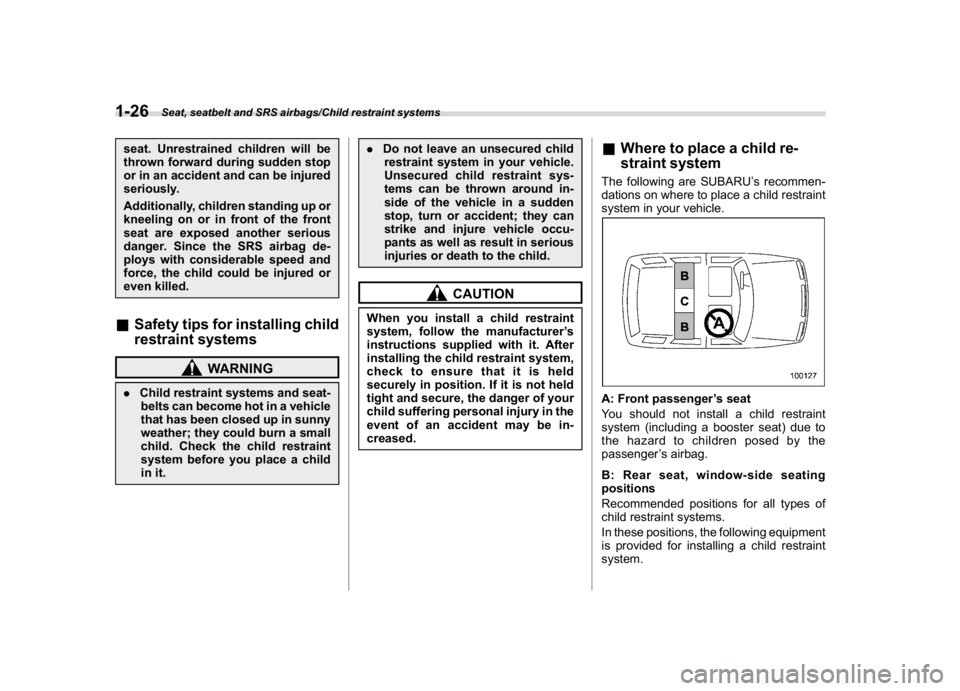
&Where to place a child re-
straint systemThe following are SUBARU’s recommen-
dations on where to place a child restraint
system in your vehicle.A: Front passenger’s seat
You should not install a child restraint
system (including a booster seat) due to
the hazard to children posed by the
passenger’s airbag.
B: Rear seat, window-side seating
positions
Recommended positions for all types of
child restraint systems.
In these positions, the following equipment
is provided for installing a child restraint
system.
Seat, seatbelt and SRS airbags/Child restraint systems
1-26
Page 58 of 474
(59,1)
北米Model "A1320BE-C" EDITED: 2017/ 10/ 10
seatback”F1-6.
2. Place the child restraint system in the
rear seating position.
3. Run the lap and shoulder belt through
or around the child restraint system follow-
ing the instructions provided by its manu-
facturer.
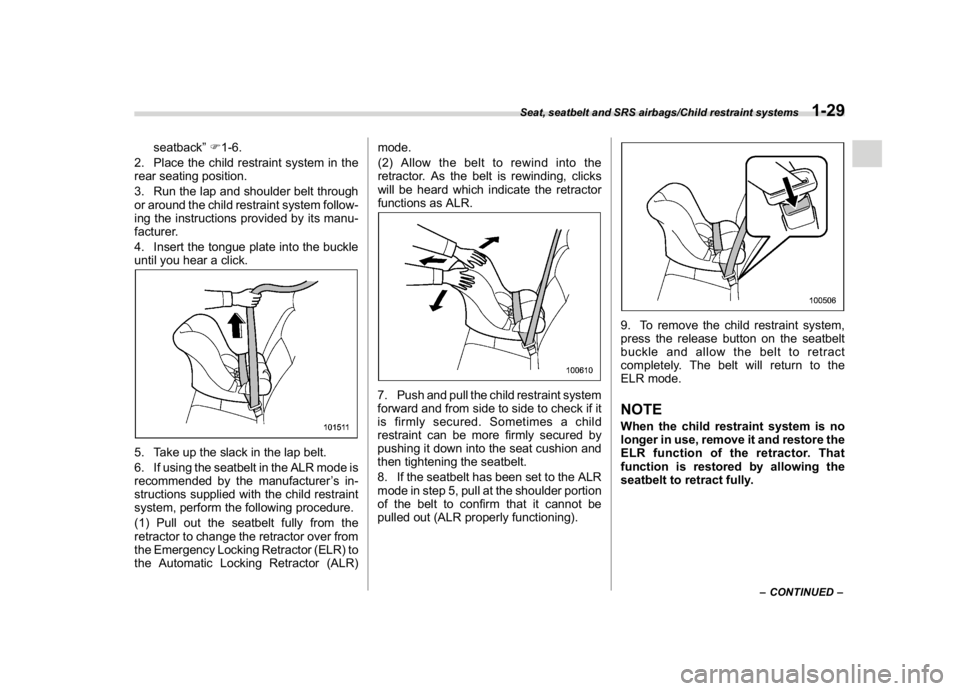
4. Insert the tongue plate into the buckle
until you hear a click.
5. Take up the slack in the lap belt.
6. If using the seatbelt in the ALR mode is
recommended by the manufacturer’s in-
structions supplied with the child restraint
system, perform the following procedure.
(1) Pull out the seatbelt fully from the
retractor to change the retractor over from
the Emergency Locking Retractor (ELR) to
the Automatic Locking Retractor (ALR)mode.
(2) Allow the belt to rewind into the
retractor. As the belt is rewinding, clicks
will be heard which indicate the retractor
functions as ALR.
7. Push and pull the child restraint system
forward and from side to side to check if it
is firmly secured. Sometimes a child
restraint can be more firmly secured by
pushing it down into the seat cushion and
then tightening the seatbelt.
8. If the seatbelt has been set to the ALR
mode in step 5, pull at the shoulder portion
of the belt to confirm that it cannot be
pulled out (ALR properly functioning).
9. To remove the child restraint system,
press the release button on the seatbelt
buckle and allow the belt to retract
completely. The belt will return to the
ELR mode.NOTEWhen the child restraint system is no
longer in use, remove it and restore the
ELR function of the retractor. That
function is restored by allowing the
seatbelt to retract fully.
–CONTINUED–
Seat, seatbelt and SRS airbags/Child restraint systems
1-29
1
Page 65 of 474
(66,1)
北米Model "A1320BE-C" EDITED: 2017/ 10/ 10
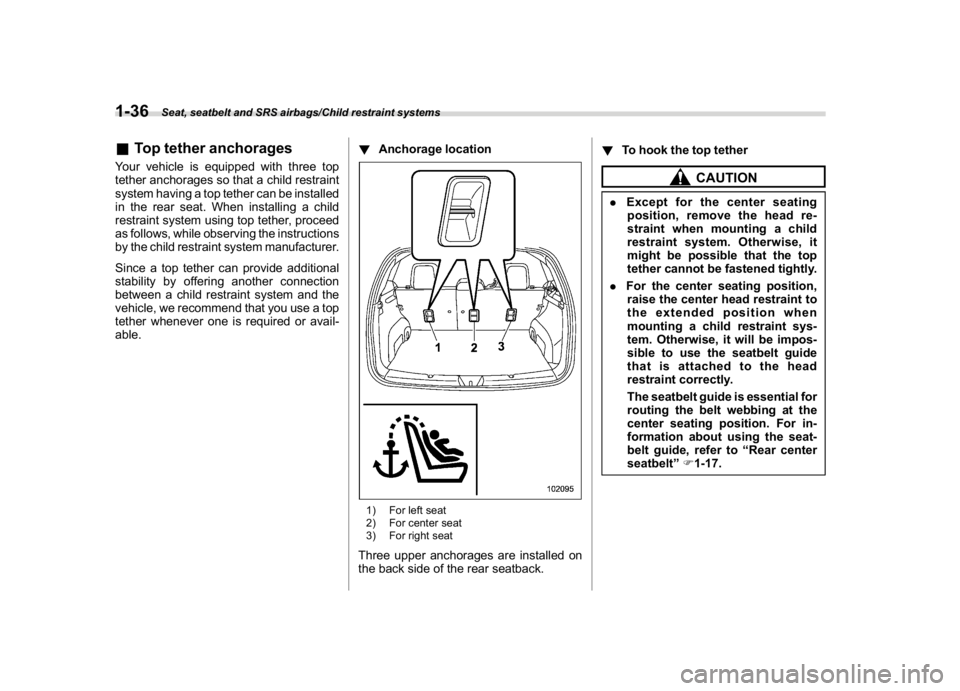
&Top tether anchoragesYour vehicle is equipped with three top
tether anchorages so that a child restraint
system having a top tether can be installed
in the rear seat. When installing a child
restraint system using top tether, proceed
as follows, while observing the instructions
by the child restraint system manufacturer.
Since a top tether can provide additional
stability by offering another connection
between a child restraint system and the
vehicle, we recommend that you use a top
tether whenever one is required or avail-
able.!Anchorage location
1) For left seat
2) For center seat
3) For right seatThree upper anchorages are installed on
the back side of the rear seatback.!To hook the top tether
CAUTION
.Except for the center seating
position, remove the head re-
straint when mounting a child
restraint system. Otherwise, it
might be possible that the top
tether cannot be fastened tightly.
.For the center seating position,
raise the center head restraint to
the extended position when
mounting a child restraint sys-
tem. Otherwise, it will be impos-
sible to use the seatbelt guide
that is attached to the head
restraint correctly.
The seatbelt guide is essential for
routing the belt webbing at the
center seating position. For in-
formation about using the seat-
belt guide, refer to“Rear center
seatbelt”F1-17.
Seat, seatbelt and SRS airbags/Child restraint systems
1-36
Page 70 of 474

(71,1)
北米Model "A1320BE-C" EDITED: 2017/ 10/ 10
the SRS airbag deploys, those ob-
jects could become projectiles that
could seriously injure vehicle occu-
pants.
WARNING
.Do not attach accessories to the
door trim or near either SRS side
airbags and do not place objects
near the SRS side airbags. In the
event of SRS side airbag deploy-
ment, they could be propelled
dangerously toward the vehicle’s
occupants and cause injuries.
.Do not attach a hands-free micro-
phone or any other accessory to
a front pillar, a center pillar, a rearpillar, the windshield, a side win-
dow, an assist grip, or any other
cabin surface that would be near
a deploying SRS curtain airbag. A
hands-free microphone or other
accessory in such a location
could be propelled through the
cabin with great force by the
curtain airbag, or it could prevent
correct deployment of the curtain
airbag. In either case, the result
could be serious injuries.
WARNING
Do not hang coat hangers or other
hard or pointed objects on the coat
hooks. If such items were hanging
on the coat hooks during deploy-ment of the SRS curtain airbags,
they could cause serious injuries by
coming off the coat hooks and being
thrown through the cabin or by
preventing deployment of the cur-
tain airbags.
Before hanging clothing on the coat
hooks, make sure there are no sharp
objects in the pockets. Hang cloth-
ing directly on the coat hooks with-
out using hangers.
WARNING
.Do not put any kind of clothes or
other objects over either front
seatback and do not attach labels
or stickers to the front seat sur-
–CONTINUED–
Seat, seatbelt and SRS airbags/SRS airbag (Supplemental Restraint System airbag)
1-41
1
Page 71 of 474
(72,1)
北米Model "A1320BE-C" EDITED: 2017/ 10/ 10
face on or near the SRS side
airbag. They could prevent prop-
er deployment of the SRS side
airbag, reducing protection avail-
able to the front seat’s occupant.
.Do not install a seat cover unless
it is a genuine SUBARU seat
cover exclusively designed for
use with the SRS airbag. Even
when using a genuine SUBARU
seat cover, the SRS side airbag
system may not function nor-
mally if the seat cover is not
installed correctly.
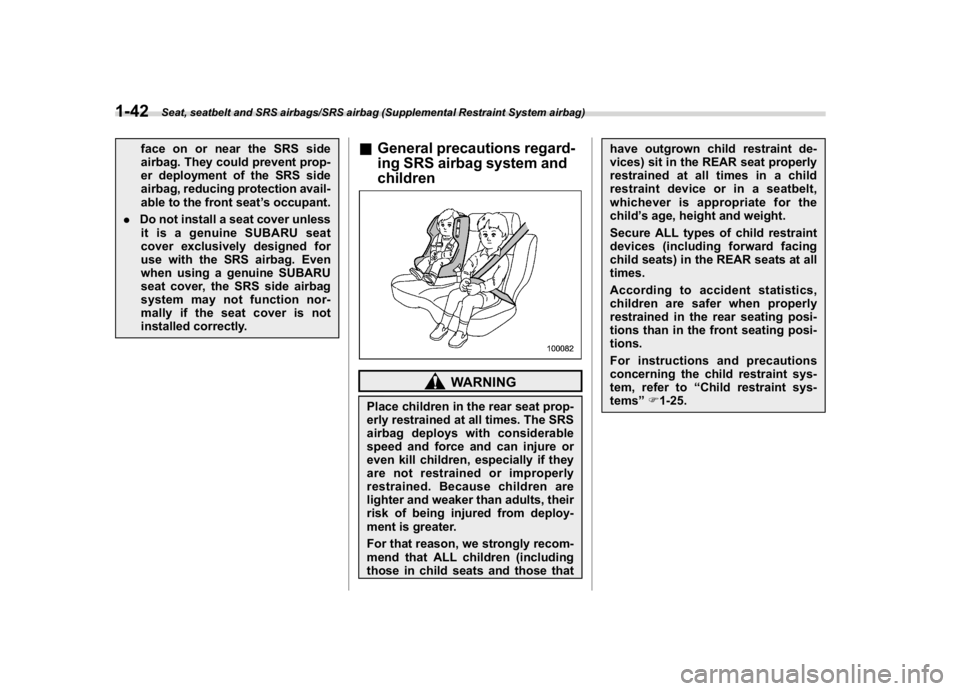
&General precautions regard-
ing SRS airbag system and
children
WARNING
Place children in the rear seat prop-
erly restrained at all times. The SRS
airbag deploys with considerable
speed and force and can injure or
even kill children, especially if they
are not restrained or improperly
restrained. Because children are
lighter and weaker than adults, their
risk of being injured from deploy-
ment is greater.
For that reason, we strongly recom-
mend that ALL children (including
those in child seats and those thathave outgrown child restraint de-
vices) sit in the REAR seat properly
restrained at all times in a child
restraint device or in a seatbelt,
whichever is appropriate for the
child’s age, height and weight.
Secure ALL types of child restraint
devices (including forward facing
child seats) in the REAR seats at all
times.
According to accident statistics,
children are safer when properly
restrained in the rear seating posi-
tions than in the front seating posi-
tions.
For instructions and precautions
concerning the child restraint sys-
tem, refer to“Child restraint sys-
tems”F1-25.
Seat, seatbelt and SRS airbags/SRS airbag (Supplemental Restraint System airbag)
1-42