2018 Seat Ateca spare wheel
[x] Cancel search: spare wheelPage 310 of 348
Advice
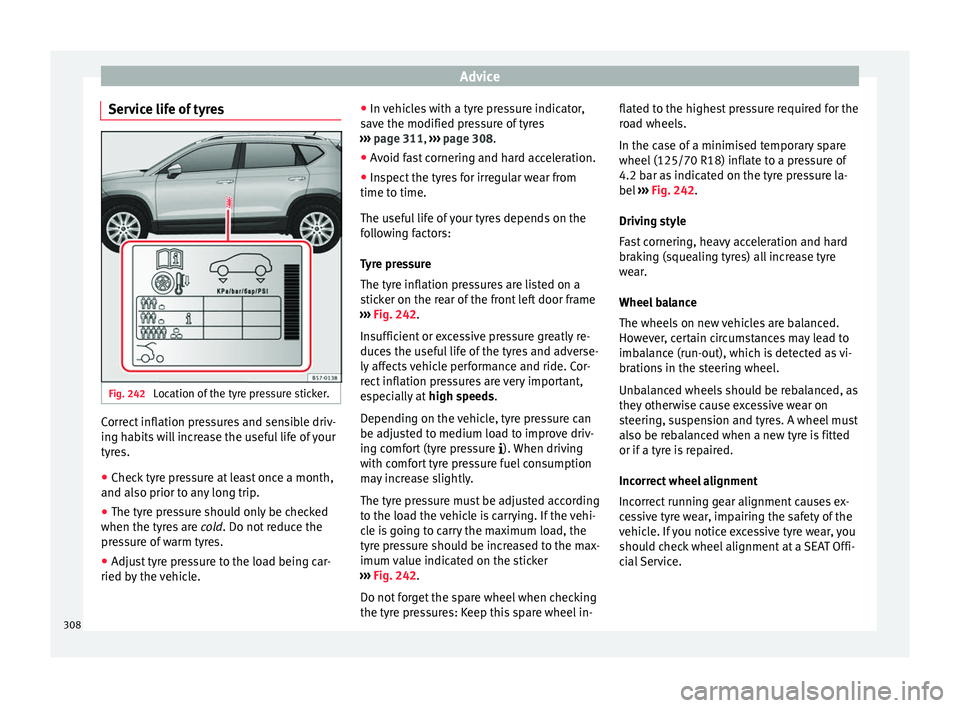
Service life of tyres Fig. 242
Location of the tyre pressure sticker. Correct inflation pressures and sensible driv-
in
g h
ab
its will increase the useful life of your
tyres.
● Check tyre pressure at least once a month,
and also prior to an
y long trip.
● The tyre pressure should only be checked
when the tyre
s are cold. Do not reduce the
pressure of warm tyres.
● Adjust tyre pressure to the load being car-
ried by the
vehicle. ●
In vehic
les with a tyre pressure indicator,
save the modified pressure of tyres
››› page 311, ››› page 308.
● Avoid fast cornering and hard acceleration.
● Inspect the tyres for irregular wear from
time to time.
The usef
ul life of your tyres depends on the
following factors:
Tyre pressure
The tyre inflation pressures are listed on a
sticker on the rear of the front left door frame
››› Fig. 242.
Insufficient or excessive pressure greatly re-
duces the useful life of the tyres and adverse-
ly affects vehicle performance and ride. Cor-
rect inflation pressures are very important,
especially at high speeds.
Depending on the vehicle, tyre pressure can
be adjusted to medium load to improve driv-
ing comfort (tyre pressure ). When driving
with comfort tyre pressure fuel consumption
may increase slightly.
The tyre pressure must be adjusted according
to the load the vehicle is carrying. If the vehi-
cle is going to carry the maximum load, the
tyre pressure should be increased to the max-
imum value indicated on the sticker
››› Fig. 242.
Do not forget the spare wheel when checking
the tyre pressures: Keep this spare wheel in- flated to the highest pressure required for the
roa
d wheels.
In the case of a minimised temporary spare
wheel (125/70 R18) inflate to a pressure of
4.2 bar as indicated on the tyre pressure la-
bel ››› Fig. 242.
Driving style
Fast cornering, heavy acceleration and hard
braking (squealing tyres) all increase tyre
wear.
Wheel balance
The wheels on new vehicles are balanced.
However, certain circumstances may lead to
imbalance (run-out), which is detected as vi-
brations in the steering wheel.
Unbalanced wheels should be rebalanced, as
they otherwise cause excessive wear on
steering, suspension and tyres. A wheel must
also be rebalanced when a new tyre is fitted
or if a tyre is repaired.
Incorrect wheel alignment
Incorrect running gear alignment causes ex-
cessive tyre wear, impairing the safety of the
vehicle. If you notice excessive tyre wear, you
should check wheel alignment at a SEAT Offi-
cial Service.
308
Page 312 of 348

Advice
– If
y
ou wish to fit the vehicle with rims or
tyres different to those installed in manu-
facture, it is advisable to consult a SEAT Of- ficial Service before purchasing them.
The tyres and wheel rims are an essential
part of the vehicle's design. The tyres and
rims approved by SEAT are specially matched
to the characteristics of the vehicle and make
a major contribution to good roadholding
and safe handling ››› .
The s iz
e
s of the rims and tyres approved for
your vehicle are listed in the vehicle docu-
mentation (e.g. EC Certificate of Conformity or
COC document 1)
). The vehicle documentation
varies depending on the country of resi-
dence.
A knowledge of tyre designations makes it
easier to choose the correct tyres. The follow-
ing wording can be read on the sides of the
tyre:
215/60 R16 95V
This contains the following information:
215Tyre width in mm
60Height/width ratio in %
RTyre construction: Radial
16Rim diameter in inches
95Load rating code
VSpeed index The manufacturing date is also indicated on
the ty
r
e sidewall (possibly only on the outer
part):
DOT... 2216...
it means, for example, that the tyre was man-
ufactured in the 22nd week of 2016.
But note that with some types of tyre, the ac-
tual tyre size can differ from the nominal size
marked on the tyre (for instance 215/60 R16
95 V), and there may be significant differen-
ces in the contours of the tyres, even though
the tyres are marked with the same nominal
size. When replacing the tyres, it is therefore
important to make sure that the actual size
of the new tyres does not exceed the dimen-
sions of the factory-approved makes of tyre.
Failure to observe this requirement can af-
fect the clearance needed for the tyres. If the
tyres rub against the bodywork, in certain
circumstances the tyres, running gear or
bodywork and pipes may be damaged, and
vehicle safety could be severely impaired
››› .
If
y
ou use tyres that are approved by SEAT
you can be sure that the actual tyre dimen-
sions will be correct for your vehicle. If you decide to fit a different type of tyre, you must
obtain the ap
propriate manufacturer's certif-
icate from the tyre retailer to confirm that
the tyres are suitable for your vehicle. Keep
this certificate in a safe place.
Your SEAT Official Service will be able to ad-
vise you on which tyres may be fitted to your
vehicle.
It is best to have all servicing of wheels and
tyres performed by a specialised workshop.
They are familiar with the procedure and
have the necessary special tools and spare
parts as well as the proper facilities for dis-
posing of the old tyres respecting the envi-
ronment. WARNING
● It i s
very important to ensure that the tyres
you have chosen have adequate clearance.
When selecting replacement tyres, do not re-
ly entirely on the nominal tyre size marked on
the tyre, since the effective tyre size can dif-
fer significantly depending on the manufac-
turer. Inadequate tyre clearance can result in
damage to the tyres or the vehicle, causing a
serious safety risk. Risk of accident! It may
also invalidate the vehicle's registration for
use on public roads. 1)
COC = certificate of conformity.
310
Page 315 of 348

Wheels
Tyre monitoring indicator Fig. 245
Instrument panel: warning of loss of
ty r
e pr
essure. The tyre monitor indicator compares wheel
r
ev
o
lutions and, with this information, the
tread of each wheel using the ABS sensors. If
the rolling circumference of one or more
wheels has changed, the tyre monitoring in-
dicator will indicate this on the instrument
panel through a warning lamp and a warning
to the driver ››› Fig. 245. When only one spe-
cific tyre is affected, its position within the
vehicle will be indicated.
Loss of pressure: Check left
tyre pressure! Wheel tread change
The wheel tre
ad changes when:
● Tyre pressure is manually changed
● Tyre pressure is insufficient
● Tyre structure is damaged
● The vehicle is unbalanced because of a
load
● The wheel
s on an axle are subject to a
heavier lo
ad (e.g. with a heavy load).
● The vehicle is fitted with snow chains
● The temporary spare wheel is fitted
● The wheel on one axle is changed
There ma
y be a delay in the reaction of the
tyre monitoring indicator or it may not in-
dicate anything under certain circumstances
(e.g. sporty driving, snow-covered or un-
paved roads, or when driving with snow
chains).
Calibrating the tyre monitoring indica-
tor After changing the tyre pressure or replacing
one or mor
e wheel
s, the ty
re monitoring indi-cator must be recalibrated. Do the same, for
examp
le, when the front and rear wheels are
swapped.
● Switch the ignition on.
● Store the new tyre pressure in the Easy
Connect 1)
sys
tem with the button and the
S ET
TINGS function button
››
›
page 33.
● In vehicles without radio : pres
s and hold
down the button with the ignition on,
until an acoustic signal is heard.
When driving, the system self-calibrates the
tyre pressure provided by the driver and the
wheels fitted. After a long journey with varied
speeds the programmed values are collected
and monitored.
With the wheels under very heavy loads, the
tyre pressure must be increased to the total
recommended tyre pressure before the cali-
bration ››› page 319. Note
● The tyr e monit
oring indicator does not
function when there is a fault in the ESC or
ABS ››› page 189. »1)
In vehicles that are not equipped with the Easy
Connect sy
stem, the switch for adjusting tyre pres-
sure is located in the centre console next to the haz-
ard warning lights. 313
Technical data
Advice
Operation
Emergencies
Safety
Page 316 of 348

Advice
●
An erroneou s
indication may be given when
snow chains are in use because they increase
the tread of the wheel. Temporary spare wheel
Genera l
information Fig. 246
Compact temporary spare wheel:
r ai
sed floor p
anel. The temporary spare wheel has been de-
s
igned t
o be u
sed for short periods of time.
Have the tyres checked and replaced as soon
as possible at a SEAT Official Service or at a
specialised workshop.
Please note the following restrictions when
using the compact temporary spare wheel.
The compact temporary spare wheel is de-
signed specifically for this model. For this reason, do not use a temporary spare wheel
from a differ
ent type of vehicle.
Removing the temporary spare wheel – Lift and hold up the floor panel to remove
the temporar
y spare wheel.
– Turn the thumb wheel anti-clockwise
›››
Fig. 246.
– Take out the temporary spare wheel.
Chains
F
or technical reasons, snow chains must not
be used on the temporary spare wheel.
If you have a puncture on one of the front
wheels when using snow chains, fit the tem-
porary spare wheel in place of one of the rear
wheels. Fit the snow chains on the rear wheel
that you have removed and replace the punc-
tured front wheel with this wheel. WARNING
● Aft er fittin
g the temporary spare wheel,
check the tyre pressures as soon as possible.
Failure to do so may cause an accident. The
tyre pressure is listed on the back of the left
front door frame ››› Fig. 242.
● Do not drive at over 80 km/h (50 mph)
when the temporar
y spare wheel is fitted on
the vehicle: risk of accident!
● Never travel more than 200 km using a tem-
porary
spare wheel. ●
Av oid he
avy acceleration, hard braking and
fast cornering: risk of accident!
● Never use more than one temporary spare
wheel at the s
ame time, risk of accident.
● No other type of tyre (normal summer or
winter ty
re) may be fitted on the compact
temporary spare wheel rim.
● If you are driving using the spare wheel,
the ACC
system could automatically switch
off during the journey. Switch off the system
when starting off. Extraction of the spare wheel in vehi-
c
l
e
s with SEAT SOUND 10 speakers
(with subwoofer)* Fig. 247
In the luggage compartment: re-
mo v
e the s
ubwoofer. 314
Page 317 of 348

Wheels
To remove the spare wheel, you must first re-
mo v
e the s
ubwoofer.
● Lift and secure the luggage compartment
floor as de
scribed in ››› page 168.
● Disconnect the subwoofer
››› Fig. 247 1 speaker cable.
●
Turn the securing wheel in an anti-clock-
w i
se dir
ection ››› Fig. 247 2 .
● Remove the s ub
woofer
speaker and the
spare wheel.
● When re-mounting the spare tyre, place the
subwoofer
on the base of the wheel rim with
care. When doing so, the tip of the “FRONT”
arrow on the subwoofer should point for-
ward.
● Reconnect the speaker cable and firmly ro-
tate the sec
uring wheel clockwise so that the
subwoofer system and wheel are firmly in
place.
Winter service
Winter ty
res–
Winter tyres must be fitted on al
l
four
wheels. –
Only u
se winter tyres that are approved for
your vehicle.
– Please note that the maximum permissible
speed for w
inter tyres may be lower than
for summer tyres.
– Also note that winter tyres are no longer ef-
fective when the
tread is worn down.
– After fitting the wheels you must always
check
the tyre pressures. When doing so,
take into account the correct tyre pressures
listed on the rear of the front left door
frame ››› page 308.
In winter road conditions winter tyres will
considerably improve vehicle handling. The
design of summer tyres (width, rubber com-
pound, tread pattern) gives less grip on ice
and snow. This applies particularly to vehi-
cles equipped with wide section tyres or with
high speed tyres (code letters H, V or Y on
the sidewall).
Only use winter tyres of the correct type ap-
proved for your vehicle. The sizes of these
tyres are specified in the vehicle's docu-
ments (e.g. EC Certificate of Conformity or
COC 1)
). The vehicle documentation varies de-
pending on the country of residence. See al-
so ››› page 309. Winter tyres lose a great deal of their proper-
ties when the
tr
ead is worn down to a depth
of 4 mm.
The performance of winter tyres is also se-
verely impaired by ageing, even if the tread is
still much deeper than 4 mm.
Winter tyres are subject to the following max-
imum speed limits according to speed rating
code letter: ›››
Speed rating
code letter
››› page 309Maximum speed limit
Q160 km/h (100 mph)
S180 km/h (112 mph)
T190 km/h (118 mph)
H210 km/h (130 mph)
V240 km/h (149 mph) (please note
relevant restrictions)
W270 km/h (168 mph)
Y300 km/h (186 mph) Vehicles capable of exceeding these speeds
mu
s
t
have an appropriate sticker attached so
that it is visible to the driver. Suitable stickers
are available from the SEAT Official Service »1)
COC = certificate of conformity.
315
Technical data
Advice
Operation
Emergencies
Safety
Page 320 of 348

Technical data
Vehicle data sticker
The v
ehic
le data sticker is under the carpet
trim in the luggage compartment, in the
spare wheel well. A sticker with the vehicle
data is attached to the inside cover of the
Maintenance Programme.
The following information is provided on the
vehicle data sticker: ››› Fig. 248
Vehicle identification number (chassis
number)
Vehicle type, model, capacity, engine
type, finish, engine power and gearbox
type
Engine code, gearbox code, external
paint code and internal equipment code
Optional extras and PR numbers
Identifying letters
The identifying letters of the engine can be
viewed on the instrument panel when the en-
gine is switched off and the ignition is on.
● Hold down the button 0.0/SET on the dash
p anel
f
or more than 15 seconds.
1 2
3
4 Information on fuel consump-
tion
Fuel
c
onsumption Approved consumption values are derived
from me
a
surements performed or supervised
by certified EU laboratories, according to the
legislation in force at the time (for more infor-
mation, see the Publications Office of the Eu-
ropean Union on the EUR-Lex website: © Eu-
ropean Union, http://eur-lex.europa.eu/) and
apply to the specified vehicle characteristics.
The values relating to fuel consumption and
CO 2 emissions can be found in the documen-
tation provided to the purchaser of the vehi-
cle at the time of purchase.
Fuel consumption and CO 2 emissions depend
on the equipment/features of each individual
vehicle, as well as on the driving style, road
conditions, traffic conditions, environmental
conditions, load or number of passengers. Note
In practice, and considering all the factors
mentioned here, c on
sumption values can dif-
fer from those calculated in the current Euro-
pean regulations. Weights
Kerb weight refers to the basic model with a
fuel
t
ank filled to 90% capacity and without
optional extras. The figure quoted includes
75 kg to allow for the weight of the driver.
Special versions, optional equipment fittings
or retro-fitting accessories will increase the
weight of the vehicle ››› .
WARNING
● Ple a
se note that the centre of gravity may
shift when transporting heavy objects; this
may affect vehicle handling and lead to an ac-
cident. Always adjust your speed and driving
style to suit road conditions and require-
ments.
● Never exceed the gross axle weight rating
or the gros
s vehicle weight rating. If the per-
missible axle load or the permissible total
weight is exceeded, the driving characteris-
tics of the vehicle may change, which could
lead to accidents, injuries and damage to the
vehicle. 318
Page 343 of 348

Index
Vertical load on the coupling . . . . . . . . . . . . . . . . 273
V er
tic
al load on the trailer coupling
loading the trailer . . . . . . . . . . . . . . . . . . . . . . . 279
W Warning symbols see Control and warning lamps . . . . . . . . . . . . 119
Warning triangle . . . . . . . . . . . . . . . . . . . . . . . . . . 149
Washing the vehicle . . . . . . . . . . . . . . . . . . . . . . . 285 sensors . . . . . . . . . . . . . . . . . . . . . . . . . . . . . . . 249
things to note . . . . . . . . . . . . . . . . . . . . . . . . . . 132
Weights . . . . . . . . . . . . . . . . . . . . . . . . . . . . . . . . . 318
Welcome light . . . . . . . . . . . . . . . . . . . . . . . . . . . . 149
What negatively affects driving safety? . . . . . . . . 73
Wheel balance . . . . . . . . . . . . . . . . . . . . . . . . . . . 308
Wheel bolts . . . . . . . . . . . . . . . . . . . . . . . . . . . . . . 319 anti-theft . . . . . . . . . . . . . . . . . . . . . . . . . . . . . . . 65
caps . . . . . . . . . . . . . . . . . . . . . . . . . . . . . . . . . . . 65
loosening . . . . . . . . . . . . . . . . . . . . . . . . . . . . . . 65
tightening torque . . . . . . . . . . . . . . . . . . . . . . . 311
Wheels . . . . . . . . . . . . . . . . . . . . . . . . . . . . 307, 319 central wheel trim . . . . . . . . . . . . . . . . . . . . . . . . 64
chains . . . . . . . . . . . . . . . . . . . . . . . . . . . . . . . . 319
changing . . . . . . . . . . . . . . . . . . . . . . . . . . . . 64, 66
new wheels . . . . . . . . . . . . . . . . . . . . . . . . . . . . 309
snow chains . . . . . . . . . . . . . . . . . . . . . . . . . . . . 67
temporary spare wheel . . . . . . . . . . . . . . . . . . 314
Wheel spanner . . . . . . . . . . . . . . . . . . . . . . . . . . . . 95
Wheel trim removing . . . . . . . . . . . . . . . . . . . . . . . . . . . . . . . 65
Windows electric . . . . . . . . . . . . . . . . . . . . . . . . . . . . 18, 139
removing ice . . . . . . . . . . . . . . . . . . . . . . . . . . . 288
Window wiper . . . . . . . . . . . . . . . . . . . . . . . . . . . . 153
Window wiper blade . . . . . . . . . . . . . . . . . . . . . . . . 32
Windscreen heated . . . . . . . . . . . . . . . . . . . . . . . . . . . . . . . . 175 windscreen and rear window wiper blades
chan ging . . . . . . . . . . . . . . . . . . . . . . . . . . . . . . . 71
cleaning . . . . . . . . . . . . . . . . . . . . . . . . . . . . . . . 71
Windscreen and rear window wiper blades . . . . . 97
Windscreen washer . . . . . . . . . . . . . . . . . . . 59, 153
Windscreen washer water capacity . . . . . . . . . . . . . . . . . . . . . . . . . . . . . . . 304
checking . . . . . . . . . . . . . . . . . . . . . . . . . . . . . . 304
topping up . . . . . . . . . . . . . . . . . . . . . . . . . . . . 304
Windscreen wiper and rear window wiper sys- tems
service position . . . . . . . . . . . . . . . . . . . . . . . . . 71
Windscreen wipers . . . . . . . . . . . . . . . . . . . . 32, 153 functions . . . . . . . . . . . . . . . . . . . . . . . . . . . . . . 153
headlight washer system . . . . . . . . . . . . . . . . . 153
heated windscreen washer jets . . . . . . . . . . . . 153
lifting the wiper blade . . . . . . . . . . . . . . . . . . . . 71
rain sensor . . . . . . . . . . . . . . . . . . . . . . . . . . . . 154
replacing the wiper blades . . . . . . . . . . . . . . . . 71
service position . . . . . . . . . . . . . . . . . . . . . . . . . 71
special characteristics . . . . . . . . . . . . . . . . . . . 153
window wiper lever . . . . . . . . . . . . . . . . . . . . . . 153
Winter conditions battery . . . . . . . . . . . . . . . . . . . . . . . . . . . . . . . . 305
defrosting the windows . . . . . . . . . . . . . . . . . . 288
diesel . . . . . . . . . . . . . . . . . . . . . . . . . . . . . . . . . 294
snow chains . . . . . . . . . . . . . . . . . . . . . . . . . . . . 67
taking care of your vehicle . . . . . . . . . . . . . . . . 285
tyres . . . . . . . . . . . . . . . . . . . . . . . . . . . . . . . . . . 315
Winter driving sunroof . . . . . . . . . . . . . . . . . . . . . . . . . . . . . . . 142
Winter operation headlight washers . . . . . . . . . . . . . . . . . . . . . . 154
heated windscreen washer jets . . . . . . . . . . . . 153
salt on the roads . . . . . . . . . . . . . . . . . . . . . . . . 154
Winter tyres . . . . . . . . . . . . . . . . . . . . . . . . . . . . . . 315 four-wheel drive . . . . . . . . . . . . . . . . . . . . . . . . 206
Wireless Charger . . . . . . . . . . . . . . . . . . . . . . . . . 123 X
XDS . . . . . . . . . . . . . . . . . . . . . . . . . . . . . . . . . . . . 190
341