2018 Seat Alhambra fuse
[x] Cancel search: fusePage 99 of 324
Fuses and bulbs Rear light, leftRear light, right
4.Unscrew the attachment screw
››› Fig. 112 2 us-
ing the screwdriver from the vehicle tool kit
››› page 83. The bolt is secured in its position.
5.Extract the rear light from the bodywork by careful-
ly pulling backwards.
6.Pull the red strip on the connector and extract the connector.
7.Disassemble the tail light unit and place it on aflat, clean surface.To change the bulb
8.To release the bulb holder, press on the attach-
ment tabs
››› Fig. 113 1 to 4 in the direction of
the arrow.
9.Remove the bulb holder from the rear light unit.
10.Replace the faulty bulb with a new identical bulb.
11.Place the bulb holder in the tail light unit. The at-
tachment tabs should audibly click into place.
12.Insert the connector and press the red attachment
strip in so that the connector is locked into place. Assembling the rear light units
C
omp
l
ete operations only in the sequence
given:
Rear light, leftRear light, right
13.Carefully insert the tail light unit into the opening in the bodywork. To do this, insert the upper rear light unit guide into the attachment ring.
14.Tighten the white attachment screw using the screwdriver from the vehicle tool kit.
15.Ensure that the tail light unit has been correctly fitted and is firmly secured.
16.
Replace the cap
››› Fig. 112 1 and ro-
tate it 90° in the oppo-
site direction of the ar-
row.Move the 12 V power
socket support up-
wards gently until it is
correctly closed.
17.Close the storage com-
partment.
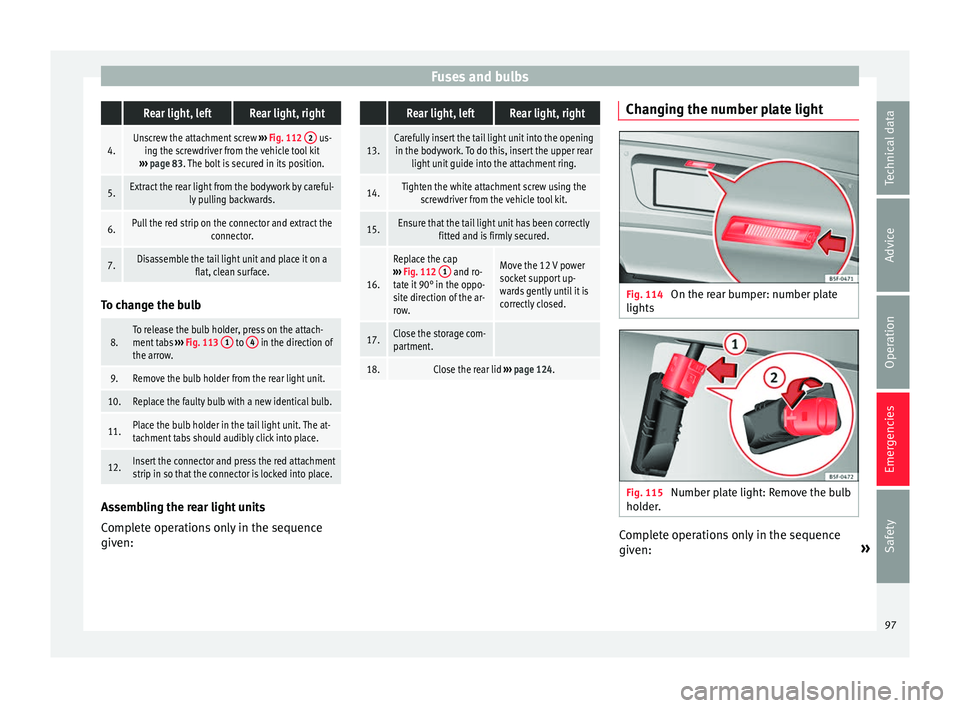
18.Close the rear lid ››› page 124. Changing the number plate light
Fig. 114
On the rear bumper: number plate
lights Fig. 115
Number plate light: Remove the bulb
ho l
der
. Complete operations only in the sequence
giv
en: »
97
Technical data
Advice
Operation
Emergencies
Safety
Page 104 of 324

Operation
Lever for:
– Manual
g
earbox . . . . . . . . . . . . . . . . 193
– Automatic
gearbox . . . . . . . . . . . . . 193
12 volt power socket . . . . . . . . . . . . . .173
Auto Hold switch
. . . . . . . . 208
Electronic parking brake switch
. . . . . . . . . . . . . . . . . . . . . . . . . . . . . . . 188
Start-up push button (Keyless Ac-
ces
s closing and start-up system)
Ignition lock . . . . . . . . . . . . . . . . . . . . . . 183
22 23
24
25
26
27 Pedals
. . . . . . . . . . . . . . . . . . . . . . . . . . . 193
Steering column adjustment lev-
er . . . . . . . . . . . . . . . . . . . . . . . . . . . . . . . . 58
Fuse box cover . . . . . . . . . . . . . . . . . . . 91
Lever for: – Crui
se C
ontrol System (CCS) –
– – – – . .221
Open bonnet lever . . . . . . . . . . . . . . . . 271
Controls for: – Electric w
indows . . . . . . . . . . . . 127
28 29
30
31
32
33 –
Chi l
d
proof locks . . . . . . . . . . . . . 121 Note
● Some of the it ems
of equipment listed here
are fitted only on certain model versions or
are optional extras.
● In versions with the steering wheel on the
right, the lay
out of the control elements is
somewhat different. But the symbols as-
signed to the controls correspond to the sym-
bols used in the versions with the steering
wheel on the left Instruments
V iew of
in
strument panel Fig. 117
Instrument panel, on dash panel. Details of the instruments
››
›
Fig. 117: Clock set button1)
.
1 –
Pr e
s
s the button to select the hour
or minute display.
102
Page 129 of 324

Opening and closing
compartment, close the rear lid and become
trap
ped. A loc
ked vehicle can be subjected to
extremely high and low temperatures, de-
pending on the time of year, resulting in seri-
ous injuries/illness or even death. WARNING
It is possible that the rear lid does not open
c omp l
etely or, if it is open, closes alone if a
large amount of snow has built up on it or if a
luggage rack is fitted. In this case, the rear lid
must be supported. CAUTION
● When us in
g a trailer, ensure that there is
sufficient space to open and close the rear
lid.
● Before opening the rear lid, any kind of
equipment carrier shou
ld be removed, for ex-
ample a bicycle carrier. CAUTION
In case of repeated short-term use, the sys-
tem i s
turned off to avoid overheating.
● When it has cooled, it may be used once
again. Durin
g this time, the rear lid may be
manually opened or closed applying a little
more effort.
● If the vehicle battery is disconnected or the
fuse b
lows when the rear lid is open, the rear
lid system must be re-initialised. To do this,
close the rear lid. Note
Before closing the rear lid, make sure that the
key h
as not been left inside the luggage com-
partment. Controls for the windows
Contr o
ls for the windows: functions Read the additional information carefully
›› ›
page 13
After turning off the ignition, the windows
can be opened and closed for a short time
using the buttons on the door as long as the
driver door or passenger side door is not
open. When the key is removed from the igni-
tion and the driver door is open, all of the
electric windows can be opened or closed at
the same time keeping the button on the
driver’s door pressed down. After a few sec-
onds, the convenience opening or closing
function will begin ›››
page 127.
One-touch opening and closing
The one-touch automatic opening and clos-
ing is used to open or close the windows
completely. It will not be necessary to hold
the button of the corresponding electric win-
dow. For the one-touch closing function: p
u
l
l the
button for the corresponding window up-
wards until it reaches the second position.
For the one-touch opening function: push the
button for the corresponding window down-
wards until it reaches the second position.
To stop the one touch function: push or pull
on the button of the corresponding window.
Resetting one-touch opening and closing
The one-touch opening and closing function
is not active after the vehicle battery has
been disconnected or is flat and will have to
be reset.
● Close all windows and doors.
● Pull the button of the corresponding win-
dow and hol
d it for one second in this posi-
tion.
● Release the button and pull upwards and
hold ag
ain. The one-touch function is now
ready for operation.
The automatic one-touch electric windows
can be reinitialised individually or several at
a time.
Convenience opening/closing
The electric windows can be opened or
closed from outside using the vehicle key: »
127
Technical data
Advice
Operation
Emergencies
Safety
Page 179 of 324

Air conditioning
the rear centre console. These controls are
u sed t
o m
ake the appropriate settings for the
rear seats. Note
● Not a l
l Climatronic buttons are operational
in mode.
● The button is locked in defrost mode.
Controls in the rear seats
Fig. 194
Centre console: details of the con-
tr o
l
s in the rear seats
Rotary control
››› Fig. 194Description
ATemperature selector
BAir flow regulator Air conditioning user instructions
The interior cooling system only works when
the engine i
s
running and fan is switched on.
The air conditioner operates most effectively
with the windows and the electric sliding
panoramic roof closed. However, if the vehi-
cle has heated up after standing in the sun
for some time, the air inside can be cooled
more quickly by opening the windows and
the sliding electric panoramic sunroof briefly.
Setting for conditions of optimal visibility
When the air conditioning is switched on, the
temperature and the air humidity in the vehi-
cle interior drop. In this way, when the out-
side air humidity is high, the windows do not
mist over and comfort for the vehicle occu-
pants is improved.
Electronic manual air conditioning
● Switch off the air recirculation ››
›
page 179.
● Set the fan to the required setting.
● Turn the temperature control to the centre
position.
● Open and dir
ect all the air outlets in the
dash p
anel ›››
page 178.
● Turn the air distribution control to the re-
quired pos
ition. With Climatronic
●
Press the AUTO button.
● Set the temperature to +22°C (+72°F).
● Open and direct all the air outlets in the
d a
sh p
anel ››› page 178.
Climatronic: Switching the measuring units
for temperature on the radio display or the
navigation system installed with the default
settings
Switching the temperature indication from
Celsius to Fahrenheit on the radio display or
the navigation system is carried out in the
menu on the instrument panel
››› page 31.
The cooling system does not switch on
If the air conditioning system cannot be
switched on, this may be caused by the fol-
lowing:
● The engine is not running.
● The fan is switched off.
● The air conditioning fuse is blown.
● The outside temperature is lower than ap-
prox
imately +3°C (+38°F).
● The air conditioner compressor has been
temporari
ly switched off because the engine
coolant temperature is too high. »
177
Technical data
Advice
Operation
Emergencies
Safety
Page 250 of 324

Advice
consumables should be changed at a speci-
ali sed w
ork
shop. Technical services are per-
manently informed of any modifications. WARNING
The incorrect use or handling of fluids or con-
sum ab
les may result in accident, serious in-
jury, burns or intoxication.
● Therefore, fluids must always be stored
closed in their origin
al container.
● Never store fluids in empty food containers
or bottles
as other people may accidentally
drink the fluid.
● Keep all fluids and consumables out of
reac
h of children.
● Read and observe the information and
warning
s given on the fluid containers.
● Only work in the open air or in well-ventila-
ted z
ones, when using products which give
off harmful vapours.
● Never use fuel, turpentine, engine oil, ace-
tone or any
other volatile liquid in the main-
tenance of the vehicle. These are toxic and
highly flammable. They could lead to fire or
explosions! CAUTION
● Only u
se appropriate fluids. Do not confuse
fluids as this can cause serious malfunctions
or engine damage.
● Accessories and other components moun-
ted in front
of the air inlet reduce the cooling effect of the coolant. If the engine is running
under gr
e
at strain in high outside tempera-
tures, it could overheat. For the sake of the environment
Leaking fluids could pollute the environment.
C o l
lect any spilt fluids in suitable containers
and dispose of them in accordance with legis-
lation and with respect for the environment. Technical repairs and replacements
When performing repairs and technical mod-
ific
ation
s,
SEAT's directives must be ob-
served! ››› Unauthorised modifications to the electronic
c
omponents
or sof
tware in the vehicle may
cause malfunctions. Due to the way the elec-
tronic components are linked together in net-
works, other indirect systems may be affec-
ted by the faults. This may significantly affect
the vehicle's performance, increase compo-
nent wear and could mean that the vehicle
registration documents are no longer valid.
Your technical service centre cannot be held
liable for any damage caused by technical
modifications or repairs performed incorrect-
ly.
The technical service centre does not accept
liability for damage resulting from technical
modifications or repairs performed incorrect- ly; neither is the SEAT warranty valid in these
case
s.
SEAT recommends you have any technical
modifications or repairs performed at a tech-
nical service centre and that you use genuine
SEAT spare parts ®
.
Vehicles with special accessories and equip-
ment
The manufacturers of additional equipment
guarantee that the equipment complies with
applicable laws and regulations with respect
to the environment, in particular Directives
2000/53/CE and 2003/11/CE. The first direc-
tive governs the disposal of end-of-life vehi-
cles while the second refers to the restric-
tions on the marketing and use of certain
dangerous substances and preparations.
The vehicle owner should keep the documen-
tation for the additional equipment safely
and hand it over to the scrap yard at the end
of the vehicle's service life. This ensures that
any additional equipment mounted in end-of-
life vehicles is correctly disposed of with re-
spect for the environment. WARNING
Repairs or modifications which are not per-
formed c orr
ectly may result in damage or er-
rors in the vehicle operation, affecting the ef-
fectiveness of the driver assist systems. This
could result in serious accident. 248
Page 261 of 324

Care and maintenance
Caring for and cleaning the ve-
hic l
e int
erior
Introduction The dye used in many modern garments, for
ex
amp
le dark jeans, is not always sufficiently
colour-fast. Seat upholstery (material and
leather), especially when light-coloured, may
visibly discolour if the dye comes out of
clothing (even when used correctly). This is
not an upholstery defect but indicates that
the dye in the item of clothing is not suffi-
ciently colour-fast.
The longer stains or dirt remain on the vehi-
cle surfaces, especially the fabrics covering
the padded upholstery, the more difficult it
becomes to clean and maintain them. If
stains and dirt are left for a long time, it may
be that they are impossible to remove. WARNING
Car-care products may be toxic and hazard-
ous. U s
ing unsuitable car-care products or,
using them in the wrong way, may cause acci-
dents, serious injury, burns or intoxication.
● Keep your car-care products in their origi-
nal
containers.
● Read the instructions.
● Never keep car-care products in empty food
container
s, bottles or other similar contain-
ers. Other people may confuse them. ●
Keep a l
l car-care products out of the reach
of children.
● Some products may give off harmful va-
pours durin
g use. Therefore, they should be
used outdoors in well-ventilated places.
● Never use fuel, turpentine, engine oil, nail-
varnish r
emover or any other volatile product
for washing, maintenance or cleaning. These
are toxic and highly flammable. WARNING
Unsuitable maintenance and cleaning of vehi-
c le c
omponents may impair proper operation
of safety equipment and cause serious injury.
● Maintain and clean vehicle components ac-
cordin
g to the manufacturer's instructions.
● Only use approved or recommended clean-
ing product
s. CAUTION
● Cle
aning products which contain solvents
have a corrosive effect and may damage the
material irreparably.
● Stains and dirt containing aggressive sub-
stanc
es or solvents attack the material and
may damage it irreparably, even when they
are cleaned quickly.
● Dirt and stains should not be allowed to dry
and should be c
leaned as quickly as possible.
● In the case of stubborn stains, take the ve-
hicle t
o a specialised workshop to avoid dam-
age. How to care for the upholstery
To treat and maintain your seat upholstery,
keep the f
o
llowing in mind ››› :
● Before entering the vehicle, close any Vel-
cr o f
asteners that might snag on the uphols-
tery or trim fabric. Any open Velcro fasteners
may damage the trim or upholstery fabrics.
● To prevent damage, avoid direct contact
between sharp dec
orative objects and the
upholstery and trim fabrics. Decorative ob-
jects include zips, rivets and rhinestones on
clothing and belts.
● From time to time, clean the dust that gath-
ers in the per
forations, folds and seams so
that the surfaces of the seats are not dam-
aged by its abrasive effect.
● Make sure clothes are colour-fast to avoid
them running and s
taining the upholstery.
This is especially important if the upholstery
is light in colour. CAUTION
If you ignore this advice, which is important
for m aint
aining your seat upholstery, the fab-
ric may be damaged or stained. Note
SEAT recommends you take the vehicle to a
spec i
alised workshop to treat any stains on
the upholstery caused by the discolouration
of clothing. 259
Technical data
Advice
Operation
Emergencies
Safety
Page 313 of 324

Index
Driving through water . . . . . . . . . . . . . . . . . . . . . 204
Driv in
g tip
s
for a loaded vehicle . . . . . . . . . . . . . . . . . . . . . 152
Driving with a trailer extinguisher . . . . . . . . . . . . . . . . . . . . . . . . . . . 239
technical requirements . . . . . . . . . . . . . . . . . . 238
Duplicate keys . . . . . . . . . . . . . . . . . . . . . . . . . . . 112
Dynamic chassis control (DCC) control . . . . . . . . . . . . . . . . . . . . . . . . . . . . . . . . 233
operation . . . . . . . . . . . . . . . . . . . . . . . . . . . . . . 233
Dynamic Chassis Control (DCC) . . . . . . . . . . . . . . 233 fault . . . . . . . . . . . . . . . . . . . . . . . . . . . . . . . . . . 234
Dynamic headlight range control . . . . . . . . . . . . 135
E E10 see Ethanol (fuel) . . . . . . . . . . . . . . . . . . . . . . . 267
EDL see Electronic differential lock . . . . . . . . . . . . . 205
EDS see Brake assist system . . . . . . . . . . . . . . . . . . 206
Electrical devices . . . . . . . . . . . . 173, 174, 183, 242
Electrical socket trailer . . . . . . . . . . . . . . . . . . . . . . . . . . . . . . . . . 241
Electric child safety lock . . . . . . . . . . . . . . . . . . . 123
Electric sliding door opening and closing . . . . . . . . . . . . . . . . . . . . 122
rollback anti-trap function . . . . . . . . . . . . . . . . 123
Electric windows . . . . . . . . . . . . . . . . . . . . . . . . . . . 13 see Windows . . . . . . . . . . . . . . . . . . . . . . . . . . . 127
Electronic differential lock . . . . . . . . . . . . . . . . . . 205
Electronic differential lock system (EDS) . . . . . . 206
Electronic drive torque management (XDS) . . . . 206
Electronic immobiliser . . . . . . . . . . . . . . . . . . . . . 187 operating fault . . . . . . . . . . . . . . . . . . . . . . . . . 183
Electronic Stability Control (ESC) . . . . . . . . . . . . 205 Emergencies . . . . . . . . . . . . . . . . . . . . . . . . . . . . . . 83
bul bs . . . . . . . . . . . . . . . . . . . . . . . . . . . . . . . . . . 44
changing a wheel . . . . . . . . . . . . . . . . . . . . . . . . 46
emergency towing of the vehicle . . . . . . . . . . . . 51
extinguishers . . . . . . . . . . . . . . . . . . . . . . . . . . . 83
first aid kit . . . . . . . . . . . . . . . . . . . . . . . . . . . . . . 83
fuses . . . . . . . . . . . . . . . . . . . . . . . . . . . . . . . . . . 43
hazard warning lights . . . . . . . . . . . . . . . . . . . 134
jump leads . . . . . . . . . . . . . . . . . . . . . . . . . . . . . 52
puncture . . . . . . . . . . . . . . . . . . . . . . . . . . . . . . . 45
replacing a blown fuse . . . . . . . . . . . . . . . . . . . . 44
vehicle tool kit . . . . . . . . . . . . . . . . . . . . . . . . . . 83
warning triangle . . . . . . . . . . . . . . . . . . . . . . . . . 83
Emergency braking function . . . . . . . . . . . . . . . . 190
Emergency locking and unlocking . . . . . . . . . . . . 90 driver door . . . . . . . . . . . . . . . . . . . . . . . . . . . . . 10
panoramic sliding sunroof . . . . . . . . . . . . . . . . . 15
passenger side door . . . . . . . . . . . . . . . . . . . . . . 11
rear lid . . . . . . . . . . . . . . . . . . . . . . . . . . . . . . . . . 12
Emergency unlocking doors . . . . . . . . . . . . . . . . . . . . . . . . . . . . . . . . . . 10
rear lid . . . . . . . . . . . . . . . . . . . . . . . . . . . . . . . . . 12
Emission control system control and warning lamps . . . . . . . . . . . . . . . 202
Emissions data . . . . . . . . . . . . . . . . . . . . . . . . . . . 298
Engine assisted starting . . . . . . . . . . . . . . . . . . . . . . . . . 52
noises . . . . . . . . . . . . . . . . . . . . . . . . . . . . . . . . 187
running in . . . . . . . . . . . . . . . . . . . . . . . . . . . . . 199
Engine and ignition . . . . . . . . . . . . . . . . . . . . . . . 183 12 volt power sockets . . . . . . . . . . . . . . . . . . . 173
ignition lock . . . . . . . . . . . . . . . . . . . . . . . . . . . 184
immobiliser . . . . . . . . . . . . . . . . . . . . . . . . . . . . 187
pre-heating . . . . . . . . . . . . . . . . . . . . . . . . . . . . 186
starting the engine . . . . . . . . . . . . . . . . . 184, 186
starting the engine with Keyless Access . . . . . 185 stopping the engine . . . . . . . . . . . . . . . . . . . . . 187
unauthori
sed vehicle key . . . . . . . . . . . . . . . . . 184
Engine bonnet . . . . . . . . . . . . . . . . . . . . . . . . . . . 271
Engine compartment . . . . . . . . . . . . . . . . . . 13, 271 battery . . . . . . . . . . . . . . . . . . . . . . . . . . . . 42, 283
brake fluid . . . . . . . . . . . . . . . . . . . . . . . . . 42, 281
coolant . . . . . . . . . . . . . . . . . . . . . . . . . . . 41, 277
engine oil . . . . . . . . . . . . . . . . . . . . . 40, 274, 277
opening and closing . . . . . . . . . . . . . . . . . . . . 273
windscreen washer reservoir . . . . . . . . . . 42, 283
Engine coolant . . . . . . . . . . . . . . . . . . . . . . . . . . . . 41 checking the level . . . . . . . . . . . . . . . . . . 277, 280
control and warning lamps . . . . . . . . . . . . . . . 278
G12 plus-plus . . . . . . . . . . . . . . . . . . . . . . 41, 279
G12 plus-plus . . . . . . . . . . . . . . . . . . . . . . . . . . . 41
G13 . . . . . . . . . . . . . . . . . . . . . . . . . . . . . . 41, 279
specifications . . . . . . . . . . . . . . . . . . . . . . 41, 279
tank filler neck . . . . . . . . . . . . . . . . . . . . . . . . . 280
temperature indicator . . . . . . . . . . . . . . . . . . . 278
topping-up . . . . . . . . . . . . . . . . . . . . . . . . . . . . 280
Engine data . . . . . . . . . . . . . . . . . . . . . . . . . . . . . . 300
Engine management . . . . . . . . . . . . . . . . . . . . . . 202 control lamp . . . . . . . . . . . . . . . . . . . . . . . . . . . 202
Engine oil . . . . . . . . . . . . . . . . . . . . . . . . . . . 40, 274 checking oil level . . . . . . . . . . . . . . . . . . . . . . . 276
consumption . . . . . . . . . . . . . . . . . . . . . . 276, 277
control and warning lamps . . . . . . . . . . . . . . . 275
dipstick . . . . . . . . . . . . . . . . . . . . . . . . . . . . . . . 276
specifications . . . . . . . . . . . . . . . . . . . . . . . . . . 275
topping up . . . . . . . . . . . . . . . . . . . . . . . . . . . . 277
Environment environmental compatibility . . . . . . . . . . . . . . 200
Environmental ecological driving . . . . . . . . . . . . . . . . . . . . . . . 200
Environmental tip refuelling . . . . . . . . . . . . . . . . . . . . . . . . . . . . . . 266
Equipment . . . . . . . . . . . . . . . . . . . . . . . . . . . . . . 247
311
Page 314 of 324

Index
ESC electr
onic
stability control . . . . . . . . . . . . . . . . 205
Ethanol (fuel) . . . . . . . . . . . . . . . . . . . . . . . . . . . . 267
Event Data Recorder . . . . . . . . . . . . . . . . . . . . . . . 250
Exhaust gas purification system . . . . . . . . . . . . . 202
Exterior mirrors adjusting . . . . . . . . . . . . . . . . . . . . . . . . . . . . . . . 18
vehicle care . . . . . . . . . . . . . . . . . . . . . . . . . . . . 255
Exterior rear view mirrors control of the function . . . . . . . . . . . . . . . . . . . 142
electric exterior mirrors . . . . . . . . . . . . . . . . . . 142
exterior . . . . . . . . . . . . . . . . . . . . . . . . . . . . . . . 141
folding the rear view mirrors . . . . . . . . . . . . . . 142
Exterior view . . . . . . . . . . . . . . . . . . . . . . . . . . . . . 7, 8
Extinguisher driving with a trailer . . . . . . . . . . . . . . . . . . . . . 239
F Fabrics: cleaning . . . . . . . . . . . . . . . . . . . . . . . . . 259
Fastening rings . . . . . . . . . . . . . . . . . . . . . . . . . . . 160
Fault dynamic chassis control (DCC) . . . . . . . . . . . . 234
panoramic sunroof . . . . . . . . . . . . . . . . . . . . . . 129
park assist system . . . . . . . . . . . . . . . . . . . . . . 215
parking distance warning system . . . . . . . . . . 212
rear assist . . . . . . . . . . . . . . . . . . . . . . . . . . . . . 220
Fault memory connector . . . . . . . . . . . . . . . . . . . . . . . . . . . . . 251
reading . . . . . . . . . . . . . . . . . . . . . . . . . . . . . . . 251
Filling capacities AdBlue tank . . . . . . . . . . . . . . . . . . . . . . . . . . . 268
Filling the tank . . . . . . . . . . . . . . . . . . . . . . 264, 266
Fire extinguisher . . . . . . . . . . . . . . . . . . . . . . . . . . . 83
First-aid kit storage . . . . . . . . . . . . . . . . . . . . . . . . . . . . . . . . 83
Fitting tow hitch . . . . . . . . . . . . . . . . . . . . . . . . . . . . . . 244 Floor mats . . . . . . . . . . . . . . . . . . . . . . . . . . . . . . . . 61
Fluid Level
control . . . . . . . . . . . . . . . . . . . . . . . . . 40
Fog light . . . . . . . . . . . . . . . . . . . . . . . . . . . . . . . . . 26
Folding down rear seats load space . . . . . . . . . . . . . . . . . . . . . . . . . . . . . 155
Folding table . . . . . . . . . . . . . . . . . . . . . . . . . . . . . 170
Folding the backrest of the front passenger seat 151
Folding wheel chocks . . . . . . . . . . . . . . . . . . . . . . . 84
Front airbags . . . . . . . . . . . . . . . . . . . . . . . . . . . . . 72
Front passenger front airbag control lamp . . . . . . . . . . . . . . . . . . . . . . . . . . . . 74
disconnection . . . . . . . . . . . . . . . . . . . . . . . . . . . 74
Front seat manual adjustment . . . . . . . . . . . . . . . . . . . . . . 15
Front wiper blades change . . . . . . . . . . . . . . . . . . . . . . . . . . . . . . . . 55
cleaning . . . . . . . . . . . . . . . . . . . . . . . . . . . . . . . 55
Fuel . . . . . . . . . . . . . . . . . . . . . . . . . . . . . . . . 40, 267 consumption . . . . . . . . . . . . . . . . . . . . . . . . . . . 298
diesel . . . . . . . . . . . . . . . . . . . . . . . . . . . . . . . . . 268
refuelling . . . . . . . . . . . . . . . . . . . . . . . . . . . . . . 267
savings . . . . . . . . . . . . . . . . . . . . . . . . . . . . . . . 200
Fuel consumption why does fuel consumption increase? . . . . . . 203
Fuel gauge control lamp . . . . . . . . . . . . . . . . . . . . . . . . . . . 266
petrol . . . . . . . . . . . . . . . . . . . . . . . . . . . . . . . . . 266
Fuel tank cap opening and closing . . . . . . . . . . . . . . . . . . . . . 40
Fuel tank flap opening and closing . . . . . . . . . . . . . . . . . . . . . 40
Function control tow hitch . . . . . . . . . . . . . . . . . . . . . . . . . . . . . . 242
Fuses . . . . . . . . . . . . . . . . . . . . . . . . . . . . . . . . . 43, 91 fuse box . . . . . . . . . . . . . . . . . . . . . . . . . . . . . . . . 91
identification using colours . . . . . . . . . . . . . . . . 43
identifying blown fuses . . . . . . . . . . . . . . . . . . . 44 preparation before replacing . . . . . . . . . . . . . . . 44
repl
acing . . . . . . . . . . . . . . . . . . . . . . . . . . . . . . . 44
G
Gearbox . . . . . . . . . . . . . . . . . . . . . . . . . . . . . . . . . 193 emergency release . . . . . . . . . . . . . . . . . . . . . . . 36
Gearbox lever . . . . . . . . . . . . . . . . . . . . . . . . . . . . . 35
Gear change . . . . . . . . . . . . . . . . . . . . . . . . . . . . . . 35 automatic gearbox . . . . . . . . . . . . . . . . . . 36, 194
changing gears manually . . . . . . . . . . . . . . . . . 193
gear recommendation . . . . . . . . . . . . . . . . . . . 197
manual gear change . . . . . . . . . . . . . . . . . . . . . . 35
putting the vehicle in gear (automatic gear-box) . . . . . . . . . . . . . . . . . . . . . . . . . . . . . . . . 194
putting the vehicle in gear (manual gearbox) 193
Tiptronic . . . . . . . . . . . . . . . . . . . . . . . . . . . . . . 196
Gear engaged . . . . . . . . . . . . . . . . . . . . . . . . . . . . . 35
General instrument panel instrument panel . . . . . . . . . . . . . . . . . . . . . . . 101
General overview of the engine compartment . . 274
Generator . . . . . . . . . . . . . . . . . . . . . . . . . . . . . . . 284
Glove compartment . . . . . . . . . . . . . . . . . . . . . . . 168
Glove compartment lighting . . . . . . . . . . . . . . . . 136
H
Hand brake see Parking brake . . . . . . . . . . . . . . . . . . . . . . . 190
Hazard warning lights . . . . . . . . . . . . . . . . . 26, 134
Head-on collisions and the laws of physics . . . . . 64
Headlamp range adjustment . . . . . . . . . . . . . . . . 101
Headlight range control . . . . . . . . . . . . . . . . . . . . 135
Headlights adaptive headlights . . . . . . . . . . . . . . . . . . . . . 132
driving abroad . . . . . . . . . . . . . . . . . . . . . . . . . 135
headlight adjustment . . . . . . . . . . . . . . . . . . . . 133
headlight washers . . . . . . . . . . . . . . . . . . . . . . 138
312