2018 RENAULT ZOE air condition
[x] Cancel search: air conditionPage 141 of 226
3.15
Stopping the programmed air
conditioning
The air conditioning stops automati-
cally around ten minutes after the set
end time.
However, the function can be deacti-
vated if:
– the charging socket is disconnected;
– the “Remote Activation” function is activated – please see the informa-
tion on “Air conditioning: remote acti-
vation” in Section 2;
– the traction battery charging level is lower than 15% or, depending on the
vehicle, 30%Driver’s responsibility
when parking or stopping
the vehicle
Never leave an animal,
child or adult who is not self-suffi-
cient alone on your vehicle, even for
a short time.
In hot and/or sunny weather, please
remember that the temperature
inside the passenger compartment
increases very quickly.
RISK OF DEATH OR SERIOUS
INJURY.
AIR CONDITIONING: programming (4/4)
Connected services
The air conditioning can also be acti-
vated using the connected services.
For more information regarding the op-
erating conditions, please contact an
authorised dealer.
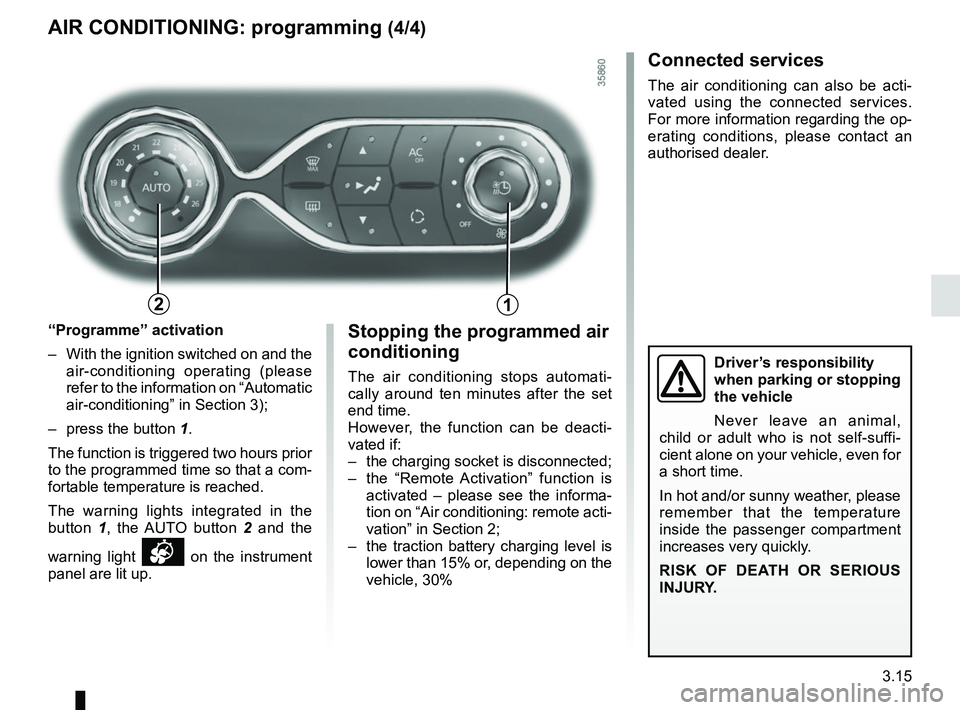
“Programme” activation
– With the ignition switched on and the air-conditioning operating (please
refer to the information on “Automatic
air-conditioning” in Section 3);
– press the button 1.
The function is triggered two hours prior
to the programmed time so that a com-
fortable temperature is reached.
The warning lights integrated in the
button 1, the AUTO button 2 and the
warning light
on the instrument
panel are lit up.
12
Page 142 of 226

3.16
1
2
FRAGRANCE DIFFUSER.
Controls
1 Fragrance diffuser outlet
2 Capsule housing
Fragrance selection
On the display A, select “Menu”, “vehi-
cle”, “well-being”, “fragrance diffuser”,
then one of the two fragrances.
Fragrance diffuser intensity
settings
Select one of the five fragrance intensi-
ties by pressing “-” or “+”.
The intensity and uniformity will also
vary depending on the air distribution
and the air-conditioning control.
To stop distribution, select “Stop”.
NB: If the fan control is in position 0
(stop), the fragrance diffuser is not ac-
tivated.
Replacing a fragrance
diffuser capsule
Press the capsule housing 2 to open it.
Replace capsule, then press the cap-
sule housing 2 to close it.
NB: if used for 1 hour a day, a capsule
may last for approximately 3 months.
You can buy capsules from Authorised
Dealers.
Precautions
– Always use capsules recommended by our Technical Department.
– Do not open or refill the diffuser cap- sule.
– Keep out of reach for children.
– Do not expose the diffuser capsule to direct sunlight.
– In the event of contact with the eyes or skin, rinse in plenty of safe drink-
ing water. If necessary, consult a
doctor.
– Do not use the fragrance diffuser capsule for anything other than its
intended purpose.
For safety reasons, do not
replace the fragrance dif-
fuser capsule while driving.
A
Page 143 of 226

3.17
AIR IONIZER
Selecting the operating mode
Air conditioning in operation, on the dis-
play A, select “Menu”, “Vehicle”, “Care”
then “Ioniser ”.
Select one of the two modes or stop dif-
fusion:
– CLEAN : helps to reduce bacteria and allergenic particles present in
the air;
– RELAX: provides a clean and relax- ing driving environment by emitting
ions;
– Stop (stop diffusion).
Activating the ioniser in CLEAN
mode at each engine start-up
To activate CLEAN mode at each
engine start-up, check the line “Start
ioniser at each vehicle start” and con-
firm.
NB:
– if the fan control is set to position 0 (stop), activating the ioniser at each
engine start-up will automatically op-
erate the fan for at least around
10 seconds.
– if the air distribution setting does not feed air to the central air vents, the
ioniser is not activated.
Do not close the vents while the ion-
iser is activated. This enables a uni-
form distribution of ions.
A
Page 144 of 226

3.18
AIR CONDITIONING: information and operating instructions (1/2)
Do not open the refriger-
ant fluid circuit. The fluid
may damage eyes or skin.
Advice on use
In some situations, (air conditioning
off, air recirculation activated, ventila-
tion speed at zero or low, etc.) you may
notice that condensation starts to form
on the windows and windscreen.
If there is condensation, use the “Clear
View” function to remove it, then use
the air conditioning in automatic mode
to stop it forming again.
Maintenance
Refer to the Maintenance Document
for your vehicle for the inspection fre-
quency.
Range
It is normal to notice an increase in
energy usage when the air conditioning
is operating. Recommendations to limit energy
consumption and maintain the
range of the vehicle:
Drive with the air vents open and the
windows closed. If the vehicle has been
parked in the sun, open the doors for a
few moments to let the hot air escape
before starting the engine.
Favour:
– before departure, the use of the air-
conditioning programming or remote
activation. Please refer to the infor-
mation on “Air-conditioning: pro-
gramming” and “Air-conditioning:
remote activation” in Section 2);
– during your journeys, using ECO mode. Please see information about
“ECO mode function” in Section 2.
Operating faults
As a general rule, contact your ap-
proved dealer in the event of an oper-
ating fault.
– Reduction in de-icing, demisting
or air conditioning performance.
This may be caused by the passen-
ger compartment filter cartridge be-
coming clogged.
– No hot or cold air is being pro-
duced. Check that the controls are
set correctly and that the fuses are
sound. Otherwise, switch off the
system.
Presence of water under the
vehicle
After prolonged use of the air condi-
tioning system, it is normal for water
to be present under the vehicle. This is
caused by condensation.
Vehicles equipped with
modeECO
Once activated, ECO mode may
reduce air conditioning perform-
ance. Please refer to the informa-
tion on “Driving advice, Eco-driving”
in Section 2.
Use the air conditioning system reg-
ularly, even in cold weather, running
it at least once a month for approxi-
mately 5 minutes.
Page 145 of 226

3.19
AIR CONDITIONING: information and operating instructions (2/2)
The refrigerant circuit may contain
fluorinated greenhouse gases.
Depending on the vehicle, you will find
the following information on label A af-
fixed inside the engine compartment.
The presence and location of the infor-
mation on label A depends on the ve-
hicle.
AAA
Do not open the refrigerant
fluid circuit. The fluid may
damage eyes or skin.
ÑType of refrigerant fluid
Type of oil in the air condi-
tioning circuit
\bInflammable product
Consult the driver’s hand-
book
Maintenance
Quantity of refrigerant
fluid present in the ve-
hicle.
x.xxx kg
Global Warming
Potential (CO2 equi-
valent).
GWP xxxxx
Quantity in weight and
in CO2 equivalent.
CO2 eq
x.xx t
Before performing any
action in the engine com-
partment, the ignition must
be switched off (please see
the information on “Starting, stop-
ping the engine” in Section 2).
Page 177 of 226
5.3
TYRE PRESSURE KIT (1/3)
A
B
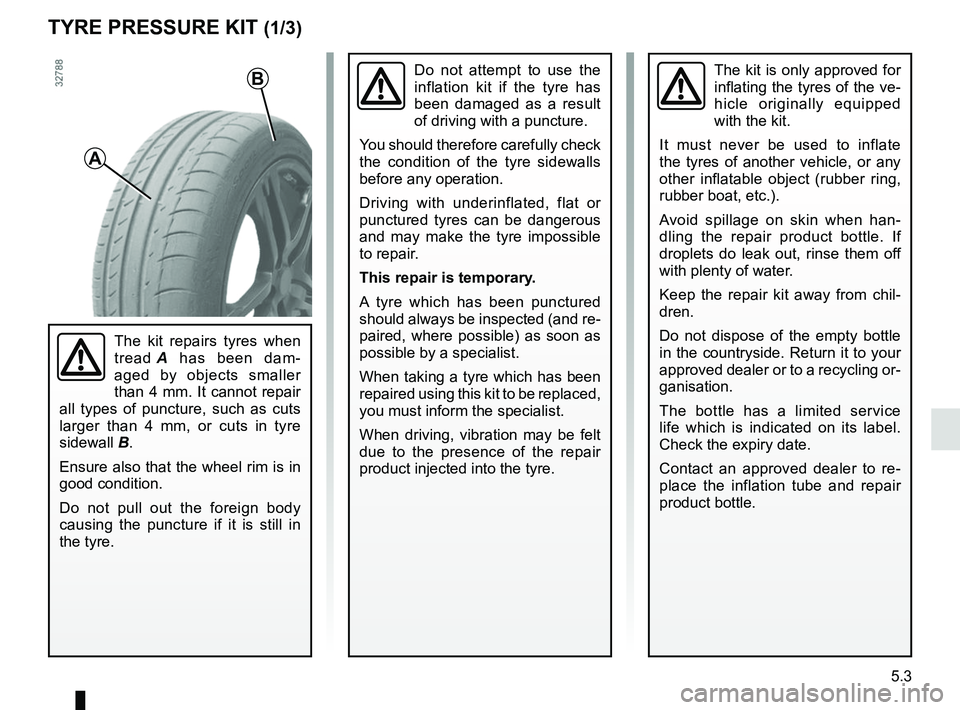
The kit repairs tyres when
tread A has been dam-
aged by objects smaller
than 4 mm. It cannot repair
all types of puncture, such as cuts
larger than 4 mm, or cuts in tyre
sidewall B.
Ensure also that the wheel rim is in
good condition.
Do not pull out the foreign body
causing the puncture if it is still in
the tyre.
Do not attempt to use the
inflation kit if the tyre has
been damaged as a result
of driving with a puncture.
You should therefore carefully check
the condition of the tyre sidewalls
before any operation.
Driving with underinflated, flat or
punctured tyres can be dangerous
and may make the tyre impossible
to repair.
This repair is temporary.
A tyre which has been punctured
should always be inspected (and re-
paired, where possible) as soon as
possible by a specialist.
When taking a tyre which has been
repaired using this kit to be replaced,
you must inform the specialist.
When driving, vibration may be felt
due to the presence of the repair
product injected into the tyre.The kit is only approved for
inflating the tyres of the ve-
hicle originally equipped
with the kit.
It must never be used to inflate
the tyres of another vehicle, or any
other inflatable object (rubber ring,
rubber boat, etc.).
Avoid spillage on skin when han-
dling the repair product bottle. If
droplets do leak out, rinse them off
with plenty of water.
Keep the repair kit away from chil-
dren.
Do not dispose of the empty bottle
in the countryside. Return it to your
approved dealer or to a recycling or-
ganisation.
The bottle has a limited service
life which is indicated on its label.
Check the expiry date.
Contact an approved dealer to re-
place the inflation tube and repair
product bottle.
Page 196 of 226

The following advice will enable you to carry out quick, temporary repai\
rs. For safety reasons you should always contact
an approved dealer as soon as possible.
FAULTSPO")
5.22
OPERATING FAULTS (1/4)
The following advice will enable you to carry out quick, temporary repai\
rs. For safety reasons you should always contact
an approved dealer as soon as possible.
FAULTSPOSSIBLE CAUSESWHAT TO DO
Impossible to charge the traction bat-
tery.
The charging flap warning light flashes
red. The outdoor temperature is lower
than -26°C.
Recharge your vehicle in a more suitable
environment. If necessary, please refer to
the information on “Towing: breakdown re-
covery” in Section 5.
No electrical current in the wall
socket or poor connection of cable
to domestic socket. Check your installation (circuit breaker, pro-
grammer, etc.).
Check the connections (socket, etc.).
Please refer to the information on “Electric
vehicle: charging” in Section 1.
The cord is defective. Please see an authorised dealer to replace
it.
Impossible to charge the traction bat-
tery.
The charging flap warning light flashes
blue. The charging cord is not correctly
locked to the vehicle. Plug the charging cord correctly to the ve-
hicle. Refer to the information on “Electric
vehicle: charging” in Section 1.
The activation of the air conditioning
using the card RENAULT fails to work. The card RENAULT is outside its
area of action.Step closer to the vehicle.
One of the usage conditions is not
complied with. Please refer to the information on “Air-
conditioning: remote control activation” in
Section 3.
Page 197 of 226

5.23
OPERATING FAULTS (2/4)
FAULTSPOSSIBLE CAUSESWHAT TO DO
The programmable air conditioning
fails to work. One of the usage conditions is not
complied with (the traction battery
is not charged, etc).Please refer to the information on “Air-
conditioning: programming” in Section 3.
The remote control does not lock or
unlock the doors. The remote control battery is flat. Use the emergency key.
Use of appliances operating on
the same frequency as the remote
control (mobile phone, etc.).Stop using the devices or use the key.
Vehicle located in a high electro-
magnetic radiation zone.
Secondary 12 V battery dis-
charged. Replace the battery or have it replaced. You
can still lock/unlock and start your vehicle (refer
to the information on “Locking, unlocking the
opening elements” in Section 1 and “Starting,
stopping the engine” in Section 2).
The steering column remains
locked. Steering wheel locked.
Move the steering wheel while pressing the
engine start button (refer to Section 2 “Starting
the engine”).
Vibrations. Tyres not inflated to correct pres-
sures, incorrectly balanced or dam-
aged. Check the tyre pressures. If this is not the
problem, have them checked by an approved
Dealer.