Page 101 of 226
2.7
DRIVING ADVICE, ECO-DRIVING (1/3)
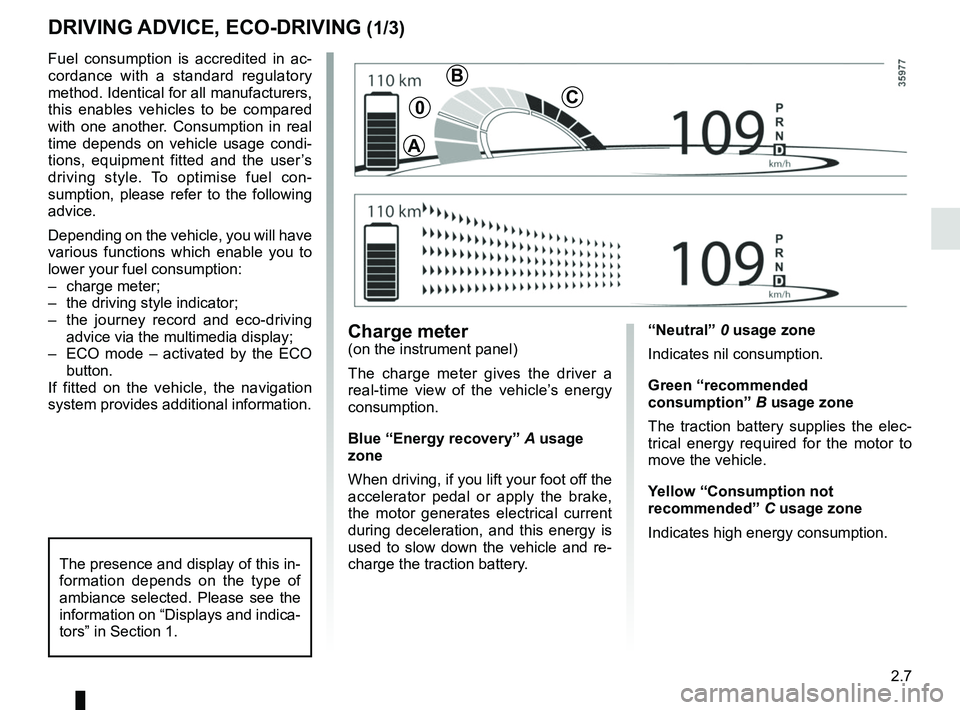
“Neutral” 0 usage zone
Indicates nil consumption.
Green “recommended
consumption” B usage zone
The traction battery supplies the elec-
trical energy required for the motor to
move the vehicle.
Yellow “Consumption not
recommended” C usage zone
Indicates high energy consumption.Charge meter(on the instrument panel)
The charge meter gives the driver a
real-time view of the vehicle’s energy
consumption.
Blue “Energy recovery” A usage
zone
When driving, if you lift your foot off the
accelerator pedal or apply the brake,
the motor generates electrical current
during deceleration, and this energy is
used to slow down the vehicle and re-
charge the traction battery.
Fuel consumption is accredited in ac-
cordance with a standard regulatory
method. Identical for all manufacturers,
this enables vehicles to be compared
with one another. Consumption in real
time depends on vehicle usage condi-
tions, equipment fitted and the user’s
driving style. To optimise fuel con-
sumption, please refer to the following
advice.
Depending on the vehicle, you will have
various functions which enable you to
lower your fuel consumption:
– charge meter;
– the driving style indicator;
– the journey record and eco-driving
advice via the multimedia display;
– ECO mode – activated by the ECO button.
If fitted on the vehicle, the navigation
system provides additional information.
The presence and display of this in-
formation depends on the type of
ambiance selected. Please see the
information on “Displays and indica-
tors” in Section 1.
A
B
C0
Page 107 of 226

2.13
TYRE PRESSURE LOSS WARNING (1/3)
1
When fitted to the vehicle, this system
notifies the driver if one or more tyres
lose pressure.
Operating principle
Each wheel (except for the emergency
spare wheel) has a sensor in the infla-
tion valve which periodically measures
the tyre pressure while driving.
Warning light
1 comes on to
alert the driver in the event of insuffi-
cient pressure (deflated wheel, punctu-
red tyre, etc.).
Resetting the standard level
for the tyre pressures
This should be done:
– when the standard tyre pressure needs to be changed to adapt to
usage conditions (empty, carrying a
load, motorway driving, etc.);
– after swapping a wheel (however this practice is not recommended);
– after changing a wheel.
It should always be done after checking
the tyre pressure of all four tyres when
cold.
Tyre pressures must correspond to the
current usage of the vehicle (empty,
carrying a load, motorway driving, etc.).
This function is an additio-
nal driving aid.
However, the function does
not take the place of the
driver. It cannot, therefore, under
any circumstances replace the vi-
gilance or the responsibility of the
driver.
Check the tyre pressures, including
the emergency spare wheel, once a
month.
Page 151 of 226
3.25
PASSENGER COMPARTMENT STORAGE, FITTINGS (3/3)
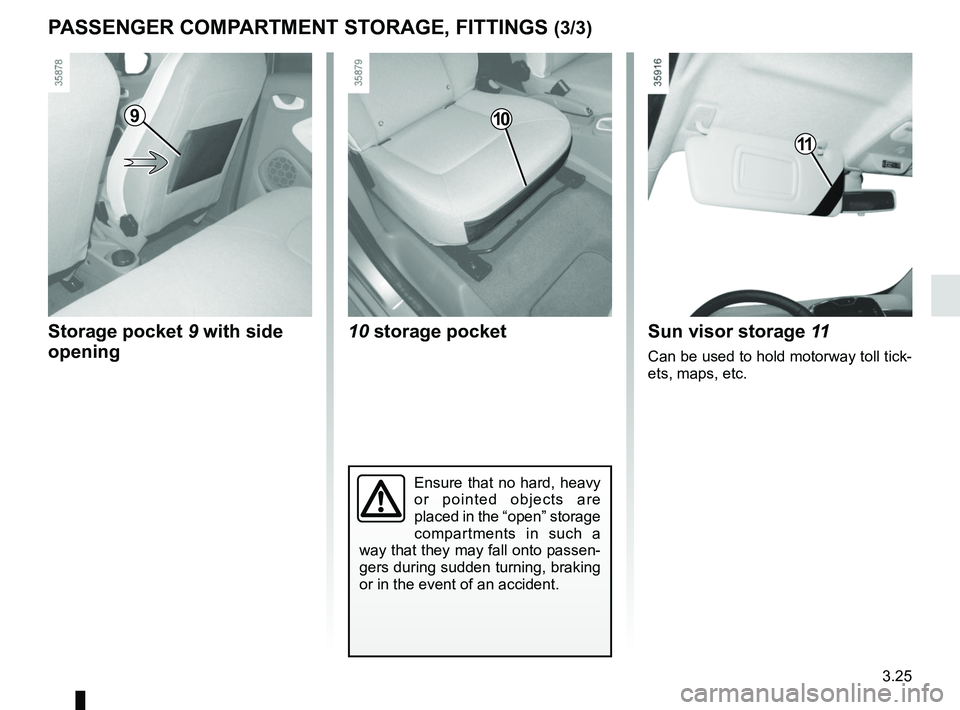
Storage pocket 9 with side opening
910
10 storage pocketSun visor storage 11
Can be used to hold motorway toll tick-
ets, maps, etc.
11
Ensure that no hard, heavy
or pointed objects are
placed in the “open” storage
compartments in such a
way that they may fall onto passen-
gers during sudden turning, braking
or in the event of an accident.
Page 180 of 226
5.6
TYRES (1/3)
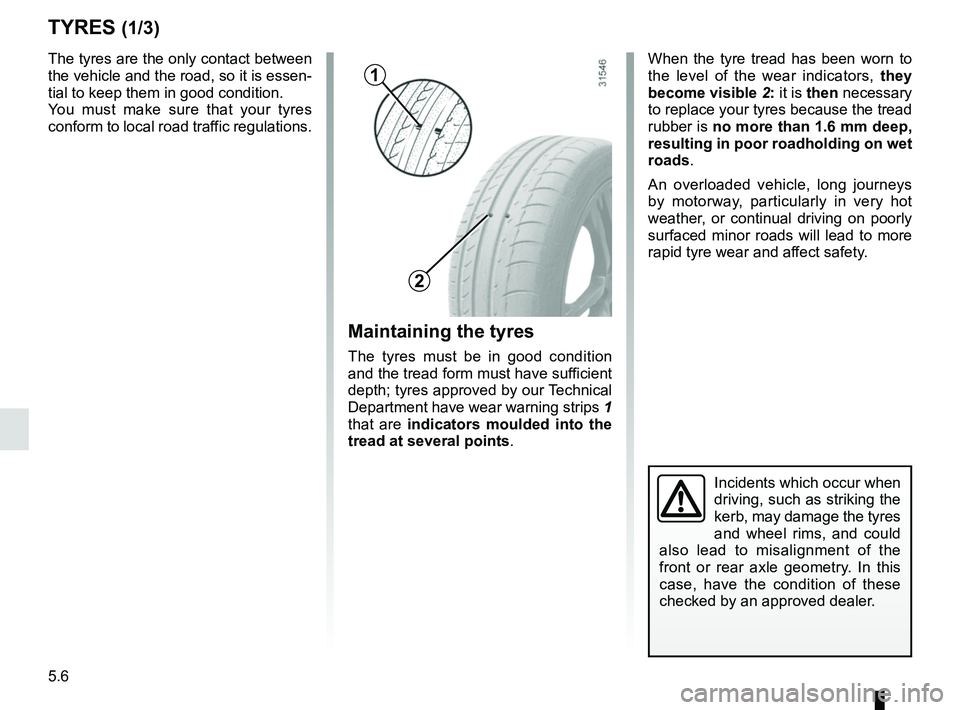
Maintaining the tyres
The tyres must be in good condition
and the tread form must have sufficient
depth; tyres approved by our Technical
Department have wear warning strips 1
that are indicators moulded into the
tread at several points.
The tyres are the only contact between
the vehicle and the road, so it is essen-
tial to keep them in good condition.
You must make sure that your tyres
conform to local road traffic regulations.
When the tyre tread has been worn to
the level of the wear indicators,
they
become visible 2: it is then necessary
to replace your tyres because the tread
rubber is no more than 1.6 mm deep,
resulting in poor roadholding on wet
roads.
An overloaded vehicle, long journeys
by motorway, particularly in very hot
weather, or continual driving on poorly
surfaced minor roads will lead to more
rapid tyre wear and affect safety.
Incidents which occur when
driving, such as striking the
kerb, may damage the tyres
and wheel rims, and could
also lead to misalignment of the
front or rear axle geometry. In this
case, have the condition of these
checked by an approved dealer.
2
1
Page 192 of 226

5.18
WINDSCREEN WIPER BLADES
Replacing wiper blades 1
With the ignition on and the engine
switched off, lower the windscreen
wiper stalk completely: they stop
slightly away from the bonnet.
Lift wiper arm 3 , pull tab 2 (move-
ment A) and push the blade upwards.
To refit
Slide the blade along the arm until it
clips on. Make sure that the blade is
correctly locked in position. Return the
windscreen wiper stalk to the park po-
sition.
1
2
3
Keep monitoring the condition of the
wiper blades. How long they last de-
pends on you:
– clean the blades and the wind- screen regularly with soapy
water;
– do not use them when the wind- screen is dry;
– free them from the windscreen when they have not been used
for a long time.
A
– In frosty weather, make
sure that the wiper blades
are not stuck by ice (to
avoid the risk of the motor
overheating).
– Check the condition of the wiper
blades.
They should be replaced as soon
as they become less efficient: ap-
proximately once a year.
When changing the blade, when it
has been removed, do not let the
wiper arm fall against the window:
risk of breaking the window.Rear screen wiper blade 4
– Lift wiper arm 6;
– pivot blade 4 until some resistance is
met (movement C);
– depending on the vehicle, press tab 5, then remove the blade by pull-
ing it (movement B).
To refit
To refit the wiper blade, proceed in re-
verse order to removal. Make sure that
the blade is correctly locked in position.
4
5
B
C
6
Page 198 of 226
5.24
Electrical equipmentPOSSIBLE CAUSESACTION REQUIRED
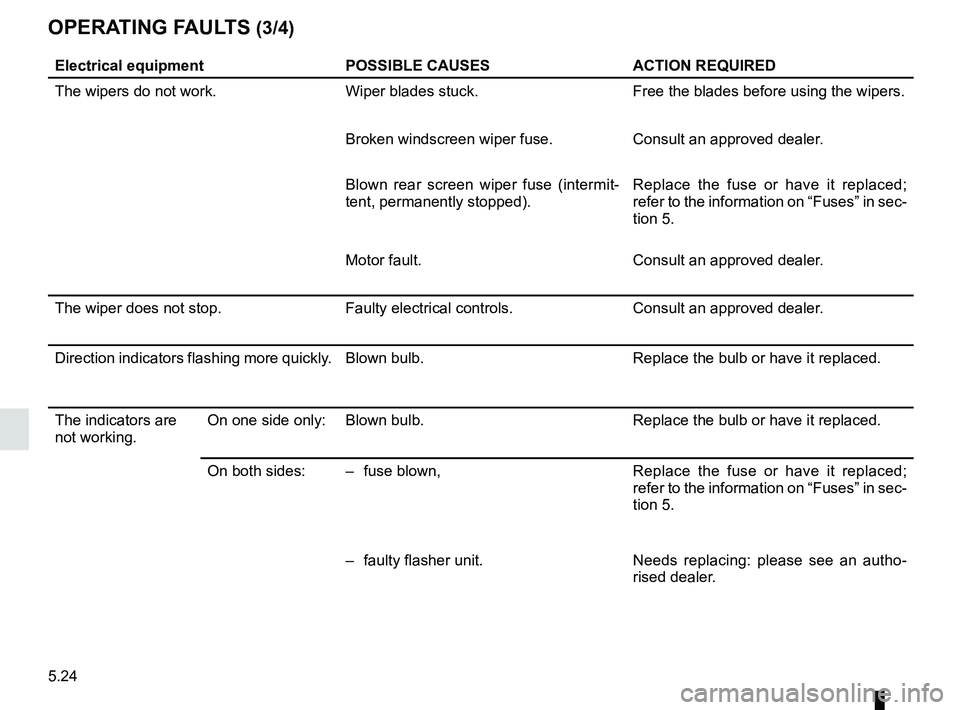
The wipers do not work. Wiper blades stuck.Free the blades before using the wipers.
Broken windscreen wiper fuse. Consult an approved dealer.
Blown rear screen wiper fuse (intermit-
tent, permanently stopped). Replace the fuse or have it replaced;
refer to the information on “Fuses” in sec-
tion 5.
Motor fault. Consult an approved dealer.
The wiper does not stop. Faulty electrical controls.Consult an approved dealer.
Direction indicators flashing more quickly. Blown bulb. Replace the bulb or have it replaced.
The indicators are
not working. On one side only: Blown bulb.
Replace the bulb or have it replaced.
On both sides: – fuse blown, Replace the fuse or have it replaced;
refer to the information on “Fuses” in sec-
tion 5.
– faulty flasher unit. Needs replacing: please see an autho-
rised dealer.
OPERATING FAULTS (3/4)