2018 RENAULT KOLEOS jack
[x] Cancel search: jackPage 29 of 332

1.23
Always wear your seat belt when trav-
elling in your vehicle. You must also
comply with the legislation of the par-
ticular country you are in.
SEAT BELTS (1/4)
1
2
Incorrectly adjusted or
twisted seat belts may
cause injuries in the event
of an accident.
Use one seat belt per person,
whether child or adult.
Even pregnant women should wear
a seat belt. In this case, ensure that
the lap belt is not exerting too much
pressure on the abdomen, but do
not allow any slack.
Before starting, first adjust your driv-
ing position, then ask all occupants
to adjust their seat belts to ensure
optimum protection.
Adjusting your driving
position
– Sit well back in your seat (having
first removed your coat or jacket).
This is essential to ensure your back
is positioned correctly;
– adjust the distance between the seat and the pedals. Your seat
should be as far back as possible
while still allowing you to depress
the clutch pedal fully. The seatback
should be adjusted so that your arms
are slightly bent when you hold the
steering wheel;
– adjust the position of your head- rest. For the maximum safety, your
head must be as close as possible to
the headrest;
– adjust the height of the seat. This
adjustment allows you to select the
seat position which offers you the
best possible view ;
– adjust the position of the steering
wheel.
Adjusting the seat belts
Sit with your back firmly against the
seatback.
Shoulder strap 1 should be as close as
possible to the base of the neck but not
on it.
Lap belt 2 should be worn flat over the
thighs and against the pelvis.
The belt should be worn so that it is
as close as possible to your body, i.e.:
avoid wearing heavy clothing or keep-
ing bulky objects under the belts, etc.
Page 142 of 332
 (4/4)
All-wheel drive system
– Irrespective of the mode selected, do not start the engine if one or mor\
e wheels are not in contact with the ground
(eg. when")
2.38
TRANSMISSION: 4-wheel drive (4WD) (4/4)
All-wheel drive system
– Irrespective of the mode selected, do not start the engine if one or mor\
e wheels are not in contact with the ground
(eg. when the vehicle is on a jack or roller bench).
– Do not turn the mode selector when cornering, reversing or if the wheels\
are spinning excessively. Only select the
“2WD”, “AUTO” or “4WD Lock” mode when the vehicle is being driven in a str\
aight line.
– Only use tyres which meet the required specifications.
– “4WD Lock” mode is exclusively reserved for driving off-road. The use of this mode in any other conditions may adversely
affect the vehicle’s manoeuvrability and damage its mechanical components.
– Always ensure tyres with identical specifications are fitted to all four\
wheels (brand, size, structure, wear etc.). Fitting tyres
of different sizes to the front and rear wheels and/or left and right wheels m\
ay have serious consequences for the tyres,
gearbox, transfer gearbox and the rear differential pinions.
Page 246 of 332
3.50
MULTIMEDIA EQUIPMENT (2/2)
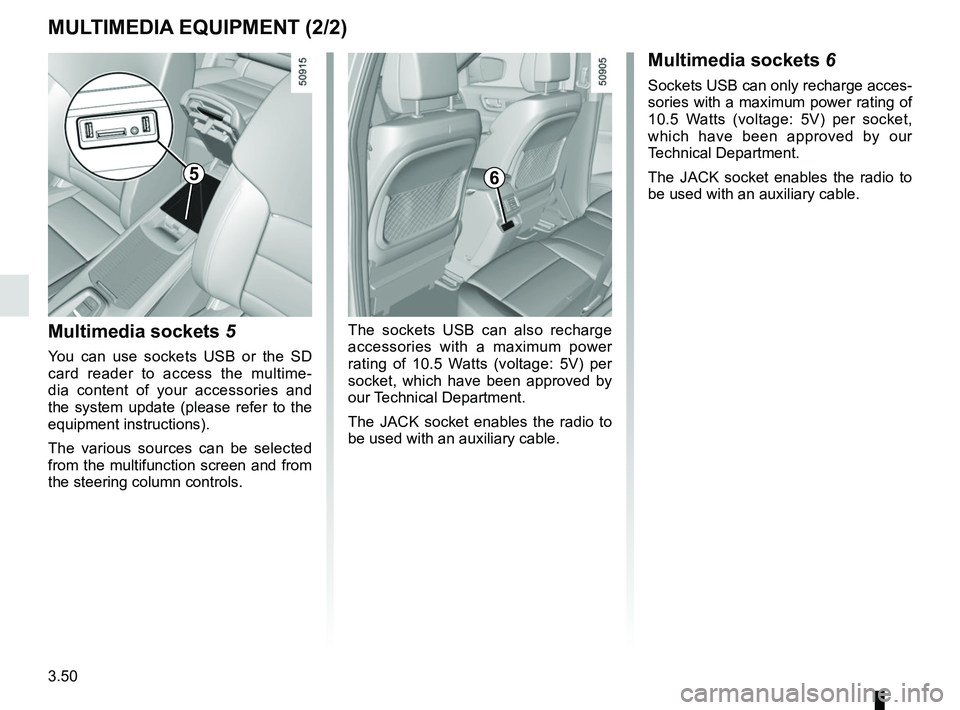
Multimedia sockets 5
You can use sockets USB or the SD
card reader to access the multime-
dia content of your accessories and
the system update (please refer to the
equipment instructions).
The various sources can be selected
from the multifunction screen and from
the steering column controls.
Multimedia sockets 6
Sockets USB can only recharge acces-
sories with a maximum power rating of
10.5 Watts (voltage: 5V) per socket,
which have been approved by our
Technical Department.
The JACK socket enables the radio to
be used with an auxiliary cable.
The sockets USB can also recharge
accessories with a maximum power
rating of 10.5 Watts (voltage: 5V) per
socket, which have been approved by
our Technical Department.
The JACK socket enables the radio to
be used with an auxiliary cable.
56
Page 271 of 332
5.7
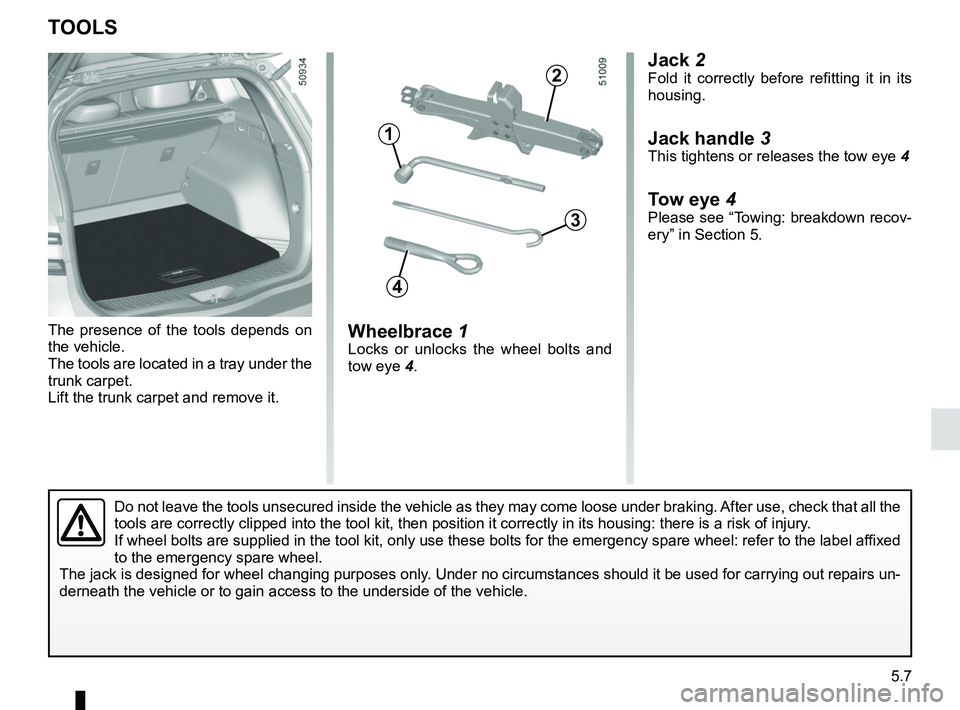
Jack 2Fold it correctly before refitting it in its
housing.
Jack handle 3This tightens or releases the tow eye 4
Tow eye 4Please see “Towing: breakdown recov-
ery” in Section 5.
Wheelbrace 1Locks or unlocks the wheel bolts and
tow eye 4.
The presence of the tools depends on
the vehicle.
The tools are located in a tray under the
trunk carpet.
Lift the trunk carpet and remove it.
TOOLS
Do not leave the tools unsecured inside the vehicle as they may come loo\
se under braking. After use, check that all the
tools are correctly clipped into the tool kit, then position it correctl\
y in its housing: there is a risk of injury.
If wheel bolts are supplied in the tool kit, only use these bolts for th\
e emergency spare wheel: refer to the label affixed
to the emergency spare wheel.
The jack is designed for wheel changing purposes only. Under no circumstances should it be used for carrying out repairs un-
derneath the vehicle or to gain access to the underside of the vehicle.
2
1
3
4
Page 272 of 332
5.8
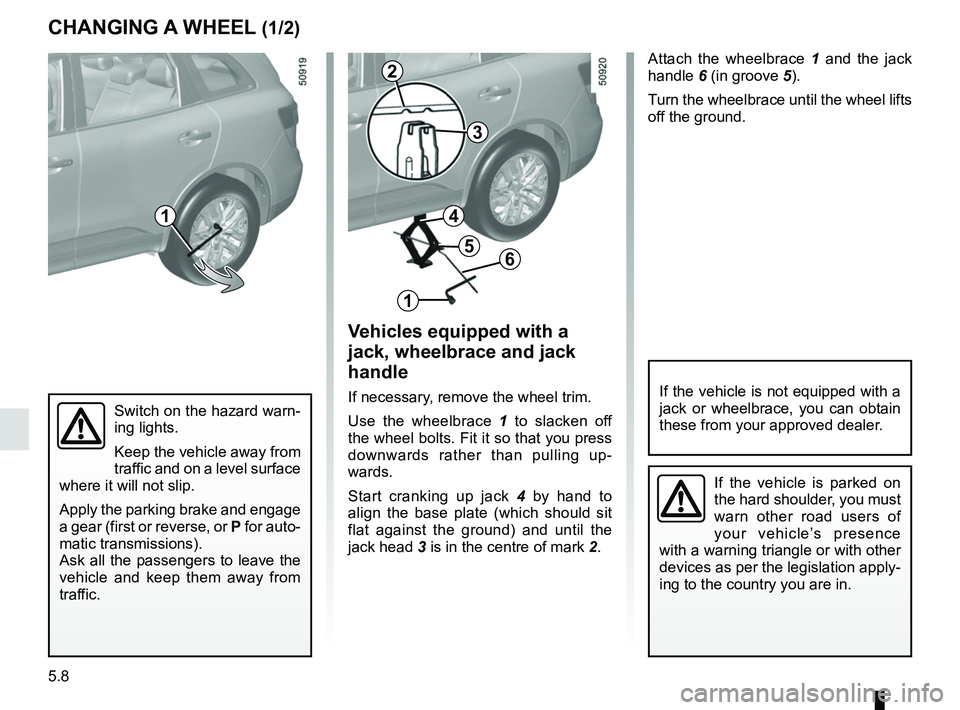
Attach the wheelbrace 1 and the jack
handle 6 (in groove 5).
Turn the wheelbrace until the wheel lifts
off the ground.
Switch on the hazard warn-
ing lights.
Keep the vehicle away from
traffic and on a level surface
where it will not slip.
Apply the parking brake and engage
a gear (first or reverse, or P for auto-
matic transmissions).
Ask all the passengers to leave the
vehicle and keep them away from
traffic.
CHANGING A WHEEL (1/2)
Vehicles equipped with a
jack, wheelbrace and jack
handle
If necessary, remove the wheel trim.
Use the wheelbrace 1 to slacken off
the wheel bolts. Fit it so that you press
downwards rather than pulling up-
wards.
Start cranking up jack 4 by hand to
align the base plate (which should sit
flat against the ground) and until the
jack head 3 is in the centre of mark 2.If the vehicle is not equipped with a
jack or wheelbrace, you can obtain
these from your approved dealer.
If the vehicle is parked on
the hard shoulder, you must
warn other road users of
your vehicle’s presence
with a warning triangle or with other
devices as per the legislation apply-
ing to the country you are in.
1
2
3
1
6
4
5
Page 273 of 332
5.9
If you have a puncture, re-
place the wheel as soon as
possible.
A tyre which has been punc-
tured should always be inspected
(and repaired, where possible) by a
specialist.
CHANGING A WHEEL (2/2)
Turn it a few times to lift the wheel off
the ground.
Undo the bolts and take off the wheel.
Fit the emergency spare wheel on the
central hub and turn it to locate the
mounting holes in the wheel and the
hub.
Tighten the bolts, checking that the
wheel is correctly positioned on its hub.
Lower the jack.
With the wheel on the ground, tighten
the bolts fully and have the tightness of
the bolts checked and the emergency
spare wheel pressure checked as soon
as possible.
Do not leave the tools un-
secured inside the vehicle
as they may come loose
under braking. After use,
check that all the tools are correctly
clipped into the tool kit, then posi-
tion it correctly in its housing: risk of
injury.
If wheel bolts are supplied in the
tool kit, only use these bolts for the
emergency spare wheel: refer to the
label affixed to the emergency spare
wheel.
The jack is designed for wheel
changing purposes only. Under no
circumstances should it be used for
carrying out repairs underneath the
vehicle or to gain access to the un-
derside of the vehicle.
Page 327 of 332

G
gear lever........................................................................\
... 2.16
H
hands-free telephone integrated control ................. 3.49 – 3.50
ha")
7.3
ALPHABETICAL INDEX (3/5)
G
gear lever........................................................................\
... 2.16
H
hands-free telephone integrated control ................. 3.49 – 3.50
hazard warning lights signal .............................................. 1.84
headlight beam adjustment .................................... 1.85 – 1.86
headrest.................................................................... 1.19, 3.32
heated seats ............................................................. 1.20, 1.22
heating and air conditioning system .................3.4 → 3.6, 3.17
heating system ........................................................3.4 → 3.17
Hill Start Assist.......................................................2.31 → 2.34
horn ...................................................................\
................ 1.84
horn: flash ..................................................................\
........... 1.84
hubcap tool ........................................................................\
.. 5.7
I
ignition switch ...................................................................... 2.3
indicators ......................................................1.84, 5.13 → 5.18
indicators: direction indicators ....................................................... 1.84
instrument panel ..............................................1.54 → 1.63
instrument panel ....................................................1.54 → 1.71
instrument panel messages...................................1.62 → 1.71
interior trim maintenance ..................................................... 4.17 – 4.18
Isofix ....................................................................... 1.37 – 1.38
J
jack ...................................................................\
................... 5.7
K
keys ...................................................................\
........1.2 → 1.4L
lane departure warning ..........................................2.50
→ 2.52
levels .................................................................\
......4.8 → 4.10
levels: brake fluid ...................................................................... 4.9
coolant ................................................................\
........... 4.8
windscreen washer reservoir ....................................... 4.10
lifting the vehicle changing a wheel .................................................. 5.8 – 5.9
lighting: exterior .............................................................1.79 → 1.86
instrument panel .......................................................... 1.79
interior ..........................................3.23 → 3.25, 5.19 – 5.20
lights adjustment ........................................................ 1.85 – 1.86
changing bulbs .................................................5.13 → 5.15
front ..................................................................\
5.13 → 5.15
lights: adjusting ........................................................... 1.85 – 1.86
brake lights ......................................................5.16 → 5.18
dipped beam headlights .................1.54, 1.79, 5.13 → 5.15
direction indicators .........................1.54, 1.84, 5.13 → 5.16
fog lights .................................................... 1.54, 1.81, 5.18
hazard warning ............................................................ 1.84
main beam headlights ................................ 1.54, 1.79, 5.13
reversing lights ............................................................. 5.18
side lights ................................................1.79, 5.13 → 5.16
load permitted on the roof.................................................... 6.6
locking the doors .....................................................1.4 → 1.16
luggage compartment cover .............................................. 3.42
M
maintenance ............................................................\
.......... 2.26
maintenance: bodywork .......................................................... 4.15 – 4.16
interior trim ........................................................ 4.17 – 4.18