305
Identification markings
Different visible markings for the identification
of your vehicle.
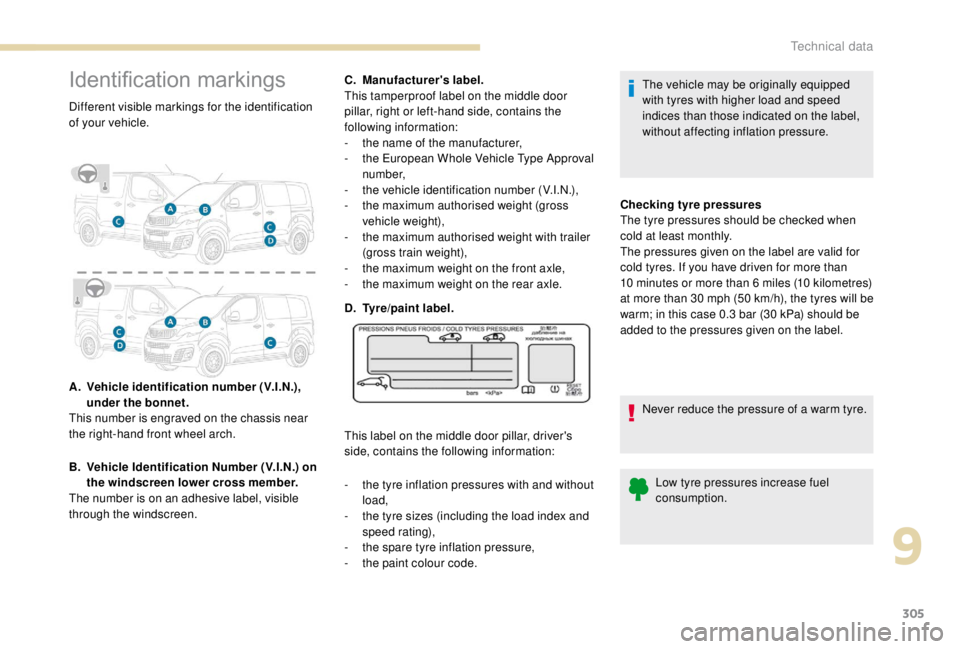
A.
V
ehicle identification number (V.I.N.),
under the bonnet.
This number is engraved on the chassis near
the right-hand front wheel arch.
B.
V
ehicle Identification Number (V.I.N.) on
the windscreen lower cross member.
The number is on an adhesive label, visible
through the windscreen. C.
M
anufacturer's label.
This tamperproof label on the middle door
pillar, right or left-hand side, contains the
following information:
-
t
he name of the manufacturer,
-
t
he European Whole Vehicle Type Approval
number,
-
t
he vehicle identification number (V.I.N.),
-
t
he maximum authorised weight (gross
vehicle weight),
-
t
he maximum authorised weight with trailer
(gross train weight),
-
t
he maximum weight on the front axle,
-
t
he maximum weight on the rear axle.
D.
T
yre/paint label.
This label on the middle door pillar, driver's
side, contains the following information:
-
t
he tyre inflation pressures with and without
load,
-
t
he tyre sizes (including the load index and
speed rating),
-
t
he spare tyre inflation pressure,
-
t
he paint colour code. The vehicle may be originally equipped
with tyres with higher load and speed
indices than those indicated on the label,
without affecting inflation pressure.
Checking tyre pressures
The tyre pressures should be checked when
cold at least monthly.
The pressures given on the label are valid for
cold tyres. If you have driven for more than
10
minutes or more than 6 miles (10 kilometres)
at more than 30
mph (50 km/h), the tyres will be
warm; in this case 0.3
bar (30 kPa) should be
added to the pressures given on the label.
Never reduce the pressure of a warm tyre.Low tyre pressures increase fuel
consumption.
9
Technical data