2018 Peugeot Boxer switch
[x] Cancel search: switchPage 104 of 232

102
Deactivation (off)
ReactivationYour vehicle will return to the last programmed
speed.
You can also repeat the "first activation"
procedure.
Changing the programmed
speed
There are two methods of storing a speed
h igher than the previous one:
Without using the accelerator:
Using the accelerator:
F
E
xceed the stored speed until the desired
speed is reached, To store a
speed lower than the previous one:
Switching off the function
F Place the ring in the central O
position or switch off the ignition
to switch the system off.
When the vehicle stops, after the ignition is
switched off, the system no longer stores any
speeds.
F
P
ress this button.
or
F
P
ress the brake or clutch pedal.
A message appears in the instrument panel
screen to confirm the deactivation.
F
F
ollowing deactivation of the cruise control,
press this button. A message appears in
the instrument panel screen to confirm the
reactivation. F
M
ove the control up (+).
A short press increases the speed by 1
mph
(km/h).
Holding it increases the speed in steps of
5
mph (km/h). F
M
ove the control up (+) or down (-).
F
M
ove the control down (-).
A short press decreases the speed by 1 mph
(km/h).
Holding it decreases the speed in steps of
5
mph (km/h).
Driving
Page 106 of 232

104
Selecting the function – ON
Programming a
speedTemporarily exceeding the
speed
When the cruise control is active, it is still
possible to exceed the programmed speed by
depressing the accelerator pedal (to overtake
another vehicle for example).
Changing the programmed
speed while the cruise
control is in operation
Yo u c a n :
Switching off/deactivating
the functionSelecting ON
switches the function on. A
message appears in the instrument panel
screen to confirm the action.
F
A
ccelerate to the required speed, with 2nd
to 6th gear engaged.
F
M
ove the control upwards (+), for
approximately one second, to store this
speed.
F
R
elease the pressure on the accelerator
pedal, the vehicle will maintain this speed. The stored speed is visible in the instrument
panel display.
-
i
ncrease the speed in steps, by means of
brief presses, or continuously by pressing
and holding the up control (+ sign), -
d
ecrease the speed continuously by
pressing and holding the control downwards
(- sign).
F
P
ress the brake or clutch pedal or place the
ring in the OFF position, the indicator goes
of f.
If the dynamic stability control system comes
into operation, the cruise control system is
deactivated temporarily.
Driving
Page 107 of 232

105
Restore – RES
To restore the vehicle's programmed speed
(for example after pressing the brake or clutch
pedal):The indicator comes on and the
cruise control function is restored.
F
G
o back gradually to the selected speed
and press RES .
Cancelling the programmed
speed
When the vehicle stops, after the ignition is
switched off, the system no longer stores any
speeds.
Malfunction
In the event of a fault, the system is
s witched off and the indicator goes
out.
Have it checked by a
PEUGEOT dealer or by
a
qualified workshop. Use the cruise control only when traffic
conditions allow you to travel at a
constant
speed for a certain period of time whilst
keeping a sufficiently safe distance from
other vehicles.
Do not activate the cruise control in urban
areas, in heavy traffic, on winding or steep
roads, on slippery or flooded roads, or in
conditions of poor visibility (heavy rain,
fog, falling snow, etc.).
In some circumstances, it may not
be possible to maintain or reach the
programmed speed: towing, vehicle
heavily loaded, steep climb, etc.
The use of mats not approved by
PEUGEOT may impair the operation of the
cruise control.
To avoid any risk of jamming of the pedals:
-
e
nsure that the mat is positioned
c o r r e c t l y,
-
d
o not fit one mat on top of another.
Lane Departure Warning
System
System which detects the involuntary crossing
of longitudinal traffic lane markings on the
ground (solid or broken line).
The lane departure warning system
cannot, in any circumstances, replace the
need for vigilance on the part of the driver.
A camera fitted at the top centre of the
windscreen monitors the road and detects lane
markings and the position of the vehicle with
respect to them.
With the vehicle running at a
speed higher than
37
mph (60 km/h), it triggers a warning if the
vehicle drifts off line.
This system is particularly useful on motor ways
and main roads.
6
Driving
Page 108 of 232
106
If the windscreen is damaged, it is strongly
recommended that you go to a PEUGEOT
dealer or a
qualified workshop for any
replacement and calibration of the camera.
Operation
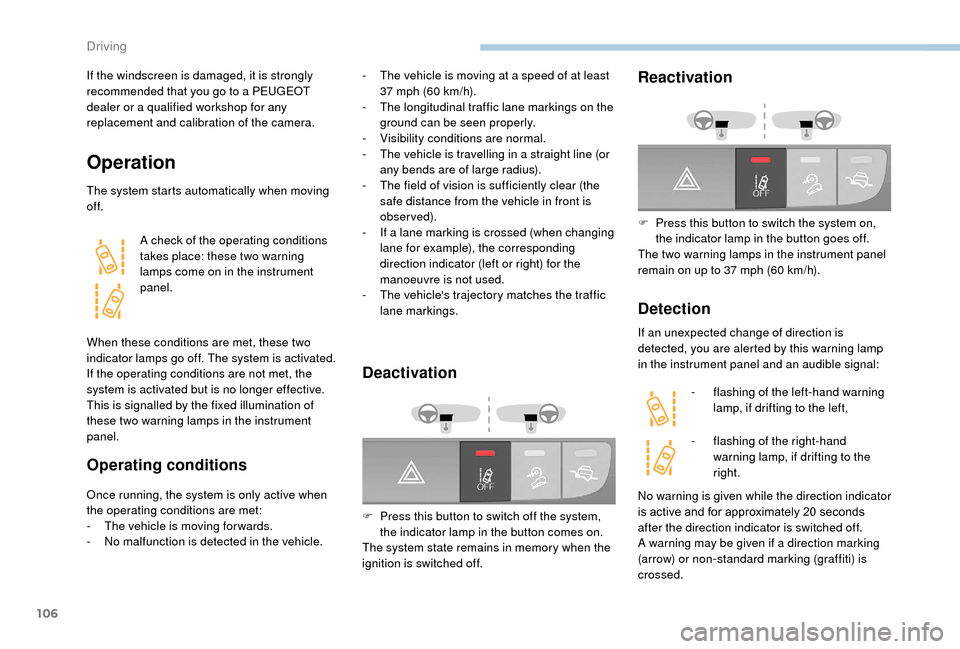
The system starts automatically when moving
of f.
A check of the operating conditions
takes place: these two warning
lamps come on in the instrument
panel.
When these conditions are met, these two
indicator lamps go off. The system is activated.
If the operating conditions are not met, the
system is activated but is no longer effective.
This is signalled by the fixed illumination of
these two warning lamps in the instrument
panel.
Operating conditions
Once running, the system is only active when
the operating conditions are met:
-
T
he vehicle is moving for wards.
-
N
o malfunction is detected in the vehicle.
Deactivation
F Press this button to switch off the system, the indicator lamp in the button comes on.
The system state remains in memory when the
ignition is switched off.
Reactivation
F Press this button to switch the system on, the indicator lamp in the button goes off.
The two warning lamps in the instrument panel
remain on up to 37
mph (60 km/h).
Detection
If an unexpected change of direction is
detected, you are alerted by this warning lamp
in the instrument panel and an audible signal:-
f
lashing of the left-hand warning
lamp, if drifting to the left,
-
f
lashing of the right-hand
warning lamp, if drifting to the
right.
-
T
he vehicle is moving at a
speed of at least
37
mph (60
km/h).
-
T
he longitudinal traffic lane markings on the
ground can be seen properly.
-
V
isibility conditions are normal.
-
T
he vehicle is travelling in a
straight line (or
any bends are of large radius).
-
T
he field of vision is sufficiently clear (the
safe distance from the vehicle in front is
observed).
-
I
f a
lane marking is crossed (when changing
lane for example), the corresponding
direction indicator (left or right) for the
manoeuvre is not used.
-
T
he vehicle's trajectory matches the traffic
lane markings.
No warning is given while the direction indicator
is active and for approximately 20 seconds
after the direction indicator is switched off.
A warning may be given if a
direction marking
(arrow) or non-standard marking (graffiti) is
crossed.
Driving
Page 114 of 232

112
Switching off
F Move from reverse gear into neutral.
Malfunction
If this warning lamp comes on in the
instrument panel accompanied by
a message in the screen, contact
a
PEUGEOT dealer or a qualified
workshop.
Reversing camera
If your vehicle is fitted with this camera, it is
located at the rear, next to the third brake lamp.
Switching on
The camera comes into operation when
reverse gear is engaged and remains active
up to approximately 9
mph (15 km/h). It is
deactivated above 11
mph (18 km/h).
The camera also comes on with the vehicle
stationary, when the rear doors are opened.
Switching off
When a for ward gear is engaged, the last
im age remains displayed for approximately
5
seconds then switches off.
In the same way, the last image also remains
displayed, with the vehicle stationary, when the
rear doors are closed.
With optimum vehicle conditions (position
on the road, loading level) the maximum
area of visibility covered by the camera
has a
field depth approximately 3 m long
and 5.5
m wide.
The area of visibility may vary depending
on the external weather conditions
(brightness, rain, snow, fog, etc.), the
load in the vehicle and the position of the
vehicle on the road.
When cleaning the camera and the
screen, avoid using a
detergent or a tool
which may scratch the glass.
Use a
non-abrasive cloth or a small brush.
It sends images to the screen installed in the
cab.
Activation and deactivation of the system is
done in the settings menu of the touch screen
audio-telematic system.
This rear vision is an aid to manoeuvring. The
reversing camera may be linked with the rear
parking sensors.
When the distance between the rear of the
vehicle and the obstacle is less than about
12 inches (30 centimetres), the audible signal
becomes continuous.
Driving
Page 118 of 232

116
Fuel
The capacity of the tank is about 90 litres.
F uel tanks of different capacities may be fitted,
60
and 120 litres, depending on the engine.
Low fuel level
When the E (Empty) level is
reached, this warning lamp lights up.
You then have around 10
to 12 litres in
reser ve, depending on the capacity of the tank
and the engine.
Refuel without delay to avoid running out of
fuel.
Refilling
The fuel tank must be filled with the engine
off.
F
O
pen the fuel filler flap.
F
H
old the black cap with one hand.
F
W
ith the other hand, insert the key, then
turn it anticlockwise. A label inside the fuel flap reminds you of the
type of fuel to use.
When filling the tank to the top, do not continue
beyond the 3
rd cut off of the nozzle; this could
cause malfunctions.
F
A
fter filling the fuel tank, lock the black cap
and close the flap.
With Stop & Start, never refuel with the
system in STOP mode; you must switch
off the ignition with the key.
F
R
emove the black cap and hook it onto the
clip located on the inside of the flap.
Fuel system cut-off
In the event of a collision, a device
a utomatically cuts off the fuel supply to the
engine and the vehicle's electrical supply.
It switches on the hazard warning lamps and
the courtesy lamps, as well as unlocking the
doors.
Following an impact and before restoring
the supply, check that there is no leak of
fuel or sparks so as to avoid any risk of
fire.
F
T
o restore the fuel supply, press the first
button, located on the front right side.
Practical information
Page 130 of 232

128
For access to the reser voir filler cap, remove
the protective cover by turning its three fixing
screws a quarter turn, then remove the second
cover fitted to the cap.
Engine coolant level
Check the coolant level regularly.
It is normal to top up this fluid
between two services.
Check the coolant level regularly,
according to the use made of your vehicle
(every 3,000
miles (5,000 km)/3 months);
if necessary, top up using coolant
recommended by the manufacturer.
The check and top up must only be done
with the engine cold.
A low coolant level presents a
risk of
serious damage to your engine.
When the engine is hot, the temperature of the
coolant is regulated by the electric fan. This
may operate with the ignition off; furthermore,
because the cooling system is under pressure,
wait for at least one hour after the engine has
stopped before carrying out any work. F
F
or access to the tank filler cap, remove the
protective cover by turning its three fixing
screws a
quarter turn.
F
T
o avoid the risk of scalding, place a cloth
around the cap, then loosen the cap by
a
quarter turn to release the pressure.
F
W
hen the pressure has dropped, remove
the cap and top up the level with coolant.
To p p i n g u p
The level must be between the MIN and MAX
marks on the expansion bottle.
As close as possible to the MAX mark is
recommended.
If more than 1
litre of fluid is required to top
up the level, have the system checked by
a
PEUGEOT dealer or a qualified workshop.
Screenwash and headlamp
wash level
To check the level or top up the fluid
on vehicles fitted with headlamp
washers, immobilise the vehicle and
switch off the engine.
Capacity of the reservoir: approximately
5.5
litres.
F
F
or access to the reser voir filler cap, pull on
the telescopic filler pipe and unclip the cap.
Practical information
Page 132 of 232

130
Operation
This filter, fitted in the exhaust system,
accumulates particles of soot. The engine
management unit controls the automatic
periodic elimination of the soot particles
(regeneration).
The regeneration procedure is triggered
depending on the amount of particles
accumulated and the vehicle use conditions.
During this phase, you may notice some
unusual phenomena – increased idling speed,
cooling fan running, increase in smoke and
higher exhaust gas temperature – which does
not affect the operation of the vehicle or the
environment.After prolonged idling or driving at very
low speeds, you may occasionally notice
water vapour being emitted from the
exhaust when accelerating. This is of no
consequence to the running of the vehicle
or to the environment. Because of the higher exhaust gas
temperature resulting from the normal
operation of the particle filter, it is
recommended that you do not park the
vehicle over inflammable materials (grass,
dry leaves, pine needles, etc.) so as to
avoid any risk of fire.
Saturation/Regeneration
If there is risk of blockage of the
filter, this warning lamp comes on in
the instrument panel.
This alert tells you that the particle filter is
starting to saturate (in conditions of urban
driving of exceptionally long duration: low
speeds, traffic jams, etc.).
To regenerate the filter, it is advised to drive
as soon as possible, when traffic conditions
and the law permit, at a
speed of at least
37
mph (60 km/h), with an engine speed above
2,000
rpm for about fifteen minutes (until the
warning lamp and/or the message disappears).
If possible, avoid switching off the engine
before the end of the filter regeneration;
repeated interruptions could cause premature
deterioration of the engine oil. It is not
recommended to end regeneration of the filter
with the vehicle stationary.
Malfunction
If this alert persists, do not ignore the warning;
it indicates that a fault has occurred in the
exhaust system/particle filter assembly.
Have the whole system checked by
a
PEUGEOT dealer or a qualified workshop.
Manual gearbox
The gearbox does not require any
maintenance (no oil change).
Brake pads
Brake wear depends on the style
of driving, particularly in the case
of vehicles used in town, over short
distances. It may be necessary to
have the condition of the brakes
checked, even between vehicle
services.
If this warning lamp comes on, have
the brake pad wear checked by
a
PEUGEOT dealer or a qualified
workshop.
Practical information