2018 Peugeot 308 seats
[x] Cancel search: seatsPage 59 of 324
57
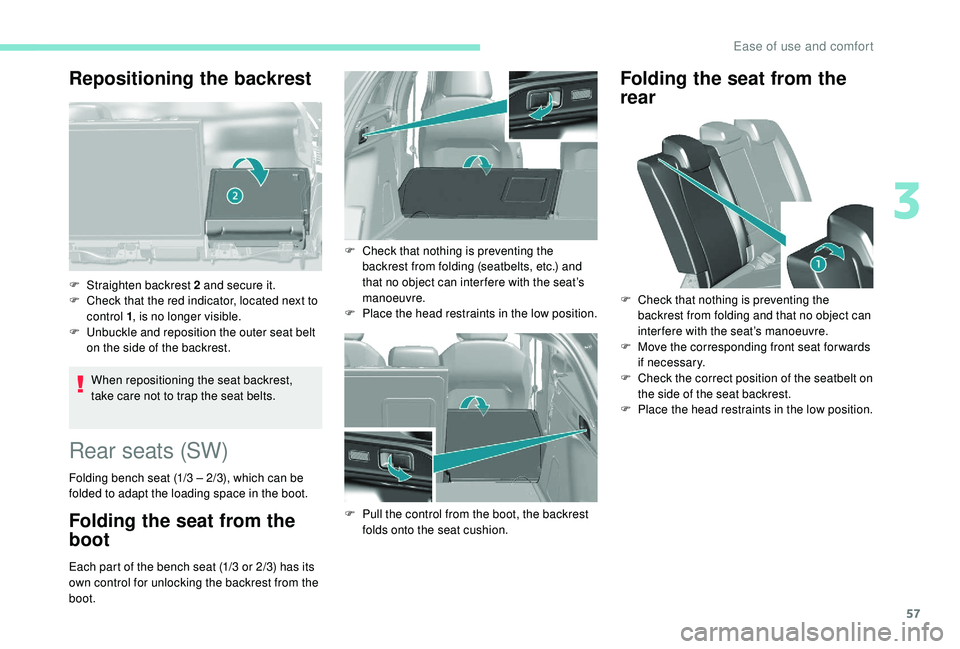
Repositioning the backrest
When repositioning the seat backrest,
take care not to trap the seat belts.
F
S
traighten backrest 2 and secure it.
F
C
heck that the red indicator, located next to
control 1 , is no longer visible.
F
U
nbuckle and reposition the outer seat belt
on the side of the backrest.
Rear seats (SW)
Folding bench seat (1/3 – 2/3), which can be
folded to adapt the loading space in the boot.
Folding the seat from the
boot
Each part of the bench seat (1/3 or 2/3) has its
own control for unlocking the backrest from the
boot.
Folding the seat from the
rear
F Check that nothing is preventing the backrest from folding (seatbelts, etc.) and
that no object can inter fere with the seat’s
manoeuvre.
F
P
lace the head restraints in the low position.
F
P
ull the control from the boot, the backrest
folds onto the seat cushion. F
C
heck that nothing is preventing the
backrest from folding and that no object can
interfere with the seat’s manoeuvre.
F
M
ove the corresponding front seat for wards
if necessary.
F
C
heck the correct position of the seatbelt on
the side of the seat backrest.
F
P
lace the head restraints in the low position.
3
Ease of use and comfort
Page 66 of 324
64
High load (SW)
Luggage retaining net
This allows the use of the entire loading
capacity, up to the roof:
-
b
ehind the front seats (1
st row) when the
rear seats are folded down,
-
b
ehind the rear seats (2
nd row).
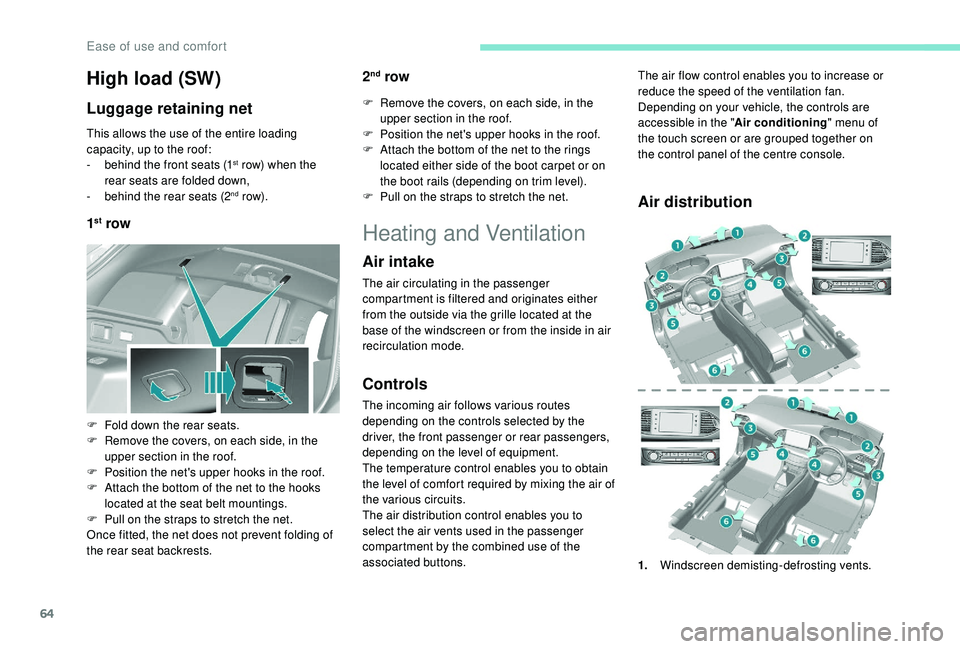
1st row 2
nd row
F Remove the covers, on each side, in the
upper section in the roof.
F
P
osition the net's upper hooks in the roof.
F
A
ttach the bottom of the net to the rings
located either side of the boot carpet or on
the boot rails (depending on trim level).
F
P
ull on the straps to stretch the net.
F
F
old down the rear seats.
F
R
emove the covers, on each side, in the
upper section in the roof.
F
P
osition the net's upper hooks in the roof.
F
A
ttach the bottom of the net to the hooks
located at the seat belt mountings.
F
P
ull on the straps to stretch the net.
Once fitted, the net does not prevent folding of
the rear seat backrests.
Heating and Ventilation
Air intake
The air circulating in the passenger
compartment is filtered and originates either
from the outside via the grille located at the
base of the windscreen or from the inside in air
recirculation mode.
Controls
The incoming air follows various routes
depending on the controls selected by the
driver, the front passenger or rear passengers,
depending on the level of equipment.
The temperature control enables you to obtain
the level of comfort required by mixing the air of
the various circuits.
The air distribution control enables you to
select the air vents used in the passenger
compartment by the combined use of the
associated buttons.
Air distribution
The air flow control enables you to increase or
reduce the speed of the ventilation fan.
Depending on your vehicle, the controls are
accessible in the " Air conditioning" menu of
the touch screen or are grouped together on
the control panel of the centre console.
1. Windscreen demisting-defrosting vents.
Ease of use and comfort
Page 92 of 324
90
Seat belts
Front seat belts
The front seat belts are fitted with a pyrotechnic
pretensioning and force limiting system.
This system improves safety in the front
seats in the event of a front or side impact.
Depending on the severity of the impact, the
pretensioning system instantly tightens the seat
belts against the body of the occupants.
The pretensioning seat belts are active when
the ignition is on.
The force limiter reduces the pressure of the
seat belt on the chest of the occupant, thus
improving their protection.
Rear seat belts
Fastening
F Pull the strap then insert the tongue in the buckle.
F
C
heck that the seat belt is fastened
correctly by pulling the strap.
Unfastening
F Press the red button on the buckle.
F G uide the seat belt as it reels in.
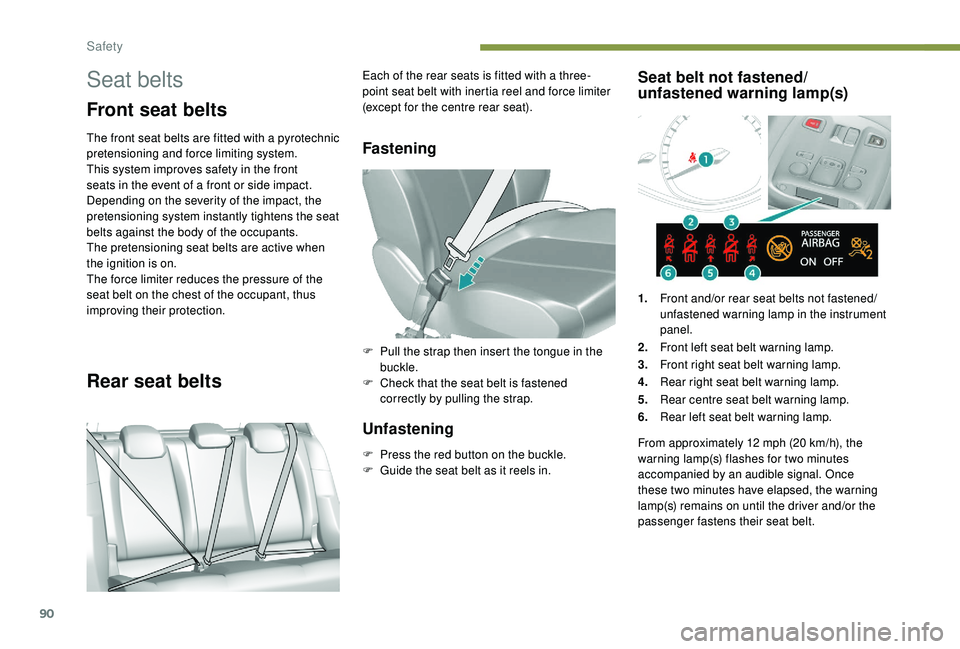
Seat belt not fastened/
unfastened warning lamp(s)
1.Front and/or rear seat belts not fastened/
unfastened warning lamp in the instrument
panel.
2. Front left seat belt warning lamp.
3. Front right seat belt warning lamp.
4. Rear right seat belt warning lamp.
5. Rear centre seat belt warning lamp.
6. Rear left seat belt warning lamp.
From approximately 12 mph (20 km/h), the
warning lamp(s) flashes for two minutes
accompanied by an audible signal. Once
these two minutes have elapsed, the warning
lamp(s) remains on until the driver and/or the
passenger fastens their seat belt.
Each of the rear seats is fitted with a three-
point seat belt with inertia reel and force limiter
(except for the centre rear seat).
Safety
Page 94 of 324
92
Maintenance
In accordance with current safety
regulations, for all repairs on your
vehicle's seat belts, go to a qualified
workshop with the skills and equipment
needed, which a PEUGEOT dealer is able
to provide.
Have your seat belts checked regularly
by a PEUGEOT dealer or a qualified
workshop, particularly if the straps show
signs of damage.
Clean the seat belt straps with soapy
water or a textile cleaning product, sold by
PEUGEOT dealers.
Instructions for children
Use a suitable child seat if the passenger
is less than 12 years old or shorter than
one and a half metres.
Never use the same seat belt to secure
more than one child.
Never allow a child to travel on your lap.
For more information on Child seats , refer
to the corresponding section. In case of impact
Depending on the nature and
seriousness of the impact
, the
pyrotechnic pretensioner may be deployed
before and independently of the airbags.
Deployment of the pretensioners is
accompanied by a slight discharge of
harmless smoke and a noise, due to the
activation of the pyrotechnic cartridge
incorporated in the system.
In all cases, the airbag warning lamp
comes on.
Following an impact, have the seat belt
system checked, and, if necessary,
replaced, by a PEUGEOT dealer or a
qualified workshop.
Airbags
General information
System designed to contribute towards improving
passenger safety (with the exception of the
rear centre passenger) in the event of violent
collisions. The airbags supplement the action of
the seat belts fitted with force limiters (all except
the rear centre passenger).
If a collision occurs, the electronic detectors
record and analyse the front and side impacts
sustained in the impact detection zones:
The airbags do not operate when the
ignition is switched off.
This equipment will only deploy once. If a
second impact occurs (during the same or
a subsequent accident), the airbag will not
be deployed again.
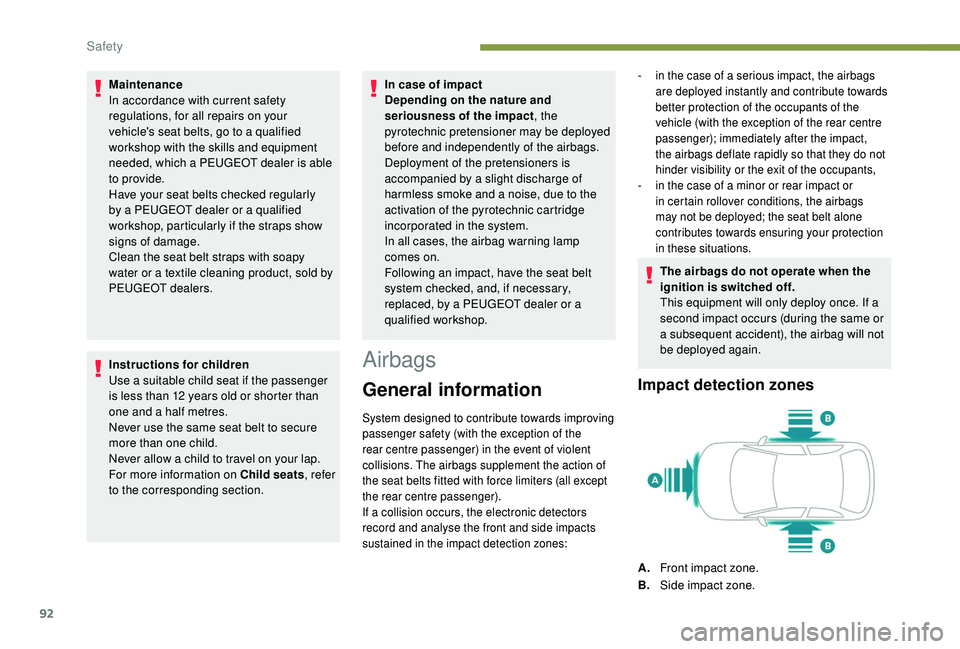
Impact detection zones
A. Front impact zone.
B. Side impact zone.
- in the case of a serious impact, the airbags
are deployed instantly and contribute towards
better protection of the occupants of the
vehicle (with the exception of the rear centre
passenger); immediately after the impact,
the airbags deflate rapidly so that they do not
hinder visibility or the exit of the occupants,
-
i
n the case of a minor or rear impact or
in certain rollover conditions, the airbags
may not be deployed; the seat belt alone
contributes towards ensuring your protection
in these situations.
Safety
Page 97 of 324
95
Lateral airbags
Use only approved covers on the seats,
compatible with the deployment of the
lateral airbags. For information on the
product range of seat covers suitable for
your vehicle, contact a PEUGEOT dealer.
Do not fix or attach anything to the seat
backrests (clothes, etc.) as this could
cause injuries to the thorax or arm when
the lateral airbag is deployed.
Do not sit with the upper part of the body
any nearer to the door than necessary.
The vehicle's front door panels include
side impact sensors.
A damaged door or any unauthorised or
incorrectly executed work (modification or
repair) on the front doors or their interior
trim could compromise the operation of
these sensors – risk of malfunction of the
lateral airbags!
Such work must only be done by a
PEUGEOT dealer or a qualified workshop.General points relating to
child seats
The regulations on carrying children are
specific to each country. Refer to the
legislation in force in your country.
For maximum safety, please obser ve the
following recommendations:
-
I
n accordance with European regulations,
all children under the age of 12 or less
than one and a half metres tall must
travel in approved child seats suited to
their weight , on seats fitted with a seat belt
or ISOFIX mountings.
-
S
tatistically, the safest seats in your
vehicle for carr ying children are the rear
seats.
-
A c
hild weighing less than 9 kg must
travel in the rear ward facing position
both in the front and in the rear.
It is recommended that children travel on
the rear seats of your vehicle:
-
"rearward facing " up to the age of 3,
-
"forward facing " over the age of 3. Ensure that the seat belt is positioned and
tightened correctly.
For child seats with a support leg, ensure
that the support leg is in firm and steady
contact with the floor.
In the front: if necessary, adjust the
passenger seat.
At the rear: if necessary, adjust the
relevant front seat.
Remove and stow the head restraint
before installing a child seat with backrest
on a passenger seat.
Refit the head restraint once the child seat
has been removed.
Child seat at the rear
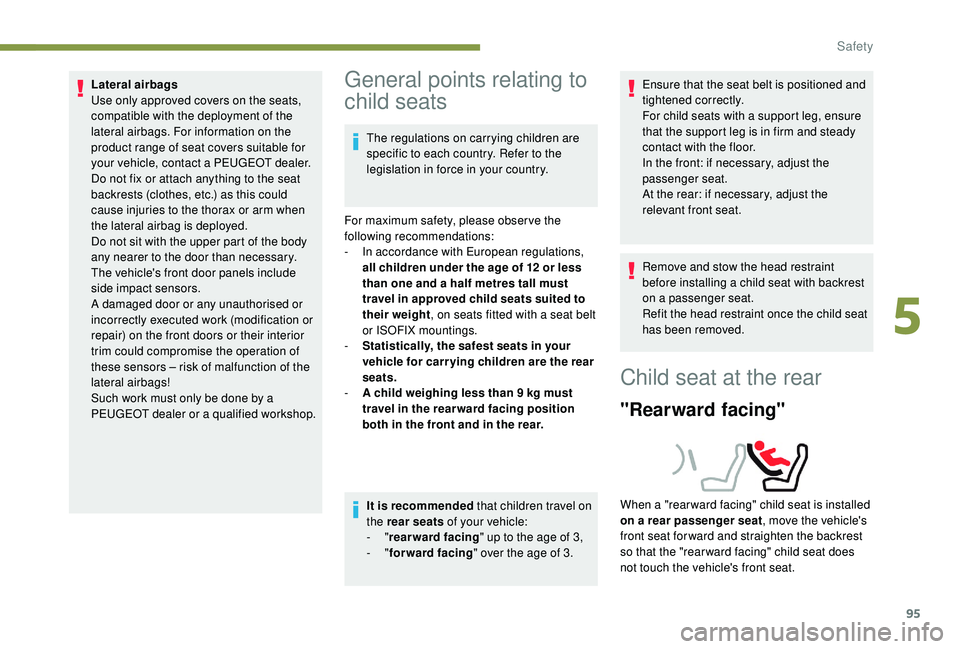
"Rearward facing"
When a "rear ward facing" child seat is installed
on a rear passenger seat
, move the vehicle's
front seat for ward and straighten the backrest
so that the "rear ward facing" child seat does
not touch the vehicle's front seat.
5
Safety
Page 102 of 324
100
Recommended child
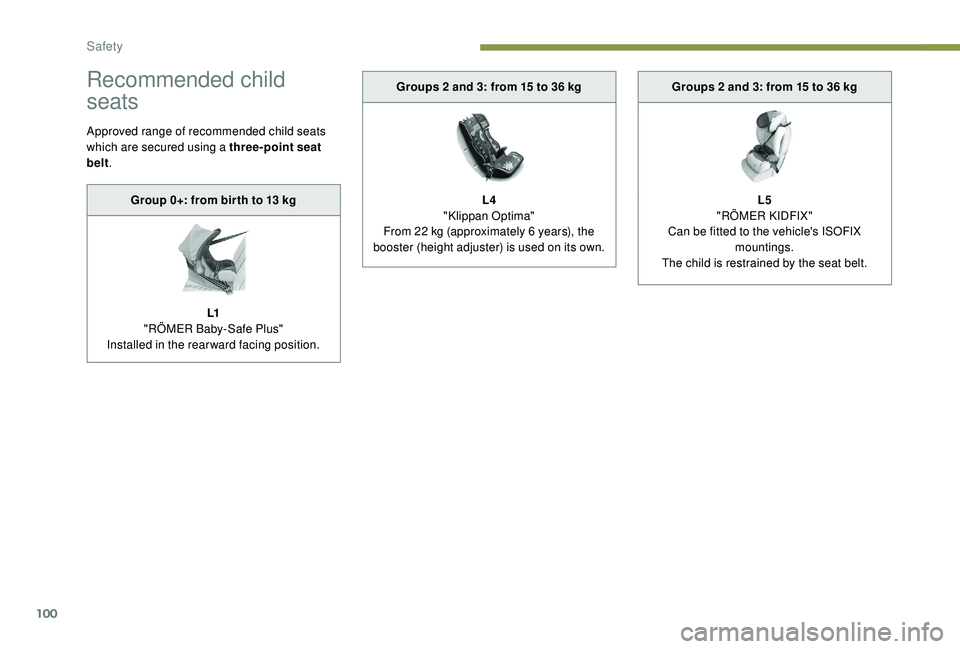
seats
Approved range of recommended child seats
which are secured using a three-point seat
belt.
Group 0+: from bir th to 13
kg
L1
"RÖMER Baby-Safe Plus"
Installed in the rearward facing position. Groups 2 and 3: from 15 to 36
kg
L4
"Klippan Optima"
From 22
kg (approximately 6 years), the
booster (height adjuster) is used on its own. Groups 2 and 3: from 15 to 36
kg
L5
"RÖMER KIDFIX"
Can be fitted to the vehicle's ISOFIX mountings.
The child is restrained by the seat belt.
Safety
Page 103 of 324
101
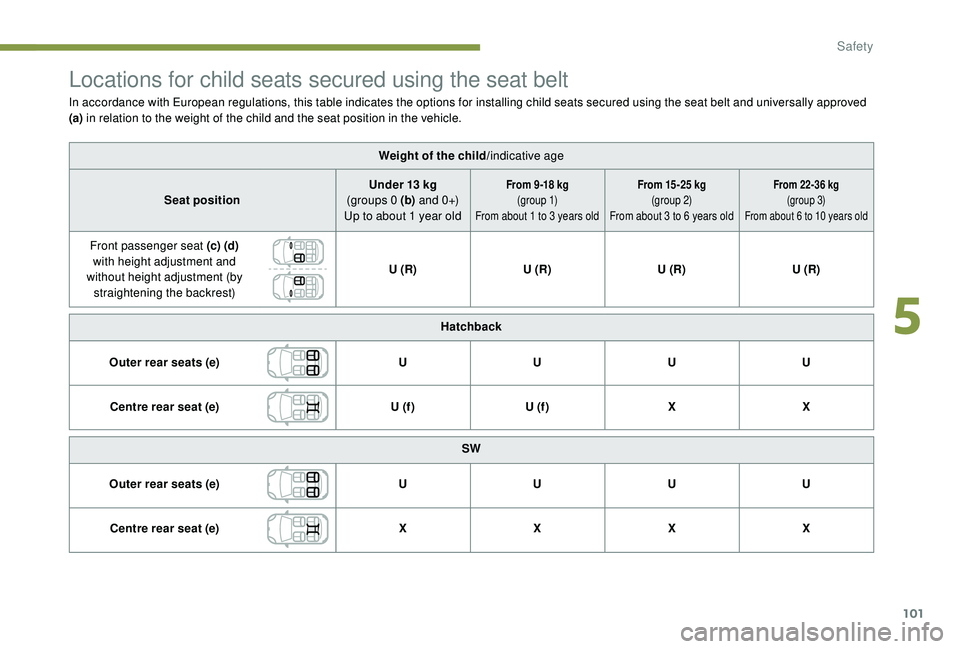
Locations for child seats secured using the seat belt
In accordance with European regulations, this table indicates the options for installing child seats secured using the seat belt and universally approved
(a) in relation to the weight of the child and the seat position in the vehicle.
Weight of the child/indicative age
Seat position Under 13
kg
(groups
0 (b) a n d 0 +)
Up to about 1 year old
From 9 -18 kg (g r o u p 1)
From about 1 to 3
years old From 15-25 kg
(group 2)
From about 3 to 6
years oldFrom 22-36 kg
( group 3)
From about 6 to 10
years old
Front passenger seat (c) (d)
with height adjustment and
without height adjustment (by straightening the backrest) U (R)
U (R)U (R)U (R)
Hatchback
Outer rear seats (e) UUUU
Centre rear seat (e) U (f )U (f ) XX
SW
Outer rear seats (e) UUUU
Centre rear seat (e) XXXX
5
Safety
Page 104 of 324
102
(e)To install a child seat at the rear, rear ward
or for ward facing, move the front seat
for ward, then straighten the backrest to
allow enough room for the child seat and
the child's legs.
(f )A child seat with a support leg must
never be installed on the centre rear
passenger seat.
Remove and stow the head restraint
before installing a child seat with backrest
on a passenger seat.
Refit the head restraint when the child
seat is removed.
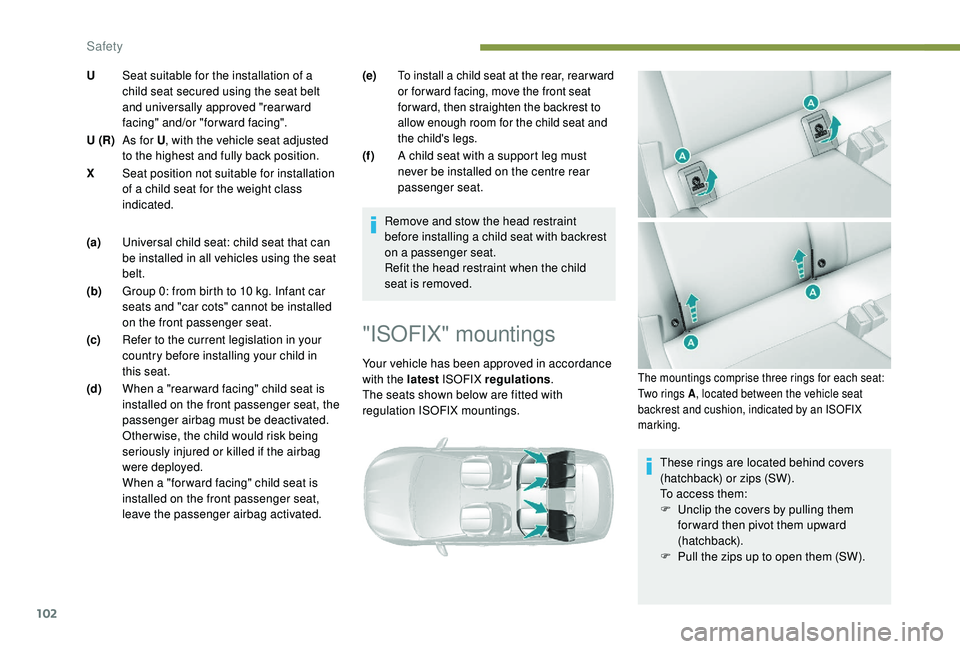
"ISOFIX" mountings
Your vehicle has been approved in accordance
with the latest ISOFIX regulations .
The seats shown below are fitted with
regulation ISOFIX mountings.
These rings are located behind covers
(hatchback) or zips (SW).
To access them:
F
U
nclip the covers by pulling them
forward then pivot them upward
(hatchback).
F
P
ull the zips up to open them (SW).
U
Seat suitable for the installation of a
child seat secured using the seat belt
and universally approved "rearward
facing" and/or "forward facing".
U (R) As for U , with the vehicle seat adjusted
to the highest and fully back position.
X Seat position not suitable for installation
of a child seat for the weight class
indicated.
(a) Universal child seat: child seat that can
be installed in all vehicles using the seat
belt.
(b) Group 0: from birth to 10
kg. Infant car
seats and "car cots" cannot be installed
on the front passenger seat.
(c) Refer to the current legislation in your
country before installing your child in
this seat.
(d) When a "rear ward facing" child seat is
installed on the front passenger seat, the
passenger airbag must be deactivated.
Otherwise, the child would risk being
seriously injured or killed if the airbag
were deployed.
When a "for ward facing" child seat is
installed on the front passenger seat,
leave the passenger airbag activated.The mountings comprise three rings for each seat:
Two rings A , located between the vehicle seat
backrest and cushion, indicated by an ISOFIX
marking.
Safety