2018 NISSAN VERSA door lock
[x] Cancel search: door lockPage 123 of 354

Press thebutton on the key fob again
within five seconds.
∙ All doors unlock.
∙ The hazard warning lights flash once if
all doors are completely closed.
The interior lights can be turned off without
waiting a period of time by inserting the key
into the ignition switch and placing the ig-
nition switch in the ON or START position,
locking the doors with the key fob, power
door lock switch or pushing the interior
light switch to the off position.
Auto relock
When thebutton on the key fob is
pressed, all doors will lock automatically
within 1 minute unless one of the following
operations is performed:
∙ Any door is opened.
∙ A key is inserted into the ignition switch
and the switch is cycled from OFF to ON.
∙ Press the
button.
Releasing the trunk lid
Press thebutton on the key fob for
longer than 0.5 seconds to open the trunk
lid. The trunk release button on the key fob
will not operate when the ignition switch is
placed in the ON position.
Using the panic alarm
If you are near your vehicle and feel threat-
ened, you may activate the panic alarm to
call attention by pressing and holding
the
button on the key fob forlonger
than 0.5 seconds.
The panic alarm and headlights will stay on
for a period of time.
The panic alarm stops when:
∙ It has run for a period of time.
∙ Any button is pressed on the key fob.
LPD2030LPD2031
3-8Pre-driving checks and adjustments
Page 128 of 354
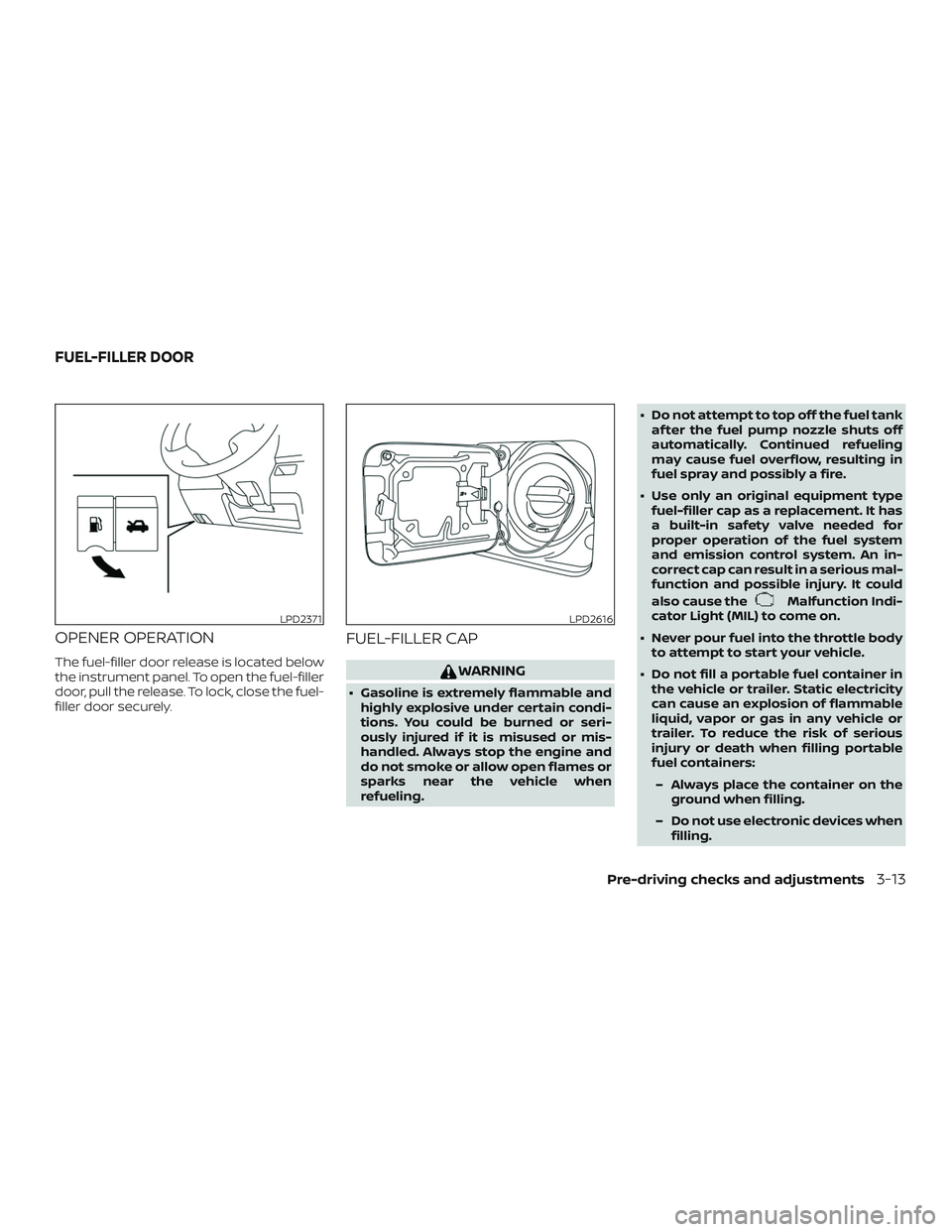
OPENER OPERATION
The fuel-filler door release is located below
the instrument panel. To open the fuel-filler
door, pull the release. To lock, close the fuel-
filler door securely.
FUEL-FILLER CAP
WARNING
∙ Gasoline is extremely flammable and
highly explosive under certain condi-
tions. You could be burned or seri-
ously injured if it is misused or mis-
handled. Always stop the engine and
do not smoke or allow open flames or
sparks near the vehicle when
refueling.∙ Do not attempt to top off the fuel tank
af ter the fuel pump nozzle shuts off
automatically. Continued refueling
may cause fuel overflow, resulting in
fuel spray and possibly a fire.
∙ Use only an original equipment type
fuel-filler cap as a replacement. It has
a built-in safety valve needed for
proper operation of the fuel system
and emission control system. An in-
correct cap can result in a serious mal-
function and possible injury. It could
also cause the
Malfunction Indi-
cator Light (MIL) to come on.
∙ Never pour fuel into the throttle body
to attempt to start your vehicle.
∙ Do not fill a portable fuel container in
the vehicle or trailer. Static electricity
can cause an explosion of flammable
liquid, vapor or gas in any vehicle or
trailer. To reduce the risk of serious
injury or death when filling portable
fuel containers:
– Always place the container on the
ground when filling.
– Do not use electronic devices when
filling.
LPD2371LPD2616
FUEL-FILLER DOOR
Pre-driving checks and adjustments3-13
Page 197 of 354

VOICE ADAPTATION (VA) MODE
Voice Adaptation (VA) allows up to two out-
of-dialect users to train the system to im-
prove recognition accuracy. By repeating a
number of commands, the users can cre-
ate a voice model of their own voice that is
stored in the system. The system is ca-
pable of storing a different Voice Adapta-
tion model for each connected phone.
Training procedure
The procedure for training a voice is as fol-
lows.
1. Position the vehicle in a reasonably
quiet outdoor location.
2. Sit in the driver’s seat with the engine
running, the parking brake on, and the
transmission in P (Park).
3. Press and hold the
button for
more than 5 seconds.
4. The system announces: “Press the
PHONE/SEND
button for the
hands-free phone system to enter the
voice adaptation mode or press the
PHONE/END
button to select a
different language.”5. Press the
button.
For additional information on selecting
a different language, refer to “Choosing
a language” in this section.
6. Voice memory A or memory B is se-
lected automatically. If both memory
locations are already in use, the system
will prompt you to overwrite one. Fol-
low the instructions provided by the
system.
7. When preparation is complete and you
are ready to begin, press the
but-
ton.
8. The VA mode will be explained. Follow
the instructions provided by the sys-
tem.
9. When training is finished, the system
will tell you an adequate number of
phrases have been recorded.
10. The system will announce that voice
adaptation has been completed and
the system is ready.
The VA mode will stop if:
∙ The
button is pressed for more
than 5 seconds in VA mode.∙ The vehicle begins moving during VA
mode.
∙ The ignition switch is placed in the OFF
or LOCK position.
Training phrases
During the Voice Adaptation mode, the sys-
tem instructs the trainer to say the follow-
ing phrases. The system will prompt you for
each phrase.
∙ phonebook transfer entry
∙ dial three oh four two nine
∙ delete call back number
∙ incoming
∙ transfer entry
∙ eight pause nine three two pause seven
∙ delete all entries
∙ call seven two four zero nine
∙ phonebook delete entry
∙ next entry
∙ dial star two one seven oh
∙yes
∙no
4-62Display screen, heater, air conditioner, audio and phone systems
Page 212 of 354
5 Starting and driving
Precautions when starting and driving..........5-2
Exhaust gas (carbon monoxide)..............5-2
Three-way catalyst...........................5-2
Tire Pressure Monitoring System
(TPMS)........................................5-3
Avoiding collision and rollover................5-6
Off-roadrecovery ............................5-6
Rapid air pressure loss.......................5-7
Drinking alcohol/drugs and driving...........5-8
Ignition switch...................................5-8
Continuously Variable Transmission
(if so equipped)...............................5-8
Manual transmission (if so equipped).........5-9
Ignition switch positions......................5-9
Before starting the engine......................5-10
Starting the engine.............................5-10
Driving the vehicle...............................5-11
Continuously Variable Transmission
(CVT) (if so equipped).........................5-11
Manual transmission (if so equipped)........5-16
Parking brake..................................5-18
Cruise control (if so equipped)..................5-19Precautions on cruise control................5-19
Cruise control operations....................5-19
Break-in schedule..............................5-20
Fuel efficient driving tips........................5-21
Increasing fuel economy.......................5-22
Parking/parking on hills........................5-23
Power steering.................................5-24
Brake system...................................5-25
Brake precautions...........................5-25
Anti-lock Braking System (ABS)..............5-25
Brake assist.................................5-26
Vehicle Dynamic Control (VDC) system.........5-27
Brake force distribution......................5-28
Cold weather driving...........................5-29
Freeing a frozen door lock...................5-29
Antifreeze...................................5-29
Battery......................................5-29
Draining of coolant water....................5-30
Tire equipment..............................
5-30
Special winter equipment...................5-30
Driving on snow or ice.......................5-30
Engine block heater (if so equipped).........5-31
Page 221 of 354

∙ Make sure the area around the vehicle is
clear.
∙ Check fluid levels such as engine oil,
coolant, brake and clutch fluid (if so
equipped), and windshield-washer fluid
as frequently as possible, or at least
whenever you refuel.
∙ Check that all windows and lights are
clean.
∙ Visually inspect tires for their appear-
ance and condition. Also check tires for
proper inflation.
∙ Lock all doors.
∙ Position seat and adjust head
restraints/headrests.
∙ Adjust inside and outside mirrors.
∙ Fasten seat belts and ask all passen-
gers to do likewise.
∙ Check the operation of warning lights
when the ignition switch is placed in the
ON position. For additional information,
refer to “Warning lights, indicator lights
and audible reminders” in the “Instru-
ments and controls” section of this
manual.1. Apply the parking brake.
2.Continuously Variable Transmission
models:
Move the shif t lever to P (Park) or N
(Neutral). P (Park) is recommended.
The shif t lever cannot be moved out
of P (Park) and into any of the other
gear positions if the ignition key is
turned to the OFF position or if the
key is removed from the ignition
switch.
The starter is designed not to oper-
ate if the shif t lever is in any of the
driving positions.
Manual transmission (M/T) models:
For best practice when operating an
M/T, depressing the clutch before
moving the shif t lever is ideal.
Move the shif t lever to N (Neutral). De-
press the clutch pedal to the floor
while cranking the engine.
The starter is designed not to oper-
ate unless the clutch pedal is fully
depressed.3. Crank the enginewith your foot off
the accelerator pedalby turning the
ignition key to the START position. Re-
lease the key when the engine starts. If
the engine starts, but fails to run, repeat
the above procedure.
∙ If the engine is very hard to start in
extremely cold weather or when re-
starting, depress the accelerator
pedal a little (approximately 1/3 to the
floor) and hold it and then crank the
engine. Release the key and the ac-
celerator pedal when the engine
starts.
∙ If the engine is very hard to start be-
cause it is flooded, depress the accel-
erator pedal all the way to the floor
and hold it. Crank the engine for
5-6 seconds. Af ter cranking the en-
gine, release the accelerator pedal.
Crank the enginewith your foot off
the accelerator pedalby turning the
ignition key to the START position. Re-
lease the key when the engine starts.
If the engine starts, but fails to run,
repeat the above procedure.
BEFORE STARTING THE ENGINE STARTING THE ENGINE
5-10Starting and driving
Page 240 of 354
WARNING
∙ The VDC system is designed to help
the driver maintain stability but does
not prevent accidents due to abrupt
steering operation at high speeds or
by careless or dangerous driving
techniques. Reduce vehicle speed and
be especially careful when driving and
cornering on slippery surfaces and al-
ways drive carefully.
∙ Do not modif y the vehicle’s suspen-
sion. If suspension parts such as
shock absorbers, struts, springs, sta-
bilizer bars, bushings and wheels are
not NISSAN recommended for your
vehicle or are extremely deteriorated,
the VDC system may not operate
properly. This could adversely affect
vehicle handling performance, and
the
indicator light may flash or
illuminate.
∙ If brake related parts such as brake
pads, rotors and calipers are not
NISSAN recommended or are ex-
tremely deteriorated, the VDC system
may not operate properly and
the
indicator light may
illuminate.∙ If engine control related parts are not
NISSAN recommended or are ex-
tremely deteriorated, the
indi-
cator light may illuminate.
∙ When driving on extremely inclined
surfaces such as higher banked cor-
ners, the VDC system may not operate
properly and the
indicator light
may flash or illuminate. Do not drive
on these types of roads.
∙ When driving on an unstable surface
such as a turntable, ferry, elevator or
ramp, the
indicator light may
flash or illuminate. This is not a mal-
function. Restart the engine af ter
driving onto a stable surface.
∙ If wheels or tires other than the
NISSAN recommended ones are used,
the VDC system may not operate
properly and the
indicator light
may flash or illuminate.
∙ The VDC system is not a substitute for
winter tires or tire chains on a snow
covered road.
FREEING A FROZEN DOOR LOCK
To prevent a door lock from freezing, apply
de-icer through the key hole. If the lock
becomes frozen, heat the key before in-
serting it into the key hole or use the re-
mote keyless entry key fob.
ANTIFREEZE
In the winter when it is anticipated that the
temperature will drop below 32°F (0°C),
check the antifreeze to assure proper win-
ter protection. For additional information,
refer to “Engine cooling system” in the “Do-
it-yourself ” section of this manual.
BATTERY
If the battery is not fully charged during
extremely cold weather conditions, the
battery fluid may freeze and damage the
battery. To maintain maximum efficiency,
the battery should be checked regularly.
For additional information, refer to “Battery”
in the “Do-it-yourself ” section of this
manual.
COLD WEATHER DRIVING
Starting and driving5-29
Page 310 of 354
Doors and engine hood:Check that the
doors and engine hood operate properly.
Also ensure that all latches lock securely.
Lubricate hinges, latches, latch pins, rollers
and links if necessary. Make sure that the
secondary latch keeps the hood from
opening when the primary latch is re-
leased.
When driving in areas using road salt or
other corrosive materials, check lubrica-
tion frequently.
Lights*:Clean the headlights on a regular
basis. Make sure that the headlights, stop
lights, tail lights, turn signal lights, and other
lights are all operating properly and in-
stalled securely. Also check headlight aim.
Road wheel nuts (lug nuts)*:When check-
ing the tires, make sure no wheel nuts are
missing, and check for any loose wheel
nuts. Tighten if necessary.
Tire rotation*:Tires should be rotated ev-
ery 5,000 miles (8,000 km).
Tires*:Check the pressure with a gauge
of ten and always prior to long distance
trips. If necessary, adjust the pressure in all
tires, including the spare, to the pressure
specified. Check carefully for damage, cuts
or excessive wear.Tire Pressure Monitoring System (TPMS)
transmitter components:Replace the
TPMS transmitter grommet seal, valve core
and cap when the tires are replaced due to
wear or age.
Wheel alignment and balance:If the ve-
hicle should pull to either side while driving
on a straight and level road, or if you detect
uneven or abnormal tire wear, there may
be a need for wheel alignment. If the steer-
ing wheel or seat vibrates at normal high-
way speeds, wheel balancing may be
needed.
For additional information regarding tires,
refer to “Important Tire Safety Information”
(US) or “Tire Safety Information” (Canada) in
the Warranty Information Booklet.
Windshield:Clean the windshield on a
regular basis. Check the windshield at least
every six months for cracks or other dam-
age. Have a damaged windshield repaired
by a qualified repair facility.
Windshield wiper blades*:Check for
cracks or wear if they do not wipe properly.
Inside the vehicle
The maintenance items listed here should
be checked on a regular basis, such aswhen performing scheduled maintenance,
cleaning the vehicle, etc.
Accelerator pedal:Check the pedal for
smooth operation and make sure the
pedal does not catch or require uneven
effort. Keep the floor mat away from the
pedal.
Brake pedal:Check the pedal for smooth
operation. If the brake pedal suddenly goes
down further than normal, the pedal feels
spongy or the vehicle seems to take longer
to stop, have your vehicle checked imme-
diately. It is recommended that you visit a
NISSAN dealer for this service. Keep the
floor mat away from the pedal.
Brakes:Check that the brakes do not pull
the vehicle to one side when applied.
Continuously Variable Transmission
(CVT) P (Park) position mechanism (if so
equipped):On a fairly steep hill check that
the vehicle is held securely with the shif t
lever in the P (Park) position without apply-
ing any brakes.
Parking brake:Check the parking brake
operation regularly. The vehicle should be
securely held on a fairly steep hill with only
the parking brake applied. If the parking
Maintenance and schedules9-3
Page 346 of 354
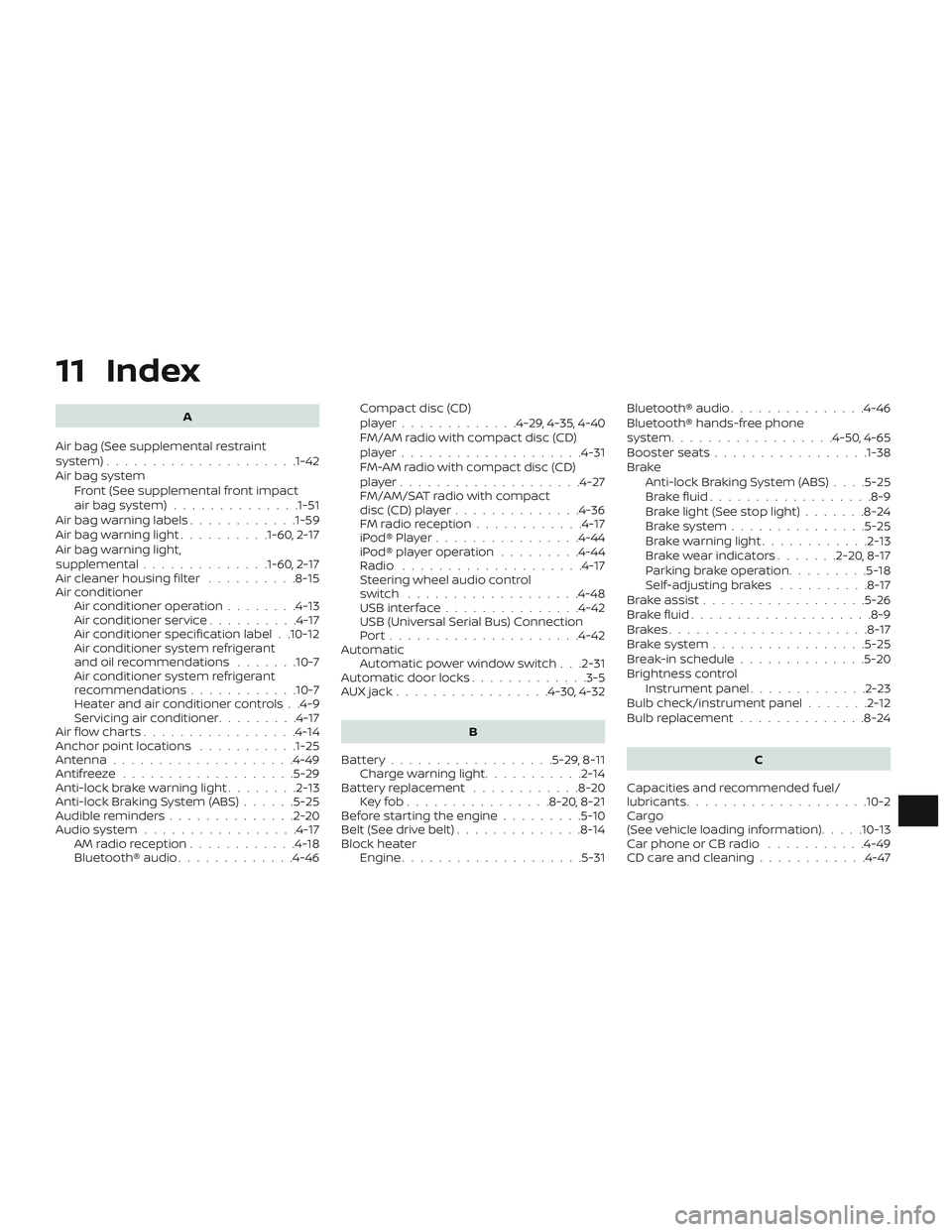
11 Index
A
Air bag (See supplemental restraint
system).....................1-42
Air bag system
Front (See supplemental front impact
airbagsystem)..............1-51
Air bag warning labels............1-59
Airbagwarninglight..........1-60, 2-17
Air bag warning light,
supplemental..............1-60, 2-17
Air cleaner housing filter..........8-15
Air conditioner
Air conditioner operation........4-13
Air conditioner service..........4-17
Air conditioner specification label . .10-12
Air conditioner system refrigerant
and oil recommendations.......10-7
Air conditioner system refrigerant
recommendations............10-7
Heater and air conditioner controls . .4-9
Servicing air conditioner.........4-17
Air flow charts.................4-14
Anchor point locations...........1-25
Antenna....................4-49
Antifreeze...................5-29
Anti-lock brake warning light........2-13
Anti-lock Braking System (ABS)......5-25
Audible reminders..............2-20
Audio system.................4-17
AMradioreception............4-18
Bluetooth® audio.............4-46Compact disc (CD)
player.............4-29,4-35,4-40
FM/AM radio with compact disc (CD)
player....................4-31
FM-AM radio with compact disc (CD)
player....................4-27
FM/AM/SAT radio with compact
disc(CD)player..............4-36
FMradioreception............4-17
iPod®Player................4-44
iPod® player operation.........4-44
Radio....................4-17
Steering wheel audio control
switch ...................4-48
USBinterface...............4-42
USB (Universal Serial Bus) Connection
Port.....................4-42
Automatic
Automatic power window switch . . .2-31
Automatic door locks.............3-5
AUXjack.................4-30,4-32
B
Battery..................5-29,8-11
Charge warning light...........2-14
Battery replacement............8-20
Keyfob................8-20,8-21
Before starting the engine.........5-10
Belt(Seedrivebelt)..............8-14
Block heater
Engine....................5-31Bluetooth® audio...............4-46
Bluetooth® hands-free phone
system..................4-50,4-65
Booster seats.................1-38
Brake
Anti-lock Braking System (ABS)....5-25
Brakefluid..................8-9
Brakelight(Seestoplight).......8-24
Brakesystem...............5-25
Brakewarninglight............2-13
Brakewearindicators.......2-20,8-17
Parking brake operation.........5-18
Self-adjustingbrakes ..........8-17
Brakeassist..................5-26
Brakefluid....................8-9
Brakes......................8-17
Brakesystem.................5-25
Break-in schedule..............5-20
Brightness control
Instrument panel.............2-23
Bulb check/instrument panel.......2-12
Bulb replacement..............8-24
C
Capacities and recommended fuel/
lubricants....................10-2
Cargo
(See vehicle loading information).....10-13
Car phone or CB radio...........4-49
CDcareandcleaning............4-47