∙ Whenever working on or near a bat-
tery, always wear suitable eye protec-
tors (for example, goggles or indus-
trial safety spectacles) and remove
rings, metal bands, or any other jew-
elry. Do not lean over the battery
when jump starting.
∙ Do not attempt to jump start a frozen
battery. It could explode and cause
serious injury.
∙ Your vehicle has an automatic engine
cooling fan. It could come on at any
time. Keep hands and other objects
away from it.
WARNING
Always follow the instructions below.
Failure to do so could result in damage
to the charging system and cause per-
sonal injury.
1. If the booster battery is in another ve-
hicle, position the 2 vehicles to bring
their batteries near each other.
Do not allow the 2 vehicles to touch.2. Apply the parking brake. Move the shif t
lever to N (Neutral) (manual transmis-
sion) or to P (Park) (continuously vari-
able transmission). Switch off all un-
necessary electrical systems (lights,
heater, air conditioner, etc.).
3. Remove vent caps on the battery (if so
equipped). Cover the battery with an
old cloth to reduce explosion hazard.
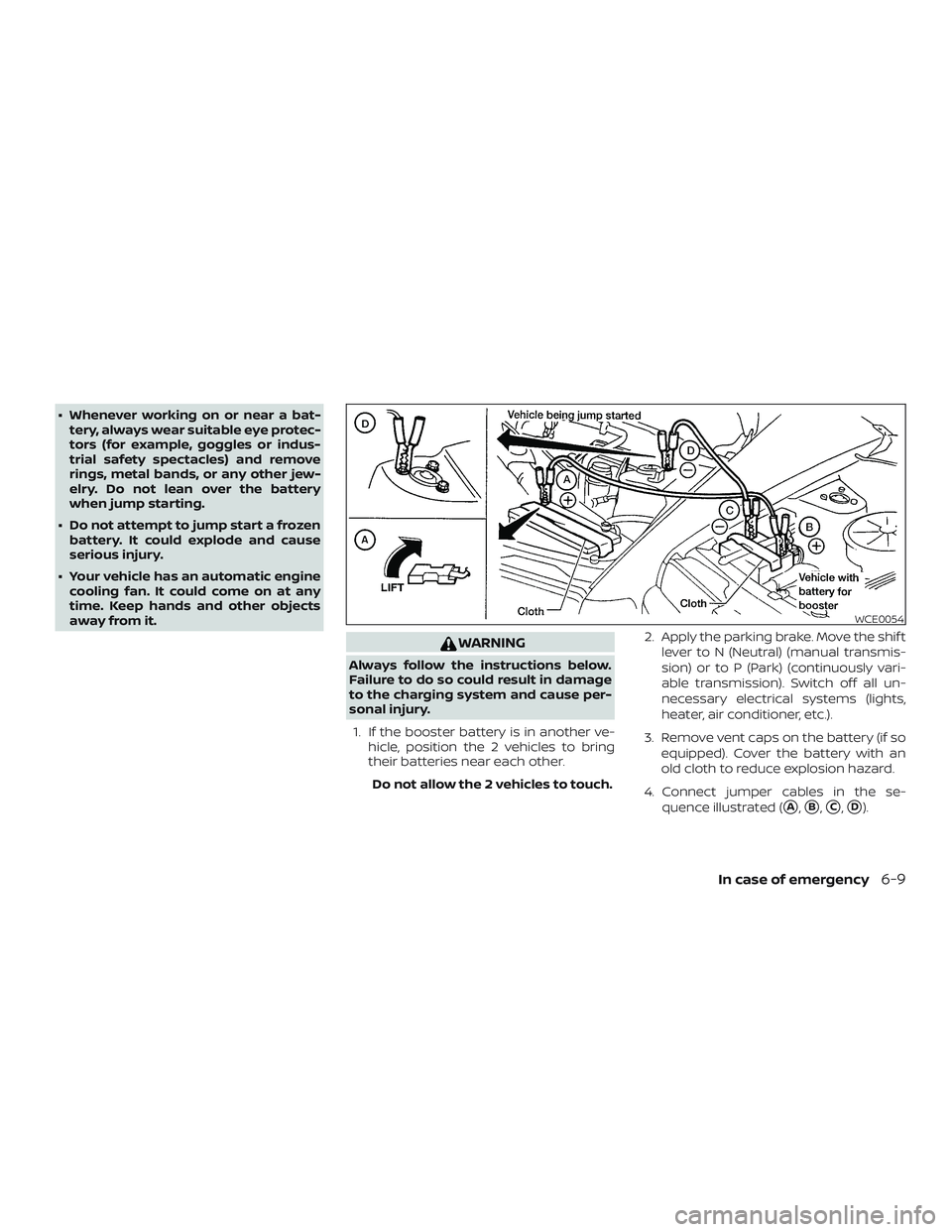
4. Connect jumper cables in the se-
quence illustrated (
�A,�B,�C,�D).
WCE0054
In case of emergency6-9
Vehicles operated in high temperatures or
under severe conditions require frequent
checks of the battery fluid level.
JUMP STARTING
If jump starting is necessary, refer to “Jump
starting” in the “In case of emergency” sec-
tion of this manual. If the engine does not
start by jump starting, the battery may
have to be replaced. It is recommended
that you visit a NISSAN dealer for this ser-
vice.
CAUTION
∙ Do not ground accessories directly to
the battery terminal. Doing so will by-
pass the variable voltage control sys-
tem and the vehicle battery may not
charge completely.
∙ Use electrical accessories with the en-
gine running to avoid discharging the
vehicle battery.Your vehicle is equipped with a variable
voltage control system. This system mea-
sures the amount of electrical discharge
from the battery and controls voltage gen-
erated by the generator.
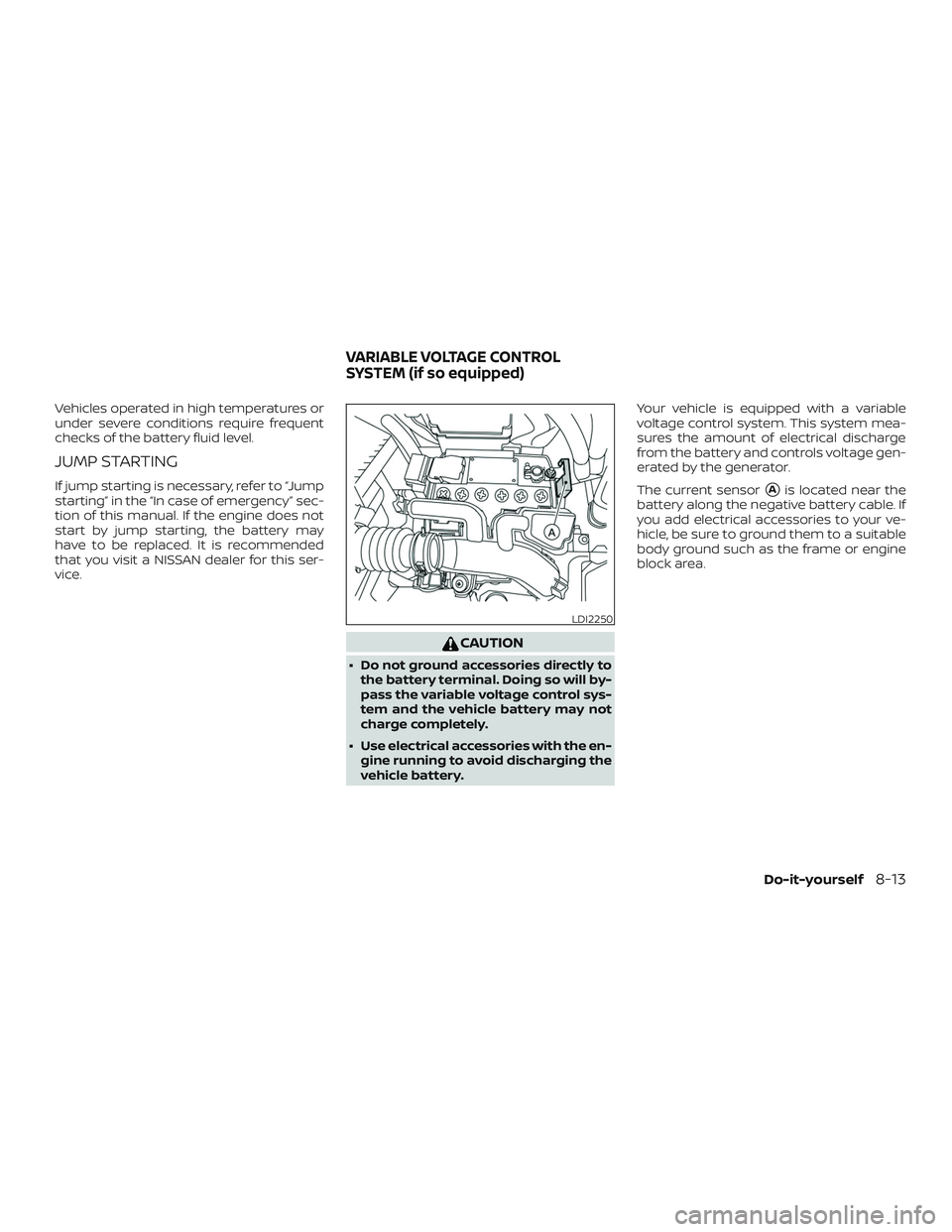
The current sensor
�Ais located near the
battery along the negative battery cable. If
you add electrical accessories to your ve-
hicle, be sure to ground them to a suitable
body ground such as the frame or engine
block area.
LDI2250
VARIABLE VOLTAGE CONTROL
SYSTEM (if so equipped)
Do-it-yourself8-13