2018 MITSUBISHI OUTLANDER PHEV cooling oil
[x] Cancel search: cooling oilPage 53 of 538

WARNING•Do not open the tailgate, for example to
remove or place an item in the cargo area.
Charging may affect the operation of elec-
tric medical devices and result in serious personal injury or death.
l Do not charge when the EV charging ca-
ble is coiled up.
Doing so the cable may be heated abnor- mally and this might result in fire.
l Before charging, make sure that there is
no foreign matter such as dust at the nor-
mal charge port and the normal charge connector.
At this time, do not touch the normal
charge port.
l When the normal charge connector is
connected to the charge port, prevent for- eign matter such as water or dust from
entering in the connection.
Connection with foreign matter such as
water or dust may cause fire or an electric shock. Do not perform charging if there
might be strong exposure to water at the connection.
l Never pull the cable to remove the plug.
And never submerge the EV charging
connector, control box or plug in water.
l Please observe the following in order to
prevent accidents during charging such as
electrocution.
• Only use the EV charging cable that is
supplied with the vehicle.WARNING• Do not charge another vehicle by the
EV charging cable. The cable may overheat and this may result in a fire.
• When charging outdoors, make sure to
use an outlet that is protected from wa-
ter entering.
• Do not perform charging with the vehi-
cle covered by a car cover, except for
the MITSUBISHI MOTORS GENU-
INE car cover.
• Do not connect or disconnect the plug
and connector with wet hands.
l While it is normal for the connector and
charging cable to become warm during charging, discontinue use immediately if
the connector or charging cable becomes hot to the touch.
l While it is normal for the control box to
become warm during charging, discontin-
ue use immediately if the control box be- comes hot to the touch.
l If abnormal smells are detected or the ve-
hicle produces smoke, quickly stop charg-
ing.
l Do not perform charging in a poorly ven-
tilated area or in an enclosed area. Keep
sparks, cigarettes, and flames away from
the auxiliary battery.
Flammable gas generated from the auxili- ary battery during charging may be trap- ped, resulting in explosion.
If charging is inevitably required, venti-
late the area well.WARNINGl Grasp the normal charge connector when
connecting or disconnecting the EVcharging cable.
Grasping the cable may damage the cable
and could cause an electric shock, short circuit, and/or fire.CAUTIONl During charging, the cooling fans inside the
engine compartment may automatically be operated even if the operation mode of the
power switch is in OFF.
Keep your hands away from the cooling fan during charging.
l Do not perform charging from other power
source like a generator. Doing so could cause a malfunction.NOTEl If the charge connector is not easily connec-
ted to the charge port due to foreign materialentering, never force the connection. Doing so could damage the charging equipment or
the vehicle. Please contact a MITSUBISHI
MOTORS Authorized Service Point.
l The on board charger is only for rated AC
220-240V outlets.
Normal charging (charging method with rated AC 220-240V outlet)
3-11OGGE18E1Charging3
Page 449 of 538

WARNINGlIf it is necessary to do work in the engine
compartment with the plug-in hybrid EV
system starting, be especially careful that
your clothing, hair, etc., does not become caught by the cooling fans, drive belts, orother moving parts.
l After performing the maintenance, make
sure that no tools or cloths are left behind in the engine compartment. If they are left
behind, a fire or damage to the vehicle
may occur.
l The cooling fans can turn on automatical-
ly even if the plug-in hybrid EV system is
stopping. Put the operation mode of the
power switch in OFF to be safe while you work in the engine compartment.
l Make sure that the engine and Plug-in
Hybrid EV system has cooled down be- fore removing the radiator cap and EV cooling system reserve tank cap, because
hot steam or boiling water will otherwise
gush from the filler port and may scald you.
l Do not smoke, cause sparks or allow open
flames around fuel or auxiliary battery.
The fumes are flammable.
l Be extremely cautious when working
around the auxiliary battery. It contains
poisonous and corrosive sulphuric acid.
l Do not get under your vehicle with just
the body jack supporting it. Always use
automotive jack stands.WARNINGl Improper handling of components and
materials used in the vehicle can endangeryour personal safety. We recommend you to consult a specialist for necessary infor- mation.
l The components inside the engine room
might be very hot to the touch.
To avoid being burnt, make sure all com- ponents have sufficiently cooled before beginning an inspection. These compo-
nents are affixed with the label indicating precautions for handling. Follow the in-
structions on the label.
1- Brake fluid reservoir (RHD)
2- Engine oil level dipstick
3- Engine oil cap
4- Brake fluid reservoir (LHD)
5- Washer fluid reservoir
6- EV cooling system reservoir
7- Engine coolant reservoir
Catalytic converter
E01000202495
The exhaust gas scavenging devices used with the catalytic converter are extremely ef- ficient for the reduction of noxious gases.
The catalytic converter is installed in the ex- haust system.
It is important to keep the engine properly
tuned to ensure proper catalyst operation and prevent possible catalyst damage.WARNINGl As with any vehicle, do not park or oper-
ate this vehicle in areas where combusti- ble materials such as dry grass or leaves
can come in contact with a hot exhaust
since a fire could occur.
l Paint should not be applied to the catalyt-
ic converter.NOTEl Use fuel of the type recommended in
“Fuel
selection” on page 2-13.
Catalytic converter
11-03OGGE18E1Maintenance11
Page 452 of 538
NOTElThe engine oil will deteriorate rapidly if the
vehicle is subjected to severe conditions, re-
quiring earlier oil replacement.
Please refer to the maintenance schedule.
l For information on how to dispose of used
engine oil, refer to page 2-17.
Recommended engine oil vis-
cosity
l Select engine oil of the proper SAE vis-
cosity number according to the atmos-
pheric temperature.
SAE 0W-20, 0W-30, 5W-30, and 5W-40
engine oils can only be used if they meet ACEA A3/B3, A3/B4 or A5/B5 and API
SM (or higher) specifications.
l Use engine oil conforming to the follow-
ing classification: • API classification: “For service SM”
or higher
• ILSAC certificated oil
• ACEA classification: “For service A1/B1, A3/B3 , A3/B4 or
A5/B5”NOTEl Use of additives is not recommended since
they may reduce the effectiveness of addi-
tives already included in the engine oil. It may result in failure of the mechanical as-
sembly.Engine coolant/Plug-in
hybrid EV system coolant E01000503466
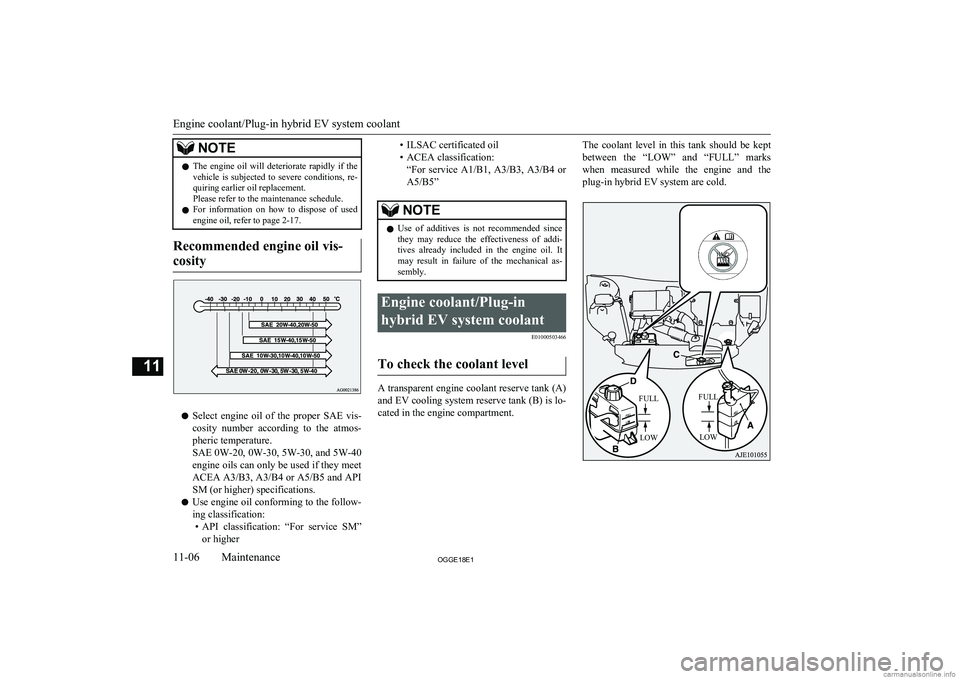
To check the coolant level
A transparent engine coolant reserve tank (A)
and EV cooling system reserve tank (B) is lo- cated in the engine compartment.
The coolant level in this tank should be kept
between the “LOW” and “FULL” marks
when measured while the engine and the
plug-in hybrid EV system are cold.
Engine coolant/Plug-in hybrid EV system coolant
11-06OGGE18E1Maintenance11 FULLLOW FULL
LOW
Page 453 of 538

To add coolant
The cooling system is a closed system andnormally the loss of coolant should be very
slight. A noticeable drop in the coolant level
could indicate leakage. If this occurs, we rec- ommend you to have the system checked as
soon as possible.
If the level should drop below the “LOW” level on the reserve tank, open the lid and
add coolant.
Also, if the reserve tank is completely empty, remove the radiator cap (C) or the reservetank cap (D) and add coolant until the level reaches the filler neck.
WARNINGl Do not open the radiator cap (C) and the
reserve tank cap (D) while the engine andthe plug-in hybrid EV system are hot. The
coolant system is under pressure and any hot coolant escaping could cause severe burns.Anti-freeze
The engine coolant and the plug-in hybrid
EV system coolant contains an ethylene gly-col anti-corrosion agent. Some parts of the
engine and the plug-in hybrid EV system are
cast aluminium alloy, and periodic changing of the engine coolant and the plug-in hybridEV system coolant are necessary to prevent
corrosion of these parts.
Use “ MITSUBISHI MOTORS GENUINE
SUPER LONG LIFE COOLANT PREMI-
UM” or equivalent *
.
MITSUBISHI MOTORS GENUINE Coolant
has excellent protection against corrosion and rust formation of all metals including alumi-
nium and can avoid blockages in the radiator,
heater, cylinder head, engine block, etc.
Because of the necessity of this anti-corro- sion agent, the coolant must not be replaced
with plain water even in summer. The re-
quired concentration of anti-freeze differs de- pending on the expected ambient tempera-
ture.
Above -35 °C: 50 % concentration of anti- freeze
* similar high quality ethylene glycol based
non-silicate, non-amine, non-nitrate andnon-borate coolant with long life hybrid
organic acid technologyBelow -35 °C: 60 % concentration of anti-
freezeCAUTIONl Do not use alcohol or methanol anti-freeze
or any engine coolants mixed with alcohol or methanol anti-freeze. The use of an im-
proper anti-freeze can cause corrosion of the aluminium components.
l Do not use water to adjust the concentration
of coolant.
l Concentrations exceeding 60 % will result in
a reduction of both the anti-freeze and cool-
ing performance thus adversely affecting the engine.
l Do not top up with water only.
Water by itself reduces the rust-protective
and anti-freeze qualities of the coolant and has a lower boiling point. It can also causedamage to the cooling system if it should freeze. Do not use tapwater, as it can causecorrosion and rust formation.
During cold weather
If the temperatures in your area drop below
freezing, there is the danger that the coolant
in the engine, plug-in hybrid EV system or radiator could freeze and cause severe dam-age to the engine and/or radiator. Add a suffi-
cient amount of anti-freeze to the coolant to prevent it from freezing.
Engine coolant/Plug-in hybrid EV system coolant
11-07OGGE18E1Maintenance11