2018 MITSUBISHI OUTLANDER PHEV warning
[x] Cancel search: warningPage 40 of 538
lThe installation of accessories, optional
parts, etc., should only be carried out
within the limits prescribed by law in your country, and in accordance with the
guidelines and warnings contained with-
in the documents accompanying this ve- hicle.
l Installing electric components incorrect-
ly could lead to a fire. Refer to the “Modification/alterations to the electri-
cal or fuel systems” section within this
owner’s manual.
l When installing the radio, for the re-
quired information (frequency, transmis-
sion output, installing procedure), con- sult a MITSUBISHI MOTORS Author-
ized Service Point.
If the frequency, transmission output and installing condition are not appropriate,
it can adversely affect the electronic de- vices and could lead to unsafe vehicle operation.
l Using a cellular phone or radio set inside
the vehicle without an external antenna
may cause electrical system interference, which could lead to unsafe vehicle oper-ation.
l Tyres and wheels which do not meet
specifications must not be used.
Refer to the “Specifications” section for information regarding wheel and tyre
sizes.Important points!
Due to large number of accessory and re-
placement parts of different manufactures
available in the market, it is not possible, not only for MITSUBISHI MOTORS , but also
for a MITSUBISHI MOTORS Authorized
Service Point, to check whether the attach- ment or installation of such parts affects theoverall safety of your vehicle.
Even when such parts are officially author-
ized, for example by a “general operators permit” (an appraisal for the part) or throughthe execution of the part in an officially ap-
proved manner of construction, or when a single operation permit following the attach-
ment or installation of such parts, it cannot be deduced from that alone, that the driving
safety of your vehicles has not been affected.
Consider also that there basically exists no li- ability on the part of the appraiser or the offi- cial. Maximum safety can only be ensured
with parts recommended, sold and fitted or
installed by a MITSUBISHI MOTORS au-
thorized Service Point ( MITSUBISHI
MOTORS GENUINE replacement parts and
MITSUBISHI MOTORS accessories). The
same also pertains to modifications of vehi- cles with respect to the production specifica- tions. For safety reasons, do not attempt anymodifications other than those that follow the
recommendations of a MITSUBISHI
MOTORS authorized Service Point.
Modification/alterations to
the electrical or fuel systems E00200401583
MITSUBISHI MOTORS CORPORATION
has always manufactured safe, high quality vehicles. In order to maintain this safety and
quality, it is important that any accessory that is to be fitted, or any modifications carried
out which involve the electrical or fuel sys- tems, should be carried out in accordancewith MITSUBISHI MOTORS guidelines.CAUTIONl If the wires interfere with the vehicle body
or improper installation methods are used (protective fuses not included, etc.), elec- tronic devices may be adversely affected, re-
sulting in a fire or other accident.Genuine parts
E00200500499
MITSUBISHI MOTORS has gone to great
lengths to bring you a superbly crafted auto-
mobile offering the highest quality and de- pendability.
Modification/alterations to the electrical or fuel systems
2-16OGGE18E1General information2
Page 41 of 538
Use MITSUBISHI MOTORS GENUINE
Parts, designed and manufactured to maintain your MITSUBISHI MOTORS automobile at
top performance. MITSUBISHI MOTORS
GENUINE Parts are identified by this mark and are available at all MITSUBISHI
MOTORS Authorized Service Points.Safety and disposal
information for used engine
oil E00200601383WARNINGlProlonged and repeated contact may
cause serious skin disorders, including
dermatitis and cancer.
l Avoid contact with the skin as far as pos-
sible and wash thoroughly after any con- tact.
l Keep used engine oils out of reach of chil-
dren.Protect the environment
It is illegal to pollute drains, water courses
and soil. Use authorized waste collection fa-cilities, including civic amenity sites and ga- rages providing facilities for disposal of used
oil and used oil filters. If in doubt, contact your local authority for advice on disposal.
Disposal information for
used batteries E00201301055
Your vehicle contains batter-ies and/or accumulators.
Do not mix with general
household waste.
For proper treatment, recov-
ery and recycling of used
batteries, please take them to applicable col-
lection points, in accordance with your na- tional legislation and the Directives 2006/66/EC.
By disposing of these batteries correctly, you
will help to save valuable resources and pre-
vent any potential negative effects on human
health and the environment which could oth- erwise arise from inappropriate waste han- dling.
Safety and disposal information for used engine oil
2-17OGGE18E1General information2
Page 47 of 538

WARNINGlTo reduce the risk of electric shock or fire
due to electric leak, always use an earthed
outlet protected by a residual current de-
tector, rated for amperage equal to or greater than the value specified by MITSUBISHI MOTORS , and that is con-
nected to a dedicated branch circuit. If
the circuit is shared, and another electri- cal device is being used at the same time
as the vehicle is charging, the circuit may heat abnormally, the breaker may trip
and the circuit may cause adverse inter- ference on the household electrical appli-
ances such as TVs and audio systems.
l It is possible to charge even in rain or
snow. However, be sure to pay attention to the following:
• Do not touch normal charge port, nor-
mal charge connector, outlet and plug with wet hands.
• Keep away from water when connect-
ing the normal charge port, normal
charge connector, outlet and plug.
• Do not perform the charging in the out
of doors when heavy rain, heavy snow, strong winds, and when bad weather is
expected.
• Do not charge if there is possibility a
lightning strike. When thunder rum- bling begins suddenly during normal
charging, do not touch the vehicle and the EV charging cable and turn off the
breaker.WARNINGl If water goes into the normal charge port
or the normal charge connector, it couldcause a short circuit, a fire and an electric shock.
Be sure to completely close the charging
lid and the inner lid and do not leave the EV charging cable in an outdoors.
l If the connected part of the charging plug
has been buried in snow while charging, turn off the hand switch or the breaker
connected with the outlet first, then re- move the snow and disconnect the charg-
ing plug. If your vehicle body has been buried in snow while charging, remove
the snow and then disconnect the charge connector.
l When you perform the normal charging
at away from home, some normal charg-
ers may not correspond to your vehicle. Consult an administrator or a maker of
the normal charger that it corresponds to your vehicle before using it. Also perform
normal charging according to the operat-
ing procedure indicated on the body of
normal charger.
l Do not open the charging lid for anything
other than charging and using the exter-
nal power feed.CAUTIONl Do not attempt to perform a jump start on
the auxiliary battery at the same time that the
drive battery is being charged. Doing so may
damage the vehicle or charging cable and
could cause injury.
Refer to “Emergency starting” on page 9-02.NOTEl If you open the charging lid with the opera-
tion mode of the power switch is ON, a buz- zer sounds approximately 10 minutes inter-mittently to alert the charging cannot be star- ted. If you close the charging lid or put theoperation mode in OFF, the buzzer stops.
l If you insert the charge connector to the
charge port with the operation mode is ON,
a buzzer sounds continuously approximately
10 minutes to alert the charging cannot be started.
If you pull the charge connector out or put the operation mode in OFF, the buzzer stops.
l Repeatedly performing only quick charging
may reduce the battery capacity.
In usual charge, normal charging is recom-
mended.
l To maintain the capacity of the drive battery,
the following is recommended:
• If you repeatedly perform only the quick
charging, fully charge the vehicle in nor- mal charging every 2 weeks.
Basic knowledge for charging
3-05OGGE18E1Charging3
Page 51 of 538
WARNINGlIf the POWER or CHARGING indicator does not illuminates or the FAULT indicator blinks or illuminates during normal charging, please contact
a MITSUBISHI MOTORS Authorized Service Point.
l Do not charge when the EV charging cable is coiled up.
The cable may be heated abnormally and resulting in fire.
l Do not alter or disassemble the EV charging cable. Doing so could cause fire, an electric shock or injury.
l Be sure to install the cap to the normal charge connector and store the EV charging cable in a place where the cable is not exposed to water or dust.
Entry of foreign matter such as water or dust in the metal terminal of the normal charge connector or charging cable plug may cause a fire or malfunction.
l Never force the connection if the EV charging cable or connector shows damage or is not easily connected due to foreign material entering the
connector or the outlet. And never use an outlet that is worn, damaged, or will not hold the plug firmly. Doing so could cause fire, an electric shock,
or short circuit.
l Pay attention to the following for handling the EV charging cable.
Damage to the cable could cause fire, an electric shock, or short circuit.
• Do not drop the cable or do not give strong impact to it.
• Do not pull or bend with undue force.
• Do not twist.
• Do not drag.
• Do not put an object on top.
• Do not put the cable close to a heating unit including heater.CAUTIONl Do not connect the normal charge cable to an outlet that has a lower rating than the current value described on the control box.NOTElAll indicators are illuminated momentarily for confirming operation when the charging cable plug is inserted into an outlet. After that the POWER indicator
and the CHARGING indicator is continuously illuminated.
l The CHARGING indicator will start to blink when the charging is completed. The POWER indicator is continuously illuminated while the charging cable
plug is inserted into an outlet.
EV charging cable*
3-09OGGE18E1Charging3
Page 52 of 538
Handling and storing the con-trol box
E08301201093
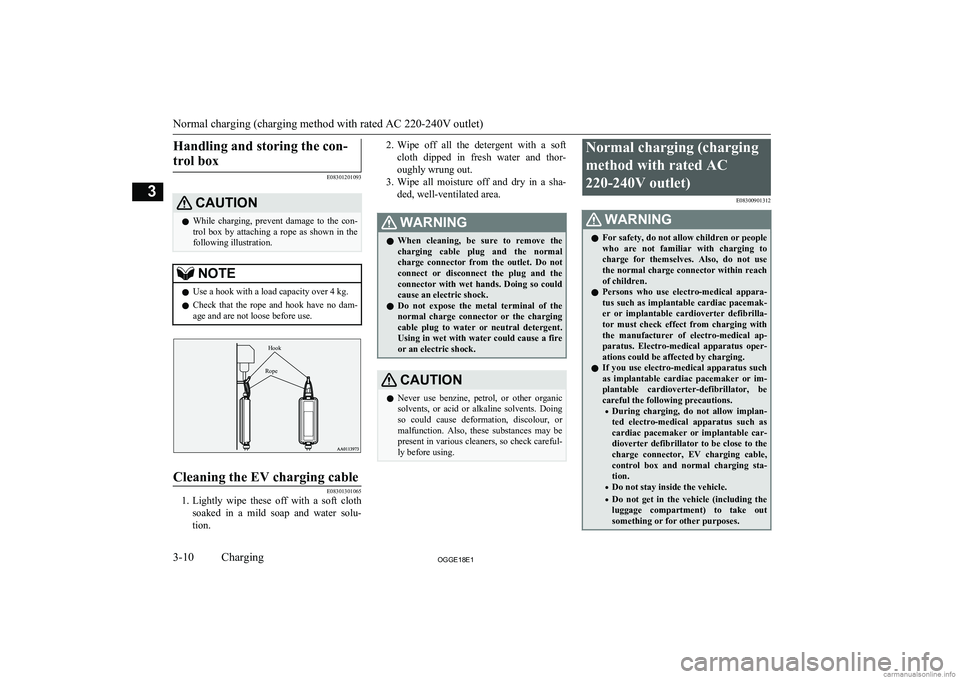
CAUTIONl While charging, prevent damage to the con-
trol box by attaching a rope as shown in the
following illustration.NOTEl Use a hook with a load capacity over 4 kg.
l Check that the rope and hook have no dam-
age and are not loose before use.HookRope
Cleaning the EV charging cable
E08301301065
1. Lightly wipe these off with a soft cloth
soaked in a mild soap and water solu- tion.
2. Wipe off all the detergent with a soft
cloth dipped in fresh water and thor- oughly wrung out.
3. Wipe all moisture off and dry in a sha-
ded, well-ventilated area.WARNINGl When cleaning, be sure to remove the
charging cable plug and the normalcharge connector from the outlet. Do not
connect or disconnect the plug and the
connector with wet hands. Doing so could cause an electric shock.
l Do not expose the metal terminal of the
normal charge connector or the chargingcable plug to water or neutral detergent.
Using in wet with water could cause a fire or an electric shock.CAUTIONl Never use benzine, petrol, or other organic
solvents, or acid or alkaline solvents. Doing so could cause deformation, discolour, or
malfunction. Also, these substances may be
present in various cleaners, so check careful- ly before using.Normal charging (charging
method with rated AC220-240V outlet) E08300901312WARNINGlFor safety, do not allow children or people
who are not familiar with charging to
charge for themselves. Also, do not use
the normal charge connector within reach of children.
l Persons who use electro-medical appara-
tus such as implantable cardiac pacemak-
er or implantable cardioverter defibrilla- tor must check effect from charging with
the manufacturer of electro-medical ap- paratus. Electro-medical apparatus oper- ations could be affected by charging.
l If you use electro-medical apparatus such
as implantable cardiac pacemaker or im- plantable cardioverter-defibrillator, be
careful the following precautions.
• During charging, do not allow implan-
ted electro-medical apparatus such as
cardiac pacemaker or implantable car- dioverter defibrillator to be close to the
charge connector, EV charging cable,
control box and normal charging sta-
tion.
• Do not stay inside the vehicle.
• Do not get in the vehicle (including the
luggage compartment) to take outsomething or for other purposes.
Normal charging (charging method with rated AC 220-240V outlet)
3-10OGGE18E1Charging3
Page 53 of 538

WARNING•Do not open the tailgate, for example to
remove or place an item in the cargo area.
Charging may affect the operation of elec-
tric medical devices and result in serious personal injury or death.
l Do not charge when the EV charging ca-
ble is coiled up.
Doing so the cable may be heated abnor- mally and this might result in fire.
l Before charging, make sure that there is
no foreign matter such as dust at the nor-
mal charge port and the normal charge connector.
At this time, do not touch the normal
charge port.
l When the normal charge connector is
connected to the charge port, prevent for- eign matter such as water or dust from
entering in the connection.
Connection with foreign matter such as
water or dust may cause fire or an electric shock. Do not perform charging if there
might be strong exposure to water at the connection.
l Never pull the cable to remove the plug.
And never submerge the EV charging
connector, control box or plug in water.
l Please observe the following in order to
prevent accidents during charging such as
electrocution.
• Only use the EV charging cable that is
supplied with the vehicle.WARNING• Do not charge another vehicle by the
EV charging cable. The cable may overheat and this may result in a fire.
• When charging outdoors, make sure to
use an outlet that is protected from wa-
ter entering.
• Do not perform charging with the vehi-
cle covered by a car cover, except for
the MITSUBISHI MOTORS GENU-
INE car cover.
• Do not connect or disconnect the plug
and connector with wet hands.
l While it is normal for the connector and
charging cable to become warm during charging, discontinue use immediately if
the connector or charging cable becomes hot to the touch.
l While it is normal for the control box to
become warm during charging, discontin-
ue use immediately if the control box be- comes hot to the touch.
l If abnormal smells are detected or the ve-
hicle produces smoke, quickly stop charg-
ing.
l Do not perform charging in a poorly ven-
tilated area or in an enclosed area. Keep
sparks, cigarettes, and flames away from
the auxiliary battery.
Flammable gas generated from the auxili- ary battery during charging may be trap- ped, resulting in explosion.
If charging is inevitably required, venti-
late the area well.WARNINGl Grasp the normal charge connector when
connecting or disconnecting the EVcharging cable.
Grasping the cable may damage the cable
and could cause an electric shock, short circuit, and/or fire.CAUTIONl During charging, the cooling fans inside the
engine compartment may automatically be operated even if the operation mode of the
power switch is in OFF.
Keep your hands away from the cooling fan during charging.
l Do not perform charging from other power
source like a generator. Doing so could cause a malfunction.NOTEl If the charge connector is not easily connec-
ted to the charge port due to foreign materialentering, never force the connection. Doing so could damage the charging equipment or
the vehicle. Please contact a MITSUBISHI
MOTORS Authorized Service Point.
l The on board charger is only for rated AC
220-240V outlets.
Normal charging (charging method with rated AC 220-240V outlet)
3-11OGGE18E1Charging3
Page 54 of 538

NOTElWhen connecting or disconnecting the nor-
mal charge connector, insert/pull out the
connector straight.
Also, do not incline or twist the connector. Doing so could cause a bad connection or malfunction.
l Make sure to lock the doors to prevent theft,
etc. during charging.
l Do not push the rear portion of the charging
lid when the charging lid is locked.There is a possibility that the charging lid
opens unexpectedly when the doors are un- locked while using the central door locks,keyless entry system or keyless operation
function.Charging from rated AC
220-240 V outlet
E08301001352
1. Firmly apply the parking brake, press the electrical parking switch to shift into the
“P” (PARK) position and put the opera- tion mode of the power switch in the
“OFF” position.
2. Unlock the driver’s door to unlock the
charging lid.
3. Push the rear portion of the charging lid
(A) until it clicks, and open the charging lid.
NOTEl The charging lid is unlocked in conjunction
with unlocking of the driver’s door as thefollowing condition.
• The operation mode is put in “OFF” or
“ACC”.
• The selector lever position is “P”
(PARK).
l When the charging lid cannot be unlocked
even if the driver’s door is unlocked. Open
the charging lid manually by using the re- lease lever inside of the interior trim in theluggage compartment.
Refer to “If the charging lid cannot be un- locked” on page 3-16.
4. Press the tab (B) to open the inner lid
(C).
WARNINGl It could cause electric leak, a fire or elec-
tric shock by entering water or dust intothe normal charge port.
l Do not touch the metal terminal of the
normal charge port (D) and the normal
charge connector.
Doing so could cause an electric shock and/or malfunction.NOTEl There is a hole on the charge port for water
drainage. If this hole is blocked and watergets trapped in the charge port, do not
charge. Please contact a MITSUBISHI
MOTORS Authorized Service Point.
l If the charge port is frozen, melt the ice us-
ing a hair drier. Forcing the charge connec- tor to connect while frozen could result in malfunction.
Normal charging (charging method with rated AC 220-240V outlet)
3-12OGGE18E1Charging3
Page 55 of 538
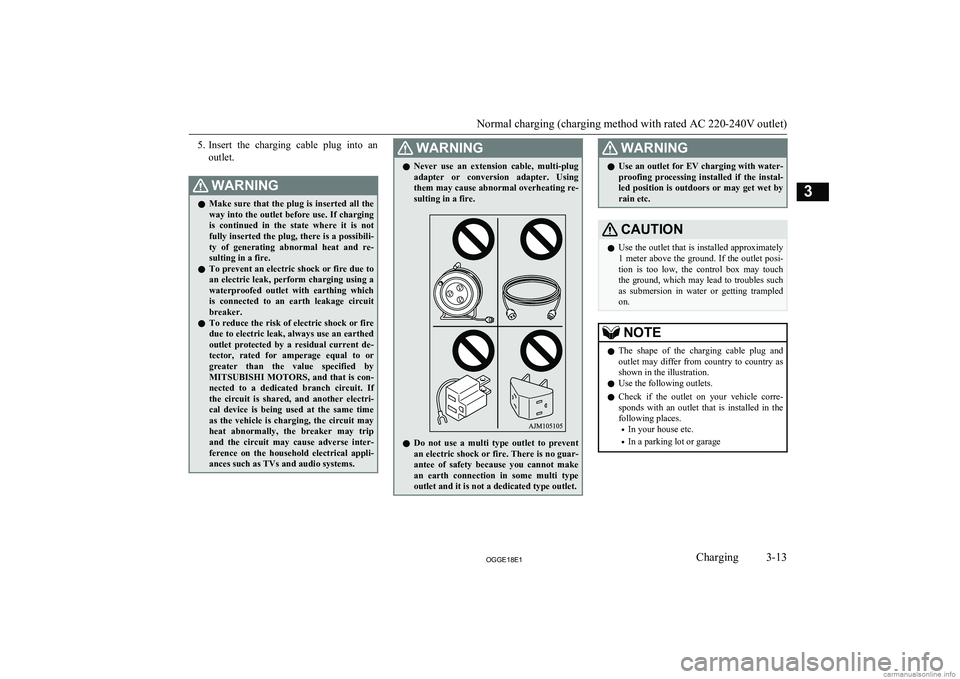
5.Insert the charging cable plug into an
outlet.WARNINGl Make sure that the plug is inserted all the
way into the outlet before use. If charging
is continued in the state where it is not
fully inserted the plug, there is a possibili- ty of generating abnormal heat and re-sulting in a fire.
l To prevent an electric shock or fire due to
an electric leak, perform charging using a waterproofed outlet with earthing whichis connected to an earth leakage circuitbreaker.
l To reduce the risk of electric shock or fire
due to electric leak, always use an earthed outlet protected by a residual current de-
tector, rated for amperage equal to or greater than the value specified by
MITSUBISHI MOTORS , and that is con-
nected to a dedicated branch circuit. If
the circuit is shared, and another electri- cal device is being used at the same time as the vehicle is charging, the circuit may
heat abnormally, the breaker may trip and the circuit may cause adverse inter-
ference on the household electrical appli- ances such as TVs and audio systems.WARNINGl Never use an extension cable, multi-plug
adapter or conversion adapter. Using
them may cause abnormal overheating re- sulting in a fire.
l Do not use a multi type outlet to prevent
an electric shock or fire. There is no guar-
antee of safety because you cannot make
an earth connection in some multi type outlet and it is not a dedicated type outlet.
WARNINGl Use an outlet for EV charging with water-
proofing processing installed if the instal-
led position is outdoors or may get wet by
rain etc.CAUTIONl Use the outlet that is installed approximately
1 meter above the ground. If the outlet posi-tion is too low, the control box may touch
the ground, which may lead to troubles such
as submersion in water or getting trampled on.NOTEl The shape of the charging cable plug and
outlet may differ from country to country as shown in the illustration.
l Use the following outlets.
l Check if the outlet on your vehicle corre-
sponds with an outlet that is installed in the
following places.
• In your house etc.
• In a parking lot or garage
Normal charging (charging method with rated AC 220-240V outlet)
3-13OGGE18E1Charging3