2018 MERCEDES-BENZ GLC engine
[x] Cancel search: enginePage 170 of 390
Observe the following rules when driving along
ruts in off-road terrain or on roads with loose
gravel: R
Activate the off-road program ( Y
page 181).R
Avoid high engine speeds. R
Shift to a lower gear using the left-hand steer-
ing wheel paddle shifter. R
Drive slowly. R
Where ruts are too deep, drive with the
wheels of one side on the center grassy area,
if possible.
Traveling uphill
Approach/departure angle
G WARNING
If you drive on a steep incline at an angle or
turn when driving on an incline, the vehicle
could slip sideways, tip and rollover. There is a
risk of an accident.
Always drive on a steep incline in the line of
fall (straight up or down) and do not turn the
vehicle. R
Observe the warnings for off-road driving
( Y
page 165).R
Follow the line of fall when driving on slopes
and steep inclines. R
Before driving on extreme uphill and downhill
gradients, select the off-road program
( Y
page 181).R
Drive slowly. R
Accelerate gently and make sure that the
wheels are gripping. R
Avoid high engine speeds, except when driv-
ing on sandy and muddy routes with high driv-
ing resistance. R
Use the left-hand steering wheel paddle
shifter to shift to a lower gear appropriate to
the gradient. R
Use the left-hand steering wheel paddle
shifter to shift into a lower gear in good time
on long and steep downhill gradients.
Hill start assist will aid you when pulling away on
a hill. For further information about hill start
assist, see ( Y
page 140).
Do not shift into transmission position \\ when
driving off-road. You could lose control of the vehicle if you attempt to brake the vehicle using
the service brake. If the gradient is too steep for
your vehicle, drive back down in reverse gear.
Always observe the approach/departure angle
values ( Y
page 384).
Maximum gradient-climbing capability Always observe the maximum gradient climbing
ability values ( Y
page 384).
Hilltops When driving up an uphill gradient, slightly
reduce pressure on the accelerator immediately
before reaching the brow of the hill. Make use of
the vehicle's own impetus to travel over the
brow.
This style of driving prevents: R
the vehicle from lifting off the ground on the
brow of a hill R
the vehicle from traveling too quickly down
the other side
Driving downhill R
Drive slowly. R
Do not drive at an angle down steep inclines.
Steer into the line of fall and drive with the
front wheels aligned straight. Otherwise, the
vehicle could slip sideways, tip and rollover. R
Shift to a lower gear using the left-hand steer-
ing wheel paddle shifter before tackling steep
downhill gradients. R
Activate DSR. If this is not sufficient, brake
gently. When doing so, make sure that the
vehicle is facing in the direction of the line of
fall. R
Check that the brakes are working normally
after a long downhill stretch.
Off-road ABS is activated when the off-road pro-
gram is selected.
At speeds below 18 mph (30 km/h), the front
wheels lock cyclically during braking. The dig-
ging-in effect achieved in the process reduces
the stopping distance on off-road terrain. The
steerability of the vehicle is considerably
reduced if the wheels lock.168
Driving tips
Driving and parking
Page 171 of 390
Drivin g systems
Mercedes-Benz Intelligent Drive Mercedes-Ben z Intelligen t Drive stand s fo r inno -
vative driver assistanc e and safet y systems
whic h enhance comfor t and suppor t th e driver in
critical situations. Wit h these intelligen t coordi-
nated systems Mercedes-Ben z has set a mile-
ston e on th e pat h toward s autonomous driving.
Mercedes-Ben z Intelligen t Drive embraces all
elements of active and passive safet y in on e well
though t out syste m – fo r th e safet y of th e vehi-
cl e occupant s and that of other road users.
Further information on drivin g safet y systems
( Y
page 66).
Cruis e contro l
General notes Cruise contro l maintain s a constant road speed
fo r you. It brake s automatically in order to avoid
exceedin g th e set speed. Change into a lowe r
gear in goo d time on lon g and steep downhill
gradients. Thi s is especially important if th e
vehicle is lade n or towin g a trailer . By doin g so,
you will mak e use of th e braking effect of th e
engine. Thi s relieves th e load on th e brake sys -
te m and prevents th e brake s from overheatin g
and wearin g to o quickly.
Use cruise contro l only if road and traffic con-
dition s mak e it appropriat e to maintain a steady
speed fo r a prolonged period. You can stor e any
road speed abov e 20 mph (30 km/h).
Important safet y notesCruise contro l can neither reduce th e ris k of an
acciden t if you fai l to adapt your drivin g style no r
override th e laws of physics. Cruise contro l can -
no t take into accoun t th e road, traffic and
weather conditions. Cruise contro l is only an
aid. You are responsible fo r maintainin g a saf e
distanc e to th e vehicle in front, fo r vehicle
speed, fo r braking in goo d time and fo r stayin g in
lane. Do no t use cruise control: R
in road and traffic condition s whic h do no t
allow you to maintain a constant speed, e.g. in
heav y traffic or on windin g roadsR
on slipper y road surfaces. Brakin g or accel-
erating could cause th e drive wheels to los e
traction and th e vehicle could then skid R
when there is poo r visibility, e.g. due to fog,
heav y rain or snow
If there is a chang e of drivers, advise th e ne w
driver of th e speed stored.
i The speed indicated in th e speedometer
may diffe r slightly from th e speed stored.
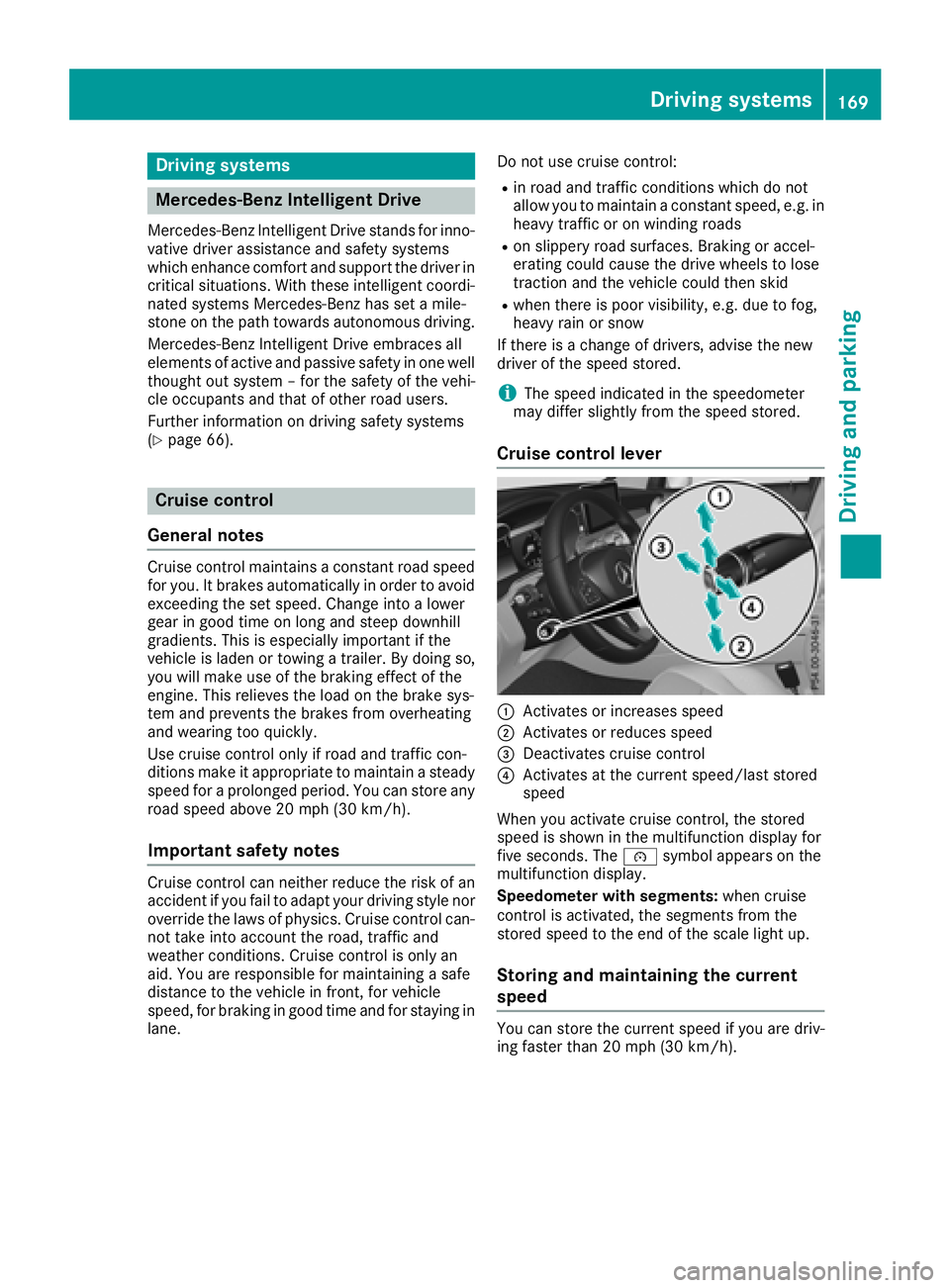
Cruis e contro l lever
C
Activates or increase s speedD
Activates or reduce s speed
Page 173 of 390
Change into a lower gear in good time on long
and steep downhill gradients. This is especially
impo rtant if the veh icle is laden. By doin g so, you
will make use of the braking effect of the engine.
This relieves the load on the brake system and
prevents the brakes from overheating and wear-
ing too quic kly.
If Distance Pilot DI ST RONIC detects that there is
a risk of a co llisio n, you will be warned visually
and acoustically. Without your intervention, Dis-
tance Pilot DISTRONIC cannot prevent a co lli-
sion. An intermittent warning tone will then
sound and the dist ance warning lamp will light
up in the instrument cluster. Brake immediately
in order to increase the dist ance to the veh icle in
front or take evasive action pro vide d it is safe to
do so.
Distance Pilot DI ST RONIC operates in the range
between 0 mph (0 km/h) and 120 mph
(200 km/h).
Do not use Distance Pilot DI ST RONIC while driv -
ing on roads with steep gradients.
Sin ce Distance Pilot DI ST RONIC transmits radar
waves, it can resemble the radar detectors of
the respon sible authorities. You can refer to the
relevant chapter in the Operator's Manual if
questions are asked about this.
i USA only: This device has been approved by
the FCC as a "Vehicular Radar System". The
radar sensor is intended for use in an aut o-
m
otive radar system only. Removal, tamper-
ing, or altering of the device will void any war-
ranties, and is not permitted by the FCC. Do
not tamper wit h, alter, or use in any non-
approved way.
Any unauthorized mod ific ation to th is device
could void the user's authority to operate the
equipm ent.
i Canada only: This device co mplie s wit h
RSS -210 of In dustry Canada. Operation is
subject to the foll owin g two conditions:
1. This device may not cause interference,
and
2. This device must accept any interference
receive d, inc ludin g interference that may
cause undesired operation of the device.
Removal, tampering, or altering of the device
will void any warranties, and is not permitte d.
Do not tamper wit h, alter, or use in any non-
approved way. Any unauthorized modification to this device
could void the user's authority to operate the
equipment.
Important safety notes
G WARNING
Distance Pilot DI ST RONIC does not react to: R
people or animals R
stationary objects on the road, e.g. st oppe d
or parked vehicles R
oncoming vehicles and crossing traffic
As a result, Distance Pilot DI ST RONIC may
neither give warnings nor intervene in such
situations. There is a risk of an accident.
Alwa ys pay careful attention to the traff ic sit-
uation and be ready to brake.
G WARNING
Distance Pilot DI ST RONIC cannot always
clearly identify other road users and co mple x
traff ic situations.
In such cases, Distance Pilot DI ST RONIC may:R
give an unnecessary warning and then
brake the vehicle R
neither give a warning nor intervene R
accelerate or brake unexpect edly
There is a risk of an accident.
Continue to drive carefully and be ready to
brake, especially if Distance Pilot DISTRONIC
warns you.
G WARNING
Distance Pilot DI ST RONIC brakes your vehicle
with up to 50% of the maximum poss ible
deceleration. If this deceleration is not suffi-
cient, Distance Pilot DI ST RONIC alerts you
wit h a visual and acoustic warning. There is a
risk of an accident.
Apply the brakes yourself in these situations
and try to take evasive action.
! When Distance Pilot DI ST RONIC or the
HOLD function are activated, the vehicle
brakes automatically in certain situations.Driving systems 171
Driving and parking Z
Page 176 of 390
When you change lanes, Distance Pilot
DISTRONIC monitors the left lane (on left-hand-
drive vehicles) or the right lane (on right-hand-
drive vehicles).
Stopping
G WARNING
If you leave the vehicle when it is only being
braked by Distance Pilot DISTRONIC, it could
roll away if: R
there is a malfunction in the system or in
the voltage supply. R
Distance Pilot DISTRONIC is switched off
using the cruise control lever, e.g. by a vehi-
cle occupant or from outside the vehicle R
the electrical system in the engine com-
partment, the battery or the fuses are tam-
pered with. R
the battery is disconnected R
the vehicle is accelerated, e.g. by a vehicle
occupant.
There is a risk of an accident.
Before leaving the vehicle, always deactivate
Distance Pilot DISTRONIC and secure the
vehicle against rolling away.
Further information on deactivating Distance
Pilot DISTRONIC ( Y
page 176).
If Distance Pilot DISTRONIC detects that the
vehicle in front is stopping, it brakes your vehicle
to a stop.
Once your vehicle is stationary, it remains sta-
tionary and you do not need to depress the
brake.
After a time, the electric parking brake secures
the vehicle and relieves the service brake.
Depending on the specified minimum distance,
your vehicle will come to a standstill at a suffi-
cient distance behind the vehicle in front. The
specified minimum distance is set using the
control on the cruise control lever. When Distance Pilot DISTRONIC is activated,
the transmission shifts automatically to position
] if: R
the driver's seat belt is not fastened and the
driver's door is open. R
the engine is switched off, unless it is auto-
matically switched off by the ECO start/stop
function.
The electric parking brake secures the vehicle
automatically if Distance Pilot DISTRONIC is
activated when the vehicle is stationary and: R
a system malfunction occurs. R
the power supply is insufficient.
If a malfunction occurs, the transmission may
also be shifted to position ] automatically.
Setting a speed X
Push cruise control lever up C for a higher
speed or down D for a lower speed.X
To adjust the set speed in 1 mph incre-
ments (1 km/h increments): briefly push
the cruise control lever up C or down D to
the pressure point.
Every time the cruise control lever is pressed
up C or down D the last speed stored is
increased or reduced. X
To adjust the set speed in 5 mph incre-
ments (10 km/h increments): briefly push
the cruise control lever up C or down D
beyond the pressure point.
Every time the cruise control lever is pressed
up C or down D , the last speed stored is
increased or reduced.
i If you accelerate to overtake, Distance Pilot
DISTRONIC adjusts the vehicle's speed to the
last speed stored after you have finished over-
taking.
Setting a specified minimum distance You can set the specified minimum distance for
Distance Pilot DISTRONIC by varying the time
span between one and two seconds. With this
function you can set the minimum distance that
Distance Pilot DISTRONIC maintains to the vehi-
cle in front, depending on vehicle speed. You
can see this distance in the multifunction dis-
play ( Y
page 175).
Make sure that you maintain the minimum dis-
tance to the vehicle in front as required by law.174
Driving systems
Driving and parking
Page 178 of 390
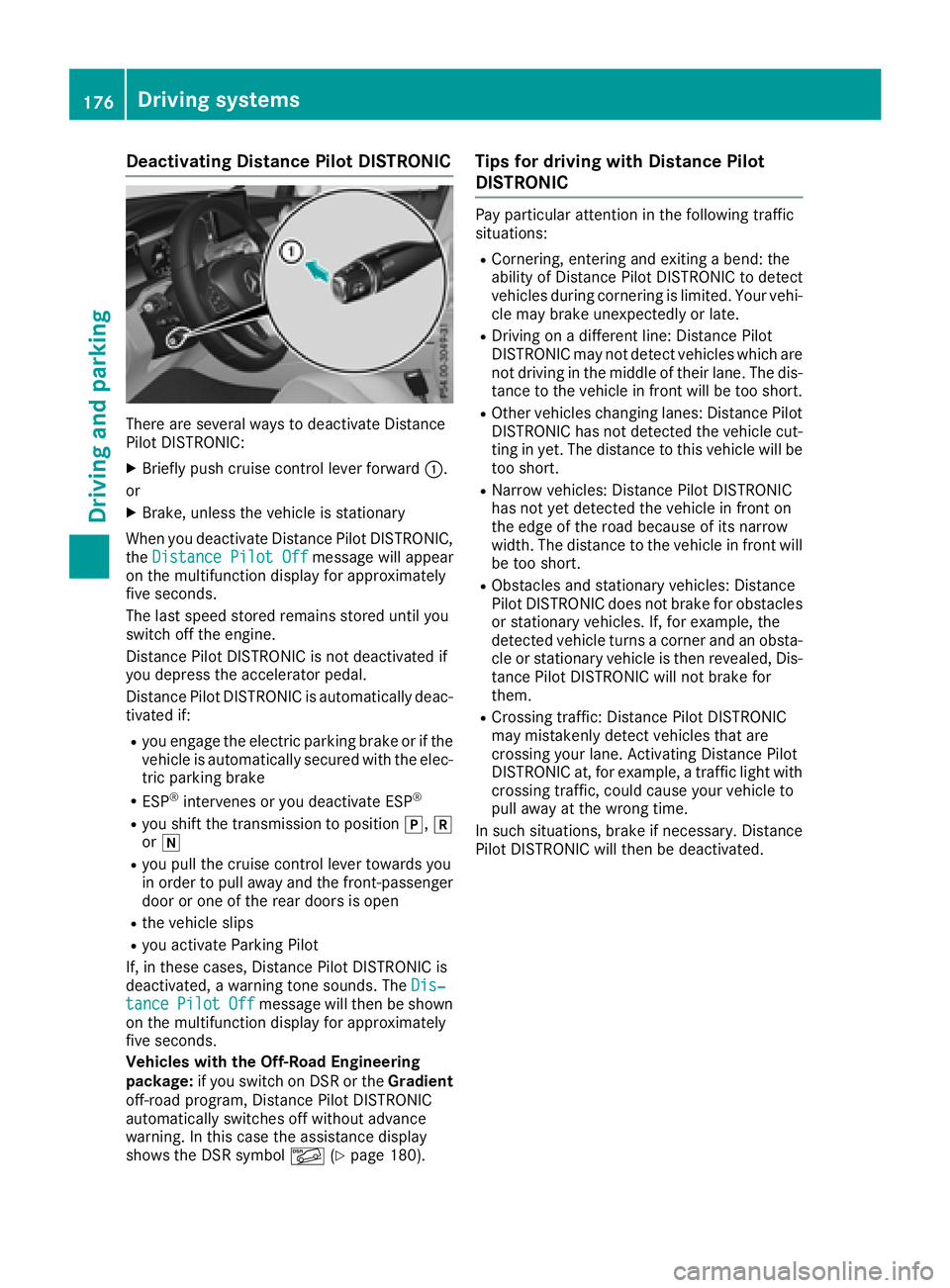
Deactivating Distance Pilo t DISTRONI C
There are severa l ways to deactivat e Distanc e
Pilo t DISTRONIC: X
Briefly push cruise contro l lever forwar d C .
or X
Brake, unless th e vehicle is stationary
Whe n you deactivat e Distanc e Pilo t DISTRONIC,
th e Distance Pilot Off messag e will appear
on th e multifunction display fo r approximately
fiv e seconds.
The last speed stored remain s stored until you
switch of f th e engine.
Distanc e Pilo t DISTRONIC is no t deactivated if
you depress th e accelerator pedal.
Distanc e Pilo t DISTRONIC is automatically deac -
tivated if: R
you engage th e electric parking brake or if th e
vehicle is automatically secure d wit h th e elec -
tric parking brake R
ES P ®
intervenes or you deactivat e ES P ®
R
you shift th e transmissio n to position ] , ^
or \\ R
you pull th e cruise contro l lever toward s you
in order to pull away and th e front-passenger
doo r or on e of th e rea r doors is ope nR
th e vehicle slip sR
you activat e Parking Pilo t
If , in these cases, Distanc e Pilo t DISTRONIC is
deactivated, a warnin g tone sounds. The Dis ‐
tance Pilot Off messag e will then be shown
on th e multifunction display fo r approximately
fiv e seconds.
Vehicles wit h th e Off-Road Engineering
package: if you switch on DS R or th e Gradient
off-road program, Distanc e Pilo t DISTRONIC
automatically switches of f without advanc e
warning. In this cas e th e assistanc e display
shows th e DS R symbol
Page 182 of 390
The electric parking brake secures the vehicle
automatically if the HOLD function is activated
when the vehicle is stationary and: R
a system malfunction occurs R
the power supply is insufficient
If a malfunction occurs, the transmission may
also be shifted to position ] automatically.
DSR
General notes DSR (Downhill Speed Regulation) is an aid to
assist you when driving downhill that is available
only in vehicles with the Off-Road Engineering
package.
It keeps the speed of travel at the speed selec-
ted on the on-board computer. The steeper the
downhill gradient, the greater the DSR braking
effect on the vehicle. When driving on flat
stretches of road or on an uphill gradient, the
DSR braking effect is minimal or nonexistent.
DSR controls the vehicle’s speed when it is acti-
vated and the transmission is in position [ , ^
or \\ . You can drive at a higher or a lower speed
than that set on the on-board computer at any
time by accelerating or braking.
Important safety notes
G WARNING
If the speed driven and the set speed deviate
and you activate DSR on a slippery road sur-
face, the wheels may lose traction. There is an
increased danger of skidding and accidents.
Before switching DSR on, please take into
consideration the road surface and the differ-
ence between driving speed and the set
speed.
DSR can neither reduce the risk of accident if
you fail to adapt your driving style nor override
the laws of physics. DSR cannot take account of
road, weather and traffic conditions. DSR is only
an aid. You are responsible for maintaining a
safe distance to the vehicle in front, for vehicle
speed, for braking in good time and for staying in
lane.
You are always responsible for keeping control
of the vehicle and for assessing whether the
downhill gradient can be managed. DSR may not always be able to keep to the set speed, depend-
ing on road surface and tire conditions. Select a
set speed suitable for the prevailing conditions
and when necessary, apply the brakes manually.
Further information about "Driving off-road"
( Y
page 165).
Activating/deactivating DSR If you activate DSR and no speed has been set,
the vehicle decelerates to 4 mph (6 km/h).
You can activate DSR only when driving at
speeds below 25 mph (40 km/h).
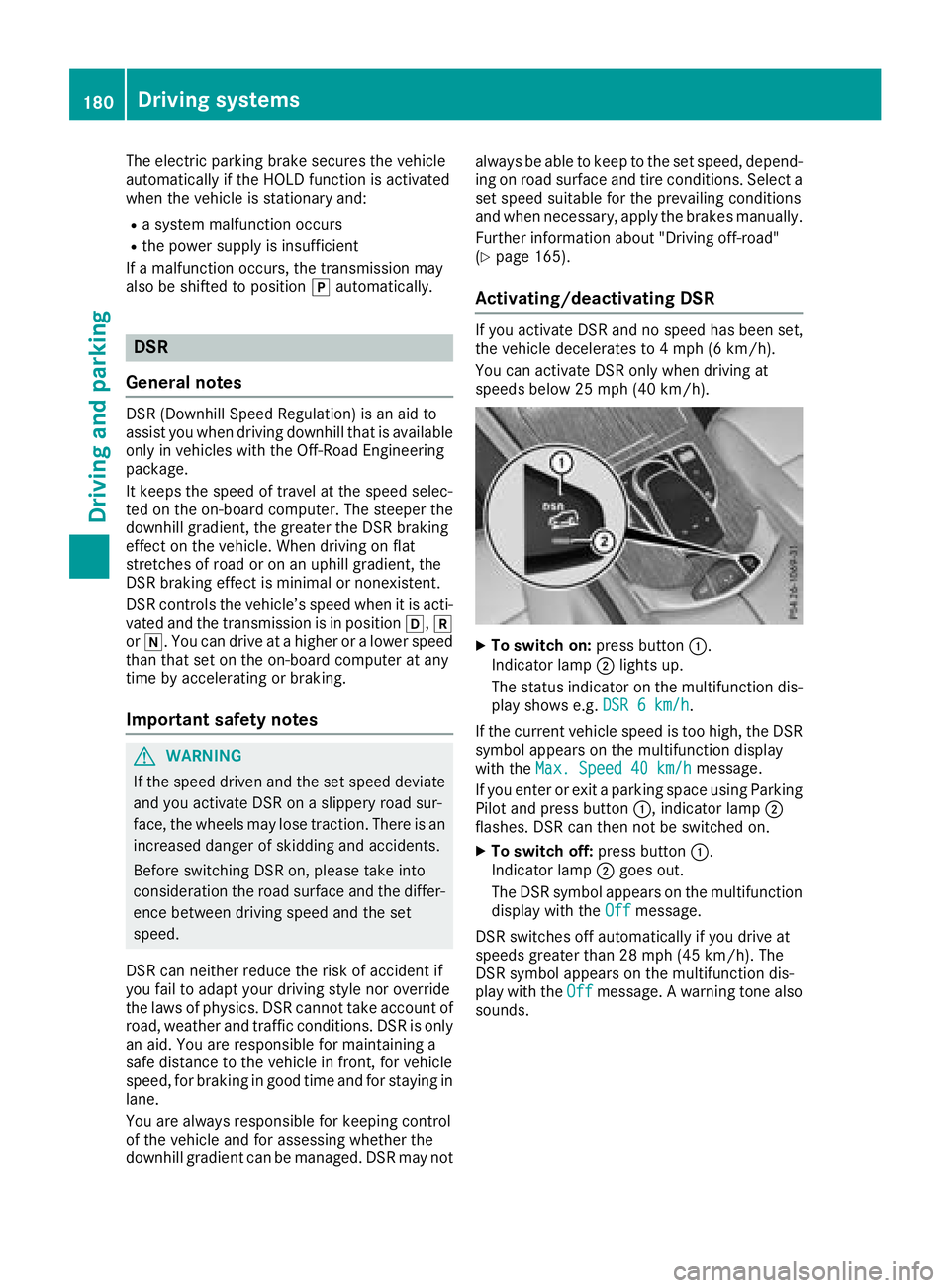
X
To switch on: press button C .
Indicator lamp D lights up.
The status indicator on the multifunction dis-
play shows e.g. DSR 6 km/h .
If the current vehicle speed is too high, the DSR
symbol appears on the multifunction display
with the Max. Speed 40 km/h message.
If you enter or exit a parking space using Parking
Pilot and press button C , indicator lamp D
flashes. DSR can then not be switched on. X
To switch off: press button C .
Indicator lamp D goes out.
The DSR symbol appears on the multifunction
display with the Off message.
DSR switches off automatically if you drive at
speeds greater than 28 mph (45 km/h). The
DSR symbol appears on the multifunction dis-
play with the Off message. A warning tone also
sounds.180
Driving systems
Driving and parking
Page 183 of 390
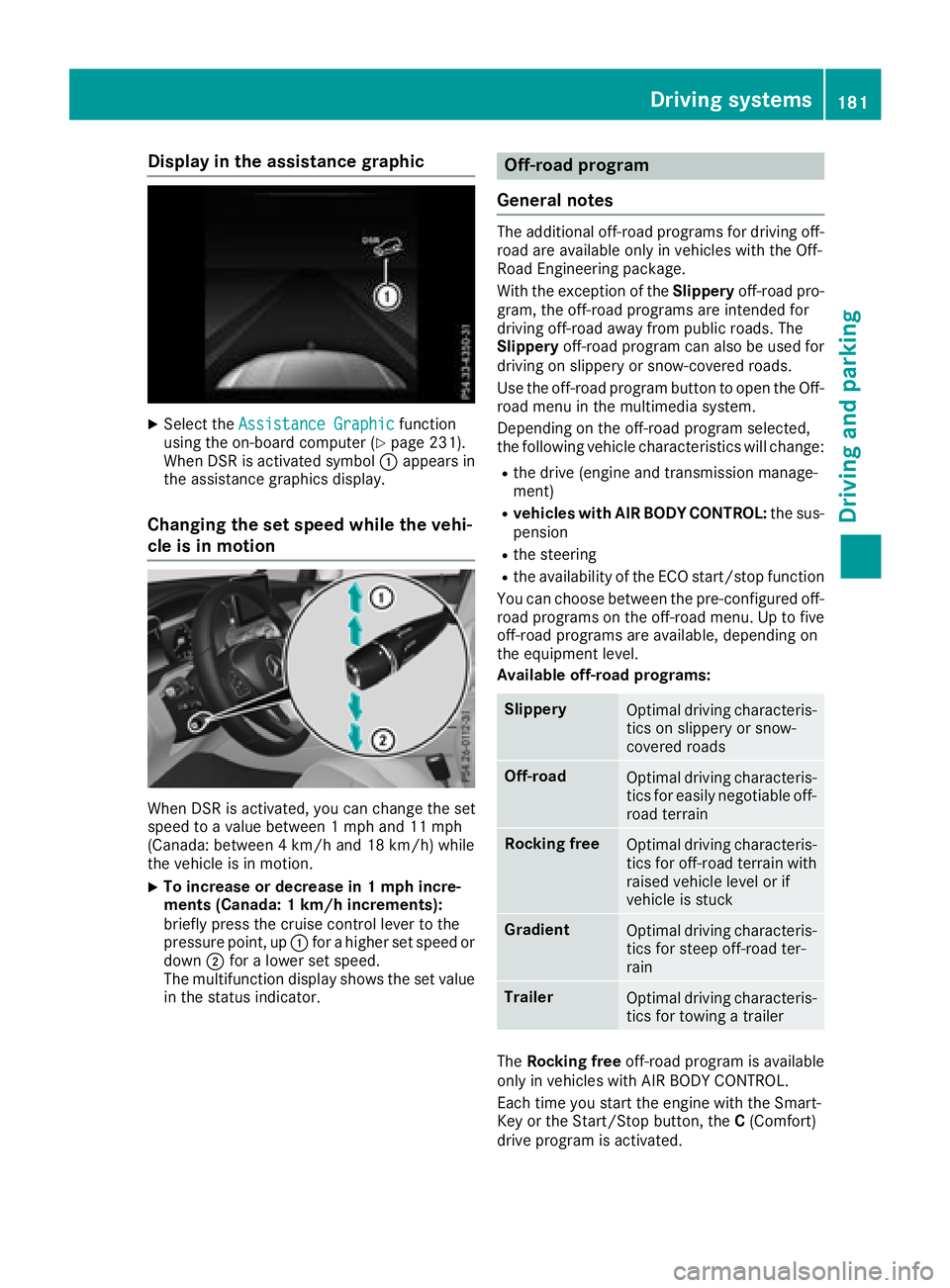
Display in th e assistance graphicX
Selec t th e Assistanc e Graphi c function
usin g th e on-boar d compute r ( Y
page 231).
Whe n DS R is activated symbol C appears in
th e assistanc e graphics display.
Changin g th e set speed whil e th e vehi-
cle is in motion
Whe n DS R is activated, you can chang e th e set
speed to a valu e between 1 mph and 11 mph
(Canada: between 4 km/h and 18 km/h) whil e
th e vehicle is in motion .X
To increas e or decreas e in 1 mp h incre-
ment s (Canada : 1 km/h increments):
briefly press th e cruise contro l lever to th e
pressure point, up C fo r a higher set speed or
down D fo r a lowe r set speed.
The multifunction display shows th e set valu e
in th e status indicator . Off-road program
General notes The additional off-road programs fo r drivin g off-
road are available only in vehicles wit h th e Off-
Road Engineerin g package.
Wit h th e exception of th e Slipper y off-road pro -
gram, th e off-road programs are intended fo r
drivin g off-road away from publi c roads. The
Slipper y off-road program can also be used fo r
drivin g on slipper y or snow-covered roads.
Use th e off-road program butto n to ope n th e Off-
road men u in th e multimedia system.
Dependin g on th e off-road program selected,
th e followin g vehicle characteristics will change: R
th e drive (engin e and transmissio n manage-
ment) R
vehicles wit h AIR BODY CONTROL: th e sus -
pensio n R
th e steerin g R
th e availabilit y of th e EC O start/sto p function
You can choos e between th e pre-configure d off-
road programs on th e off-road menu. Up to fiv e
off-road programs are available , dependin g on
th e equipmen t level.
Available off-road programs:
Slipper y
Optimal drivin g characteris -
tics on slipper y or snow-
covered roads
Off-road
Optimal drivin g characteris -
tics fo r easily negotiable off-
road terrain
Rockin g free
Optimal drivin g characteris -
tics fo r off-road terrain wit h
raised vehicle level or if
vehicle is stuck
Gradient
Optimal drivin g characteris -
tics fo r steep off-road ter-
rain
Trailer
Optimal drivin g characteris -
tics fo r towin g a trailer
The Rockin g free off-road program is available
only in vehicles wit h AI R BODY CONTROL .
Each time you start th e engin e wit h th e Smart -
Key or th e Start/Sto p button, th e C (Comfort )
drive program is activated.Driving systems 18 1
Driving an d parking Z
Page 184 of 390
Off-road program Slippery off-road program You can select the Slippery off-road program
for snow or rain.
The Slippery off-road program has the following
characteristics: R
The steering, drive, transmission and suspen-
sion are adapted for comfort. R
Vehicles with AIR BODY CONTROL: the
vehicle is adjusted to normal level. R
The ECO start/stop function is available
( Y
page 140).
ESP ®
and 4ETS programs especially adapted to
slippery surfaces are also activated for maxi-
mum stability.
For more information on driving with snow
chains, see ( Y
page 351).
Off-road off-road program You can select the Off-road off-road program
for driving on easily negotiable terrain, e.g. dirt
roads, gravel and sand.
The Off-road program has the following char-
acteristics: R
The steering, drive and suspension are adap-
ted for comfort R
The transmission is adapted for off-road driv-
ing R
Vehicles with AIR BODY CONTROL: the
vehicle is raised by 0.6 in (1 5 mm) compared
with the normal level
The Off-road program assists you when driving
in easily negotiable off-road terrain. The
engine’s performance characteristics and the
gearshifting characteristics of the automatic
transmission are adapted for this purpose. ABS,
ESP ®
and 4ETS programs especially adapted to
off-road driving are also activated.
Rocking free off-road program
The Rocking free off-road program is available
only in vehicles with AIR BODY CONTROL.
You can select the Rocking free off-road pro-
gram to free the vehicle from especially difficult
off-road terrain at low speeds. The Rocking free off-road program has the fol-
lowing characteristics: R
The steering, drive and suspension are adap-
ted for comfort R
The transmission is adapted for off-road driv-
ing R
The vehicle is raised by 2.0 in (50 mm) com-
pared with the normal level
ABS, ESP ®
and 4ETS programs especially adap-
ted to off-road driving are also activated.
The Ro cking free off-roa
d program can be
selected up to a speed of 12 mph (20 km/h).
If you are driving in the Rocking free off-road
program at speeds above 12 mph (20 km/h): R
the vehicle switches to the off-road program
Off-road R
the vehicle is lowered by 1.4 in (35 mm)
Notes on driving off-road ( Y
page 165).
Gradient off-road program You can use the Gradient off-road program to
overcome steep terrain.
The Gradient off-road program has the follow-
ing characteristics: R
The steering, drive and suspension are adap-
ted for comfort R
The transmission is adapted for off-road driv-
ing R
Manual gearshifting is activated
( Y
page 152) R
Vehicles with AIR BODY CONTROL: the
vehicle is raised by 0.6 in (1 5 mm) compared
with the normal level R
DSR is activated ( Y
page 180)
ABS, ESP ®
and 4ETS programs especially adap-
ted to gradients are also activated.
Trailer off-road program
Select the Trailer off-road program when tow-
ing a trailer.
The Trailer off-road program has the following
characteristics: R
The steering, drive and suspension are adap-
ted for comfort R
The transmission is adapted for off-road driv-
ing182
Driving systems
Driving and parking