2018 MERCEDES-BENZ E-CLASS WAGON seats
[x] Cancel search: seatsPage 366 of 506
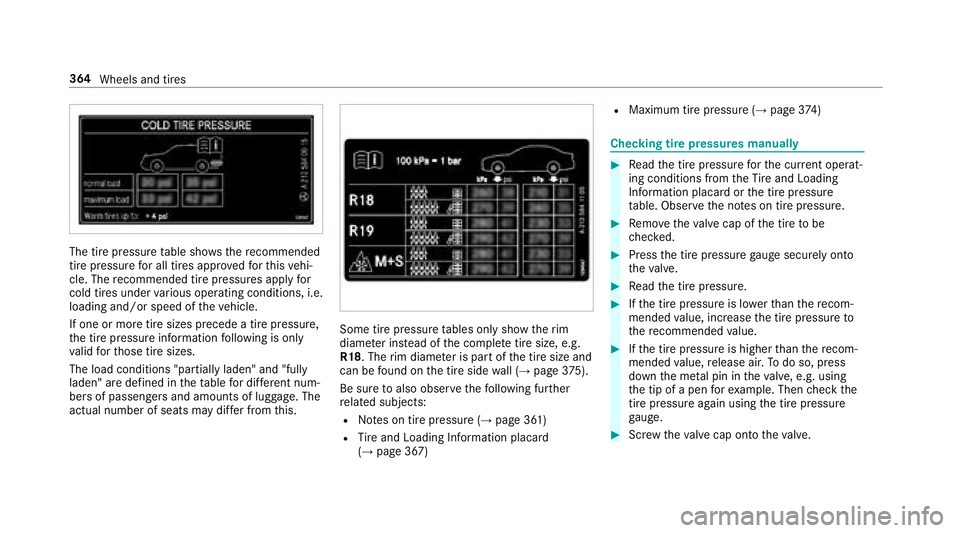
The tire pressuretable sho ws there commended
tire pressure for all tires app rove dfo rth is vehi‐
cle. The recommended tire pressures apply for
cold tires under various operating conditions, i.e.
loading and/or speed of theve hicle.
If one or more tire sizes precede a tire pressure,
th e tire pressure information following is only
va lid forth ose tire sizes.
The load conditions "partially laden" and "fully
laden" are defined in theta ble for dif fere nt num‐
be rs of passengers and amounts of luggage. The
actual number of seats may dif fer from this.
Some tire pressure tables only show therim
diame ter ins tead of the comple tetire size, e.g.
R18 . The rim diame ter is part of the tire size and
can be found on the tire side wall (
→page 375).
Be sure toalso observ eth efo llowing fur ther
re lated subjects:
RNo tes on tire pressure (→page 361)
RTire and Loading Info rmation placard
(→page 367)
RMaximum tire pressure (→page 374)
Che cking tire pressures manually
#Re ad the tire pressure forth e cur rent operat‐
ing conditions from theTire and Loading
Info rmation placard or the tire pressure
ta ble. Obser vethe no tes on tire pressure.
#Re mo vetheva lve cap of the tire tobe
ch ecked.
#Press the tire pressure gauge securely onto
th eva lve.
#Re ad the tire pressure.
#Ifth e tire pressure is lo werth an there com‐
mended value, inc rease the tire pressure to
th ere commended value.
#Ifth e tire pressure is higher than there com‐
mended value, release air. Todo so, press
down the me tal pin in theva lve, e.g. using
th e tip of a pen forex ample. Then check the
tire pressure again usingthe tire pressure
ga uge.
#Sc rew theva lve cap onto theva lve.
364
Wheels and tires
Page 370 of 506
#Observethe load rating of the tires.
#The load rating must be at least half the
permissible axle load of theve hicle.
#Ne verove rload the tires by exceeding
th e maximum load.
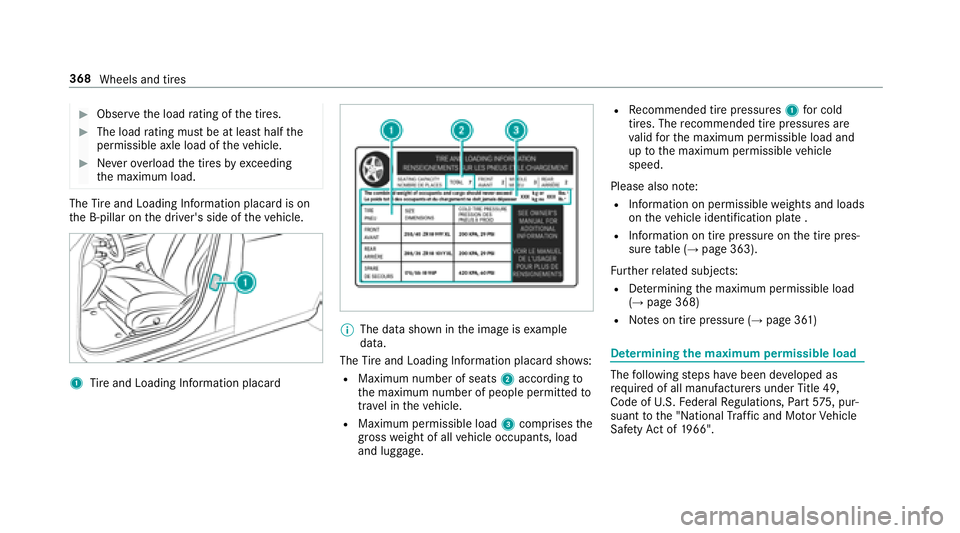
The Tire and Loading Info rmation placard is on
th e B-pillar on the driver's side of theve hicle.
1Tire and Loading Info rmation placard
%
The data shown in the image is example
data.
The Tire and Loading Info rmation placard sho ws:
RMaximum number of seats 2according to
th e maximum number of people permitted to
tr ave l in theve hicle.
RMaximum permissible load 3comprises the
gros swe ight of all vehicle occupants, load
and luggage.
RRe commended tire pressures 1for cold
tires. The recommended tire pressures are
va lid forth e maximum permissible load and
up tothe maximum permissible vehicle
speed.
Please also no te:
RInformation on permissible weights and loads
on theve hicle identification plate .
RInformation on tire pressure on the tire pres‐
sure table (→page 363).
Fu rther related subjects:
RDe term ining the maximum permissible load
(→page 368)
RNo tes on tire pressure (→page 361)
De term ining the maximum permissible load
The following steps ha vebeen de veloped as
re qu ired of all manufacturers under Title 49,
Code of U.S. Federal Regulations, Part57 5, pur‐
suant tothe "National Traf fic and Mo torVe hicle
Saf etyAc t of 1966".
368
Wheels and tires
Page 381 of 506
these are ins talled on theve hicle, but does not
include passengers or luggage.
Maximum tire load: the maximum tire load is
th e maximum permissible weight in kilog rams or
lbs for which a tire is appr oved.
Maximum permissible tire pressure: maxi‐
mum permissible tire pressure for one tire.
Maximum load on one tire: maximum load on
one tire. This is calculated bydividing the maxi‐
mum axle load of one axle bytwo.
PSI (pounds per square in ch):standard unit of
measurement for tire pressure .
Aspect ratio: ratio between tire height and tire
width in pe rcent.
Ti re pressure: pressure inside the tire applying
an outward forc eto eve rysquare inch of the tire.
The tire pressure is specified in pounds per
square inch (psi), in kilopascals (kPa) or in bar.
The tire pressure should only be cor rected when
th e tires are cold.
Cold tire pressure: the tires are cold when the
ve hicle has been par kedfo r at least 3 hours without direct sunlight on
the tires or theve hicle
has been driven for less than 1 mile (1.6 km).
Ti re contact sur face: the part of the tire that
comes into con tact wi th thero ad.
Ti re bead: the purpose of the tire bead is to
ensure that the tire sits securely on the wheel
ri m. There are se veral wire cores in the tire bead
to pr
eve ntthe t
ire fromchanging length on the
wheel rim.
Side wall:the part of the tire between the tread
and the tire bead.
We ight of optional equipment: the combined
we ight of the optional equipment weighing more
th an there placed standard parts and more than
5 lbs (2.3 kg).This optional equipment, such as
high-per form ance brakes, le vel control sy stem, a
ro of luggage rack or high-per form ance batte ries,
is not included in the curb weight and thewe ight
of the accessories.
TIN (Tire Identification Number): a unique
identification number which can be used bya
tire manufactu rerto identify tires, forex ample,
in a product recall, and thus identify the pur‐
ch asers. The TIN is made up of the manufactur‐ er's identity code, tire size, tire type code and
th
e manufacturing date.
Load-bearing index: the load-bearing index is a
code that con tains the maximum load-bearing
capacity of a tire.
Tr action: traction is the grip resulting from fric‐
tion between the tires and thero ad sur face.
We ar indicator: narrow bars (tread wear bars)
th at are distributed overth e tire conta ct surface.
If th e tire tread is le vel with the bars, thewe ar
limit of 1/ 16in (1.6 mm) has been reached.
Distribution of vehicle occupants: distribution
of vehicle occupants ov
er design
ated seat posi‐
tions in a vehicle.
Maximum permissible pa yload weight: nomi‐
nal load and luggage load plus 150 lb (68 kg)
multiplied bythe number of seats in theve hicle.
Wheels and tires 37
9
Page 488 of 506

Turn signal light ................................... 124
Limited Warranty
Ve hicle .................................................. 26
Limiting the opening angle (tailgate) ...... 69
Live Traf fic Information
Displaying subscri ption information .... .274
Displ aying the tra ffic map .................... 274
Displ aying traf fic incidents .................. 275
Extending a subscription ...................... 274
Issuing hazard alert s ........................... 275
Load index (tires) .................................... .375
Load-bea ring capacity (tires) .................375
Loading Definitions .......................................... .377
Loading guidelines .................................. 101
Loading information table ...................... 367
Loads Securing .............................................. 101
Locking/unlocking .................................... 64
KEYLESS-GO .......................................... 61
Un locking and opening doors from
th e inside ............................................... 61Low beam
Swit ching on/off ................................ .123
Lu bricant additives
see Additives
Lu ggage
Securing ...
...........................................
101
Lu mbar support
see Lumbar support (4-w ay)
Lu mbar support (4-w ay).......................... .87
M
Maintenance Vehicle ................................................... 21
Maintenance see ASS YST PLUS
Making a call via theove rhead con‐
trol panel
Mercedes-Benz mbrace
®(USA) .......... .294
Malfunction Restra int sy stem ................................... 32
Malfunction message see Display message Map
................................................... 274, 276
Av oiding an area ..................................2 78
Av oiding an area (o verview) ................ .278
Changing an area ................................ 279
Del eting an area .................................. 279
Displ aying the compass ....................... 280
Displaying the map version .................. 278
Displ aying the next intersecting
st re et ................................................... 278
Displ aying the satellite map ............... .280
Display ingthe traf fic map .................... 274
Displ aying weather information .......... .281
Map data ............................................. 280
Moving ................................................ 277
Overview ..............................................2 76
Selecting POI symbols ......................... 277
Selecting text information ................... 278
Selecting the map orientation ............ .277
Se tting
the map scale ..
........................276
Setting the map scale automatically ... .280
Up dating .............................................. 279
Map and compass Overview .............................................. 276
Massage prog ram
Selecting the front seats ....................... 92
486
Index