2018 MERCEDES-BENZ E-CLASS WAGON warning
[x] Cancel search: warningPage 350 of 506
Wear saf etygl asses.
Ke ep children away.
Obser vethis Opera tor's Manual.
If yo udo not intend touse theve hicle over an
ex tended pe riod of time:
RAc tivate standby mode, or
RConnect the battery toa batte rycharge r
appr ovedby Mercedes-Benz, or
RConsult a qualified specialist workshop to
disconnect the battery
St arting assist ance andcharging the12 V
battery
Ve hicles with a lithium-ion battery
#When charging the battery and during start‐
ing assis tance, al ways use the jump-s tart
connection point in the engine compartment.
* NO
TEDama getothe battery from over‐
vo ltage
When charging using a batte rycharge r with‐
out a maximum charging voltage, the battery
or the on-board electronics may be damaged.
#Only use battery charge rs with a maxi‐
mum charging voltage of 14.4 V.
* NO
TEShor tening the service life of the
battery bycharging the battery at low
te mp eratures
Charging the battery at very low temp era‐
tures may shor tenth e service life of the bat‐
te ry and ha vea negative ef fect on starting.
#Do not charge the battery at very low
te mp eratures.
All other vehicles
#When charging the battery and during start‐
ing assis tance, al ways use the jump-s tart
connection point in the engine compartment.
* NO
TEDamaging the battery thro ugh
ove rvoltage
When charging using a batte rycharge r with‐
out a maximum charging voltage, the battery
or theve hicle electronics may be damaged.
#Only use battery charge rs with a maxi‐
mum charging voltage of 14.8 V.
&
WARNING Risk ofexplosion from hydro‐
ge nga s igniting
A battery generates hydrogen gas during the
ch arging process. If there is a short circuit or
spar ksstart toform ,th ere is a danger of the
hy drogen gas igniting.
34 8
Breakdown assis tance
Page 351 of 506

#Make surethat the positive term inal of
th e connected battery does not come
into conta ct withvehicle parts.
#Ne ver place me tal objects or tools on a
batter y.
#When connecting and disconnecting the
batter y,yo u must observ eth e descri‐
bed order forth e battery clamps.
#When giving starting assis tance, al ways
make sure that you only connect bat‐
te ry term inals with identical polarity.
#During starting assis tance, you must
observ eth e described order for con‐
necting and disconnecting the jumper
cables.
#Do not connect or disconnect the bat‐
te ry cla mp s while the engine is running.
&
WARNING Risk ofexplosion during
ch arging process and starting assis tance
During thech arging process and starting
assis tance, the battery may release an explo‐
sive gas mixture.
#Av oid fire , open flames, creating spar ks
and smoking.
#Make sure that there is suf ficient venti‐
lation du ring thech arging process and
during starting assis tance.
#Do not lean over a batter y.
Ifth e indicator/warning lamps in the instrument
clus ter do not light up at low temp eratures, it is
ve ry likely that the dischar ged battery has fro‐
zen.
& WARNING Risk ofexplosion from a fro‐
zen battery
A dischar ged battery may freeze at temp era‐
tures slightly abo veor below freezing point.
During starting assis tance or battery charg‐
ing, batte rygas may be released.
#Alw aysth aw a frozen batte ryout firs t
before charging it or per form ing start‐
ing assis tance.
The service li feof a battery that has been
th awe d may be dramatically shor tened. It is
recommended that you ha veathaw ed bat‐
te ry checked at a qualified specialist workshop.
All vehicles
* NO
TEDama gecaused bynumerous or
ex tended attem ptsto start the engine
Nume rous or extended attem ptsto start the
engine may damage the catalytic con verter
due tonon-combu sted fuel.
#Av oid numerous and extended attem pts
to start the engine.
Obser vethefo llowing points during starting
assis tance and when charging the battery:
ROnly use undamaged jumper cable/charging
cables with a suf ficient cross-section and
insula tedte rm inal clamps.
RNon- insulated parts of thete rm inal clamps
must not come into con tact wi thother me tal
parts while the jumper cable/charging cable
is connected tothe battery/jump-s tart con‐
nection point.
Breakdown assis tance 34
9
Page 355 of 506
%Vehicles with automatic transmission: if
th e automatic transmission cannot be shif‐
te dto position i, havetheve hicle trans‐
por tedaw ay (
→page 354). A towing vehicle
with lifting equipment is requiredforve hicle
transpor tation.
* NO
TEDama gedue to to wing away at
exc essively high speeds or over long dis‐
ta nces
The driv etra in could be damaged when tow‐
ing at excessively high speeds or over long
dis tances.
#A towing speed of 30 mph (50 km/h)
must not be exceeded.
#Atowing dis tance of 30 miles (50 km)
must not be exceeded.
&
WARNING Risk of accident when towing
a ve hicle which is too heavy
If th eve hicle being tow- star ted or towe d
aw ay is heavier than the permissible gross
mass of your vehicle, thefo llowing situations
can occur:
RThe towing eye may become de tach ed.
RThe vehicle/trailer combination may
swer veoreve nov erturn.
#If ano ther vehicle is tow- star ted or
to we daw ay, its weight must not exceed
th e permissible gross mass of your ow n
ve hicle.
If a vehicle must be tow star ted or towe daw ay,
its weight must not exceed the permissible gross
mass of theto wing vehicle.
#Information on the permissible gross mass of
th eve hicle can be found on theve hicle iden‐
tification plate .
#Ve hicles with automatic transmission: do
not open the driver's door or front passenger
door, otherwise the automatic transmission
automatically shifts toposition j.
#Installth eto wing eye (→page 356).
#Attach theto w bar.
* NO
TEDama gedue toincor rect connec‐
tion
#Only connect theto w rope or tow bar to
th eto wing eyes.
#Deactivate the automatic locking mechanism
(→page 63).
#Do not activate the HOLD function.
#Deactivate Active Brake Assi st(→page 174).
#Ve hicles with automatic transmission:
shift the automatic transmission toposition
i.
#Re lease the electric parking brake.
Breakdown assis tance 353
Page 356 of 506
&WARNING Risk of accident due tolimi‐
te d saf ety-re lated functions during the
to wing process
Saf ety-re lated functions are limited or no lon‐
ge rav ailable in thefo llowing situations:
Rth e ignition is switched off.
Rthe brake sy stem or po werst eering sys‐
te m is malfunctioning.
Rth e energy supply or the on-board electri‐
cal sy stem is malfunctioning.
When your vehicle is then towe daw ay, signif‐
icantly more ef fort may be requ ired tosteer
and brake than is no rmally requ ired.
#Use a tow bar.
#Make sure that thesteering wheel can
mo vefreely, before towing theve hicle
aw ay.
* NO
TEDama gedue toexcessive tracti ve
po we r
Ifyo u pull away sharpl y,the tractive po wer
may be too high and theve hicles could be
damaged.
#Pull away slowly and smoo thly.
Loading the vehicle for transport
#Obser vethe no tes on towing away
(→page 352).
#Connect theto w bar totheto wing eyeto
load theve hicle.
#Ve hicles with automatic transmission:
Shift the automatic transmission toposition
i.
% Ve
hicles with automatic transmission:
The au tomatic transmission may be loc ked
in position jintheeve nt of damage tothe
electrical sy stem. Toshift toi, pr ovide the
on-board electrical sy stem with po wer
(
→page 348).
#Load theve hicle onto the transpor ter.
#Ve hicles with automatic transmission:
Shift the automatic transmission toposition
j.
#Use the electric parking brake tosecure the
ve hicle and pr event it from rolling away.
#Only secure theve hicle bythe wheels.
Ve hicles with ADS PLUS (Adaptive Damping
Sy stem PLUS)
&
WARNING Risk of an accident when
transporting vehicles with Adaptive
Damping Sy stem PLUS
The reduced damping forc es on theve hicle
being transpor ted can cause theve hicle/
trailer combination tostart toswing.
As a result, when transporting vehicles with
th eAd aptive Damping Sy stem PLUS, the
ve hicle/trailer combination may start toskid.
Consequentl y,yo u could lose cont rol of your
ve hicle.
#When transporting, ensure that:
354
Breakdown assis tance
Page 358 of 506
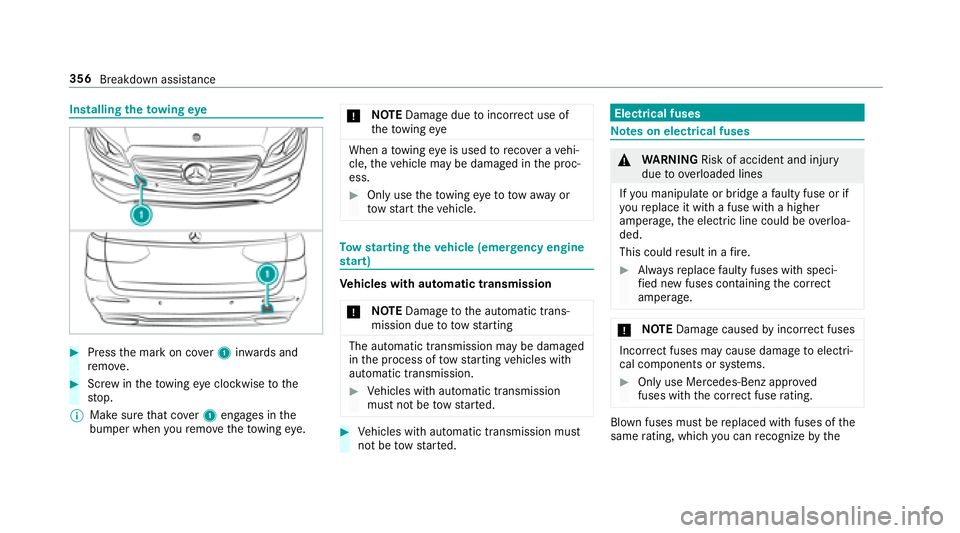
Installingtheto wing eye
#Press the mark on co ver1 inwa rds and
re mo ve.
#Scr ew intheto wing eyeclockwise tothe
st op.
% Make sure that co ver1 engages in the
bumper when youre mo vetheto wing eye. *
NO
TEDama gedue toincor rect use of
th eto wing eye
When a towing eye is used toreco ver a vehi‐
cle, theve hicle may be damaged in the proc‐
ess.
#Only use theto wing eyeto to waw ay or
to w start theve hicle.
To w starting theve hicle (eme rgency engine
st art)
Ve hicles with automatic transmission
* NO
TEDama getothe automatic trans‐
mission due to towstarting
The automatic transmission may be damaged
in the process of tow starting vehicles with
automatic transmission.
#Ve hicles with automatic transmission
must not be tow star ted.
#Ve hicles with automatic transmission must
not be tow star ted.
Electrical fuses
Note s on electrical fuses
&
WARNING Risk of accident and injury
due to ov erloaded lines
If yo u manipulate or bridge a faulty fuse or if
yo ure place it with a fuse with a higher
amperage, the electric line could be overloa‐
ded.
This could result in a fire .
#Alw aysre place faulty fuses with speci‐
fi ed new fuses conta iningthe cor rect
amperage.
* NO
TEDama gecaused byincor rect fuses
Incor rect fuses may cause damage toelectri‐
cal components or sy stems.
#Only use Mercedes-Benz appr oved
fuses with the cor rect fuse rating.
Blown fuses must bereplaced with fuses of the
same rating, which you can recognize bythe
356
Breakdown assis tance
Page 359 of 506

color and fuserating. The fuse ratings are li sted
in the fuse assignment diagram.
Fu se assignment diag ram: onthe fuse box in
th e cargo compartment (
→page 359).
* NO
TEDama geor malfunctions caused
by moisture
Moisture may cause dama getothe electrical
sy stem or cause it tomalfunction.
#When the fuse box is open, make sure
th at no moisture can enter the fuse
box.
#When closing the fuse box, make sure
th at the seal of the lid is positioned cor‐
re ctly on the fuse box.
If a newly inser ted fuse also blo ws, ha vethe
cause traced and rectified at a qualified special‐
ist workshop.
Ensure thefo llowing before replacing a fuse:
RThe vehicle is secured against rolling away.
RAll electrical consumers are switched off.
RThe ignition is switched off. The electrical fuses are located in
various fuse
bo xes:
RFu se box in the engine compartment on the
driver's side (→page 357)
RFu se box on the driver's side of the cockpit
(→page 358)
RFu se box in the front-passen gerfo ot we ll
(→page 358)
RFu se box in the cargo compartment on the
ri ght-hand side of theve hicle, when vie wed
in the direction of tra vel (
→page 359)
Fu se box in the engine compa rtment
Prerequisites
Observ eth e no tes on electrical fuses
(
→page 356).
Ha ve thefo llowing readily available:
RA dry clo th
RA screwdriver Opening
&
WARNING Risk of injury from usingthe
windshield wipers while the engine hood
is open
When the engine hood is open and the wind‐
shield wipers are set in motion, you can be
trapped bythe wiper linkage.
#Alw ays switch off the windshield wipers
and ignition before opening the engine
hood.
Breakdown assis tance 357
Page 362 of 506
Noise or unusual handling characteristics
While driving, pay attention tovibrations, noises
and unusual handling characteristics, e.g. pulling
to one side. This may indicate that the wheels or
tires are damaged. If you suspect that a tire is
defective, reduce your speed immediatel y.Stop
th eve hicle as soon as possible tocheck the
wheels and tires for dama ge. Hidden tire dam‐
age could also be causing the unusual handling
ch aracteristics. If youfind no signs of damage,
ha ve the tires and wheels checked at a qualified
specialist workshop.
Checking wheels and tires regular ly
&
WARNING Risk of accident from dam‐
aged tires
Dama ged tires can cause tire pressure loss.
As a result, you could lose cont rol of your
ve hicle.
#Check the tires regularly for signs of
dama geand replace any damaged tires
immediatel y.
&
WARNING Risk of aquaplaning due to
insuf ficient tire tread
Insuff icient tire tread will result in reduced
tire grip. The tire tread is no longer able to
dissipate water.
This means that in heavy rain or slush the
ri sk of hydroplaning is increased, in particu‐
lar if vehicle speed is not adap tedto suit the
conditions.
If th e tire pressure is too high or too lo w,
tires may exhibit dif fere nt le vels of wear at
dif fere nt locations on the tire conta ct sur‐
fa ce.
#Thus, you should regularly check the
tread de pth and the condition of the tire
conta ct surf ace across the entire width
of all tires.
Minimum tread dep thfor:
RSummer tires: âin (3 mm)
RM+S tires: ãin (4 mm)
#For saf etyre asons, replace the tires
before the legally prescribed limit for
th e minimum tread dep thisreached.
Car ryout thefo llowing checks on all wheels reg‐
ularly, at least once a month or as requ ired, e.g.
prior toa long journey or driving off- road:
RCheck the tire pressure (→page 361).
RVisual inspection of wheels and tires for
damage.
RCheck theva lve caps.
The valves must be pr otected against mois‐
ture and dirt bytheva lve caps appr oved
especially foryo ur vehicle byMercedes-Benz.
RVisual check of the tread dep thand the tire
conta ct surf ace across the entire width.
The minimum tread dep thfor summer tires is
â in (3 mm) and for winter tires ãin
(4 mm).
360 Wheels and tires
Page 363 of 506
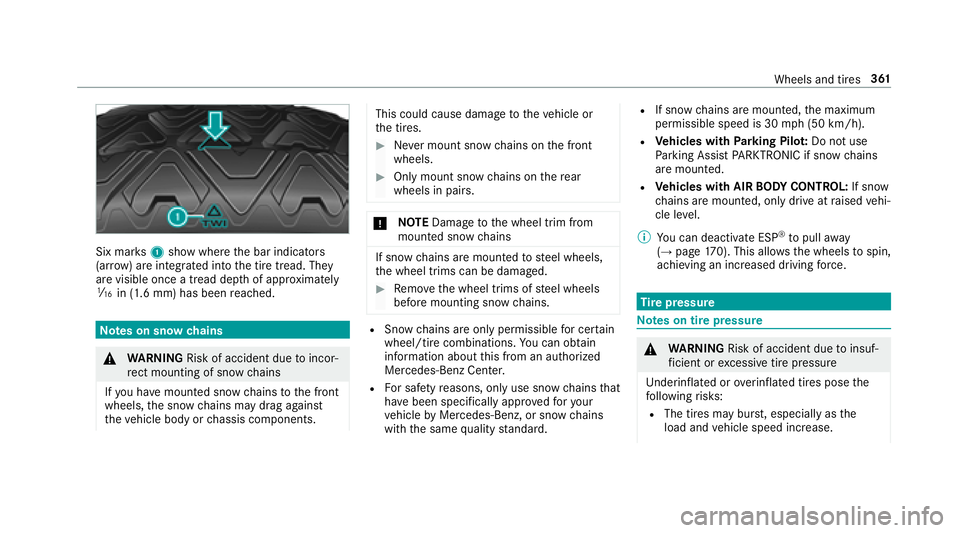
Six marks1 show where the bar indicators
(ar row ) are integrated into the tire tread. They
are visible once a tread dep thof appr oximately
á in (1.6 mm) has been reached.
Note s on snow chains
&
WARNING Risk of accident due toincor‐
re ct mounting of snow chains
If yo u ha vemounted snow chains tothe front
wheels, the snow chains may drag against
th eve hicle body or chassis components.
This could cause damage totheve hicle or
th e tires.
#Ne ver mount snow chains on the front
wheels.
#Only mount snow chains on there ar
wheels in pairs.
* NO
TEDama getothe wheel trim from
mounted snow chains
If snow ch ains are mounte dto steel wheels,
th e wheel trims can be damaged.
#Re mo vethe wheel trims of steel wheels
before mounting snow chains.
RSn ow chains are only pe rmissible for cer tain
wheel/tire combinations. You can obtain
information about this from an authorized
Mercedes-Benz Center.
RFo r saf etyre asons, only use snow ch ainsthat
ha ve been specifically appr oved foryo ur
ve hicle byMercedes-Benz, or snow chains
with the same quality standard.
RIf snow ch ains are moun ted, the maximum
permissible speed is 30 mph (50 km/h).
RVehicles with Parking Pilo t:Do no t use
Pa rking Assist PARKTRONI Cif sn ow ch ains
are mounte d.
RVehicles with AIR BODY CONT ROL:If snow
ch ains are mounte d, only drive atraised vehi‐
cle le vel.
% You can deactivate ESP
®to pull away
(→page 170). This allo wsthe wheels tospin,
achieving an increased driving forc e.
Tire pressure
Note s on tire pressure
&
WARNING Risk of accident due toinsuf‐
fi cient or excessive tire pressure
Underinfla ted or overinfla ted tires pose the
fo llowing risks:
RThe tires may bur st, especially as the
load and vehicle speed increase.
Wheels and tires 361