2018 MERCEDES-BENZ E-CLASS COUPE fuel pressure
[x] Cancel search: fuel pressurePage 5 of 486

Drivingand pa rking ................................. 128
Driving ........................................................ 128
DY NA MIC SELECT switch ............................1 35
Au tomatic transmission .............................. 136
Re fueling .................................................... 140
Pa rking ...................................................... .142
Driving and driving saf etysy stems ............ .150
Instrument Display and on-board
comp uter .................................................. 205
Instrument display overview ...................... .205
Overview of the buttons on thesteering
wheel ......................................................... .206
Operating the on-board computer .............. 206
Displa ysinthe multifunction display ......... .208
Ad justing the instrument lighting ............... 208
Menus and submenus ................................ 209
Head-up Display .......................................... 215
Vo ice Control Sy stem ............................... 217
Operating saf ety.......................................... 217
Operation ....................................................2 17
Using Voice Cont rol Sy stem ef fectively ....... 219
Essential voice commands .......................... 219
Multimedia sy stem .................................. 228
Overview and operation .............................. 228
Sy stem settings .......................................... 236
Na vigation .................................................. 243
Te lephone .................................................. .264
Online and Internet functions ..................... 279
Media ......................................................... 286
Ra dio .......................................................... 298
Sound .........................................................3 05
Maintenance and care.............................308
ASS YST PLUS service inter val display ........ 308
Engine compartment .................................. 309
Cleaning and care ...................................... .315
Breakdown assistance ............................322
Emergency .................................................. 322
Flat tire ....................................................... 322
Battery (vehicle) ......................................... 328
To w starting or towing away ....................... 333
Electrical fuses ........................................... 338
Wheels and tires ...................................... 342
Noise or unusual handling characteris‐
tics ............................................................ .342
Re gular checking of wheels and tires ......... 342
No tes on snow chains ................................ 343
Ti re pressure .............................................. 343
Loading theve hicle .................................... 349
Ti re labeling ................................................ 354
Definitions for tires and loading ................. 359
Changing a wheel ....................................... 362
Te ch nical data .......................................... 372
No tes on tech nical da ta.............................. 372
Ve hicle electronics .....................................3 72
Ve hicle identification plate, VIN and
engine number ............................................ 374
Operating fluids .. ........................................ 376
Ve hicle data ................................................ 382
Display messages and warning/indi‐
cator lamps .............................................. 384
Display messages ...................................... .384
Wa rning and indicator lamps ...................... 429
Contents 3
Page 11 of 486

1Speedom eter →
205
2 ÷ ESP
®→
431
3 #! Turn signal light →
109
4 Ð Steering assis tance malfunction →
441
5 Multifunction display →
208
6 ! ABS malfunction →
431
7 ; Check Engine →
442
8 Tach ome ter →
205
9 % This indicator lamp has no function
A Electric parking brake applied (red)
F USA only
! Canada only
B Brakes (red) →
431
$ USA only
J Canada only
C # Electrical malfunction →
442
D
· Distance warning →
440
E ? Coolant too hot/cold →
442
F Coolant temp erature gauge →
205
G J Brakes (yello w) →
431
H ! Electric park ing brake (yellow)
I 6 Restra int sy stem →
31
J ü Seat belt is not fastened →
439
K T Parking lights →
108
L Fuel le vel display
8 Fuelreser vewith fuel filler flap location
indicator →
442
M K High beam →
109
N L Low beam →
108
N R Rear fog light →
109
P h Tire pressure monitoring sy stem →
446
Q å ESP
®OFF →
431
Ataglance – Warning and indicator lamps 9
Page 13 of 486

1Speedom eter →
205
2 ü Seat belt is not fastened →
439
3 #! Turn signal light →
109
4 Multifunction display →
208
5 Tach ome ter →
205
6 å ESP
®OFF →
431
÷ ESP
®→
431
7 K High beam →
109
L Low beam →
108
T Parking lights →
108
8 ? Coolant too hot/cold →
442
9 Coolant temp erature gauge →
205
A · Distance warning →
440
B Ð Steering assis tance malfunction →
441
C # Electrical malfunction →
442
D Brakes (red) →
431
$USA only
J Canada only
E Fuel le vel display
F 8 Fuelreser vewith fuel filler flap location
indicator →
442
G R Rear fog light →
109
H 6 Restra int sy stem →
31
I % This indicator lamp has no function
J ; Check Engine →
442
K J Brakes (yell ow) →
431
L Electric parking brake applied (red)
F USA only
! Canada only
M h Tire pressure monitoring sy stem →
446
N ! ABS malfunction →
431
O ! Electric pa rking brake (yellow)
At aglance – Warning and indicator lamps 11
Page 19 of 486

Whattodo in theeve nt of an accident
1 QR code for accessing there scue card →
26
2 Safetyve sts →
322
3 Button forth e SOS emer gency call sy stem and
Ro adside Assis tance →
276
4 Checking and topping up operating fluids →
376
5 Tow- starting and towing away →
334
6 Flat tire →
3227Starting assis tance →
330
8 Haza rdwa rning lights →
110
9 Fuelfiller flap with instruction labels for tire
pressure , fuel type and QR code for accessing
th ere scue card →
140
A Tow- starting and towing away →
334
B TIREFIT kit →
324
Ataglance – Emer gencies and breakdowns 17
Page 21 of 486
Protecting the environment
+ENVIRONMENTAL NOTEEnvironmental
damage duetooperating conditions and
personal driving style
The pollutant emission of your vehicle is
directly related tothewa yyo u operate your
ve hicle.
Yo u can help toprotect the environment by
operating your vehicle in an environmentally-
re sponsible manner. Please obser vethefo l‐
lowing recommendations on ope rating condi‐
tions and pe rsonal driving style.
Operating conditions:
#Make sure that the tire pressure is cor‐
re ct.
#Do not car ryany unnecessary weight
(e.g. roof luggage rack s once you no
longe r need them).
#Ad here tothe service inter vals.
A regularly serviced vehicle will contri b‐
ute toenvironmen tal pr otection.
#Alw ays ha veservice workcar ried out at
a qu alified specialist workshop.
Pe rsonal driving style:
#Do not depress the accelera tor pedal
when starting the engine.
#Do not warm upthe engine while the
ve hicle is stationar y.
#Drive carefully and maintain a suitable
dist ance from theve hicle in front.
#Av oid frequent, sudden acceleration
and braking.
#Change gear in good time and use each
ge ar only uptoÔ of its maximum
engine speed.
#Switch off the engine in stationary traf‐
fi c.
#Ke ep an eye on theve hicle's fuel con‐
sum ption.
Environmental issues and recommendations:
It is recommended that youre -use or recycle
materials firs t ins tead of just disposing of them. The
releva nt environmental regulations and
guidelines ser vetoprotect the environment and
must be strictly obser ved.
Mercedes-Benz GenuineParts
+ENVIRONMEN TALNO TEEnvironmental
damage causedbythe non-use of recon‐
ditioned components.
Daimler AGoffers recycled reconditioned
components and part s withthe same quality
as new parts. The same entitlement from the
limited warranty is valid as for new parts.
#Use recycled reconditioned compo‐
nents and part s from Daimler AG.
Gene ral no tes 19
Page 141 of 486

#Toactivate: pullsteering wheel paddle
shif ter1 or2.
Manual gearshifting is activated for a short
time. The cur rent gear is displa yed in the
multifunction displa y.
#Toshift up: pullsteering wheel paddle
shif ter2.
#To shift down: pullsteering wheel paddle
shif ter1.
#To deactivate: pullsteering wheel paddle
shif ter2 and hold it in place.
The transmission position
h appears in the multifunction displa y.
% Ifyo u select theManual drive setting in
drive prog ram I, manual gearshifting is per‐
manent lyactivated.
Gears hiftrecommendation
The gearshift recommendations assist youin
adopting an economical drivingst yle.
#If ge arshift recommendation message 1is
shown in the multifunction displa y,shift to
th ere commended gear.
Using kickdow n
#Maximum acceleration: depressthe accel‐
erator pedal be yond the pressure point.
During kickdown, you cannot shift gears using
th esteering wheel paddle shif ters. The au to‐
matic transmission shifts up tothe next gear
when the maximum engine speed is reached to
pr otect the engine from overrev ving.
#Ease off the accelera tor pedal once the
desired speed is reached.
Glide mode function
Wi th an anticipatory driving style, glide mode
helps youto reduce fuel consum ption.
Glide mode is characterized bythefo llowing:
RThe combustion engine is disconnected from
th e driv etra in and theve hicle continues to
ro ll in neut ral.
RThe transmission position his displa yed in
green in the multifunction displa y.
Glide mode is activated if thefo llowing condi‐
tions are me t:
RDrive program Eis selected.
RThe speed is wi thin a suitable range.
RThe cours e ofthero ad is suitable, e.g. no
st eep uphill or downhill gradients or tight
bends.
RYo u are no longe r depressingthe accelera tor
or brake pedal.
Driving and parking 13
9
Page 144 of 486
Refueling
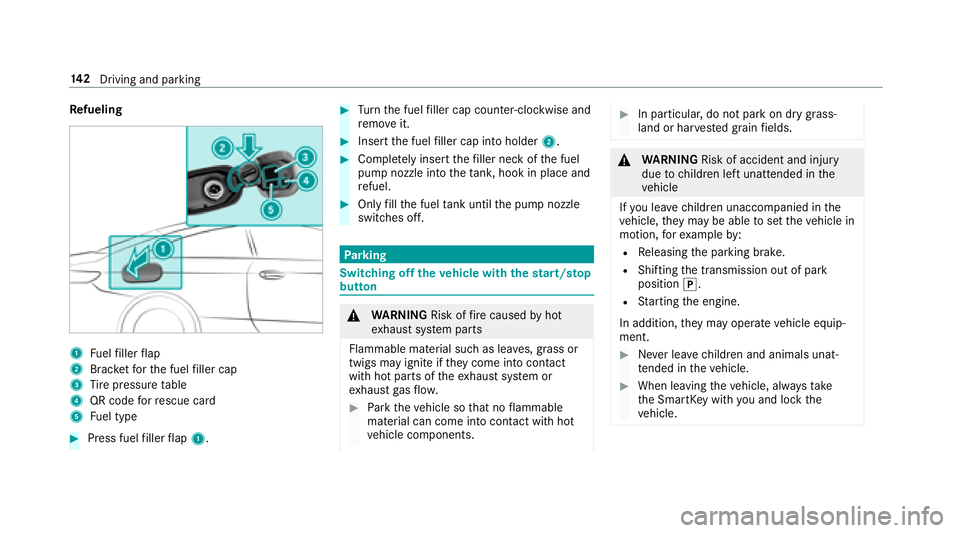
1Fuelfiller flap
2Brac ketfo rth e fuel filler cap
3Ti re pressure table
4QR code forre scue card
5Fu el type
#Press fuel filler flap 1.
#Turn the fuel filler cap coun ter-clockwise and
re mo veit.
#Insert the fuel filler cap into holder 2.
#Completely inse rtthefiller neck of the fuel
pump nozzle into theta nk, hook in place and
re fuel.
#Only fill th e fuel tank until the pump nozzle
switches off.
Pa rking
Switching off theve hicle with thest art/s top
button
& WARNING Risk offire caused byhot
ex haust sy stem parts
Flammable material such as lea ves, grass or
twigs may ignite if they come into contact
wi th hot parts of theex haust sy stem or
ex haust gasflow .
#Park theve hicle so that no flammable
material can come into con tact wi thhot
ve hicle components.
#In particular, do not park on dry grass‐
land or har vested grain fields.
&
WARNING Risk of accident and injury
due tochildren left unatte nded inthe
ve hicle
If yo u lea vechildren unaccompanied in the
ve hicle, they may be able toset theve hicle in
motion, forex ample by:
RRe leasing the parking brake.
RShifting the transmission out of park
position j.
RStarting the engine.
In addition, they may operate vehicle equip‐
ment.
#Ne ver lea vechildren and animals unat‐
te nded in theve hicle.
#When leaving theve hicle, alw aysta ke
th e SmartK eywith you and lock the
ve hicle.
14 2
Driving and pa rking
Page 330 of 486
#Correct the tire pressure if it is still at least
13 0 kPa (1.3 bar/19 psi). See theTire and
Loading Info rmation placard on the driver's
side B‑pillar or the tire pressure table in the
fuel filler flap forva lues.
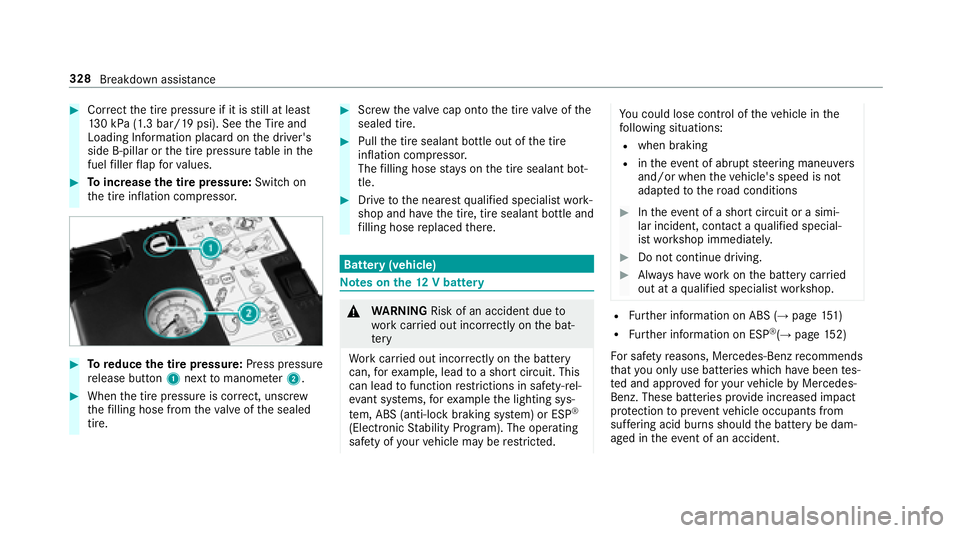
#To increase the tire pressure: Switchon
th e tire inflation compressor.
#To reduce the tire pressure: Press pressure
re lease button 1next tomanome ter2.
#When the tire pressure is cor rect, unscr ew
th efilling hose from theva lve of the sealed
tire.
#Scr ew theva lve cap onto the tire valve of the
sealed tire.
#Pull the tire sealant bottle out of the tire
inflation compressor.
The filling hose stay s on the tire sealant bot‐
tle.
#Drive tothe nearest qualified specialist work‐
shop and ha vethe tire, tire sealant bottle and
fi lling hose replaced there.
Bat tery (vehicle)
Note s onthe12 V battery
&
WARNING Risk of an accident due to
wo rkcar ried out incor rectly on the bat‐
te ry
Wo rkcar ried out incor rectly on the battery
can, forex ample, lead toa short circuit. This
can lead tofunction restrictions in saf ety-re l‐
eva nt sy stems, forex ample the lighting sys‐
te m, ABS (anti-lock braking system) or ESP
®
(Elect ronic Stability Prog ram). The operating
saf etyof your vehicle may be restricted.
Yo u could lose cont rol of theve hicle in the
fo llowing situations:
Rwhen braking
Rin theeve nt of ab rupt steering maneuvers
and/or when theve hicle's speed is not
adap tedto thero ad conditions
#In theeve nt of a short circuit or a simi‐
lar incident, contact a qualified special‐
ist workshop immediately.
#Do not continue driving.
#Alw ays ha vewo rkon the battery car ried
out at a qualified specialist workshop.
RFu rther information on ABS (→page 151)
RFu rther information on ESP®(→page 152)
Fo r saf etyre asons, Mercedes-Benz recommends
th at you only use batte ries which ha vebeen tes‐
te d and appr oved foryo ur vehicle byMercedes-
Benz. These batteries pr ovide inc reased impact
pr otection toprev ent vehicle occupants from
suf fering acid bu rns should the battery be dam‐
aged in theev ent of an accident.
328
Breakdown assis tance