2018 MERCEDES-BENZ E-CLASS COUPE esp
[x] Cancel search: espPage 73 of 486

Automatic reve rsing function for the side
windo ws
If an object bloc ksa side wind owduring the
closing process, the side window opens again
automaticall y.The automatic reve rsing function
is only an aid and is not a substitute foryo ur
attentiveness.
#When closing, make sure that no body parts
are in the closing area.
&
WARNING Risk of becoming trapped
despite reve rsing pr otection on the side
window
The reve rsing function does not react:
Rto soft, light and thin objects, e.g. small
fi ngers.
Rove rth e last ãin (4 mm) of the closing
path.
Rduring resetting.
Rwhen closing the side window again man‐
ually immediately af ter au tomatic reve rs‐
ing.
This means that there ve rsing function can‐
not pr event someone from becoming trapped
in these situations.
#When closing, make sure that no body
parts are in the closing area.
#If someone becomes trapped, press the
W button toopen the side window
again.
Ve ntilating theve hicle before starting a jour‐
ney (con venience opening)
&
WARNING Risk of entrapment when
opening a side window
When opening a side windo w,parts of the
body could be dr awn in or become trapped
between the side window and window frame.
#When opening, make sure that nobody
is touching the side windo w.
#Release the button immediately if
somebody becomes trapped.
#Press and hold the% button on the
SmartK ey.
The following functions are per form ed:
RThe vehicle is unloc ked.
RThe side windo wsare opened.
RThe pano ramic sliding sunroof is opened.
RThe seat ventilation of the driver's seat is
switched on.
If th ero ller sunblinds of the panoramic sliding
sunroof are closed, thero ller sunblinds are
opened firs t.
#To continue the opening procedu re:press
th e% button again.
#Tointer rupt convenience opening: release
th e% button.
Opening and closing 71
Page 75 of 486
ProblemPossible causes/consequences and MSolutions
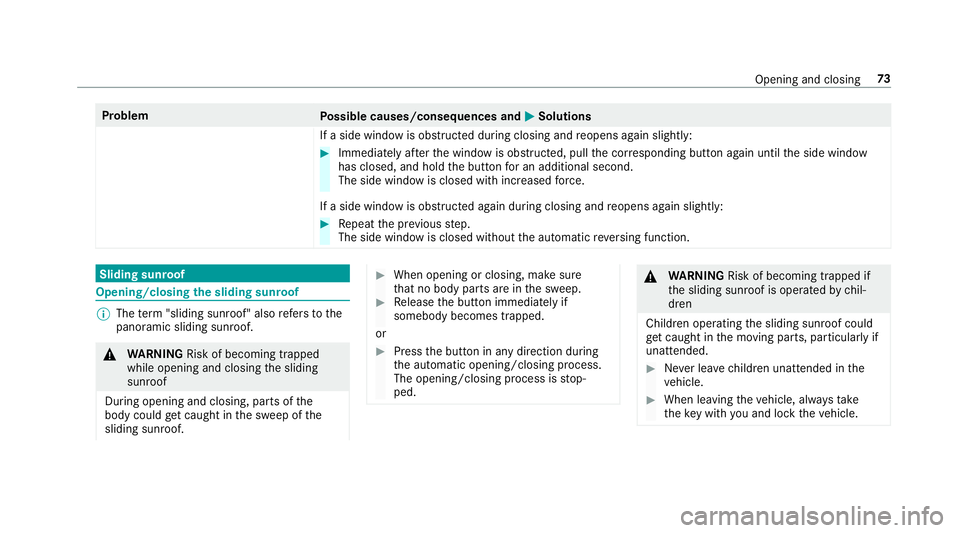
If a side window is obstructed during closing and reopens again slightly:
#Immediately af terth e window is obstructed, pull the cor responding button again until the side window
has closed, and hold the button for an additional second.
The side window is closed with increased forc e.
If a side window is obstructed again during closing and reopens again slightly:
#Re peat the pr evious step.
The side window is closed without the automatic reve rsing function.
Sliding sunroof
Opening/closing the sliding sunroof
%
The term "slidin g sunro of" also refers to the
panoramic sliding sunroof.
& WARNING Risk of becoming trapped
while opening and closing the sliding
sunroof
During opening and closing, parts of the
body could getcaught in the sweep of the
sliding sunroof.
#When opening or closing, make sure
th at no body parts are in the sweep.
#Re lease the button immediately if
somebody becomes trapped.
or
#Press the button in any direction during
th e automatic opening/closing process.
The opening/closing process is stop‐
ped.
& WARNING Risk of becoming trapped if
th e sliding sunroof is operated bychil‐
dren
Children operating the sliding sunroof could
get caught in the moving parts, particularly if
unattended.
#Ne ver lea vechildren unatte nded inthe
ve hicle.
#When leaving theve hicle, alw aysta ke
th eke ywit hyo u and lock theve hicle.
Opening and closing 73
Page 77 of 486

RTheroller sunblind can only be operated
when the panoramic sliding sunroof is
closed.
#To start automatic operation: press/pull
th e3 button be yond the pressure point.
#To inter rupt automatic operation: press/
pull the3 button again.
Re strictions:
RVe hicles with a panoramic sliding sun‐
ro of: The automatic raising feature is only
av ailable when the sliding sunroof is closed
or raised.
Au tomatic reve rsing function of the sliding
sunroof
If th ere is an object obstructing the sliding sun‐
ro of during the closing process, the sliding sun‐
ro of opens again automatically. The automatic
re ve rsing function is only an aid and is not a sub‐
st itute foryo ur attentiveness.
#When closing, make sure that no body parts
are in the closing area.
&
WARNING Risk of becoming trapped
despite there ve rsing function being
active
The reve rsing function does not react:
Rto soft, light and thin objects, e.g. small
fi ngers
Rdu ring the last 1/6 in (4 mm) of the clos‐
ing path
Rduring resetting
Rwhen closing the sliding sunroof again
manually immediately af ter au tomatic
re ve rsing
This means that there ve rsing function can‐
not pr event someone being trapped in these
situations.
#When closing, make sure that no body
parts are in the closing area.
#Re lease the button immediately if
somebody becomes trapped.
or
#Press the button in any direction during
th e automatic closing process.
The closing process is stopped.
Au tomatic reve rsing function of thero ller
sunblind
If th ere is an object obstructing thero ller sun‐
blind during the closing process, thero ller sun‐
blind opens again automaticall y.The automatic
re ve rsing function is only an aid and is not a sub‐
st itute foryo ur attentiveness.
#When opening or closing thero ller sunblind,
make sure that no body parts are in the
sweep.
& WARNING Risk of becoming trapped
despite there ve rsing function being
active
In particular, there ve rsing function does not
re act tosoft, light and thin objects, forex am‐
ple small fingers.
This means that there ve rsing function can‐
not pr event entrapment in these situations.
Opening and closing 75
Page 96 of 486

#Tocall up: press and hold there leva nt pre‐
set position button 1,2 or 3 until the front
seat is in thestored position.
St ow age areas
Note s on loading theve hicle
&
WARNING Risk ofexhaust gas poisoning
Combustion engines emit poisonous exhaust
ga ses such as carbon monoxide. Exhaust
ga ses can enter theve hicle interior if the
trunk lid is open when the engine is running,
especially if theve hicle is in motion.
#Alw ays switch off the engine before
opening the trunk lid.
#Ne ver drive with the trunk lid open.
&
WARNING Risk of injury from unsecured
items in theve hicle
If objects, luggage or loads are not secured
or not secured suf ficientl y,they could slip,
tip ove r or be throw n around and thereby hit
ve hicle occupants.
There is a risk of injur y,particularly in the
ev ent of sudden braking or a sudden change
in direction.
#Alw aysstow objects in such a wayth at
th ey cannot be thro wn around.
#Before the journe y,secure objects, lug‐
ga ge or loads against slipping or tipping
ove r.
&
WARNING Risk of injury from incorrectly
stowe d objects
If objects in theve hicle interior are stowed
incor rectly, they can slide or be throw n
around and hit vehicle occupants. In addi‐
tion, cup holders, open stowage spaces and
mobile phone brac kets cann otalw aysre tain
all objects they contain.
There is arisk of injur y,particularly in the
ev ent of sudden braking or a sudden change
in direction.
#Alw aysstow objects so that they can‐
not be throw n around in such situa‐
tions.
#Alw ays make sure that objects do not
pr otru de from stowage spaces, luggage
nets or stowage nets.
#Close the loc kable stow age spaces
before starting a journe y.
#Alwaysstow and secure heavy, hard,
pointe d, sharp-edged, fragile or bulky
objects in the trunk.
&
WARNING Risk of burn s fromtailpipes
and tailpipe trim
The tailpipe and tailpipe trim can become
ve ry hot. If you come into contact with these
parts of theve hicle, you could burn yourself.
#Alw ays be particular lycareful around
th eta ilpipe and theta ilpipe trim.
#Allow theve hicle parts tocool down
before youto uch them.
94
Seats and stowing
Page 99 of 486
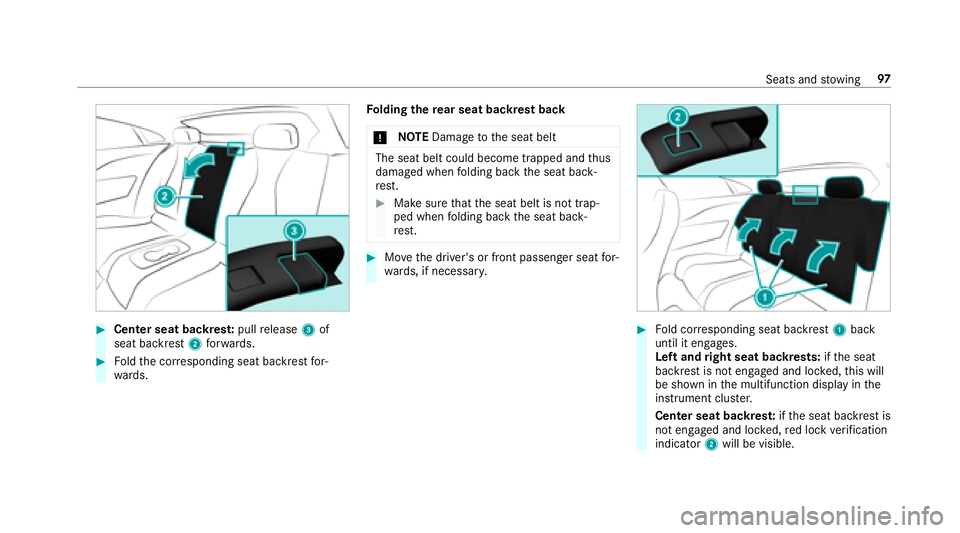
#Center seat backrest:pull release 3of
seat backrest 2forw ards.
#Foldthe cor responding seat backrest for‐
wa rds. Fo
lding there ar seat backrest back
* NO
TEDama getothe seat belt
The seat belt could become trapped and thus
damaged when folding back the seat back‐
re st.
#Make sure that the seat belt is not trap‐
ped when folding back the seat back‐
re st.
#Mo vethe driver's or front passenger seat for‐
wa rds, if necessar y.
#Fold cor responding seat backrest 1back
until it engages.
Left and right seat backrests: ifth e seat
backrest is not engaged and loc ked, this will
be shown in the multifunction display in the
instrument clus ter.
Center seat backres t:ifth e seat backrest is
not engaged and loc ked, red lock verification
indicator 2will be visible.
Seats and stowing 97
Page 107 of 486
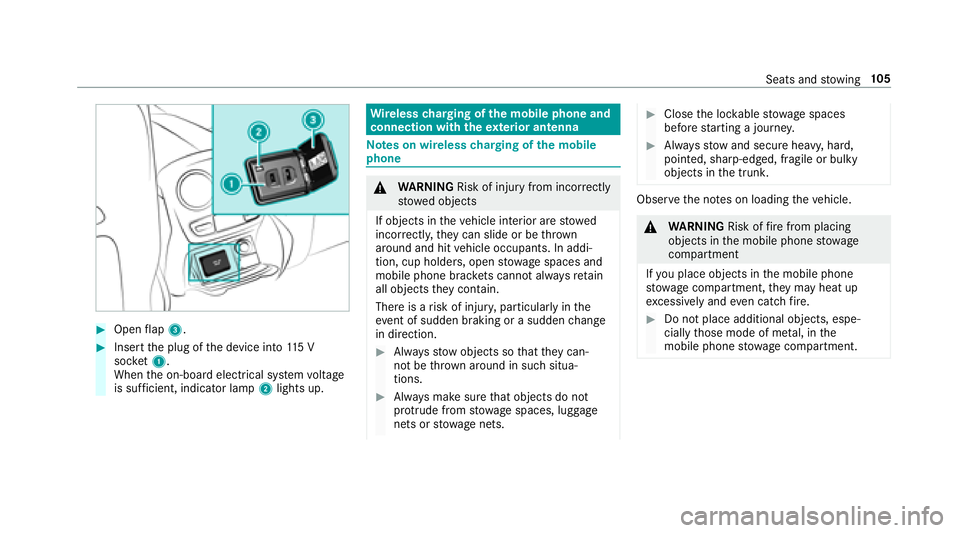
#Openflap 3.
#Insert the plug of the device into 115 V
soc ket1.
When the on-board electrical sy stem voltage
is suf ficient, indicator la mp2lights up.
Wire lesscharging of the mobile phone and
connection with theex terior antenna
Note s on wireless charging of the mobile
phone
& WARNING Risk of injury from incorrectly
stowe d objects
If objects in theve hicle interior are stowed
incor rectly, they can slide or be throw n
around and hit vehicle occupants. In addi‐
tion, cup holders, open stowage spaces and
mobile phone brac kets cann otalw aysre tain
all objects they contain.
There is arisk of injur y,particularly in the
ev ent of sudden braking or a sudden change
in direction.
#Alw aysstow objects so that they can‐
not be throw n around in such situa‐
tions.
#Alw ays make sure that objects do not
pr otru de from stowage spaces, luggage
nets or stowage nets.
#Close the loc kable stow age spaces
before starting a journe y.
#Alwaysstow and secure heavy, hard,
pointe d, sharp-edged, fragile or bulky
objects in the trunk.
Obser vethe no tes on loading theve hicle.
&
WARNING Risk offire from placing
objects in the mobile phone stowage
compartment
If yo u place objects in the mobile phone
stow age compartment, they may heat up
exc essively and even catch fire .
#Do not place additional objects, espe‐
cially those mode of me tal, in the
mobile phone stowage compartment.
Seats and stowing 10
5
Page 110 of 486
Exterior lighting
Lighting systems and your responsibility
The various lighting sy stems of theve hicle are
only aids. The driver of theve hicle is responsible
fo r cor rect vehicle illumination in accordance
with the pr evailing light and visibility conditions,
legal requirements and traf fic situation.
Light switch
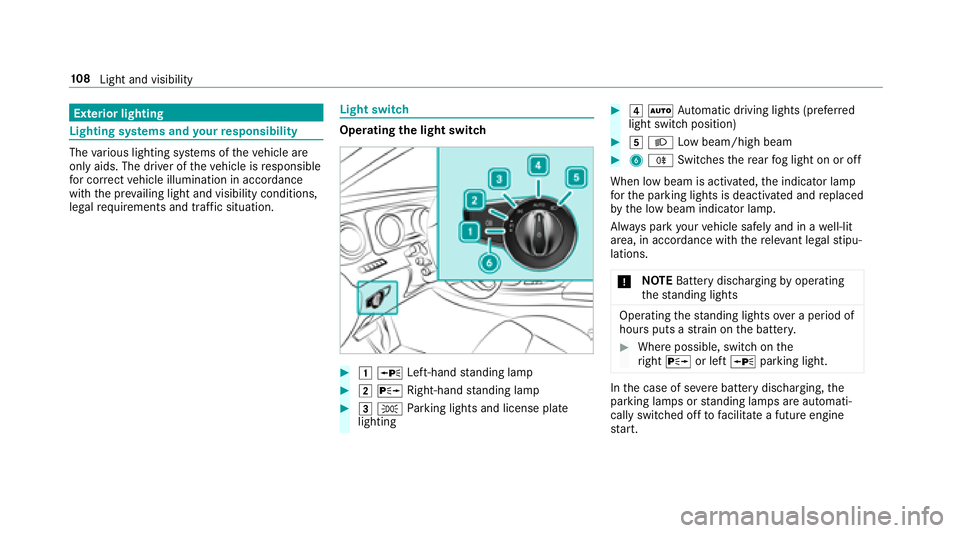
Opera ting the light switch
#1W Left-hand standing lamp
#2 X Right-hand standing lamp
#3 T Parking lights and license plate
lighting
#4 Ã Automatic driving lights (prefer red
light switch position)
#5 L Low beam/high beam
#6R Switches there ar fog light on or off
When low beam is activated, the indicator lamp
fo rth e parking lights is deactivated and replaced
by the low beam indicator lamp.
Alw ays park your vehicle safely and in a well-lit
area, in accordance with there leva nt le galst ipu‐
lations.
* NO
TEBattery discharging byoperating
th est anding lights
Operating thest anding lights over a period of
hours puts a stra in on the batter y.
#Where possible, switch on the
ri ght X or left Wparking light.
Inthe case of se vere battery discharging, the
parking lamps or standing lamps are automati‐
cally switch ed offtofacilitate a futu reengine
st art.
10 8
Light and visibility
Page 111 of 486

Theexterior lighting (e xcept parking and stand‐
ing lamps) switch es off automatically when the
driver's door is opened.
Au tomatic headlamp mode
The pa rking lights, low beam and daytime run‐
ning la mps are switched on or off automatically
depending on the ignition status, whe ther the
engine is running and on the ambient light.
&
WARNING Risk of accident when the low
beam is switched off in poor visibility
When the light switch is set toÃ, the low
beam may not be switched on automatically
if th ere is fog, snow or other causes of poor
visibility such as spr ay.
#In such cases, turn the light switch to
L.
The automatic driving lights are only an aid. You
are responsible forve hicle lighting. Ac
tivating/deactivating the rear fog light
Re quirement:
RThe light switch is in theL orà posi‐
tion.
#Press the R button.
Please obser vethe count ry-specific la wsonthe
use of rear fog lamps.
Operating the light combination switch
1High beam
2Turn signal light, right
3High-beam flasher
4Tu rn signal light, left
#Pull or push the combination switch in the
re leva nt di rection following the ar row.
Light and visibility 10
9