2018 MERCEDES-BENZ E-CLASS COUPE warning
[x] Cancel search: warningPage 357 of 486
and one-half times aswell on the go vernment
te st track as a tire graded 100.
The relative per form ance of tires depends upon
th e actual conditions of their use, ho wever,and
may depart significantly from the norm due to
va riations in driving habits, service practices and
dif fere nces in road characteristics and climate
conditions.
Tr action grade
&
DANG ER Risk of accident due toinade‐
qu ate traction
The traction grade assigned tothis tire is
based on stra ight-ahead braking traction
te sts, and does not include either accelera‐
tion, cornering, hydroplaning or peak traction
ch aracteristics.
#Alw ays adapt your drivin gst yle and
drive at a speed tosuit the pr evailing
traf fic and weather conditions.
* NO
TEDama getothe driv etra in from
wheelspin
#Av oid wheelspin.
The traction grades – from highest tolowest –
are AA, A,B and C. Those grades represent the
tire's ability tostop on wet pa vement as meas‐
ured under controlled conditions on specified
go vernment test sur faces made of asphalt and
concr ete.
Te mp erature grade
&
WARNING Risk of accident from tire
ove rheating and tire failure
The temp erature grade forth is tire is es tab‐
lished for a tire that is proper ly inflated and
not overloaded. Excessive speed, underinfla‐
tion, or excessive loading, either separately
or in combination, can cause excessive heat
build-up and possible tire failure.
#Obser vethere commended tire pres‐
sure s and regularly check the tire pres‐
sure of all tires including the spare
wheel.
#Ad just the tire pressure as necessar y.
Thetemp erature grades are A (the highest), B
and C. They represent the tire's resis tance tothe
ge neration of heat and its ability todissipate
heat when tested under controlled conditions on
a specified indoor laboratory test wheel. Sus‐
ta ined high temp eratures can cause the material
of the tire todegenerate and reduce tire life, and
exc essive temp erature can lead tosudden tire
fa ilure. Grade C cor responds toa le vel of per‐
fo rm ance which all passenger car tires must
meet under therequ irements of the US Depart‐
ment of Transpor tation.
DO T,Tire Identification Number (TIN)
US tire regulations stipulate that eve rytire man‐
ufactu rer or retreader must imprint a TIN in or
on the side wall of each tire produced.
Wheels and tires 355
Page 359 of 486
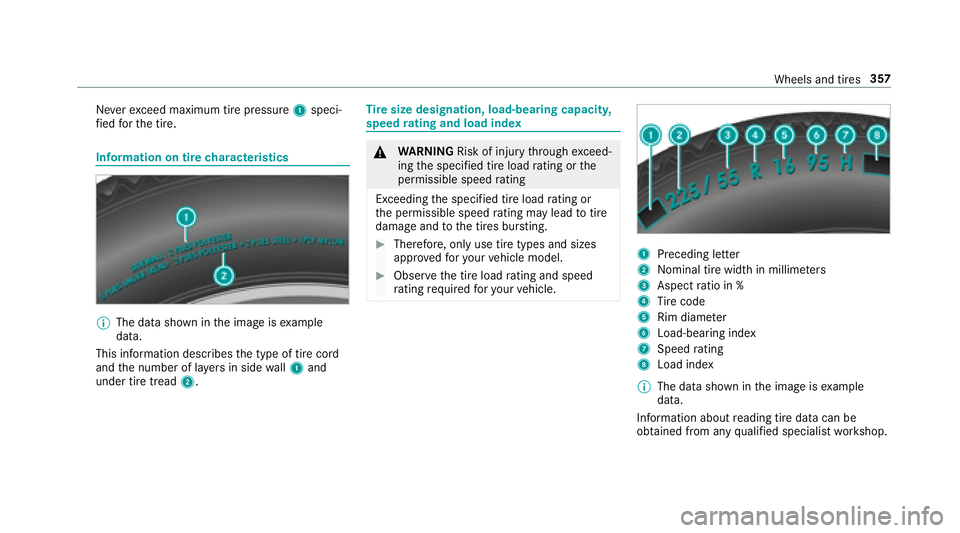
Neverexc eed maximum tire pressure 1speci‐
fi ed forth e tire.
Information on tire characteristics
%
The data shown in the image is example
data.
This information descri besthe type of tire cord
and the number of la yers in side wall1 and
under tire tread 2.
Tire size designation, load-bearing capacity,
speed rating and load index
&
WARNING Risk of injury thro ugh exceed‐
ing the specified tire load rating or the
permissible speed rating
Exceeding the specified tire load rating or
th e permissible speed rating may lead totire
damage andtothe tires bur sting.
#Therefore, only use tire types and sizes
appr ovedfo ryo ur vehicle model.
#Obser vethe tire load rating and speed
ra ting requ ired foryo ur vehicle.
1Preceding letter
2Nominal tire width in millime ters
3Aspect ratio in %
4Tire code
5Rim diame ter
6Load-bearing index
7Speed rating
8Load ind ex
% The data shown in the image is example
data.
Info rmation about reading tire data can be
obtained from any qualified specialist workshop.
Wheels and tires 357
Page 364 of 486
Changing a wheel
Notes on selecting, mounting and replacing
tires
Yo u can ask for information rega rding permitte d
wheel/tire combination at an authorized
Mercedes-Benz Center.
& WARNING Risk of accident due toincor‐
re ct dimensions of wheels and tires
If wheels and tires of the wrong size are
ins talled, the wheel brakes or wheel suspen‐
sion components may be damaged.
#Alw aysre place wheels and tires with
th ose that fulfill the specifications of
th e original part.
When replacing wheels, make sure tofit th e
cor rect:
RDesignation
RModel
When replacing tires, make sure toins tallth e
cor rect:
RDesignation
RManufactu rer
RModel
&
WARNING Risk of injury thro ugh exceed‐
ing the specified tire load rating or the
permissible speed rating
Exceeding the specified tire load rating or
th e permissible speed rating may lead totire
damage andtothe tires bur sting.
#Therefore, only use tire types and sizes
appr ovedfo ryo ur vehicle model.
#Obser vethe tire load rating and speed
ra ting requ ired foryo ur vehicle.
* NO
TEDama getovehicle and tires due to
non-app rove d tire types and sizes
Fo r saf etyre asons, only use wheels, tires
and accessories which havebeen appr oved
fo ryo ur vehicle byMercedes-Benz.
These tires ha vebeen specially adap tedfo r
use with the control sy stems, e.g. ABS or
ESP
®, and are mar ked as follo ws :
RMO = Mercedes-Benz Original
RMOE = Mercedes-Benz Original Extended
(run-flat tires only for cer tain wheels)
RMO1 = Mercedes-Benz Original (only cer‐
tain AMG tires)
Cer tain characteristics, e.g. handling, vehicle
noise emissions or fuel consum ption, may
ot herwise be adversely af fected. In addition,
when driving wi tha load, tire dimension var‐
iations could cause the tires tocome into
contact wi th the body and axle components.
This could result in damage tothe tires or the
ve hicle.
362
Wheels and tires
Page 365 of 486
Only use tires, wheels or accessoriestested
and appr ovedby Mercedes-Benz.
* NO
TERisk todriving saf etyfrom retrea‐
ded tires
Re treaded tires are nei ther tested nor recom‐
mended byMercedes-Benz, since pr evious
damage cannot alw ays be de tected on
re treaded tires.
Fo rth is reason driving saf etycanno tbe guar ‐
anteed.
#Do no tuse used ti res if you ha veno
information about their pr evious usage.
* NO
TEPossible damage towheels or tires
when driving over obs tacles
Large wheels ha vea lo wer tire section wid th.
The lo werth e tire section width, the greater
is therisk of damage towheels or tires when
driving over obs tacles.
#Av oid obs tacles or drive part icularly
carefully.
* NO
TEDama getoelectronic component
parts from the use of tire-mounting tools
Ve hicles with a tire pressure monitoring
sy stem: Electronic component parts are
located in the wheel. Tire -mounting tools
should not be used in the area of theva lve.
This could otherwise damage the electronic
component parts.
#Ha ve the tires changed at a qualified
specialist workshop onl y.
*NO
TEDama getosummer tires at low
ambient temp eratures
Using summer tires at very low ambient tem‐
peratures can cause crac kstoform ,th ereby
damaging the tires permanentl y.
#Attemp eratures below 45 °F (7 °C) use
M+S tires.
Ac cessory part sth at are not appr ovedfo ryo ur
ve hicle byMercedes-Benz or are not being used
cor rectly can impair the operating saf ety. Before purc
hasing and using non-appr oved
accessori es, visit a qualified specialist workshop
and inquire about:
RSuitability
RLegal stipulations
RFa ctory recommendations
&
WARNING Risk of accident wi thhigh
per form ance tires
The special tire tread in combination with the
optimized tire compound means that therisk
of skidding or hydroplaning on wetro ads is
inc reased.
In addition, the tire grip is greatly reduced at
a low outside temp erature and tire running
te mp erature.
#Switch on the ESP®and adapt your
dr ivin gst yle accordingly.
#Use M+S tire at outside temp eratures
of less than 10 °C (50 °F).
Wheels and tires 363
Page 366 of 486

Observethefo llowing when selecting, mounting
and replacing tires:
ROnly use tires and wheels of the same type
(summer tires, winter tires, MOEx tended
tires) and make .
ROnly mount wheels of the same size on one
axle (left and right).
It is only permissible tomount a dif fere nt
wheel size in theeve nt of a flat tire in order
to drive tothe specialist workshop.
ROnly mount tires of the cor rect size onto the
wheels.
RVe hicles with a tire pressure monitoring
sy stem: All mounte d wheels must be equip‐
ped with functioning sensors forth e tire
pressure monitoring sy stem.
RAt temp eratures below 45 °F (7 °C), use win‐
te r tires or all-season tires mar ked M+S for
all wheels.
Wi nter tires bearing thei snowflake sym‐
bol in addition tothe M+S marking pr ovide
th e best possible grip in wintry road condi‐
tions.
RFo r M+S tires, only use tires with the same
tread.
RObser vethe maximum permissible speed for
th e M+S tires mounted.
If th is is below theve hicle's maximum speed,
th is must be indicated in an appropriate label
in the driver's field of vision.
RBreak in new tires at moderate speeds for
th efirs t 60 miles (100 km).
RRe place the tires af ter six years at the latest,
re ga rdless of wear.
RWhen replacing with tires that do not fea‐
ture run-flat charac
teristics: Vehicles with
MOExtended tires are not equipped with a
TIREFIT kit at thefa ctor y.Equip theve hicle
with a TIREFIT kit af terre placing with tires
th at do not feature run-flat characteristics,
e.g. winter tires.
Fo r more information on wheels and tires, con‐
ta ct a qualified specialist workshop.
Be sure toalso observ eth efo llowing fur ther
re lated subjects:
RNo tes on tire pressure (→page 343)
RTire and Loading Info rmation placard
(→page 349)
RTi re size designation, load-beari ng capacity,
speed rating and load ind ex(→page 357)
RTire pressure table (→page 345)
Note s on inter changing wheels
&
WARNING Risk of injury thro ugh dif fer‐
ent wheel sizes
Inter changing the front and rear wheels if the
wheels or tires ha vediffere nt dimensions
may se verely impair the driving characteris‐
tics.
The wheel brakes or wheel suspension com‐
ponents may also be damaged.
#Ro tate front and rear wheels only ifth e
wheels and tires are of the same dimen‐
sions.
364 Wheels and tires
Page 370 of 486

#Usingthe wheel wrench, loosen the wheel
bolts on the wheel youwish tochange by
about one full turn. Do not unscr ewthe
scr ews comple tely.Po sition of jack support points
&
WARNING Risk of injury from incorrect
positioning of the jack
If yo u do not position the jack cor rectly at
th e appropriate jacking point of theve hicle,
th e jack could tip with theve hicle raised.
#Only position the jack at the appropri‐
ate jacking point of theve hicle. The
base of the jack must be positioned ver‐
tically under the jacking point of the
ve hicle.
* NO
TEVehicle damage from the jack
Ifyo udo not position the jack cor rectly at
th e appropriate jack support point of the
ve hicle, the jack could tip over with theve hi‐
cle raised.
#The jack is designed exclusively for
jacking up theve hicle at the jack sup‐
port points.
#Ta ke thera tchet box wrench out of the tire-
ch ange tool kit and place it on the he xagon
nut of the jack so that the letters AUF are
visible.
368 Wheels and tires
Page 372 of 486
&WARNING Risk of accident from losing a
wheel
Oiled, greased or damaged wheel bolt/wheel
nut thre ads or wheel hub/wheel mounting
bolt thre ads can cause the wheel bolts/
wheel nuts tocome loose.
As a result, you could lose a wheel while driv‐
ing.
#Ne ver oil or grease theth re ads.
#In theeve nt of damage totheth re ads,
con tact a qualified specialist workshop
immediatel y.
#Have the damaged wheel bolts or dam‐
aged hub thre ads replaced.
#Do not continue driving.
#Obser vethe information on thech oice of
tires (→page 362).
Fo r tires with a specified direction of rotation, an
ar row onthe side wall of the tire indicates the
cor rect dire ction of rotation. Observ eth e direc‐
tion of rotation when ins talling.
#Slide the wheel tobe mounted onto the cen‐
te ring pin and push it on.
&
WARNING Risk of injury from tightening
wheel bolts and nuts
If yo u tighten the wheel bolts or wheel nuts
when theve hicle is raised, the jack could tip.
#Only tighten wheel bolts or wheel nuts
when theve hicle is on the ground.
#Fo r saf etyre asons, Mercedes-Benz recom‐
mends that you only use wheel bolts which
ha ve been appr oved for Mercedes-Benz vehi‐
cles, as well as forth e wheel in question.
* NO
TEDama getopaintwork of the wheel
ri m when scr ewing on thefirs t wheel bolt
If th e wheel has too much play when scr ew‐
ing in thefirs t wheel bolt, the wheel rim paint
can be dama ged.
#Press the wheel firm lyagainst the
wheel hub when scr ewing on thefirs t
wheel bolt.
#Ti ghten the wheel bolts until they are finger-
tight.
#Un scr ew the centering pin.
#Tighten the last wheel bolt until it is finger-
tight.
#Lo we rth eve hicle (→page 370).
Lo weri ngtheve hicle af ter a wheel change
Re quirement:RThe new wheel has been ins talled
(→page 369).
#Place thera tchet wrench onto the he xagon
nut of the jack so that the letters "AB" are
visible.
#To lowe r the vehicle: turnthera tchet
wrench of the jack counter-clockwise.
37 0
Wheels and tires
Page 373 of 486
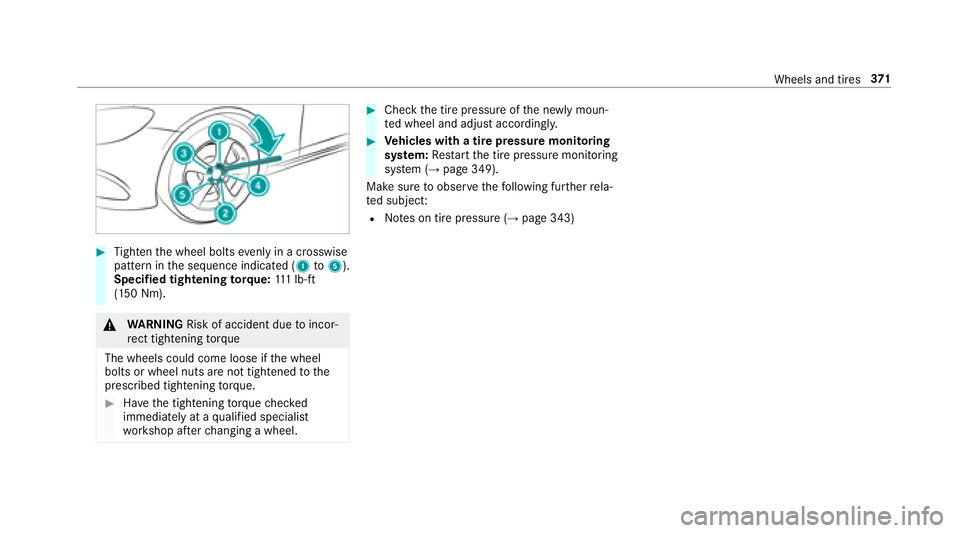
#Tighten the wheel bolts evenly in a crosswise
pattern in the sequence indicated (1 to5).
Specified tightening torq ue: 111 lb-ft
(150 Nm).
& WARNING Risk of accident due toincor‐
re ct tigh tening torque
Th ewheels could come loose if the wheel
bolts or wheel nuts are not tightened tothe
prescribed tightening torque.
#Ha ve the tightening torque checked
immediately at a qualified specialist
wo rkshop af terch anging a wheel.
#Check the tire pressure of the newly moun‐
te d wheel and adjust according ly.
#Ve hicles with a tire pressure monitoring
sy stem: Restart the tire pressure monitoring
sy stem (
→page 349).
Make sure toobser vethefo llowing fur ther rela‐
te d subjec t:
RNotes on tire pressure (→page 343)
Wheels and tires 37
1