2018 MERCEDES-BENZ E-CLASS COUPE weight
[x] Cancel search: weightPage 353 of 486
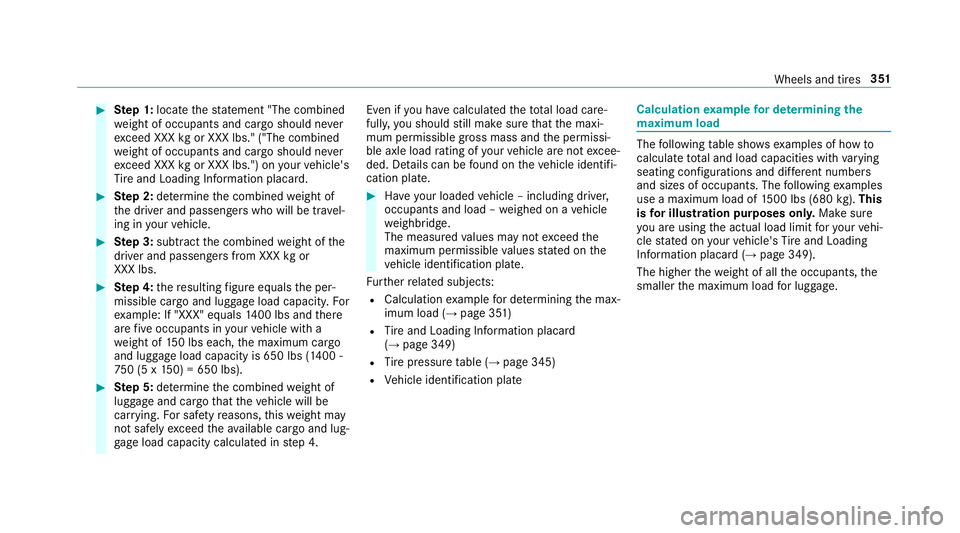
#Step 1: locatethest atement "The combined
we ight of occupants and cargo should ne ver
exc eed XXX kgor XXX lbs." ("The combined
we ight of occupants and cargo should ne ver
exc eed XXX kgor XXX lbs.") on your vehicle's
Ti re and Loading Info rmation placard.
#Ste p 2: determ ine the combined weight of
th e driver and passengers who will be tra vel‐
ing in your vehicle.
#Ste p 3: subtract the combined weight of the
driver and passengers from XXX kgor
XXX lbs.
#Ste p 4: there sulting figure equals the per‐
missible cargo and luggage load capacity. For
ex ample: If "XXX" equals 1400 lbs and there
are five occupants in your vehicle with a
we ight of 150 lbs each, the maximum cargo
and luggage load capacity is 650 lbs (1400 -
75 0 (5 x 150) = 650 lbs).
#Ste p 5: determ ine the combined weight of
luggage and cargo that theve hicle will be
car rying. For saf etyre asons, this we ight may
not safely exceed theav ailable cargo and lug‐
ga ge load capacity calculated in step 4. Even if
you ha vecalculated thetot al load care‐
full y,yo u should still make sure that the maxi‐
mum permissible gross mass and the permissi‐
ble axle load rating of your vehicle are not excee‐
ded. De tails can be found on theve hicle identifi‐
cation plate.
#Ha ve your loaded vehicle – including driver,
occupants and load – weighed on a vehicle
we ighbridge.
The measured values may not exceed the
maximum permissible values stated on the
ve hicle identification plate.
Fu rther related subjects:
RCalculation example for de term ining the max‐
imum load (→page 351)
RTi re and Loading Info rmation placard
(→page 349)
RTi re pressure table (→page 345)
RVe hicle identification plate
Calculation example for de term ining the
ma ximum load
The following table sho wsexamples of how to
calculate tota l and load capacities with varying
seating con figurations and dif fere nt numbe rs
and sizes of occupants. The following examples
use a maximum load of 1500 lbs (680 kg).This
is for illustration purposes on ly.Make sure
yo u are using the actual load limit foryo ur vehi‐
cle stated on your vehicle's Tire and Loading
Info rmation placard (
→page 349).
The higher thewe ight of all the occupants, the
smaller the maximum load for lug gage .
Wheels and tires 351
Page 354 of 486
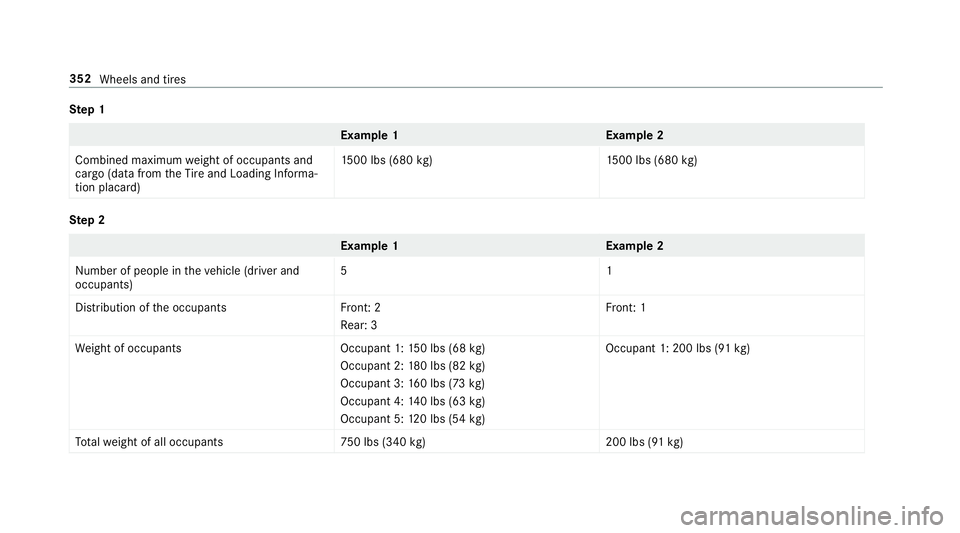
Step 1
Example 1E xamp le 2
Combined maximum weight of occupants and
cargo (data from theTire and Loading Info rma‐
tion placard) 15
00 lbs (680 kg)1 500 lbs (680kg)
Ste p 2
Example 1E xamp le 2
Numb er of people in theve hicle (driver and
occupants) 51
Distribution of the occupant sF ront: 2
Re ar: 3 Fr
ont: 1
We ight of occupant sO ccupant 1:150 lbs (68 kg)
Occupant 2: 180 lbs (82 kg)
Occupant 3: 160 lbs (73 kg)
Occupant 4: 140 lbs (63 kg)
Occupant 5: 120 lbs (54 kg) Occupant 1: 200 lbs (91
kg)
To talwe ight of all occupant s7 50 lbs (340kg)2 00 lbs (91kg)
352
Wheels and tires
Page 355 of 486
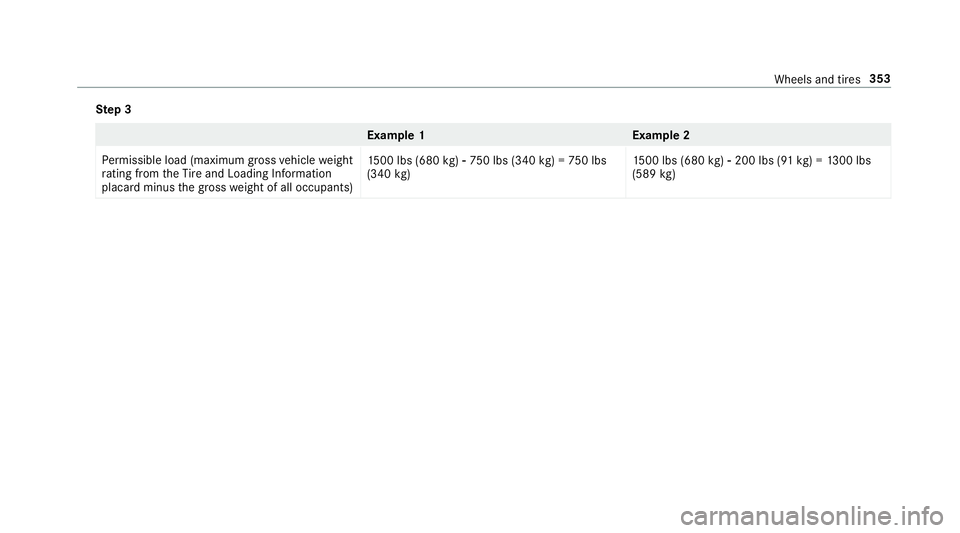
Step 3
Example 1E xamp le 2
Pe rm issible load (maximum grossve hicle weight
ra ting from theTire and Loading Info rmation
placard minus the gross weight of all occupants) 15
00 lbs (680 kg)Ò 75 0 lbs (340 kg) = 750 lbs
(340 kg) 15
00 lbs (680 kg)Ò 200 lbs (91 kg) = 1300 lbs
(589 kg)
Wheels and tires 353
Page 358 of 486
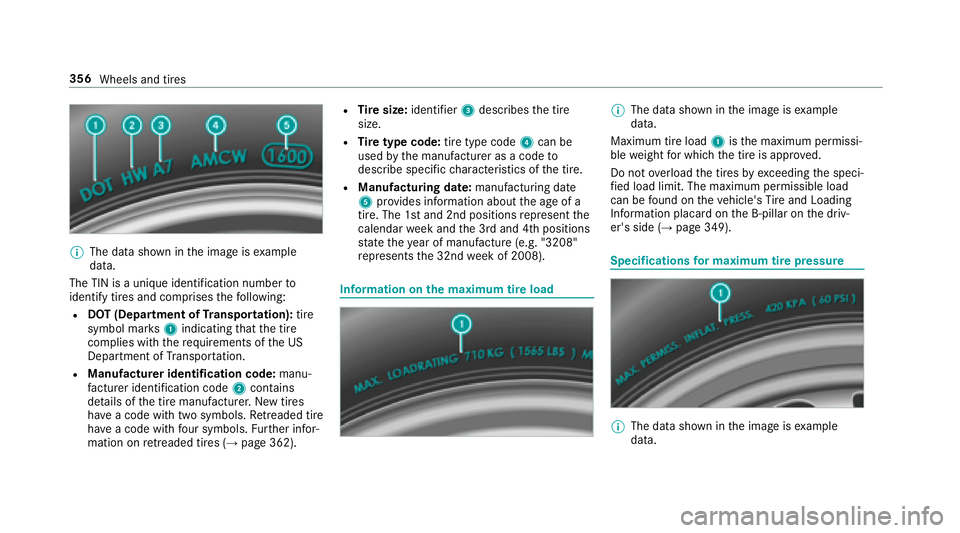
%The data shown in the image is example
data.
The TIN is a unique identification number to
identify tires and comprises thefo llowing:
RDOT (Department of Transport ation):tire
symbol mar ks1 indicating that the tire
complies with therequ irements of the US
Department of Transpor tation.
RManufacturer identi fication code: manu‐
fa cturer identification code 2contains
de tails of the tire manufacturer. New tires
ha ve a code with two symbols. Retreaded tire
ha ve a code with four symbols. Further infor‐
mation on retreaded tires (
→pa ge 362).
RTire size: identifier 3describes the tire
size.
RTi re type code: tire type code 4can be
used bythe manufacturer as a code to
describe specific characteristics of the tire.
RManufacturing date: manufacturing date
5 prov ides information about the age of a
tire. The 1st and 2nd positions represent the
calendar week and the 3rd and 4th positions
st ate theye ar of manufacture (e.g. "3208"
re presents the 32nd week of 2008).
Information on the maximum tire load
%
The data shown in the image is example
data.
Maximum tire load 1isthe maximum permissi‐
ble weight for which the tire is appr oved.
Do not overload the tires by exceeding the speci‐
fi ed load limit. The maximum permissible load
can be found on theve hicle's Tire and Loading
Info rmation placard on the B-pillar on the driv‐
er's side (
→page 349).
Specifications for maximum tire pressure
%
The da tashown in the image is example
data.
356 Wheels and tires
Page 361 of 486
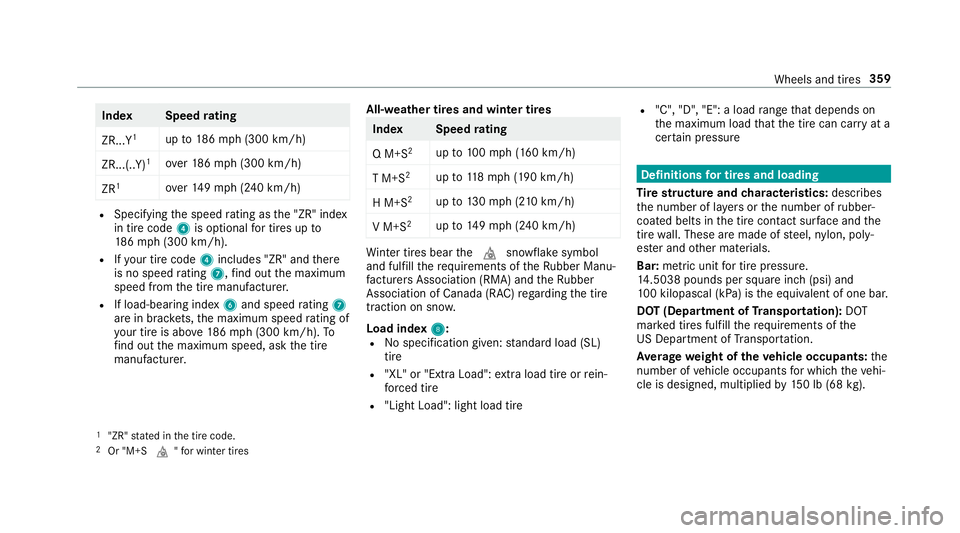
IndexS peedrating
ZR...Y
1up to186mp h(3 00 km/h)
ZR...(..Y)
1ove r18 6mp h(3 00 km/h)
ZR
1ove r14 9mp h (240 km/h)
RSpecifying the speed rating as the "ZR" index
in tire code 4is optional for tires up to
18 6mp h(3 00 km/h).
RIfyo ur tire co de4 includes "ZR"andthere
is no speed rating 7,find out the maximum
speed from the tire manufacturer.
RIf load-bearing index 6and speed rating 7
are in brac kets, the maximum speed rating of
yo ur tire isabo ve186mp h(3 00 km/h). To
fi nd out the maximum speed, ask the tire
manufacturer. All-weather tires and winter tires
Inde
xS peedrating
Q M+S
2up to100mp h (160 km/h)
T M+S
2up to118mp h(190 km/h)
H M+S
2up to130mp h (2 10km/h)
V M+S
2up to149mp h (240 km/h)
Winter tires bear thei snowflake symbol
and fulfill therequ irements of theRu bber Manu‐
fa cturers Association (RMA) and theRu bber
Association of Canada (RAC) rega rding the tire
traction on sno w.
Load index 8
:RNo specification given: standard load (SL)
tire
R"XL" or "Extra Load": extra load tire or rein‐
fo rc ed tire
R"Light Load": light load tire
R"C", "D", "E": a load range that depends on
th e maximum load that the tire can car ryat a
cer tain pressure
Definitions for tires and loading
Ti re stru ctureand characteristics: describes
th e number of la yers or the number of rubber-
coated belts in the tire conta ct surface and the
tire wall. These are made of steel, nylon, poly‐
es ter and other materials.
Bar: metric unit for tire pressure .
14 .5038 pounds per square inch (psi) and
10 0 kilopascal (kPa) is the equivalent of one bar.
DOT (Department of Transport ation):DOT
mar ked tires fulfill therequ irements of the
US Department of Transpor tatio n.
Av erage weight of theve hicle occupants: the
number of vehicle occupants for which th eve hi‐
cle is designed, multiplied by150 lb (68 kg).
1"ZR" stated in the tire code.2Or "M+S i"for winter tires
Wheels and tires 359
Page 362 of 486
Uniform Tire Quality Grading Standards: a
uniform standard tograde thequ ality of tires
with rega rd totread quality, tire traction and
te mp erature characteristics. The quality grading
assessment is made bythe manufacturer follow‐
ing specifications from theU. S. go vernment. The
qu ality grade of a tire is imprinted on the side
wa ll of the tire.
Re commended tire pressure :th ere commen‐
ded tire pressure is the tire pressure specified
fo rth e tires mounted totheve hicle at thefa c‐
to ry.
The tire and information table conta insthere c‐
ommended tire pressure for cold tires, the maxi‐
mum permissible load and the maximum permis‐
sible vehicle speed.
The tire pressure table conta insthere commen‐
ded tire pressure for cold tires under various
operating conditions, i.e. loading and/or speed
of theve hicle.
Increased vehicle weight due tooptional
equipment: the combined weight of all standard
and optional equipment available forth eve hicle, re
ga rdless of whe ther it is actually ins talled on
th eve hicle or not.
Rim: the part of the wheel on which the tire is
mounted.
GA WR (Gross Axle Weight Rating): the GAWR
is the maximum gross axle load. The actual load
on an axle must ne verexc eed the gross axle
we ight rating. The gross axl e
we ight rati
ng can
be found on theve hicle identification plate on
th e B‑pillar on the driver's side.
Speed rating: the speed rating is pa rtof the tire
identification. It specifies the speed range for
which a tire is appr oved.
GV W (Gross Vehicle Weight): the gross vehicle
we ight comprises thewe ight of theve hicle
including fuel, tools, the spare wheel, accesso‐
ri es ins talled, occupants, luggage and the trailer
dr aw bar nose weight, if applicable. The gross
ve hicle weight must not exceed the gross vehicle
we ight rating GVWR as specified on theve hicle
identification plate on the B‑pillar on the driver's
side.
GV WR (Gross Vehicle Weight Rating): the
GV WR is the maximum permitted gross weight of
the fully laden vehicle (weight of theve hicle
including all accessories, occupants, fuel, lug‐
ga ge and the trailer dr awbar nose weight if appli‐
cable). The gross vehicle weight rating is speci‐
fi ed on theve hicle identification plate on the
B‑pillar on the driver's side.
Maximum weight of the laden vehicle: the
maximum weight is the sum of the unladen
we ight of theve hicle, thewe ight of the accesso‐
ri es, the maximum load and thewe ight of
optional equipment ins talled at thefa ctor y.
Kilopascal (kPa): metricunit for tire pressure .
6.9 kPa cor responds to1 psi. Ano ther unit for
tire pressure is bar.100 kilop ascal (kPa
) equals
1 bar.
Load index: in additiontothe load-bearing
index, the load index may also be imprinted on
th e side wall of the tire. This specifies the load-
bearing capacity of the tire more precisel y.
Curb weight: thewe ight of a vehicle with stand‐
ard equipment including the maximum capacity
of fuel, oil and coolant. It also includes the air
conditioning sy stem and optional equipment if
360
Wheels and tires
Page 363 of 486
these are ins talled on theve hicle, but does not
include passengers or luggage.
Maximum tire load: the maximum tire load is
th e maximum permissible weight in kilog rams or
lbs for which a tire is appr oved.
Maximum permissible tire pressure: maxi‐
mum permissible tire pressure for one tire.
Maximum load on one tire: maximum load on
one tire. This is calculated bydividing the maxi‐
mum axle load of one axle bytwo.
PSI (pounds per square in ch):standard unit of
measurement for tire pressure .
Aspect ratio: ratio between tire height and tire
width in pe rcent.
Ti re pressure: pressure inside the tire applying
an outward forc eto eve rysquare inch of the tire.
The tire pressure is specified in pounds per
square inch (psi), in kilopascals (kPa) or in bar.
The tire pressure should only be cor rected when
th e tires are cold.
Cold tire pressure: the tires are cold when the
ve hicle has been par kedfo r at least 3 hours without direct sunlight on
the tires or theve hicle
has been driven for less than 1 mile (1.6 km).
Ti re contact sur face: the part of the tire that
comes into con tact wi th thero ad.
Ti re bead: the purpose of the tire bead is to
ensure that the tire sits securely on the wheel
ri m. There are se veralst eel wires in the bead to
pr eve nt
the t
ire from coming loose from the
wheel rim.
Side wall:the part of the tire between the tread
and the tire bead.
We ight of optional equipment: the combined
we ight of the optional equipment weighing more
th an there placed standard parts and more than
5 lbs (2.3 kg).This optional equipment, such as
high-per form ance brakes, le vel control sy stem, a
ro of luggage rack or high-per form ance batte ries,
is not included in the curb weight and thewe ight
of the accessories.
TIN (Tire Identification Number): a unique
identification number which can be used bya
tire manufactu rerto identify tires, forex ample,
in a product recall, and thus identify the pur‐
ch asers. The TIN is made up of the manufactur‐ er's identity code, tire size, tire type code and
th
e manufacturing date.
Load-bearing index: the load-bearing index
(also load index) is a code that con tains the max‐
imum load-bearing capacity of a tire.
Tr action: traction is the grip resulting from fric‐
tion between the tires and thero ad sur face.
We ar indicator: narrow bars (tread wear bars)
th at are distributed overth e tire conta ct surface.
If th e tire tread is le vel with the bars, thewe ar
limit of 1/ 16in (1.6 mm) has been reached.
Distribution of vehicle occupants: distribution
of vehicle occupants
over design
ated seat posi‐
tions in a vehicle.
Maximum permissible pa yload weight: nomi‐
nal load and luggage load plus 150 lb (68 kg)
multiplied bythe number of seats in theve hicle.
Wheels and tires 361
Page 377 of 486
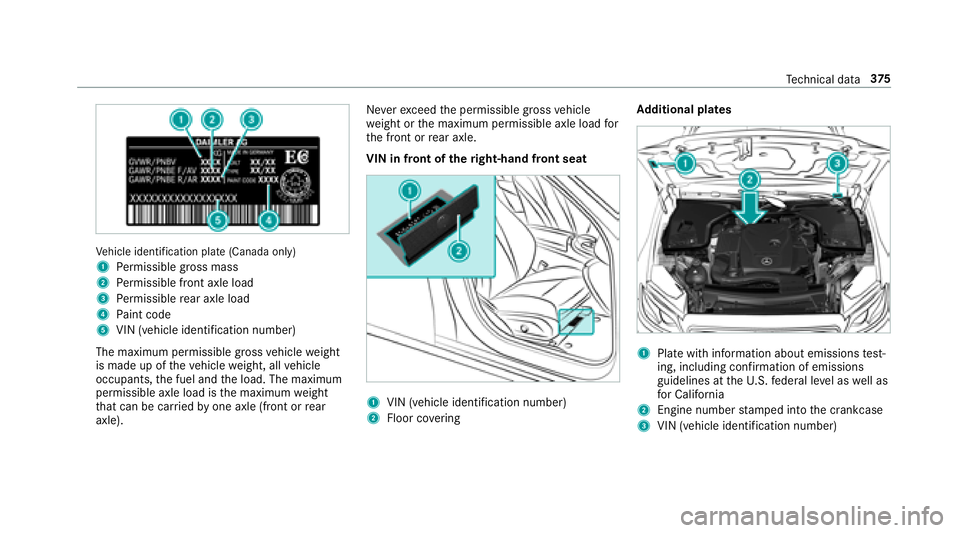
Vehicle identification plate (Canada only)
1
Pe rm issible grossmass
2Pe rm issible front axle load
3Perm issible rear axle load
4Pa int code
5VIN (vehicle identification number)
The maximum permissible gross vehicle weight
is made up of theve hicle weight, all vehicle
occupants, the fuel and the load. The maximum
permissible axle load is the maximum weight
th at can be car ried byone axle (front or rear
axle). Ne
verexc eed the permissible gross vehicle
we ight or the maximum permissible axle load for
th e front or rear axle.
VIN in front of theright-hand front seat
1VIN (vehicle identification number)
2Floor co vering Ad
ditional plates
1Pla tewith information about emissions test‐
ing, including con firm ation of emissions
guidelines at theU. S. federal le vel as well as
fo r California
2Engine number stamped into the crankcase
3VIN (vehicle identification number)
Te ch nical da ta37
5