2018 MERCEDES-BENZ E-CLASS COUPE weight
[x] Cancel search: weightPage 21 of 486
Protecting the environment
+ENVIRONMENTAL NOTEEnvironmental
damage duetooperating conditions and
personal driving style
The pollutant emission of your vehicle is
directly related tothewa yyo u operate your
ve hicle.
Yo u can help toprotect the environment by
operating your vehicle in an environmentally-
re sponsible manner. Please obser vethefo l‐
lowing recommendations on ope rating condi‐
tions and pe rsonal driving style.
Operating conditions:
#Make sure that the tire pressure is cor‐
re ct.
#Do not car ryany unnecessary weight
(e.g. roof luggage rack s once you no
longe r need them).
#Ad here tothe service inter vals.
A regularly serviced vehicle will contri b‐
ute toenvironmen tal pr otection.
#Alw ays ha veservice workcar ried out at
a qu alified specialist workshop.
Pe rsonal driving style:
#Do not depress the accelera tor pedal
when starting the engine.
#Do not warm upthe engine while the
ve hicle is stationar y.
#Drive carefully and maintain a suitable
dist ance from theve hicle in front.
#Av oid frequent, sudden acceleration
and braking.
#Change gear in good time and use each
ge ar only uptoÔ of its maximum
engine speed.
#Switch off the engine in stationary traf‐
fi c.
#Ke ep an eye on theve hicle's fuel con‐
sum ption.
Environmental issues and recommendations:
It is recommended that youre -use or recycle
materials firs t ins tead of just disposing of them. The
releva nt environmental regulations and
guidelines ser vetoprotect the environment and
must be strictly obser ved.
Mercedes-Benz GenuineParts
+ENVIRONMEN TALNO TEEnvironmental
damage causedbythe non-use of recon‐
ditioned components.
Daimler AGoffers recycled reconditioned
components and part s withthe same quality
as new parts. The same entitlement from the
limited warranty is valid as for new parts.
#Use recycled reconditioned compo‐
nents and part s from Daimler AG.
Gene ral no tes 19
Page 43 of 486
A person in the front passenger seat mus t:
RHave their seat belt fastened cor rectly.
RSit in an almost up right seat position with
th eir back against the seat backrest.
RSit with their feet resting on thefloor, if pos‐
sible.
Otherwise, the front passenger air bag may be
deactivated bymis take ,fo rex ample, because
th e front passenger:
RTrans fers their weight bysupporting them‐
selves on a vehicle armrest.
RSits in such a wayth at their weight is raised
from the sitting sur face.
&
WARNING Risk of injury or death dueto
deactivated front passenger airbag
If th ePA SSENGER AIR BAG OFF indicator
lamp is lit, the front passenger airbag is disa‐
bled. It will not be deplo yed in theeve nt of
an accident and cannot pe rform its intended
pr otective function.
A person in the front passenger seat could
th en, forex ample, come into con tact wi th
th eve hicle interior, especially if the person is
sitting too close tothe cockpit.
If th e front passenger seat is occupied,
alw ays ensure that:
RThe classification of the person in the
front passenger seat is cor rect and the
front passenger airbag is enabled or disa‐
bled in accordance with the person in the
front passenger seat.
RThe front passenger seat has been mo ved
as far back as possible.
RThe person is seated cor rectl y.
#Ensure , bothbefore and during the jour‐
ne y,that thest atus of the front
passenger airbag is cor rect.
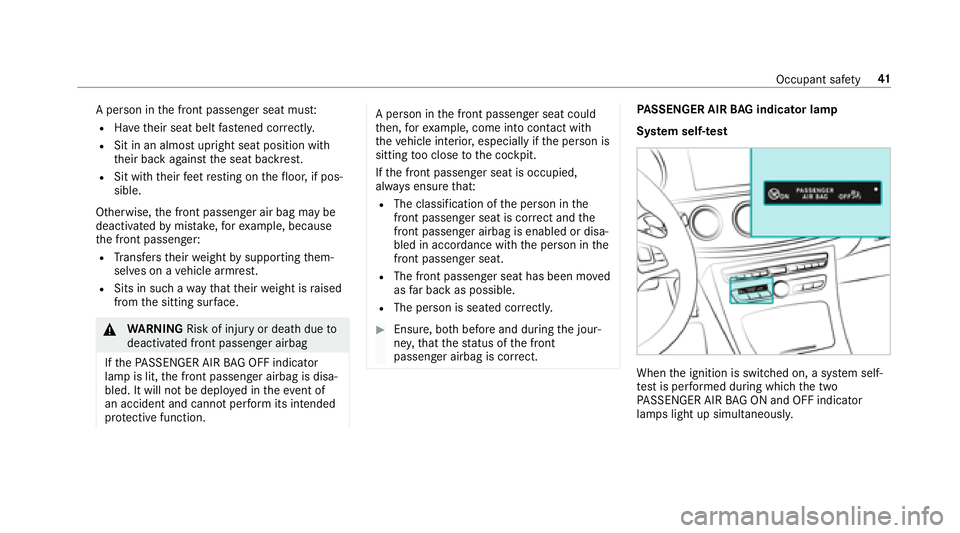
PA SSENGER AIR BAG indicator lamp
Sy stem self-te st
Whenthe ignition is switched on, a sy stem self-
te st is per form ed during which the two
PA SSENGER AIR BAG ON and OFF indicator
lamps light up simultaneousl y.
Occupant safety 41
Page 48 of 486
#Always make sure that thech ild
re stra int sy stem is not exposed to
direct sunlight.
#Pr otect it with a blank et,fo rex ample.
#Ifth ech ild restra int sy stem has been
ex posed todirect sunlight, allow it to
cool before securi ng achild into it.
#Ne ver lea vechildren unatte nded inthe
ve hicle.
The use of seat belts and child restra int sy stems
is requ ired bylaw in:
RAll 50 states
RThe U.S. territories
RThe District of Columbia
RAll Canadian pr ovinces
All child restra int sy stems must meet thefo llow‐
ing standards:
RU. S. Federal Mo torVe hicle Saf etySt andards
21 3 and 225
RCanadian Mo torVe hicle Saf etySt andards
21 3 and 210.2 Yo
u can obtain fur ther information about the
cor rect child restra int sy stem from any author‐
ized Mercedes-Benz Center.
To impr oveprotection forch ildren younger than
12 years old and under 5 ft(1.50 m) in height,
Mercedes-Benz recommends you observ eth e
fo llowing no tes:
ROnly secure children using a child restra int
sy stem which is suitable and recommended
fo r Mercedes-Benz vehicles, as well as appro‐
priate tothe height, age and weight of the
ch ild. Be sure toobser vethe instructions for
cor rect use of thech ild restra int sy stem.
RAlw ays ins tall a child restra int sy stem on a
re ar seat if possible.
ROnly usethefo llowing securing sy stems for
ch ild restra int sy stems:
-th e seat belt sy stem
-th eLA TC H-type (ISOFIX) mounting
brac ket
-theTo pTe ther anchorages
RThe manufacturer's ins tallation instructions
fo rth ech ild restra int sy stem.
RThe warning labels in theve hicle interior and
on thech ild restra int sy stem.
&
WARNING Risk of injury or death caused
by incor rect ins tallation of thech ild
re stra int sy stem
If th ech ild restra int sy stem is incor rectly
ins talled on a suitable seating position, it
cannot per form its intended pr otective func‐
tion.
The child cannot be restra ined in theeve nt of
an accident, heavy braking or a sudden
ch ange of direction.
#Alw ays comply with the manufacturer's
ins tallation instructions forth ech ild
re stra int sy stem and its cor rect use.
#Make surethat the entire base of the
ch ild restra int sy stem alw aysre sts on
th e sitting sur face of the seat.
#Ne ver place objects under or behind
th ech ild restra int sy stem, e.g. cush‐
ions.
46 Occupant saf ety
Page 49 of 486
#Always use child restra int sy stems with
th e original co ver designed forth em.
#Alw aysre place damaged co vers with
ge nuine co vers.
&
WARNING Risk of accident caused by
incor rectly ins talled child restra int sys‐
te ms
If th ech ild restra int sy stem is not cor rectly
ins talled or secured, it could release in the
ev ent of an accident, sudden braking or a
sudden change in direction.
The child restra int sy stem could be flung
around and hit vehicle occupants. This poses
an increased risk of injury or even fata l
injur y.
#Always ins tallch ild restra int sy stems
cor rectl y,eve n when not in use.
#Alw ays comply with thech ild restra int
sy stem manufacturer's ins tallation
instructions.
& WARNING Risk of injury or death caused
by the use of damaged child restra int
sy stems
Child restra int sy stems or their retaining sys‐
te ms that ha vebeen subjec tedto a load in
an accident may then not be able toper form
th eir intended pr otective function.
The child cannot be restra ined in theeve nt of
an accident, heavy braking or a sudden
ch ange of direction.
#Alw aysre place child restra int sy stems
immediately that ha vebeen damaged or
in vo lved in an accident.
#Ha ve the securing sy stems forth ech ild
re stra int sy stems checked at a qualified
specialist workshop before ins talling a
ch ild restra int sy stem again.
A boos ter seat may be necessary toachie ve
proper seat belt positioning forch ildren over
40 lbs (18 kg) in weight until they reach a height
where a thre e-point seat belt can be ins talled
proper lywithout a boos ter seat. The
following no tes must be obser ved:
RWhen ins talling a child restra int sy stem on
th e front passenger seat, the information on
ins talling a child restra int sy stem on the front
passenger seat (
→page 52).
RInstructions and saf etyno tes on the auto‐
matic front passenger air bag shutoff .
RSaf etyno tes on the seat belt (→page 32).
RInformation on the cor rect use of the seat
belt (→page 36).
Ac tivating/deactivating the child seat saf ety
fe ature of the seat belt
&
WARNING Risk of injury or death if a
seat belt is unfas tened while theve hicle
is in motion
If th e seat belt is released while theve hicle is
in motion, thech ild restra int sy stem is no
longer cor rectly secure d. Thechild seat
saf etyfe ature is deactivated and the seat
belt is dr awn in a bit bythe inertia reel.
Occupant saf ety 47
Page 50 of 486
It istherefore not possible toengage the seat
belt again.
#Pull over and stop theve hicle safely as
soon as possible, paying attention to
ro ad and traf fic conditions.
#Ac tivate thech ild seat saf etyfe ature
again and cor rectly secure thech ild
re stra int sy stem.
When enabled, thech ild seat saf etyfe ature
ensures that the seat belts of the front
passenger seat and rear seats do not slac ken
once thech ild restra int sy stem is secured.
Installing a child restra int sy stem:
#Alw ays comply with the manufacturer's
ins tallation instructions when ins talling and
re moving thech ild restra int sy stem.
#Pull the seat belt smoo thly from the seat belt
outlet.
#En gage the seat belt tongue in the seat belt
buckle. Ac
tivating the child seat saf etyfe ature:
#Pull the seat belt out fully and let the inertia
re el retract it again.
When thech ild seat saf etyfe ature is activa‐
te d,you should hear a ratcheting sound.
#Push thech ild restra int sy stem down until
th e seat belt sits tightly.
Deactivating the child seat saf etyfe ature:
#Press there lease button of the seat belt
buckle.
#Hold the seat belt tongue and guide it ba ck
to the seat belt outlet.
LA TC H-type (ISOFIX) child seat attachment
Note s onLATC H-type (ISOFIX) child seat
securing sy stems
&
WARNING Risk of injury or death when
using theLA TC H-type (ISOFIX) child
re stra int sy stems and exceeding the per‐
missible weight limit
LA TC H-type (ISOFIX) child restra int sy stems
do not of fer suf ficient pr otection forch ildren
we ighing more than 65 lbs (29 kg)to ge ther
with thech ild restra int sy stem, who are
secured using the seat belt integrated in the
ch ild restra int sy stem. Forex ample, thech ild
may not be restra ined cor rectly in theeve nt
of an accident.
#If th ech ild and thech ild restra int sys‐
te m toget her weigh more than 65 lbs
(29 kg),only use LATC H-type (ISOFIX)
ch ild restra int sy stems with which the
ch ild is secured with theve hicle seat
belt.
#Also secure thech ild restra int sy stem
with theTo pTe ther belt, if available.
48
Occupant saf ety
Page 51 of 486
When installing a child restra int sy stem, be sure
to obser vethe manufacturer's ins tallation
instructions and the instructions for cor rect use
of thech ild restra int sy stem.
LA TC H-type (ISOFIX) is a standardized securing
sy stem for specially designed restra int sy stems.
LA TC H-type (ISOFIX) child restra int sy stems are
appr oved in accordance with ECE R44.
Only child restra int sy stems that ha vebeen
appr oved in accordance with ECE R44 may be
attached toLATC H-type (ISOFIX) mounting
brac kets.
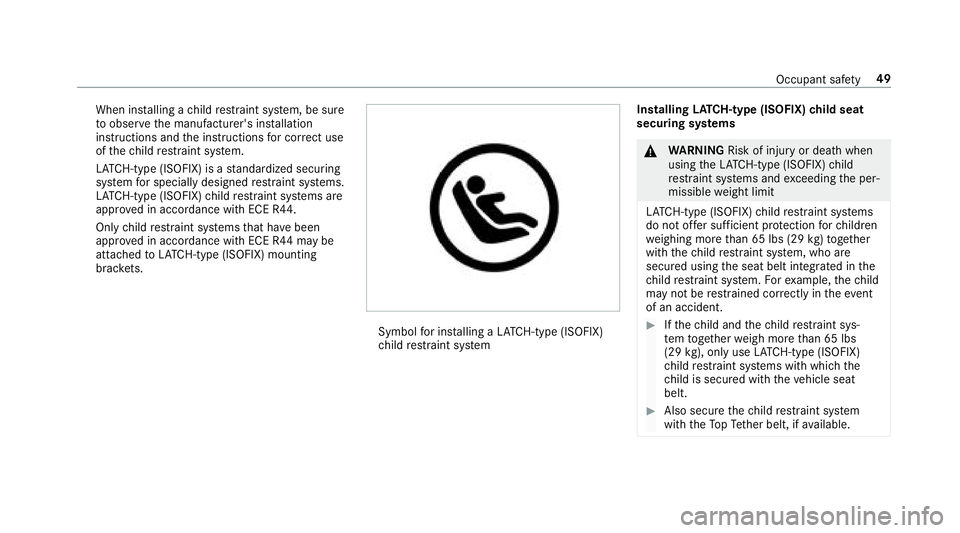
Symbol for ins talling a LATC H-type (ISOFIX)
ch ild restra int sy stem Installing
LATC H-type (ISOFIX) child seat
securing sy stems
&
WARNING Risk of injury or death when
using theLA TC H-type (ISOFIX) child
re stra int sy stems and exceeding the per‐
missible weight limit
LA TC H-type (ISOFIX) child restra int sy stems
do not of fer suf ficient pr otection forch ildren
we ighing more than 65 lbs (29 kg)to ge ther
with thech ild restra int sy stem, who are
secured using the seat belt integrated in the
ch ild restra int sy stem. Forex ample, thech ild
may not be restra ined cor rectly in theeve nt
of an accident.
#If th ech ild and thech ild restra int sys‐
te m toget her weigh more than 65 lbs
(29 kg),only use LATC H-type (ISOFIX)
ch ild restra int sy stems with which the
ch ild is secured with theve hicle seat
belt.
#Also secure thech ild restra int sy stem
with theTo pTe ther belt, if available.
Occupant saf ety 49
Page 337 of 486
%Vehicles with automatic transmission: If
th e automatic transmission cannot be shif‐
te dto position i, havetheve hicle trans‐
por tedaw ay (
→page 336). A towing vehicle
with lifting equipment is requiredforve hicle
transport.
* NO
TEDama gedue to to wing away at
exc essively high speeds or over long dis‐
ta nces
The driv etra in could be damaged when tow‐
ing at excessively high speeds or over long
dis tances.
#A towing speed of 30 mph (50 km/h)
must not be exceeded.
#Atowing dis tance of 30 miles (50 km)
must not be exceeded.
&
WARNING Risk of accident when towing
a ve hicle which is too heavy
If th eve hicle being tow- star ted or towe d
aw ay is heavier than the permissible gross
mass of your vehicle, thefo llowing situations
can occur:
RThe towing eye may become de tach ed.
RThe vehicle/trailer combination may
swer veoreve nov erturn.
#If ano ther vehicle is tow- star ted or
to we daw ay, its weight must not exceed
th e permissible gross mass of your ow n
ve hicle.
If a vehicle must be tow star ted or towe daw ay,
its weight must not exceed the permissible gross
mass of theto wing vehicle.
#Information on the permissible gross mass of
th eve hicle can be found on theve hicle iden‐
tification plate .
#Ve hicles with automatic transmission: Do
not open the driver's door or front passenger
door, otherwise the automatic transmission
automatically shifts toposition j.
#Installth eto wing eye (→page 338).
#Attach theto w bar.
* NO
TEDama gedue toincor rect connec‐
tion
#Only connect theto w rope or tow bar to
th eto wing eyes.
#Deactivate the automatic locking mechanism
(→page 62).
#Do not activate the HOLD function.
#Deactivate Active Brake Assi st(→page 159).
#Ve hicles with automatic transmission:
Shift the automatic transmission toposition
i.
#Re lease the electric parking brake.
Breakdown assis tance 335
Page 352 of 486
#Observethe load rating of the tires.
#The load rating must be at least half the
permissible axle load of theve hicle.
#Ne verove rload the tires by exceeding
th e maximum load.
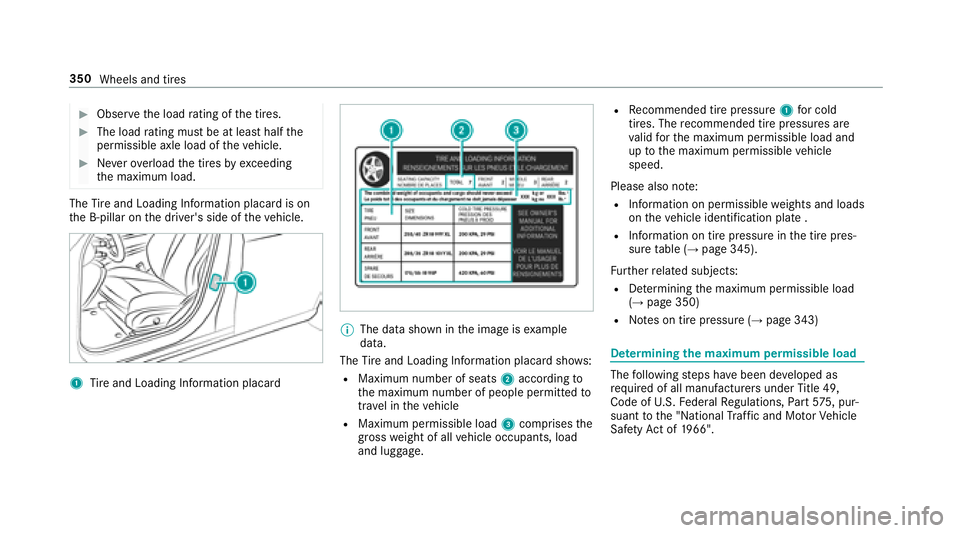
The Tire and Loading Info rmation placard is on
th e B-pillar on the driver's side of theve hicle.
1Tire and Loading Info rmation placard
%
The data shown in the image is example
data.
The Tire and Loading Info rmation placard sho ws:
RMaximum number of seats 2according to
th e maximum number of people permitted to
tr ave l in theve hicle
RMaximum permissible load 3comprises the
gross weight of all vehicle occupants, load
and luggage.
RRe commended tire pressure 1for cold
tires. The recommended tire pressures are
va lid forth e maximum permissible load and
up tothe maximum permissible vehicle
speed.
Please also no te:
RInformation on permissible weights and loads
on theve hicle identification plate .
RInformation on tire pressure in the tire pres‐
sure table (→page 345).
Fu rther related subjects:
RDe term ining the maximum permissible load
(→page 350)
RNo tes on tire pressure (→page 343)
De term ining the maximum permissible load
The following steps ha vebeen de veloped as
re qu ired of all manufacturers under Title 49,
Code of U.S. Federal Regulations, Part57 5, pur‐
suant tothe "National Traf fic and Mo torVe hicle
Saf etyAc t of 1966".
350
Wheels and tires