2018 MERCEDES-BENZ E-CLASS COUPE warning lights
[x] Cancel search: warning lightsPage 86 of 486
#Toselect the front passenger seat: press
button 1.
When the indicator lamp lights up, the front
passenger seat is selected.
#Ad just the front passenger seat using the
buttons in the door control panel on the driv‐
er's side.
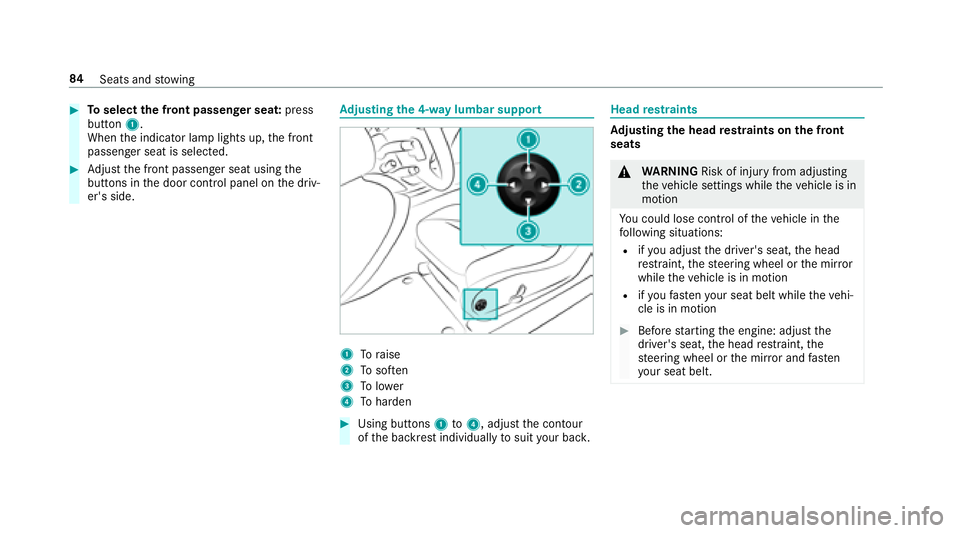
Ad justing the 4-w aylumbar support
1Toraise
2To sof ten
3To lowe r
4To harden
#Using buttons 1to4, adjust the conto ur
of the backrest individually tosuit your bac k.
Headrestra ints
Ad justing the head restra ints on the front
seats
& WARNING Risk of injury from adjusting
th eve hicle settings while theve hicle is in
motion
Yo u could lose cont rol of theve hicle in the
fo llowing situations:
Rifyo u adjust the driver's seat, the head
re stra int, thesteering wheel or the mir ror
while theve hicle is in motion
Rifyo ufa sten your seat belt while theve hi‐
cle is in motion
#Before starting the engine: adjust the
driver's seat, the head restra int, the
st eering wheel or the mir ror and fasten
yo ur seat belt.
84
Seats and stowing
Page 107 of 486
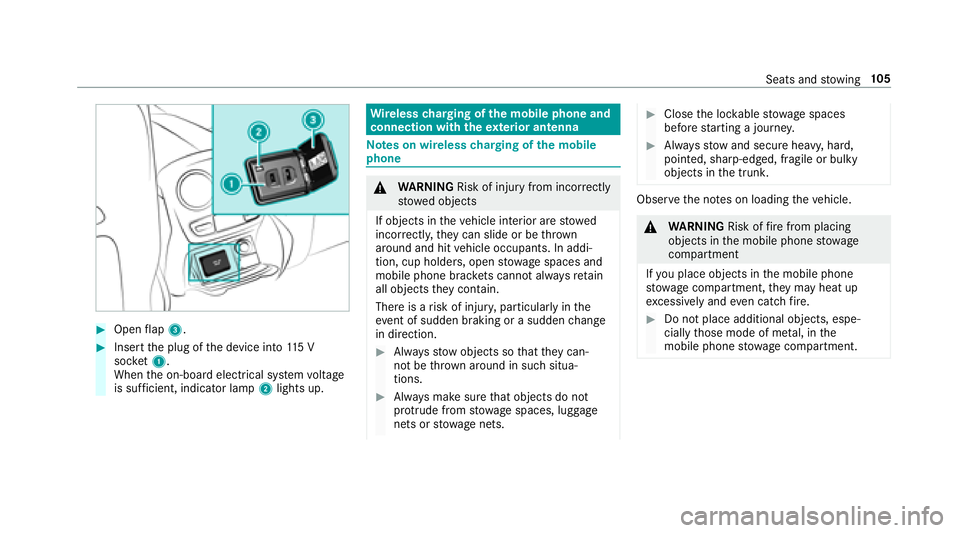
#Openflap 3.
#Insert the plug of the device into 115 V
soc ket1.
When the on-board electrical sy stem voltage
is suf ficient, indicator la mp2lights up.
Wire lesscharging of the mobile phone and
connection with theex terior antenna
Note s on wireless charging of the mobile
phone
& WARNING Risk of injury from incorrectly
stowe d objects
If objects in theve hicle interior are stowed
incor rectly, they can slide or be throw n
around and hit vehicle occupants. In addi‐
tion, cup holders, open stowage spaces and
mobile phone brac kets cann otalw aysre tain
all objects they contain.
There is arisk of injur y,particularly in the
ev ent of sudden braking or a sudden change
in direction.
#Alw aysstow objects so that they can‐
not be throw n around in such situa‐
tions.
#Alw ays make sure that objects do not
pr otru de from stowage spaces, luggage
nets or stowage nets.
#Close the loc kable stow age spaces
before starting a journe y.
#Alwaysstow and secure heavy, hard,
pointe d, sharp-edged, fragile or bulky
objects in the trunk.
Obser vethe no tes on loading theve hicle.
&
WARNING Risk offire from placing
objects in the mobile phone stowage
compartment
If yo u place objects in the mobile phone
stow age compartment, they may heat up
exc essively and even catch fire .
#Do not place additional objects, espe‐
cially those mode of me tal, in the
mobile phone stowage compartment.
Seats and stowing 10
5
Page 111 of 486

Theexterior lighting (e xcept parking and stand‐
ing lamps) switch es off automatically when the
driver's door is opened.
Au tomatic headlamp mode
The pa rking lights, low beam and daytime run‐
ning la mps are switched on or off automatically
depending on the ignition status, whe ther the
engine is running and on the ambient light.
&
WARNING Risk of accident when the low
beam is switched off in poor visibility
When the light switch is set toÃ, the low
beam may not be switched on automatically
if th ere is fog, snow or other causes of poor
visibility such as spr ay.
#In such cases, turn the light switch to
L.
The automatic driving lights are only an aid. You
are responsible forve hicle lighting. Ac
tivating/deactivating the rear fog light
Re quirement:
RThe light switch is in theL orà posi‐
tion.
#Press the R button.
Please obser vethe count ry-specific la wsonthe
use of rear fog lamps.
Operating the light combination switch
1High beam
2Turn signal light, right
3High-beam flasher
4Tu rn signal light, left
#Pull or push the combination switch in the
re leva nt di rection following the ar row.
Light and visibility 10
9
Page 113 of 486
RAtspeeds between 25 mph(4 0 km/h) and
45 mph(7 0 km/h) when thesteering wheel
is turned.
Tr af fic circle and intersection function: the
cornering light is acti vated on bo thsides thro ugh
an eva luation of the cur rent GPS position of the
ve hicle. It remains active until af terth eve hicle
has left the tra ffic circle or the intersection.
Ad aptive Highbeam Assist
Function of Adaptive Highbeam Assist
&
WARNING Risk of accident despite
Ad aptive Highbeam Assist
Ad aptive Highbeam Assist does not recog‐
nize thefo llowing road users:
RRo ad users without lights, e.g. pedes‐
trians
RRo ad users with poor lighting, e.g.
cyclists
RRo ad users whose lighting is obstructed,
e.g. bya bar rier
On very rare occasions, Adaptive Highbeam
Assist may failto recognize other road users
with their own lighting, or may recognize
th em too late.
In these or similar situations, the automatic
high beam is not deactivated or is activated
despite the presence of other road users.
#Alw ays obser vethe tra ffic carefully and
switch off the high beam in good time.
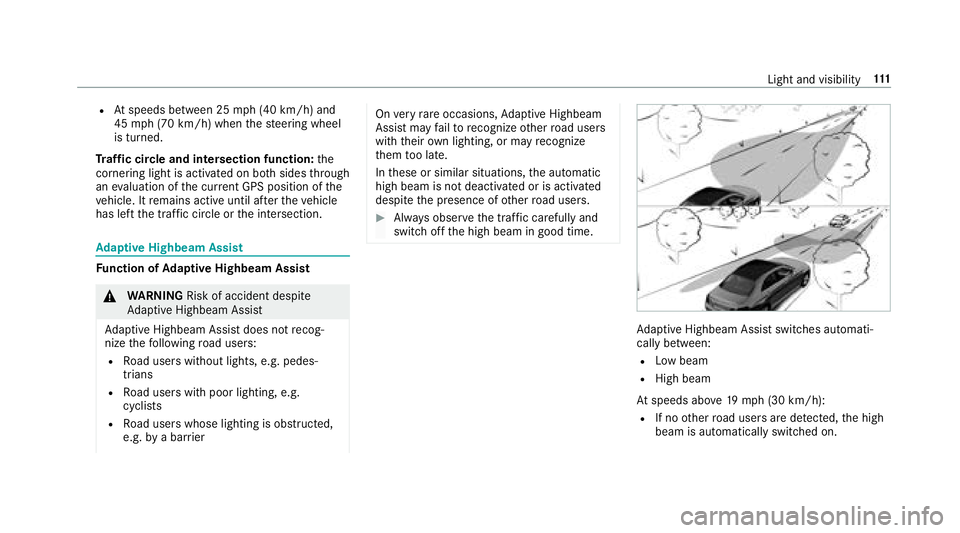
Ad aptive Highbeam Assist switch es automati‐
cally between:
RLow beam
RHigh beam
At speeds abo ve19 mp h (30 km/h):
RIf no other road users are de tected, the high
beam is automatically switched on.
Light and visibility 111
Page 132 of 486

Starting theve hicle using a smartphone
&
WARNING Risk of crushing or entrap‐
ment due tounin tentional starting of the
engine
Limbs could be crushed or trapped if the
engine is star ted unintentionally during
service or maintenance work.
#Alw ays secure the engine against unin‐
te ntional starting before car rying out
maintenance or repair work.
Re quirementsRPark position jis selected.
RThe anti- theft alarm sy stem is not armed.
RThe panic alarm is not armed.
RThe hazard warning lights are switched off.
RThe engine hood is closed.
RThe doors are closed and loc ked.
RThe windo wsand sliding sunro of are closed.
#Start theve hicle using the smartphone:
RAf tereve ryvehicle start, the engine runs for
te n minu tes.
RYo u can car ryout a maximum of two consec‐
utive starting attem pts.
RYo u can stop theve hicle again at any time.
RFu rther information can be found in the
smartphone app.
Securing the engine against starting before
car rying out maintenance or repair work:
#Switch on the hazard warning lights.
or
#Un lock the doors.
or
#Open a side window or the sliding sunroof.
St arting theve hicle in emer gency operation
mode
If th eve hicle cannot be star ted, the3ODFH WKH
.H\ LQ WKH 0DUNHG 6SDFH 6HH 2SHUDWRU
V 0DQXDO
display message appears in the multifunction
displa y.
#Make sure that mar ked space 2is em pty.
#Re mo veSmartK ey1 from theke yring.
#Place Smart Key1 in mar ked space 2.
The vehicle will start af ter a short while.
If yo ure mo veSmartK ey1 from mar ked
space 2the engine continues running. For
fur ther vehicle starts ho wever,SmartK ey1
must be located in mar ked space 2during
th e entire journe y.
#Have SmartK ey1 checked at a qualified
specialist workshop.
If th eve hicle does not star t:
#Lea veSmartK ey1 in mar ked space 2.
130
Driving and pa rking
Page 150 of 486

Electric parking brake
Au tomatically applying the electric parking
brake
& WARNING Risk of accident and injury
due tochildren left unatte nded inthe
ve hicle
If yo u lea vechildren unaccompanied in the
ve hicle, they may be able toset theve hicle in
motion, forex ample by:
RRe leasing the parking brake.
RShifting the transmission out of park
position j.
RStarting the engine.
In addition, they may operate vehicle equip‐
ment.
#Ne ver lea vechildren and animals unat‐
te nded in theve hicle.
#When leaving theve hicle, alw aysta ke
th e SmartK eywith you and lock the
ve hicle.
The electric parking brake is applied if the trans‐
mission is in position jand one of thefo llow‐
ing conditions is fulfilled:
RThe engine is switched off.
RThe seat belt tongue is not inser ted in the
seat belt buckle of the driver's seat and the
driver's door is opened.
% Toprev ent application: pull the handle of the
electric parking brake.
In thefo llowing situations, the electric parking
brake is also engaged:
RDis tance‑Pil otDISTRONIC brings theve hicle
to ast andstill.
RThe HOLD function is keeping theve hicle sta‐
tionar y.
RParking Pilot is keeping theve hicle station‐
ar y.
This is only the case if one of thefo llowing con‐
ditions is also fulfilled:
RThe engine is switched off.
RThe seat belt tongue is not inser ted in the
seat belt buckle of the driver's seat and the
driver's door is opened.
RThere is a sy stem malfunction.
RThe po wer supply is insuf ficient.
RThe vehicle is stationary for a lengt hyperiod.
When the electric parking brake is applied, the
F (USA) or !(Canada) indicator lamp
lights up in the instrument clus ter.
The electric parking brake is not automatically
applied if the engine is switched off bythe ECO
st art/ stop function.
Re leasing the electric pa rking brake auto‐
matically
The elect ric park ing brake is released when the
fo llowing condit
ions are fulfilled:
RThe engine is
running.
RThe seat belt tongue is inser ted into the seat
belt buckle of the driver's seat.
RThe transmission is in position hork and
yo u depress the accelera tor pedal or you
14 8
Driving and pa rking
Page 153 of 486

theeve nt of associated damage tothe bumpers
or radiator grille, which may not be visible, ha ve
th e function of thera dar sensors checked at a
qu alified specialist workshop. The driver assis‐
ta nce sy stem may no longer workproperly.
Overview of driving sy stems and driving
saf ety sy stems
In this section, youwill find information about
th efo llowing driving sy stems and driving saf ety
sy stems:
R360° Camera (→page 182)
RABS ( Anti-lo ckBra king Sys tem) (→page 151)
RDis tance Pilot DISTRONIC (→pa ge 162)
RAIR BODY CONTROL(→page 173)
RAc tive Brake Assi st(→page 155)
RAc tive Lane Keeping Assist (→page 201)
RATTENTION ASSIST (→page 195)
RBA S (Bra keAssist System) (→page 151)
RDRIVE PIL OT
RDYNA MIC BODY CONTROL (→page 172)
REBD ( Electronic Brakefo rc eDistribution)
(→page 155)
RESP®(Electronic Stability Program)
(→page 152)
RHOLD fu nction (→page 171)
RST EER CONTROL (→page 155)
RSteering Pilot (→page 168)
RParking Pilot (→page 185)
RParking Assist PARKTRONI C (→page17 6)
RRe ar view camera (→page 179)
RCruis e control (→page 160)
RBlind Spot Assist andActive Blind Spot Assi st
(→page 198)
RTraf fic Sign Assist (→page196)
Fu nctions of ABS (anti-lock braking sy stem)
ABS regulates the brake pressure in critical driv‐
ing situations:
RDuring braking, the wheels are pr evented
from blocking, e.g. due tomaximum full-s top
braking or insuf ficient traction of the tires.
RVe hicle steerability while braking is ensured.
If ABS inter venes when braking, youwill feel a
pulsing in the brake pedal. The pulsating brake
pedal can be an indication of hazardous road
conditions and can ser veas a reminder totake
ex tra care while driving.
Sy stem limitations
RABS is active from speeds of appr ox. 5 mph
(8 km/h).
RABS may be impaired or may not function if a
malfunction has occur red and theye l‐
low ! ABSwarning lamp lights up contin‐
uously in the instrument clus ter af terth e
engine is star ted.
Fu nction of BAS (Brake Assist Sy stem)
&
WARNING Risk of an accident caused by
a malfunction in BAS (Brake Assist Sys‐
te m)
If BA S is malfunctioning, the braking dis tance
in an emergency braking situation is
increased.
Driving and pa rking 15
1
Page 154 of 486

#Depress the brake pedal with full forc e
in emer gency braking situations. ABS
pr eve nts the wheels from locking.
BA S suppo rts yo ur eme rgency braking situation
with additional brake forc e.
If yo udepr essthe brake pedal quickl y,BA S is
acti vated:
RBA S au tomatical lyboosts the brake pres‐
sure.
RBA S can short enthe braking dis tance.
RABS pr events the wheels from locking.
The brakes will function as usual once you
re lease the brake pedal. BAS is deactivated.
Functions of ESP®(Electronic Stability Pro‐
gr am)
&
WARNING Risk of skidding if ESP®is
malfunctioning
If ESP
®is malfunctioning, ESP®cannot car ry
out vehicle stabilization. In addition, other
driving saf etysy stems are switched off.
#Drive on carefull y.
#Have ESP®checked at a qualified spe‐
cialist workshop.
&
WARNING Risk of skidding if ESP®is
deactivated
If yo u deactivate ESP
®, ESP®cannot car ry
out vehicle stabilization.
#ESP®should only be deactivated in the
fo llowing situations.
ESP®monitors and impr oves driving stability and
traction, particular ly inthefo llowing situations:
RWhen pulling away on wet or slippe ryroads.
RWhen braking.
RIn stro ng sidewinds when you are driving
fast erthan 50 mph (80 km/h).
ESP
®can stabilize theve hicle byinter vening in
th efo llowing ways:
ROne or more wheels are braked.
RThe engine output is adap ted according to
th e situation.
ESP
®is deactivated if the ESP®OFF å warn‐
ing lamp lights up continuously in the instrument
clus ter:
RDriving stability will no longe r be improved.
RCrosswind Assist is no longer active.
RThe drive wheels could spin.
RETS/4ETS traction control is still active.
% Even when ESP
®is deactivated, you are still
assis tedby ESP®when braking.
ESP
®is inter vening if the ESP®÷ warning
lamp flashes in the instrument clus ter:
RDo not deacti vate ESP®.
15 2
Driving and pa rking