2018 MERCEDES-BENZ E-CLASS CABRIOLET warning
[x] Cancel search: warningPage 147 of 498

00BBInsertthe fuel filler cap into holder 2.
00BBCompletely inse rtthe fuel pump nozzle into
th eta nk filler nec k,hook in place and refuel.
00BBOnly fill th e fuel tank until the fuel pump noz‐
zle switches off.
Pa rking
Switching off theve hicle
0071
WARNING Risk offire caused byhot
ex haust sy stem parts
Flammable material such as lea ves, grass or
twigs may ignite if they come into contact
wi th hot parts of theex haust sy stem or
ex haust gasflow .
00BBPark theve hicle so that no flammable
material can come into con tact wi thhot
ve hicle components.
00BBIn particular, do not park on dry grass‐
land or har vested grain fields.
0071
WARNING Risk of accident and injury
due tochildren left unatte nded inthe
ve hicle
If yo u lea vechildren unaccompanied in the
ve hicle, they may be able toset theve hicle in
motion, forex ample by:
RRe leasing the parking brake.
RShifting the transmission out of park
position 005D.
RStarting the engine.
In addition, they may operate vehicle equip‐
ment.
00BBNe ver lea vechildren and animals unat‐
te nded in theve hicle.
00BBWhen leaving theve hicle, alw aysta ke
th e SmartK eywith you and lock the
ve hicle.
0075 NO
TEDama getotheve hicle or the driv‐
et ra in caused bytheve hicle rolling away
00BBAlw ays proper lysecure theve hicle
against rolling away.
00BBOn uphill or downhill inclines, turn the front
wheels towa rdsth e curb.
00BBSelect transmission position 005D.
Driving and parking14
5
Page 148 of 498
00BBApplythe electric parking brake.
00BBPress button 1(USA) or 2(Canada) once.
00CE When youswit choff theve hicle, you can still
opera tethe side windo wsforfive minutes.
Garage door opener
Prog ramming buttons for the garage door
opener
0071 WARNING Risk ofexhaust gas poisoning
Combustion engines emit poisonous exhaust
ga ses such as carbon monoxide. Inhaling
th ese exhaust gases causes poisoning.
00BBNe ver lea vethe engine running in an
enclosed space wi thout suf ficient venti‐
lation.
0071 WARNING Risk of injury and entrapment
when opening thega rage door using the
ga rage door opener
When you operate or program thega rage
door with the integrated garage door opener,
persons in thera nge of mo vement of the
ga rage door can become trapped or stru ck
by thega rage door.
00BBWhen using the integrated garage door
opener, alw ays make sure that nobody
is within the sweep of thega rage door.
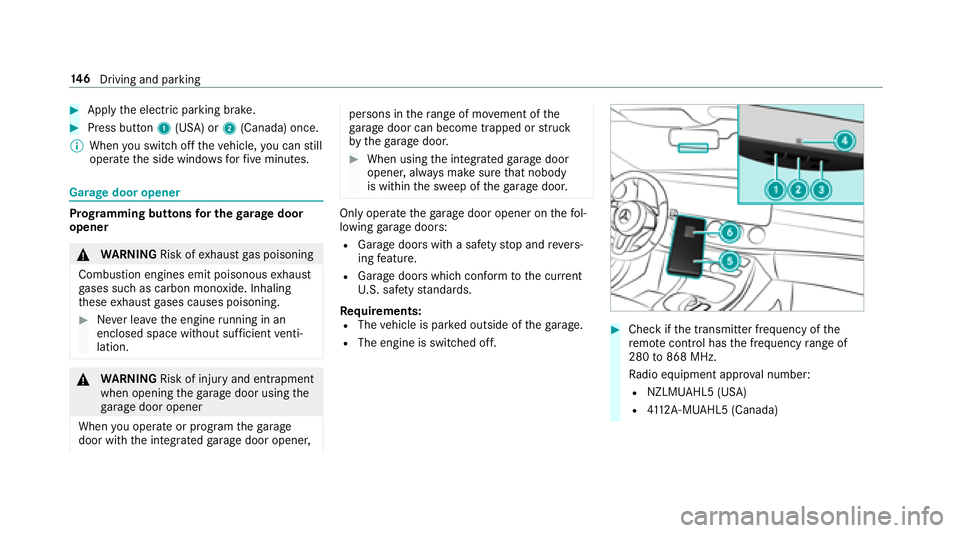
Only operate thega rage door opener on thefo l‐
lowing garage doors:
RGarage doors with a saf etyst op and reve rs‐
ing feature.
RGarage doors which con form tothe cur rent
U. S. safe tystandards.
Re quirements:
RThe vehicle is par ked outside of thega rage .
RThe engine is switched off.
00BBCheck if the transmit ter frequency of the
re mo tecontrol has the frequency range of
280 to868 MHz.
Ra dio equipment appr oval number:
RNZLMUA HL5 (USA)
R4112 A-MUAHL5 (Canada)
14 6
Driving and pa rking
Page 152 of 498

CountryRadio type appr oval number
South
Africa
TA -20 15/1386
Tu rkey notrequ ired
Uni ted
Arab Emi‐
ra tes ER4
1849/15
Dealer No: DA35176/14
United
St ates FCC ID: NZLMUA
HL5
Brazil
Este equipamento opera em caráter secundário,
is to é, não tem direito à pr oteção contra inter fer‐
ência prejudicial, mesmo de es tações do mesmo
tipo, e não pode causar inter ferê ncia a sist emas
operando em caráter primário.
Pa ra maio res informações acessar
www.anatel.go v.br
Fu rther information on the declaration of con‐
fo rm ity for wireless vehicle components
(
→page 23).
Electric parking brake
Electric parking brake function (applying
automatically)
0071 WARNING Risk of accident and injury
due tochildren left unatte nded inthe
ve hicle
If yo u lea vechildren unaccompanied in the
ve hicle, they may be able toset theve hicle in
motion, forex ample by:
RRe leasing the parking brake.
RShifting the transmission out of park
position 005D.
RStarting the engine.
In addition, they may operate vehicle equip‐
ment.
00BBNe ver lea vechildren and animals unat‐
te nded in theve hicle.
00BBWhen leaving theve hicle, alw aysta ke
th e SmartK eywith you and lock the
ve hicle.
15 0
Driving and pa rking
Page 156 of 498

Overview of driving systems and driving
saf ety sy stems
In this section, youwill find information about
th efo llowing driving sy stems and driving saf ety
sy stems:
R360° Camera (→page 181)
RABS ( Anti-lock Braking Sys tem)
(→page 154)
RAc tive Dis tance Assist DISTRONIC
(→pa ge 162)
RAIR BODY CONTROL (→page 171)
RAc tive Brake Assi st(→page 156)
RAc tive Lane Keeping Assist (→page 195)
RATTENTION ASSIST (→page 189)
RBA S (Brak eAssist System) (→page 154)
REBD ( Electronic Brakeforc eDistribution)
(→page 155)
RESP®(E lectronic Sta bility Program)
RHill Start Assist
RHOLD function (→page 170)
RSTEER CONTROL (→page 155)
RAc tive Steering Assist (→page 167)
RAc tive Parking Assist (→page 184)
RParking Assist PARKTRONI C (→page17 5)
RRe ar view camera (→page 178)
RCruis e control (→page 160)
RBlind Spot Assist and Active Blind Spot Assi st
(→page 193)
RTraf fic Sign Assist (→page191)
Fu nctions of ABS (Anti-lock Brake Sy stem)
ABS regulates the brake pressure in critical driv‐
ing situations:
RDuring braking, e.g. at maximum full-s top
braking or insuf ficient traction of the tires,
th e wheels are pr evented from blocking.
RVehicle steerability while braking is ensured.
If ABS inter venes when braking, you will feel a
pulsing in the brake pedal. The pulsating brake
pedal can be an indication of hazardous road
conditions and can ser veas a reminder totake
ex tra care while driving. Sy
stem limitations
RABS is active from speeds of appr ox. 5 mph
(8 km/h).
RABS may be impaired or may not function if a
malfunction has occur red and theye l‐
low 0025 ABSwarning lamp lights up contin‐
uously in the instrument clus ter af terth e
engine is star ted.
Fu nction of BAS (Brake Assist Sy stem)
0071
WARNING Risk of an accident caused by
a malfunction in BAS (Brake Assist Sys‐
te m)
If BA S is malfunctioning, the braking dis tance
in an eme rgency braking situation is
increased.
00BBDepress the brake pedal with full forc e
in emer gency braking situations. ABS
pr eve nts the wheels from locking.
BA S suppo rts yo ur eme rgency braking situation
with additional brake forc e.
15 4
Driving and pa rking
Page 157 of 498

Ifyo udepr essthe brake pedal quickl y,BA S is
acti vated:
RBA S au tomatical lyboosts the brake pres‐
sure.
RBA S can short enthe braking dis tance.
RABS pr events the wheels from locking.
The brakes will function as usual once you
re lease the brake pedal. BAS is deactivated.
Activating/deactivating ESP®(Electronic Sta‐
bility Prog ram)
Multimedia sy stem:
00869HKLFOH00CFk $VVLVWDQFH00CF(63
00BBActivate 0073or deacti vate 0053 the function.
ESP
®is deactivated if the00BB ESP®OFFwarn‐
ing lamp lights up continuously in the instrument
clus ter.
Obser vethe information on warning lamps and
display messages which may be shown in the
instrument clus ter.
Fu nctions of ESP®Crosswind Assist
ESP®Crosswind Assist de tects sudden gust s of
side wind and helps the driver tokeep theve hi‐
cle in the lane:
RESP®Crosswind Assist is active at vehicle
speeds between 50 mph(8 0 km/h) and
12 5mp h(2 00 km/h) when driving stra ight
ahead or cornering slightly .
RThevehicle is stabilized bymeans of individ‐
ual brake application on one side.
Fu nction of EBD (Electronic Brake forc e Dis‐
tribution)
EBD is characterized bythefo llowing:
RMonitoring and regulating the brake pressure
on there ar wheels.
RImpr oved driving stability when braking,
especially on bends.
ST EER CONT ROL function
STEER CONTROL helps youby transmitting a
noticeable steering forc eto thesteering wheel in
th e direction requ ired forve hicle stabilization.
This steering recommendation is given part icu‐
larly in thefo llowing situations:
RBo th right wheels or bo thleft wheels are on
a we t or slippe ryroad sur face when you
brake.
RThe vehicle starts toskid.
Sy stem limitations
ST EER CONTROL may be impaire d or may not
function in thefo llowing situations:
RESP®is deactivated.
RESP®is malfunctioning.
RThe steering is malfunctioning.
If ESP
®is malfunctioning, youwill be assis ted
fur ther by the electric po werst eering.
Driving and parking 15
5
Page 158 of 498
Function of Active Brake Assi st
Active Brake Assi stconsist s of:
RDistance warning function
RAu tonomous braking function
RSituation-dependent braking assist ance
RVehicles with Driving Assistance Pack‐
age: Evasi veSteering Assist
Ac tive Brake Assi stcan help youto minimize the
ri sk of a collision with vehicles or pedestrians or
to reduce the ef fects of such a collision.
If Ac tive Brake Assi sthas de tected a risk of colli‐
sion, youwill be warned visually and acousti‐
cally.
If yo udo not react tothe visual and audible colli‐
sion warning, autonomous braking can be initi‐
ated in critical situations.
In especially critical situations, Active Brake
Assi stcan initiate autonomous braking direct ly.
In this case, the visual and acoustic warning
occurs simultaneously with the braking applica‐
tion. If
yo u apply the brake yourself ina critical situa‐
tion or apply the brake during autonomous brak‐
ing, situation-dependent braking assis tance
occurs . This increases the brake pressure up to
maximum full-s top braking if necessar y.
If th e autonomous braking function or the situa‐
tion-dependent braking assis tance is trig gered,
additional pr eventive measures for occupant
pr otection (PRE-SAFE
®) may also be initiated, if
th eve hicle is equipped with these.
0071
WARNING Risk of an accident caused by
limited de tection per form ance of Active
Brake Assi st
Ac tive Brake Assi stcannot al ways clearly
identify objects and complex traffic situa‐
tions.
In such cases,Active Brake Assi stmight:
RGive a warning or brake without reason
RNot give a warning or not brake
00BBAlw ays pay careful attention tothe traf‐
fi c situation; do not rely on Active Brake
Assi stalone. Active Brake Assi stis only
an aid. The driver is responsible for
maintaining a sui table dis tance tothe
ve hicle in front, vehicle speed and for
braking in good time.
00BBBe prepared tobrake or swer veif nec‐
essar y.
Also obser vethe sy stem limitations of Active
Brake Assi st.
The individual subfunctions are available in
th efo llowing speed ranges:
Distance warning function
The dis tance warning function issues a warning
at speeds:
RFr om appr oximately 4 mph (7 km/h), if your
ve hicle is critically close toave hicle or
pedestrian. An intermittent warning tone
sounds and the00BA distance warning lamp
lights up in the instrument clus ter.
Brake immediately or take evasive action, pr ovi‐
ded it is safe todo so and the traf fic situation
allo wsthis.
15 6
Driving and pa rking
Page 159 of 498
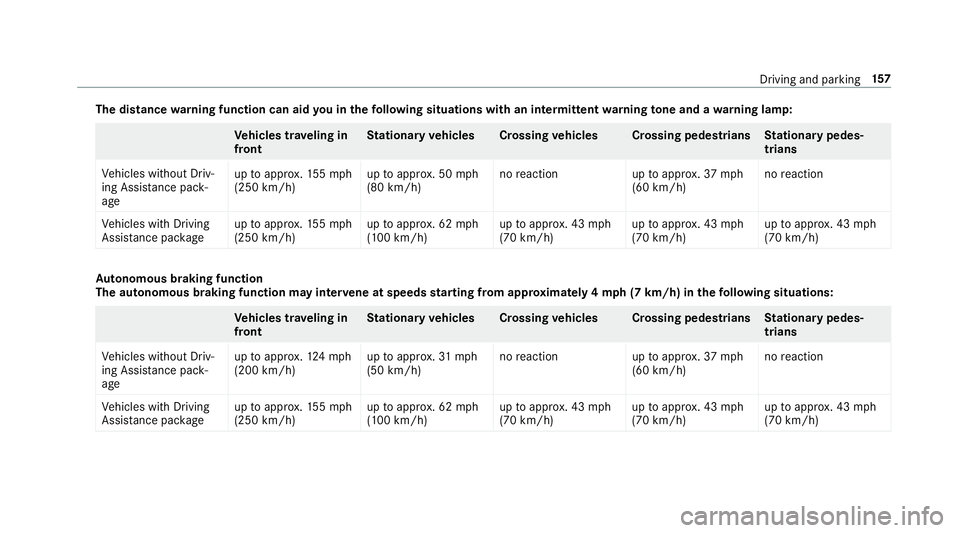
The distancewarning function can aid you in thefo llowing situations with an intermit tent wa rning tone and a warning lamp:
Ve hicles tr aveling in
front St
ationary vehicles Crossing vehicles Crossing pedestrians Stationary pedes‐
trians
Ve hicles without Driv‐
ing Assis tance pa ck‐
age up
toappr ox.15 5mp h
(250 km/h) up
toappr ox. 50 mph
(80 km/h) no
reaction uptoappr ox.37 mph
(60 km/h) no
reaction
Ve hicles with Driving
Assis tance pa ckage up
toappr ox.15 5mp h
(250 km/h) up
toappr ox. 62 mph
(100 km/h) up
toappr ox. 43 mph
(70 km/h) up
toappr ox. 43 mph
(70 km/h) up
toappr ox. 43 mph
(70 km/h)
Au tonomous braking function
The autonomous braking function may inter vene at speeds starting from appr oxima tely 4mp h(7 km/h )in the following situations:
Ve hicles tr aveling in
front St
ationary vehicles Crossing vehicles Crossing pedestrians Stationary pedes‐
trians
Ve hicles without Driv‐
ing Assis tance pa ck‐
age up
toappr ox.12 4mp h
(200 km/h) up
toappr ox.31 mp h
(50 km/h) no
reaction uptoappr ox.37 mph
(60 km/h) no
reaction
Ve hicles with Driving
Assis tance pa ckage up
toappr ox.15 5mp h
(250 km/h) up
toappr ox. 62 mph
(100 km/h) up
toappr ox. 43 mph
(70 km/h) up
toappr ox. 43 mph
(70 km/h) up
toappr ox. 43 mph
(70 km/h)
Driving and parking 15
7
Page 161 of 498

0071WARNING Risk of an accident despite
Evasive Steering Assist
Evasive Steering Assist cannot always clearly
identify objects and complex traf fic situa‐
tions.
In addition, thesteering support of Evasive
St eering Assist is general lynot suff icientto
avo id a collision.
In such cases Evasive Steering Assist can:
Rgive an unnecessary warning or pr ovide
assis tance
Rnot give awa rning or not pr ovide assis‐
ta nce
00BBAlw ays pay careful attention tothe traf‐
fi c situation; do not rely on Ev asive
St eering Assist alone.
00BBBe ready tobrake and take evasive
action if necessar y.
00BBPreve ntthe assis tance byactively steer‐
ing in non-critical driving situations.
00BBDrive at an appropriate speed if pedes‐
trians are close tothe path of your vehi‐
cle.
Also obser vethe sy stem limitations of Evasive
St eering Assist.
Sy stem limitations
The sy stem may be impaired or may not function
in thefo llowing situations:
RIn sno w,rain, fog, heavy spr ay, if there is
gl are, in direct sunlight or in greatlyvarying
light conditions.
RIf th e sensors are dirty, mis ted up, damaged
or co vered.
RIfth e sensors malfunction due to otherradar
source inter fere nce, forex ample stro ng radar
re flections in parking garage s.
RIf a loss of tire pressure or a defective tire
has been de tected and displ ayed.
The sy stem may not react cor rectly:
RIn complex traffic situations whe reobjects
cannot always be clearly identified.
RTo pedestrians or vehicles if they mo ve
qu ickly into the sensor de tection range.
RTo pedestrians who are hidden by other
objects.
RIf th e typical outline of a pedestrian cannot
be distinguished from the bac kground.
RIf a pedestrian isnot recognized as such , e.g.
due tospecial clo thing or other objects.
ROn bends with a tight radius.
Setting Active Brake Assi st
Multimedia system:
00869HKLFOH00CFk $VVLVWDQFH00CF$FWLYH
%UDNH $VVLVW
Ve hicles without Driving Assistance pack‐
age: The settings can be made af terst arting the
ve hicle.
Ve hicles with Driving Assistance pac kage:
The settings can be made when the ignition is
switched on.
00CE It is recommended that you alw ays lea ve
Ac tive Brake Assi stactivated.
Driving and parking 15
9