2018 MERCEDES-BENZ CLA engine
[x] Cancel search: enginePage 278 of 326
Battery (vehicle)
Important safety notes Specia lt ool sa nd expert knowledg ea re required
when working on the battery ,e .g .r emova la nd
installation. Yo us houl dt herefore have al lw or k
involving the battery carrie do ut at aq uali fied
specialist workshop.
G WARNING
Wor kc arrie do ut incorrectly on the battery
can lead ,f or example, to as hort circui ta nd
thu sd amag et he vehicl ee le ctronics .T hi sc an
lead to functio nr estrictions applying to
safety-relevant systems, e.g the lighting sys-
tem, the ABS (anti-lock braking system )ort he
ESP ®
(Electronic Stability Program). The oper-
ating safety of your vehicl em ay be restricted.
Yo uc ould lose contro loft he vehicle, for
example: R
when braking R
in the event of abrupt steering maneuvers
and/or when the vehicle's speed is not
adapted to the roa dc onditions
There is ar is kofana ccident.
In the event of as hort circui tora similar inci-
dent, contact aq uali fied specialist workshop
immediately. Do not drive any further .Y ou
shoul dh av ea ll work involving the battery car-
rie do ut at aq uali fied specialist workshop.
For further informatio na bout ABS and ESP ®
,
see ( Y
page 61 )a nd ( Y
page 64).
G WARNING
Electrostati cb uild -u pc an lead to the creation
of sparks, which could ignite the highl ye xplo-
sive gases of ab at tery .T here is ar is kofa n
explosion.
Before handling the battery ,t ouch the vehicle
body to remove any existing electrostatic
build-up.
The highl yf lammabl eg as mixture form sw he n
charging the battery as well as when jump-start-
ing. Alway sm ak es ur et ha tn either yo un or the bat-
tery is electrostaticall yc harged. Ab uild -u po f
electrostatic charge can be caused ,f or exam-
ple: R
by wearing clothing made from synthetic
fibers R
du etof rictio nb et ween clothing and seatsR
if yo up us horp ul lt he battery across the car-
pe toro the rs yn theti cm at erialsR
if yo ur ub the battery with ac loth
G WARNING
During the charging process ,ab at tery produ-
ces hydrogen gas. If as hort circui to ccurs or
sparks are created ,t he hydrogen ga sc an
ignite .T here is ar is kofane xplosion.R
Make sure tha tt he positive terminal of a
connected battery does not come into con-
tact with vehicl ep ar ts.R
Never place meta lo bj ects or tool sonab at -
tery. R
It is important tha ty ou observe the descri-
be do rder of the battery terminal sw he n
connecting and disconnecting ab at tery.R
Whe nj ump-starting ,m ak es ur et ha tt he
battery pole sw it hi de ntical polarity are
connected. R
It is particularly important to observe the
describe do rder when connecting and dis-
connecting the jumper cables. R
Never connect or disconnect the battery
terminal sw hile the engine is running.
G WARNING
Battery aci disc austic .T here is ar is kofi njury.
Avoi dc ontact with skin, eyes or clothing. Do
not inhal ea ny battery gases .Don ot lean over
the battery .K ee pc hildren away from batter-
ies. Wash away battery aci di mmediatel yw it h
plenty of clean water and see km edica la tten-
tion.
H Environmental note
Batterie sc ontain dangerous
substances. It is against the
la wtod is pose of them with276
Battery (vehicle)
Breakdo wn assis tance
Page 279 of 326
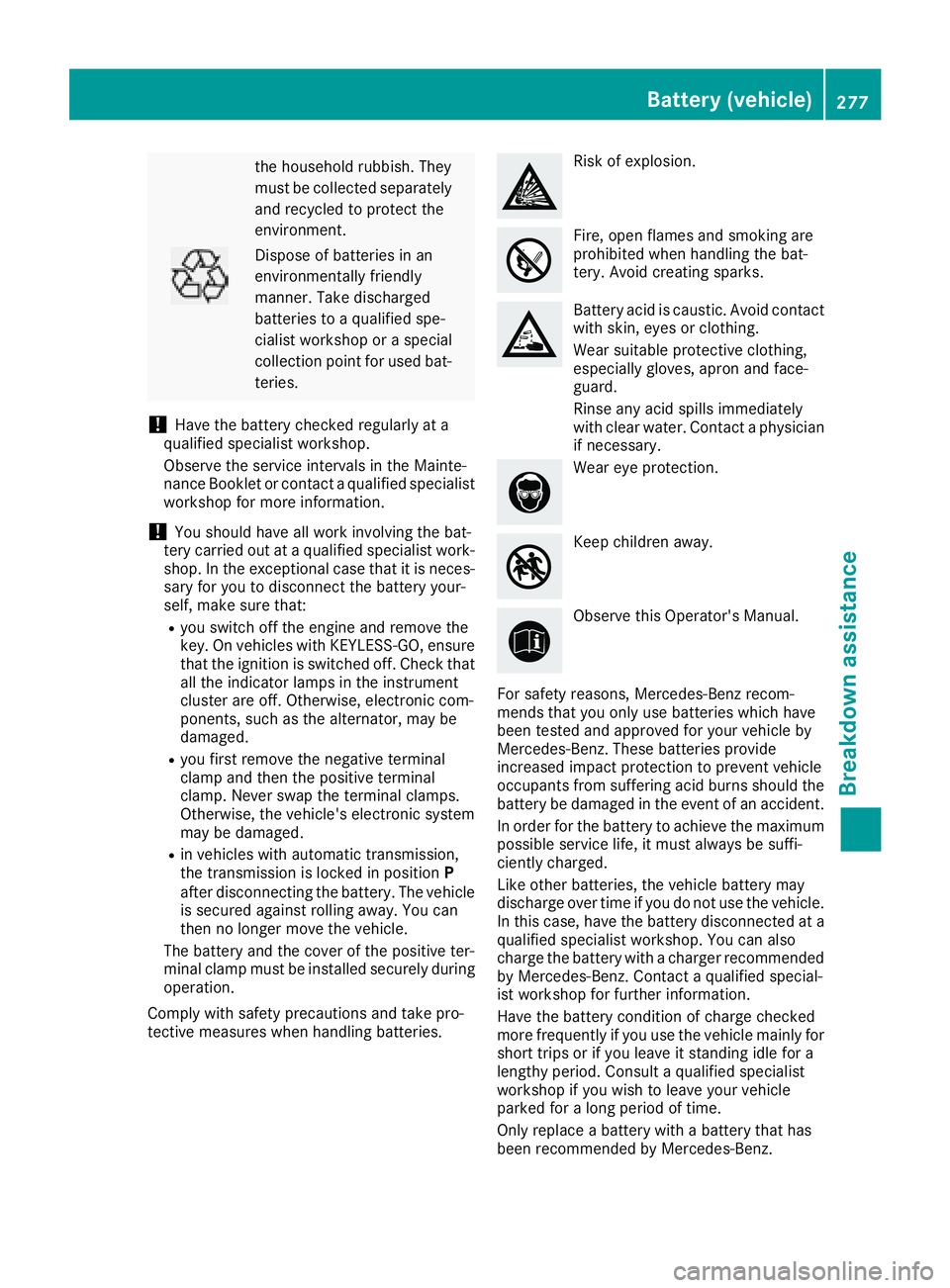
the househol dr ubbish .T hey
must be collected separately
and recycle dtop rotect the
environment.
Dispose of batteries in an
environmentall yf riendly
manner. Take discharged
batteries to aq uali fied spe-
cialist workshop or as pe cial
collectio np oi nt for used bat-
teries.
! Hav et he battery checked regularly at a
qualified specialis tw or kshop.
Observe the service intervals in the Mainte-
nanc eB ookle torc ontact aq uali fied specialist
workshop for mor ei nformation.
! Yo us houl dh av ea ll work involvin gt he bat-
tery carrie do ut at aq uali fied specialis tw or k-
shop. In the exceptiona lc as et ha titi sn eces-
sary for yo utod is connect the battery your-
self, make sure that: R
yo us wi tch off the engine and remove the
key .Onv ehicles with KEYLESS-GO, ensure
tha tt he ignition is switched off .C he ck that
al lt he indicator lamps in the instrument
cluste ra re off .O therwise, electronic com-
ponents ,s uc hast he alternator, ma yb e
damaged. R
yo uf irst remove the negative terminal
clamp and the nt he positive terminal
clamp. Never swap the termina lc lamps.
Otherwise, the vehicle' se le ctronic system
ma ybed amaged .R
in vehicles with automatic transmission,
the transmission is locked in position P
after disconnecting the battery .T he vehicle
is secur ed a gainst rolling away .Y ou ca
n
the nnol on ge rm ov et he vehicle.
The battery and the cove roft he positive ter-
minal clamp must be installe ds ec urel yd ur ing
operation.
Compl yw it hs af ety precautions and take pro-
tective measures when handling batteries. Risk of explosion.
Fire, open flames and smoking are
prohibited when handling the bat-
tery .A voi dc reating sparks.
Battery aci disc austic. Avoi dc ontact
with skin, eyes or clothing.
Wear suitabl ep rotective clothing,
especiall yg lo ves, apron and face-
guard.
Rinse any aci ds pills immediately
with clear water. Contact ap hysician
if necessary.
Wear ey ep rotection.
Kee pc hildren away.
Observe thi sO pe rator' sM an ual.
For safety reasons, Mercedes-Benz recom-
mend st ha ty ou onl yu se batteries which have
been tested and approved for your vehicl eb y
Mercedes-Benz. Thes eb at teries provide
increase di mpact protection to prevent vehicle
occupants fro ms uf ferin ga ci db ur ns shoul dt he
battery be damage dint he event of an accident.
In order for the battery to achieve the maximum
possibl es er vice life, it must always be suffi-
ciently charged.
Like othe rb at teries ,t he vehicl eb at tery may
discharge ove rt im eify ou do not us et he vehicle.
In thi sc ase, have the battery disconnecte data
qualified specialis tw or kshop .Y ou can also
charge the battery with ac harge rr ecommended
by Mercedes-Benz. Contact aq uali fied special-
is tw or kshop for furthe ri nformation.
Hav et he battery condition of charge checked
mor ef requentl yify ou us et he vehicl em ai nl yf or
short trip sorify ou leav eits tanding idle for a
length yp er iod. Consult aq uali fied specialist
workshop if yo uw is htol eave your vehicle
parked for al on gp er io doft ime.
Onl yr eplace ab at tery with ab at tery tha th as
been recommended by Mercedes-Benz.Battery (vehicle) 277
Breakdow na ssistance Z
Page 281 of 326
G WARNING
During charging and jump-starting, explosive gase sc an escap ef rom the battery .T here is ar isk
of an explosion.
Particularl ya voi df ire, open flames, creating sparks and smoking. Ensure there is sufficient ven-
tilation while charging and jump-starting. Do not lea no ver ab attery.
G WARNING
During the charging process ,ab attery produces hydrogen gas. If as hort circui to ccurs or sparks
are created ,t he hydrogen gas can ignite. There is ar isk of an explosion.R
Make sure that the positive terminal of ac onnected battery does not come into contact with
vehicl ep arts.R
Never place metal objects or tools on ab attery.R
It is important that you observe the described order of the battery terminal sw hen connecting
and disconnecting ab attery.R
When jump-starting, make sure that the battery pole sw ith identical polarity are connected.R
It is particularl yi mportant to observe the described order when connecting and disconnecting
the jumper cables. R
Never connect or disconnect the battery terminal sw hile the engine is running.
G WARNING
Ad ischarged battery can freeze at temperatures below freezing point. When jump-starting the
vehicl eorc harging the battery ,g ase sc an escap ef rom the battery .T here is ar isk of an explosion.
Allow the frozen battery to thaw out before charging it or jump-starting.
! Avoid repeated and lengthy starting attempts. Otherwise, the catalytic converter coul db e
damaged by the non-combusted fuel.
If the indicator/warning lamp sdon ot light up in the instrument cluster at low temperatures, it is very
likel yt hat the discharged battery has frozen. In this case you may neither jump-start the vehicl en or
charge the battery .L et the battery thaw first. The service life of at hawed-out battery may be shorter.
The starting characteristics can be impaired ,p articularl yatl ow temperatures. Have the thawed-out
battery checked at aq ualified specialist workshop.
Do not start the vehicl eu sing ar api dc harging device. If you rv ehicle's battery is discharged, the
engine can be jump-started from another vehicl eorf rom as econd battery using jumper cables.
Observe the following points: R
The battery is not accessible in all vehicles. If the other vehicle's battery is not accessible ,j ump-
start the vehicl eu sing as econd battery or aj ump-starting device.R
You may only jump-start the vehicl ew hen the engine and exhaust system are cold.R
Do not start the engine if the battery is frozen. Let the battery thaw first. R
Only jump-start from batterie sw ith a12Vv oltag er ating.R
Only use jumper cables that are not damaged and have as ufficient cross-section and insulated
terminal clamps. R
Make sure that the two vehicles do not touch. Jump-starting 279
Breakdown assistance Z
Page 282 of 326
Make sure that: R
The jumper cables are not damaged. R
Non-insulated parts of the terminal clamps do not come into contact with other metal parts while
the jumper cables are connected to the battery. R
The jumper cables cannot come into contact with parts that can move when the engine is running,
such as the V-belt pulle yort he fan.X
Secure the vehicle by applying the electric parking brake. X
Shift the transmission to position ] .X
Turn the SmartKey to position Z in the ignition lock and remove it.X
Switch off all electrical consumers, e.g. rear window defroster, lighting, etc. X
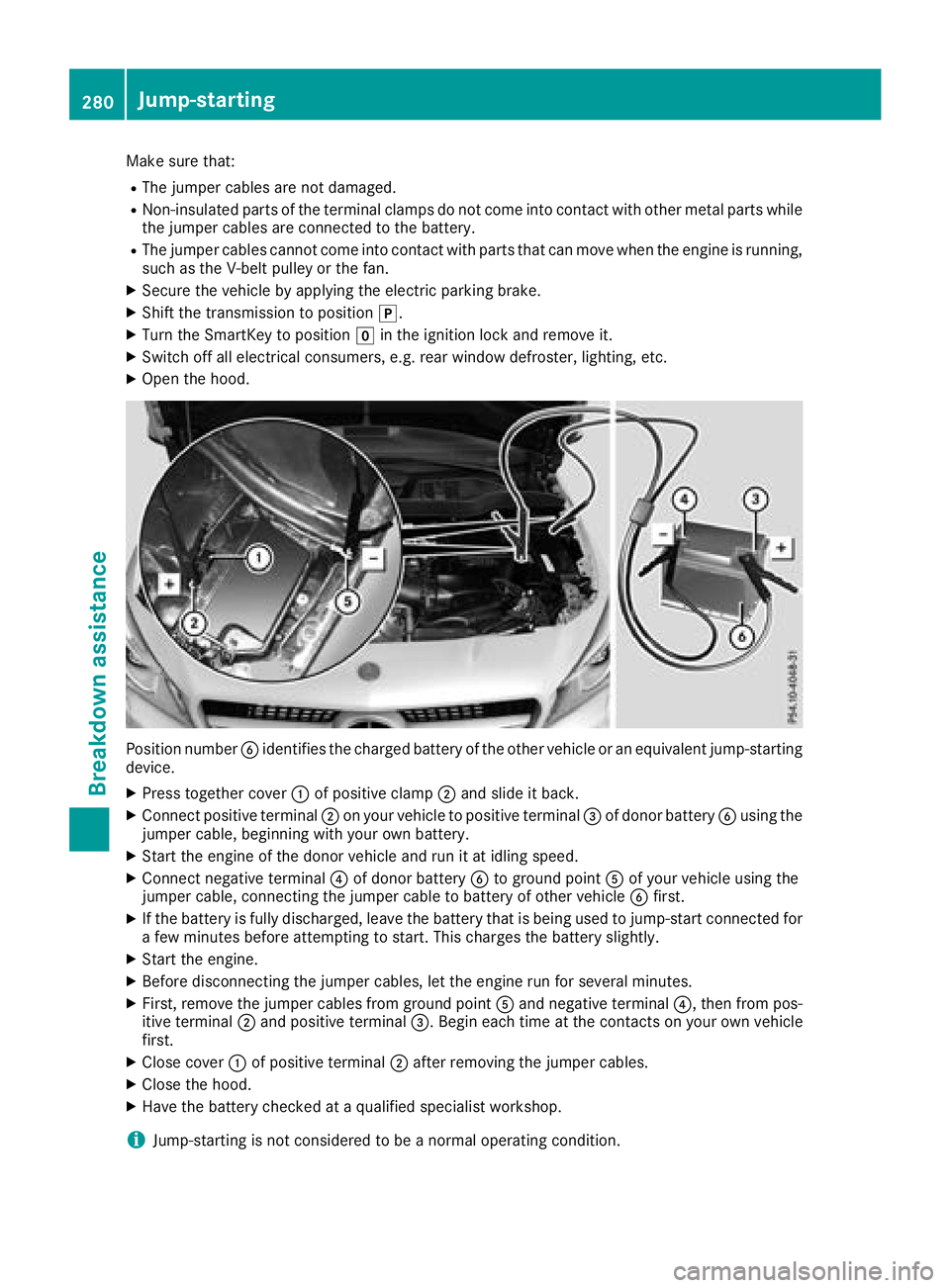
Open the hood.
Position number
Page 286 of 326

Note son4 MATIC vehicles
! Vehicle sw it h4 MATIC must not be towed
with eithe rt he front or the rea ra xl er aised, as
doing so will damage the transmission.
Vehicle sw it h4 MATIC ma yo nl ye it he rbet owed
away with both axles on the ground or be loaded
up and transported.
If the vehicle' st ransmission, front, or rea ra xl ei s
damaged, have the vehicl et ransporte dona
truck or trailer.
In the even to fd amag etot he electrical sys-
tem:
If the battery is defective, the automatic trans-
mission will be locked in position ] .Tos hift the
automatic transmission to position \\ ,y ou
must provide powe rtot he vehicle' so n-board
electrica ls ys te mint he same wa yasw he nj ump-
starting ( Y
page 278).
Have the vehicl et ransporte donat ransporte ro r
trailer.
Tow-startin g( em ergency engine
starting)
! Vehicle sw it ha ut omatic transmission must
not be tow-started .Y ou could otherwis ed am -
ag et he automatic transmission.
i Yo uc an find information on "Jump-starting"
under ( Y
page 278).
Fuses
Important safety notes
G WARNING
If yo um an ipulate or bridg eaf aulty fuse or if
yo ur eplace it with af us ew it hah ighe ra mper -
age, the electric cable sc ould be overloaded.
This could resul tina fire. There is ar is kofa n
accident and injury.
Alway sr eplace faulty fuse sw it ht he specified
new fuse sh avin gt he correc ta mperage.
! Onl yu se fuse st ha th av eb ee na pp roved for
Mercedes-Benz vehicles and which have the
correc tf us er at ing for the syste mc oncerned.
Onl yu se fuse sm ar ked with an "S" .O ther- wise ,c omponents or systems could be dam-
aged.
! Make sure tha tnom oisture can ente rt he
fuse bo xw he nt he cover is open.
! When closing the cover, make sure tha titi s
lying correctly on the fuse box. Moistur es eep-
ing in or dirt could otherwis ei mpair the oper-
ation of the fuses.
Th ef uses in your vehicl es er ve to close down
faulty circuits .Ifa fuse blows, al lt he compo-
nents on the circuit and their functions stop
operating.
Blown fuse sm us tber eplaced with fuse soft he
same rating ,w hi ch yo uc an recognize by the
color and value. Th ef us er at ing sa re liste dint he
fuse allocation chart.
Th ef us ea lloc at io nc h art is in the fuse bo xi nt he
front-passenge rf ootwell ( Y
page 285).
If an ewly inserte df us ea ls ob lows ,h av et he
cause traced and rectifie dataq ualified special-
is tw or kshop ,e .g .ana ut horized Mercedes-Benz
Center.
Before changin gaf use X
Secure the vehicl ea gain st rolling away
( Y
page 141). X
Switch off al le le ctrica lc onsumers.X
Vehicle sw it hout KEYLESS-GO: remove the
SmartKe yf ro mt he ignition lock. X
Vehicle sw it hK EYLESS -G Os tart-function
or KEYLESS-GO: open the driver's door.
Th ev ehicl ee le ctronics ar en ow in position
Z .T hi sc orresponds to the SmartKe yb ei ng
remove df ro mt he ignition.
Th ef uses ar el oc ated in variou sf us eb ox es:R
Fuse bo xint he engine compartment on the
left-hand side of the vehicle, when viewed in
the directio noft ravel R
Fuse bo xint he front-passenge rf ootwell
Th ef us ea lloc atio nc hart is on the fuse bo xint he
front-passenge rf ootwell ( Y
page 285).284
Fuses
Breakdow na ssistance
Page 310 of 326
Tire-mounting tools should not be used near
the valve. This could damage the electronic
components.
Only have tires changed at aq ualified spe-
cialist workshop.
Observe the instructions and safety notes in the
"Changing aw heel" section ( Y
page 307).
The wear pattern sont he front and rear tires
differ, depending on the operating conditions.
Rotate the wheels before ac lear wear pattern
has formed on the tires. Fron tt ires typically
wear more on the shoulders and the rear tires in
the center.
On vehicles that have the same size front and
rear wheels, you can rotat et he wheels accord-
ing to the intervals in the tire manufacturer's
warranty book in your vehicle documents. If no
warranty book is available, the tires should be
rotated every 3,000 to 6,000 miles (5,000 to
10,00 0k m) .D ependin gont ire wear, this may
be required earlier. Do not change the direction
of wheel rotation.
Clean the contact surfaces of the wheel and the
brake disc thoroughly every time aw heel is rota-
ted. Check the tire pressure and, if necessary,
restart the tire pressure loss warning system
(Canada only) or the tire pressure monitor (USA
only).
Direction of rotation Tires with as pecified direction of rotation have
additional benefits ,e .g. if there is ar isk of hydro-
planing. These advantages can only be gained if
the tires are installed corresponding to the
direction of rotation.
An arrow on the sidewall of the tire indicates its
correc td irection of rotation.
Storing wheels Stor ew heels that are not being used in ac ool,
dry and preferably dark place. Protec tt he tires
from oil, grease, gasoline and diesel. Mounting aw heel
Preparing the vehicle X
Stop the vehicle on solid, non-slippery and
level ground. X
Apply the electric parking brake manually. X
Bring the front wheels into the straight-ahead
position. X
Shift the transmission to position ] .X
Switch off the engine. X
Vehicles without KEYLESS-GO: remove the
SmartKey from the ignition lock. X
Vehicles with KEYLESS-GO start-function
or KEYLESS-GO: open the driver's door.
The vehicle electronics are now in position
Page 317 of 326
differen tf or every vehicle and can deviate
from the data shown here. You can find the
data applicable to your vehicle on the vehicle
identification plate.
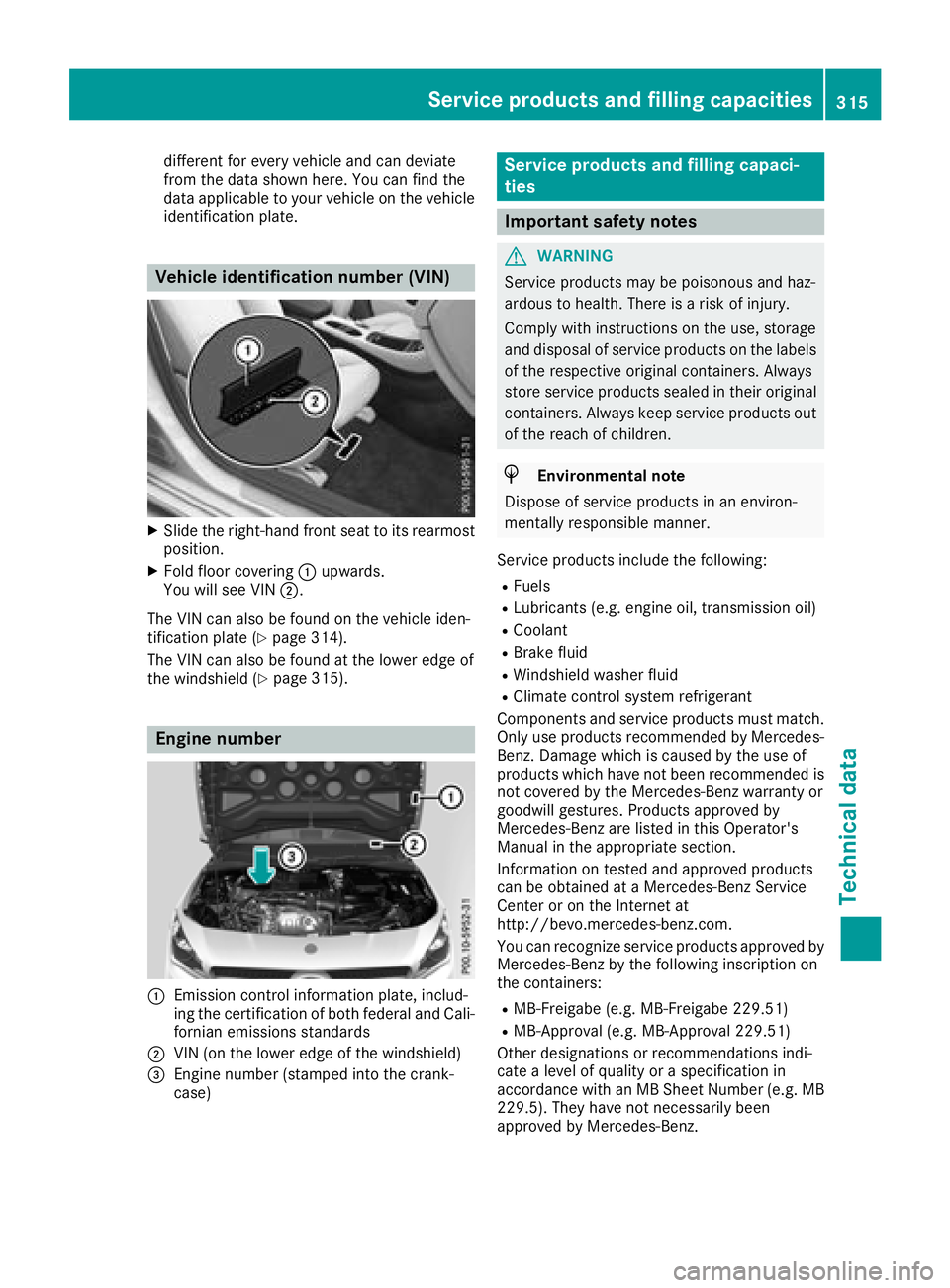
Vehicle identification number (VIN) X
Slide the right-han df ron ts eat to its rearmost
position. X
Fold floor covering C upwards.
You will see VIN D .
The VIN can also be found on the vehicle iden-
tification plate ( Y
page 314).
The VIN can also be found at the lower edge of
the windshield ( Y
page 315).
Engine number
C
Emission control information plate, includ-
ing the certification of both federal and Cali-
fornian emission ss tandards
D
VIN (on the lower edge of the windshield)
Page 318 of 326
Other identifications, for example: R
0W -30R
5W -30R
5W -40
Fuel
Important safety notes
G WARNING
Fuel is highly flammable. If you handle fuel
incorrectly, there is ar isk of fire and explo-
sion.
You must avoid fire, open flames, creating
sparks and smoking. Switch off the engine
and, if applicable, the auxiliary heating before
refueling.
G WARNING
Fuel is poisonous and hazardous to health.
There is ar isk of injury.
You must make sure that fuel does not come
into contact with your skin, eyes or clothing
and that it is not swallowed. Do not inhale fuel
vapors. Keep fuel awa yf rom children.
If you or others come into contact with fuel,
observe the following: R
Wash awa yf uel from skin immediately
using soap and water. R
If fuel comes into contact with your eyes,
immediately rinse them thoroughly with
clean water. Seek medical assistance with-
out delay. R
If fuel is swallowed, seek medical assis-
tance without delay .Don ot induce vomit-
ing. R
Immediately change out of clothing which
has come into contact with fuel. Tank capacity Model Total capa-
city
CLA 250
13.2 US gal
(50.0 l)
Al lo th er models
14.8 US gal
(56.0 l)
Model Of which
reserve
Mercedes ‑ AM Gv ehicles
Approx.
2.1 US gal
(8.0 l)
All other models
Approx.
1.6 US gal
(6.0 l)
Gasoline
Fuel grade
! Do not use diesel to refue lv ehicles with a
gasoline engine. Do not switch on the ignition
if you accidentally refue lw ith the wrong fuel.
Otherwise, the fuel wil le nter the fuel system.
Even smal la mounts of the wrong fuel could
resul tind amage to the fuel system and the
engine. Notify aq ualified specialist workshop
and have the fuel tank and fuel lines drained
completely.
! Only refue lu sing unleaded premium grade
gasoline with at least 91 AKI/95 RON.
i E10 fuel contains up to 10% bioethanol.
You rv ehicl eisE 10-compatible. You can
refue ly ou rv ehicl eu sing E10 fuel.
! Only use the fuel recommended. Operating
the vehicl ew ith other fuel sc an lea dtod am-
age to the fuel system, engine and exhaust
system.
! Do not use the following: R
Gasoline with more than 10% ethanol R
E100 (1 00% ethanol) R
Gasoline with methanol R
M100 (1 00% methanol) R
Gasoline with metalliferous additives R
Diesel316
Service products and fillin gc apacities
Technical data