Page 367 of 595

Dissimilar Spare Wheel and TireAssembly Information
WARNING
Failure to follow these guidelines couldresult in an increased risk of loss ofvehicle control, injury or death.
If you have a dissimilar spare wheel and tire,then it is intended for temporary use only.This means that if you need to use it, youshould replace it as soon as possible with aroad wheel and tire assembly that is thesame size and type as the road tires andwheels that were originally provided by Ford.If the dissimilar spare tire or wheel isdamaged, it should be replaced rather thanrepaired.
Important Use of Spare Wheel
A dissimilar spare wheel and tire assemblyis defined as a spare wheel and tire assemblythat is different in brand, size or appearancefrom the road tires and wheels and can beone of three types:
1. T-type mini-spare.*
2. Full-size dissimilar spare with label onwheel.**
3.Full-size dissimilar spare without label onwheel.*This spare tire begins with the letter T for
tire size and may have Temporary Use Onlymolded in the sidewall.** This spare tire has a label on the wheel that
states: THIS WHEEL AND TIRE ASSEMBLYFOR TEMPORARY USE ONLY.
Driving with a T-type Mini-spare or Full-sizeDissimilar Spare With Label on Wheel
Do not:
•Exceed 50 mph (80 km/h).
•Load the vehicle beyond maximumvehicle load rating listed on the SafetyCompliance Label.
•Tow a trailer.
•Use snow chains on the end of thevehicle with the dissimilar spare tire.
•Use more than one dissimilar spare tireat a time.
•Use commercial car washing equipment.
•Try to repair the dissimilar spare tire.
Use of the above dissimilar spare wheel atany one wheel location can lead toimpairment of the following:
•Handling, stability and brakingperformance.
•Comfort and noise.
•Ground clearance and parking at curbs.
•Winter weather driving capability.
•Wet weather driving capability.
•All-wheel driving capability (if applicable).
Driving With a Full-size Dissimilar SpareWheel and Tire Assembly
Do not:
•Exceed 70 mph (113 km/h).
•Use more than one dissimilar sparewheel and tire assembly at a time.
364
MKZ (CC9) Canada/United States of America, enUSA, Edition date: 201706, First Printing
Wheels and Tires
Page 368 of 595

•Use commercial car washing equipment.
•Use snow chains on the end of thevehicle with the dissimilar spare wheeland tire assembly.
Use of the above dissimilar spare wheel atany one wheel location can lead toimpairment of the following:
•Handling, stability and brakingperformance.
•Comfort and noise.
•Ground clearance and parking at curbs.
•Winter weather driving capability.
•Wet weather driving capability.
•All-wheel driving capability.
Give additional caution to the following whendriving with the full-size dissimilar sparewheel and tire assembly:
•Towing a trailer.
•Driving vehicles equipped with a camperbody.
•Driving vehicles with a load on the cargorack.
Drive cautiously when using a full-sizedissimilar spare wheel and tire assembly andseek service as soon as possible.
Changing a Road Wheel Procedure
WARNINGS
When one of the front wheels is off theground, the transmission alone will notprevent the vehicle from moving or slippingoff the jack, even if the transmission is in park(P).
To help prevent your vehicle frommoving when changing a wheel, shiftthe transmission into park (P), set the parkingbrake and use an appropriate block or wheelchock to secure the wheel diagonallyopposite to the wheel being changed. Forexample, when changing the front left wheel,place an appropriate block or wheel chockon the right rear wheel.
Do not work on your vehicle when thejack is the only support. If the vehicleslips off the jack, you or someone else couldbe seriously injured.
WARNINGS
Do not attempt to change a tire on theside of the vehicle close to movingtraffic. Pull far enough off the road to avoidthe danger of being hit when operating thejack or changing the wheel.
Always use the jack provided asoriginal equipment with your vehicle.If using a jack other than the one provided,make sure the jack capacity is adequate forthe vehicle weight, including any vehiclecargo or modifications. If you are unsure ifthe jack capacity is adequate, contact theauthorized dealer.
Note:Passengers should not remain in yourvehicle when the vehicle is being jacked.
1. Park on a level surface, set the parkingbrake and activate the hazard flashers.
2. Place the transmission in park (P) andturn the engine off. For vehicles with amanual transmission, place thetransmission in reverse (R) after theengine is turned off.
365
MKZ (CC9) Canada/United States of America, enUSA, Edition date: 201706, First Printing
Wheels and Tires
Page 369 of 595
3.Block both the front and rear of the wheeldiagonally opposite the flat tire. Forexample, if the left front tire is flat, blockthe right rear wheel.
4. Remove the carpeted wheel cover.
5. Remove the spare tire bolt securing thespare tire by turning it counterclockwise.
6.Remove the spare tire from the spare tirecompartment.
7. Remove the lug wrench and jack fromthe spare tire compartment.
8.To remove the wrench from the jack, turnthe hex nut on the jack counterclockwise.This will lower the jack and loosen themechanical lock.
9. If your vehicle has a wheel trim, use thetool supplied to remove it and access thelug nuts.
10. Loosen each wheel lug nut one-halfturn counterclockwise, but do notremove them until the wheel is raisedoff the ground.
366
MKZ (CC9) Canada/United States of America, enUSA, Edition date: 201706, First Printing
Wheels and TiresE175447 E178186 E175694 E224246
Page 370 of 595

11. The vehicle jacking points are shownhere, and can be identified by thetriangle markings on the molding. Thetriangle marking may be located on theside or the underside of the molding.The jacking points are identified onvehicles without moldings by a pair ofarrows on the metal flange pointing tothe jacking point between them. Detailsare depicted on the warning label onthe jack.
12.Place the jack at the jacking point nextto the tire you are changing. Turn thejack handle clockwise until the wheelis completely off the ground.
13. Remove the lug nuts with the lugwrench.
14.Replace the flat tire with the spare tire,making sure the valve stem is facingoutward. Reinstall the lug nuts until thewheel is snug against the hub. Do notfully tighten the lug nuts until the wheelhas been lowered. If you are using thetemporary tire, the lug nut washers willnot appear to be flush with the rim. Thisis normal only when using thetemporary spare tire.
15. Lower the wheel by turning the jackhandle counterclockwise.
367
MKZ (CC9) Canada/United States of America, enUSA, Edition date: 201706, First Printing
Wheels and TiresE145908 E174939 12
3
4
5
E75442
Page 371 of 595
16. Remove the jack and fully tighten thelug nuts in the order shown. SeeTechnical Specifications (page 371).
17.To store the folded wrench on the jack,engage the bracket of the jack base onthe wrench feature as shown. Swingthe wrench upward and adjust theheight of the jack until the pin engagesthe hole. Tighten the hex nut clockwiseby hand until secure.
18. Put the flat tire, jack and lug wrenchaway. Make sure the jack is fastenedsecurely before you drive.
19. Unblock the wheel.
368
MKZ (CC9) Canada/United States of America, enUSA, Edition date: 201706, First Printing
Wheels and TiresE176165
Page 372 of 595

Stowing the Flat Tire Without theRetainer Strap
You can temporarily stow the full-size roadwheel in the spare tire compartment.
1.Lift the carpeted wheel cover at an angleto access the spare tire compartment.
2.Place the wheel in the spare tire well withthe valve stem facing down.
3.Install the shorter jack retainer bolt to thejack bolt-down bracket through thecentre of the wheel. Finally, wind thewheel retainer down to secure the wheelin place.
4. Place the jack and tools back into thespare tire compartment.
5. Replace the carpeted wheel cover.
Stowing the Flat Tire Using theRetainer Strap (If Equipped)
You can temporarily stow the full-size roadwheel in the spare tire compartment.
1. Find the flat tire retainer strap tuckedinside the jack channel.
2.Locate the jack bolt-down bracket. Pushthe retainer strap through the jackbolt-down bracket.
3.Put the jack and lug wrench away. Makesure the jack is fastened so it does notrattle when you drive.
4.Stow the flat tire on the floor in the cargoarea.
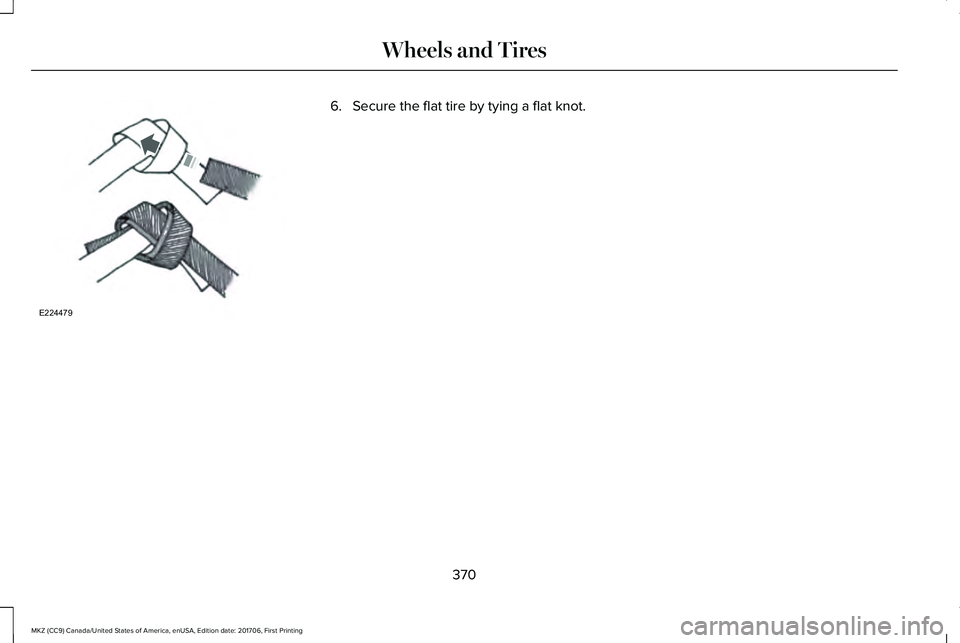
5. Weave the retainer strap through thewheel openings.
369
MKZ (CC9) Canada/United States of America, enUSA, Edition date: 201706, First Printing
Wheels and TiresE227869 E224480
Page 373 of 595
6. Secure the flat tire by tying a flat knot.
370
MKZ (CC9) Canada/United States of America, enUSA, Edition date: 201706, First Printing
Wheels and TiresE224479
Page 374 of 595

TECHNICAL SPECIFICATIONS
Wheel Lug Nut Torque Specifications
WARNING
When you install a wheel, always remove any corrosion, dirt or foreign materials present on the mounting surfaces of the wheel or thesurface of the wheel hub, brake drum or brake disc that contacts the wheel. Make sure to secure any fasteners that attach the rotor tothe hub so they do not interfere with the mounting surfaces of the wheel. Installing wheels without correct metal-to-metal contact at the wheelmounting surfaces can cause the wheel nuts to loosen and the wheel to come off while your vehicle is in motion, resulting in loss of vehiclecontrol, personal injury or death.
lb.ft (Nm)1Bolt size
150 lb.ft (204 Nm)M14 x 1.5
1 Torque specifications are for nut and bolt threads free of dirt and rust. Use only Ford recommended replacement fasteners.
Retighten the lug nuts to the specified torque within 100 miles (160 kilometers) after any wheel disturbance (such as tire rotation, changing aflat tire, wheel removal).
371
MKZ (CC9) Canada/United States of America, enUSA, Edition date: 201706, First Printing
Wheels and Tires