2018 LINCOLN CONTINENTAL seats
[x] Cancel search: seatsPage 4 of 615

Introduction
About This Manual...........................................7
Symbols Glossary.............................................7
Data Recording...............................................10
Perchlorate.......................................................12
Lincoln Automotive Financial Services..........................................................................12
Replacement Parts Recommendation..........................................................................13
Special Notices...............................................13
Mobile Communications Equipment.........14
Export Unique Options..................................14
Environment
Protecting the Environment.........................16
At a Glance
Instrument Panel Overview..........................17
Child Safety
General Information.......................................19
Child Seats.......................................................21
Installing Child Restraints.............................21
Booster Seats.................................................30
Child Restraint Positioning..........................33
Child Safety Locks.........................................34
Seatbelts
Principle of Operation..................................36
Fastening the Seatbelts...............................37
Seatbelt Height Adjustment.........................41
Seatbelt Warning Lamp and IndicatorChime............................................................41
Seatbelt Reminder.........................................42
Child Restraint and Seatbelt Maintenance.........................................................................44
Seatbelt Extension........................................45
Personal Safety System™
Personal Safety System™.............................46
Supplementary Restraints System
Principle of Operation...................................47
Driver and Passenger Airbags...................48
Front Passenger Sensing System.............50
Side Airbags...................................................52
Driver and Passenger Knee Airbags........53
Safety Canopy™..............................................54
Crash Sensors and Airbag Indicator........55
Airbag Disposal..............................................56
Keys and Remote Controls
General Information on Radio Frequencies.........................................................................57
Remote Control..............................................58
Replacing a Lost Key or Remote Control..........................................................................61
MyKey™
Principle of Operation..................................62
Creating a MyKey..........................................63
Clearing All MyKeys......................................64
Checking MyKey System Status................64
Using MyKey With Remote Start Systems........................................................................65
MyKey Troubleshooting...............................65
Doors and Locks
Locking and Unlocking.................................67
1
Continental (CPL) Canada/United States of America, enUSA, Edition date: 201706, Second-Printing
Table of Contents
Page 6 of 615

Seats
Sitting in the Correct Position...................153
Head Restraints............................................154
Power Seats...................................................157
Memory Function.........................................163
Rear Seats......................................................165
Heated Seats................................................166
Climate Controlled Seats...........................168
Rear Seat Armrest........................................169
Universal Garage Door Opener
Universal Garage Door Opener................171
Auxiliary Power Points
Auxiliary Power Points................................175
Storage Compartments
Center Console.............................................177
Overhead Console.......................................177
Starting and Stopping the Engine
General Information.....................................178
Keyless Starting............................................178
Starting a Gasoline Engine........................179
Engine Block Heater....................................181
Fuel and Refueling
Safety Precautions.......................................183
Fuel Quality....................................................183
Fuel Filler Funnel Location........................184
Running Out of Fuel....................................184
Refueling........................................................186
Fuel Consumption........................................189
Engine Emission Control
Emission Law................................................190
Catalytic Converter.......................................191
Transmission
Automatic Transmission.............................194
All-Wheel Drive
Using All-Wheel Drive................................200
Brakes
General Information...................................209
Hints on Driving With Anti-Lock Brakes.......................................................................210
Electric Parking Brake.................................210
Hill Start Assist..............................................213
Auto Hold.......................................................213
Traction Control
Principle of Operation.................................216
Using Traction Control................................216
Stability Control
Principle of Operation.................................217
Using Stability Control................................218
Parking Aids
Principle of Operation.................................219
Rear Parking Aid...........................................219
Front Parking Aid........................................220
Side Sensing System..................................221
Active Park Assist........................................223
Rear View Camera.......................................231
3
Continental (CPL) Canada/United States of America, enUSA, Edition date: 201706, Second-Printing
Table of Contents
Page 8 of 615
Automatic Transmission Fluid Check......324
Brake Fluid Check.......................................324
Power Steering Fluid Check....................325
Washer Fluid Check...................................325
Fuel Filter......................................................325
Changing the 12V Battery.........................325
Checking the Wiper Blades......................327
Changing the Wiper Blades......................327
Adjusting the Headlamps.........................328
Changing a Bulb..........................................329
Bulb Specification Chart............................330
Changing the Engine Air Filter - 3.7L......332
Changing the Engine Air Filter - 2.7LEcoBoost™/3.0L EcoBoost™..................332
Vehicle Care
General Information....................................334
Cleaning Products.......................................334
Cleaning the Exterior.................................335
Waxing...........................................................336
Cleaning the Engine...................................337
Cleaning the Windows and Wiper Blades......................................................................337
Cleaning the Interior...................................338
Cleaning the Instrument Panel andInstrument Cluster Lens........................340
Cleaning Leather Seats..............................341
Repairing Minor Paint Damage.................341
Cleaning the Wheels...................................341
Vehicle Storage...........................................342
Body Styling Kits..........................................343
Wheels and Tires
General Information....................................344
Tire Care........................................................344
Using Summer Tires...................................358
Using Snow Chains....................................358
Tire Pressure Monitoring System...........359
Changing a Road Wheel...........................364
Technical Specifications............................370
Capacities and Specifications
Engine Specifications - 2.7L......................373
Engine Specifications - 3.0L.....................374
Engine Specifications - 3.7L......................375
Motorcraft Parts - 2.7L................................377
Motorcraft Parts - 3.0L................................378
Motorcraft Parts - 3.7L................................379
Vehicle Identification Number.................380
Vehicle Certification Label........................380
Transmission Code Designation..............381
Capacities and Specifications - 2.7L......382
Capacities and Specifications - 3.0L......388
Capacities and Specifications - 3.7L......395
Audio System
General Information....................................403
Audio Unit.....................................................405
Satellite Radio..............................................409
USB Port.........................................................412
SYNC™ 3
General Information.....................................413
Home Screen...............................................428
Using Voice Recognition...........................430
Entertainment...............................................440
Climate...........................................................454
Phone.............................................................458
Navigation.....................................................466
5
Continental (CPL) Canada/United States of America, enUSA, Edition date: 201706, Second-Printing
Table of Contents
Page 24 of 615
•You are required by law to properly usesafety seats for infants and toddlers inthe United States and Canada.
•Many states and provinces require thatsmall children use approved boosterseats until they reach age eight, a heightof 4 feet 9 inches (1.45 meters) tall, or80 lb (36 kg). Check your local and stateor provincial laws for specificrequirements about the safety of childrenin your vehicle.
•When possible, always properly restrainchildren 12 years of age and under in arear seating position of your vehicle.Accident statistics suggest that childrenare safer when properly restrained in therear seating positions than in a frontseating position. See Front PassengerSensing System (page 50).
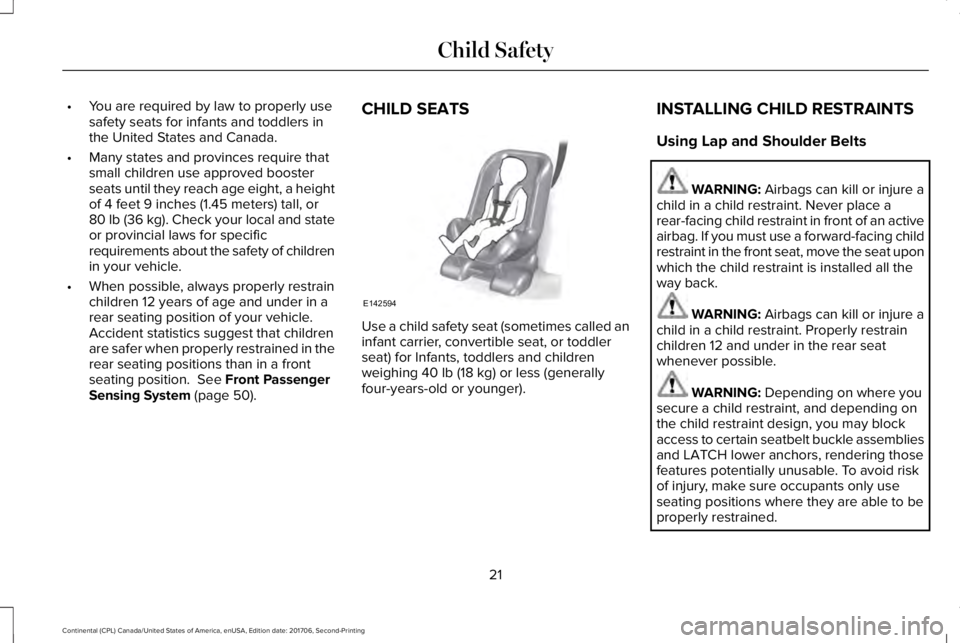
CHILD SEATS
Use a child safety seat (sometimes called aninfant carrier, convertible seat, or toddlerseat) for Infants, toddlers and childrenweighing 40 lb (18 kg) or less (generallyfour-years-old or younger).
INSTALLING CHILD RESTRAINTS
Using Lap and Shoulder Belts
WARNING: Airbags can kill or injure achild in a child restraint. Never place arear-facing child restraint in front of an activeairbag. If you must use a forward-facing childrestraint in the front seat, move the seat uponwhich the child restraint is installed all theway back.
WARNING: Airbags can kill or injure achild in a child restraint. Properly restrainchildren 12 and under in the rear seatwhenever possible.
WARNING: Depending on where yousecure a child restraint, and depending onthe child restraint design, you may blockaccess to certain seatbelt buckle assembliesand LATCH lower anchors, rendering thosefeatures potentially unusable. To avoid riskof injury, make sure occupants only useseating positions where they are able to beproperly restrained.
21
Continental (CPL) Canada/United States of America, enUSA, Edition date: 201706, Second-Printing
Child SafetyE142594
Page 26 of 615

4. Insert the belt tongue into the properbuckle (the buckle closest to the directionthe tongue is coming from) for thatseating position until you hear a snap andfeel the latch engage. Make sure thetongue is latched securely by pulling onit.
5. To put the retractor in the automaticlocking mode, grasp the shoulder portionof the belt and pull downward until youpull all of the belt out.
Note:The automatic locking mode isavailable on the front passenger and rearseats.
6.Allow the belt to retract to remove slack.The belt clicks as it retracts to indicate itis in the automatic locking mode.
7.Try to pull the belt out of the retractor tomake sure the retractor is in theautomatic locking mode (you should notbe able to pull more belt out). If theretractor is not locked, unbuckle the beltand repeat Steps 5 and 6.
8. Remove remaining slack from the belt.Force the seat down with extra weight,for example, by pressing down orkneeling on the child restraint whilepulling up on the shoulder belt in orderto force slack from the belt. This isnecessary to remove the remaining slackthat will exist once the extra weight of
23
Continental (CPL) Canada/United States of America, enUSA, Edition date: 201706, Second-Printing
Child SafetyE142531 E142875 E142533
Page 29 of 615

5. To put the retractor in the automaticlocking mode, grasp the lap portion ofthe inflatable seatbelt and pull upwarduntil you pull all of the belt out.
Note:The automatic locking mode isavailable on the front passenger and rearseats.
Note:Unlike the standard seatbelt, theinflatable seatbelt's unique lap portion locksthe child restraint for installation. The abilityfor the shoulder portion of the belt to movefreely is normal, even after you put the lapbelt into the automatic locking mode.
Note:The lock-off device on some childrestraints may not accommodate theshoulder portion of the inflatable seatbelt.Follow all instructions provided by themanufacturer of the child restraint regardingthe necessary and proper use of the lock-offdevice. In some instances, these deviceshave been provided only for use in vehicleswith seatbelt systems that would otherwiserequire a locking clip.
6.Allow the belt to retract to remove slack.The belt clicks as it retracts to indicate itis in the automatic locking mode.
7.Try to pull the belt out of the retractor tomake sure the retractor is in theautomatic locking mode (you should notbe able to pull more belt out). If theretractor is not locked, unbuckle the beltand repeat Steps 5 and 6.
8. Remove remaining slack from the belt.Force the seat down with extra weight,for example, by pressing down orkneeling on the child restraint whilepulling down on the lap belt in order toforce slack from the belt. This isnecessary to remove the remaining slackthat will exist once the extra weight ofthe child is added to the child restraint.It also helps to achieve the propersnugness of the child restraint to yourvehicle. Sometimes, a slight lean towardthe buckle will additionally help toremove remaining slack from the belt.
26
Continental (CPL) Canada/United States of America, enUSA, Edition date: 201706, Second-Printing
Child SafetyE146524 E146525
Page 30 of 615

9. Attach the tether strap (if the childrestraint is equipped).
10. Before placing the child in the seat,forcibly move the seat forward and backto make sure the seat is securely heldin place. To check this, grab the seat atthe belt path and attempt to move itside to side and forward and back.There should be no more than 1 in(2.5 cm) of movement for properinstallation.
We recommend checking with a NHTSACertified Child Passenger Safety Technicianto make certain the child restraint is properlyinstalled. In Canada, check with TransportCanada for referral to a Child Car Seat Clinic.
Using Lower Anchors and Tethers for
CHildren (LATCH)
WARNING: Do not attach two childsafety restraints to the same anchor. In acrash, one anchor may not be strong enoughto hold two child safety restraint attachmentsand may break, causing serious injury ordeath.
WARNING: Depending on where yousecure a child restraint, and depending onthe child restraint design, you may blockaccess to certain seatbelt buckle assembliesand LATCH lower anchors, rendering thosefeatures potentially unusable. To avoid riskof injury, make sure occupants only useseating positions where they are able to beproperly restrained.
The LATCH system is composed of threevehicle anchor points: two lower anchorswhere the seatback and seat cushion meet(called the seat bight) and one top tetheranchor behind that seating position.
LATCH compatible child safety seats havetwo rigid or webbing mounted attachmentsthat connect to the two lower anchors at theLATCH equipped seating positions in yourvehicle. This type of attachment methodeliminates the need to use seatbelts to attachthe child restraint, however the seatbelt canstill be used to attach the child restraint. Forforward-facing child restraints, you must alsoattach the top tether strap to the proper toptether anchor, if a top tether strap has beenprovided with your child restraint.
27
Continental (CPL) Canada/United States of America, enUSA, Edition date: 201706, Second-Printing
Child SafetyE142534
Page 31 of 615
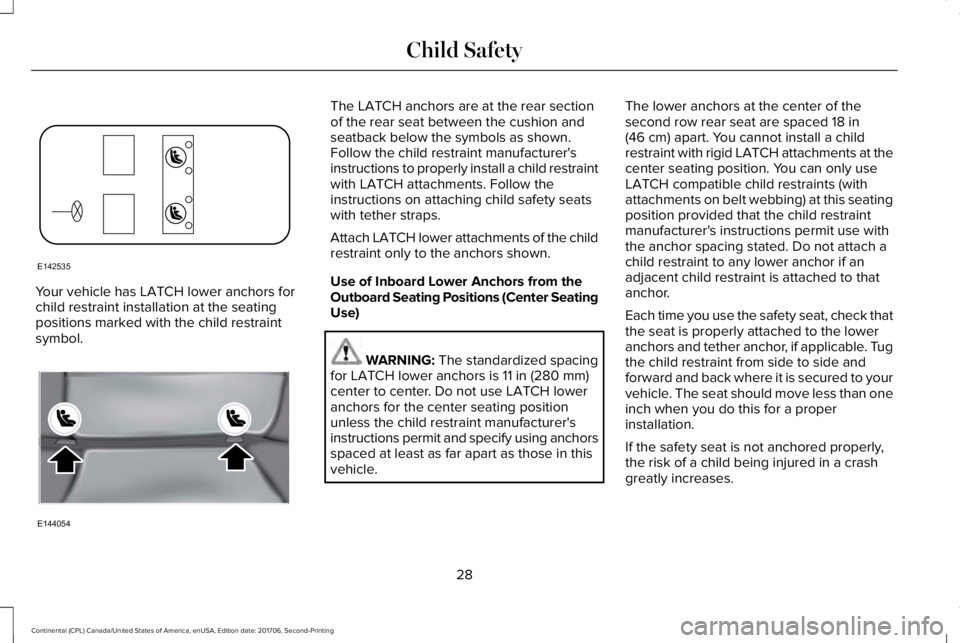
Your vehicle has LATCH lower anchors forchild restraint installation at the seatingpositions marked with the child restraintsymbol.
The LATCH anchors are at the rear sectionof the rear seat between the cushion andseatback below the symbols as shown.Follow the child restraint manufacturer'sinstructions to properly install a child restraintwith LATCH attachments. Follow theinstructions on attaching child safety seatswith tether straps.
Attach LATCH lower attachments of the childrestraint only to the anchors shown.
Use of Inboard Lower Anchors from theOutboard Seating Positions (Center SeatingUse)
WARNING: The standardized spacingfor LATCH lower anchors is 11 in (280 mm)center to center. Do not use LATCH loweranchors for the center seating positionunless the child restraint manufacturer'sinstructions permit and specify using anchorsspaced at least as far apart as those in thisvehicle.
The lower anchors at the center of thesecond row rear seat are spaced 18 in(46 cm) apart. You cannot install a childrestraint with rigid LATCH attachments at thecenter seating position. You can only useLATCH compatible child restraints (withattachments on belt webbing) at this seatingposition provided that the child restraintmanufacturer's instructions permit use withthe anchor spacing stated. Do not attach achild restraint to any lower anchor if anadjacent child restraint is attached to thatanchor.
Each time you use the safety seat, check thatthe seat is properly attached to the loweranchors and tether anchor, if applicable. Tugthe child restraint from side to side andforward and back where it is secured to yourvehicle. The seat should move less than oneinch when you do this for a properinstallation.
If the safety seat is not anchored properly,the risk of a child being injured in a crashgreatly increases.
28
Continental (CPL) Canada/United States of America, enUSA, Edition date: 201706, Second-Printing
Child SafetyE142535 E144054