2018 Lexus GS300 fuel
[x] Cancel search: fuelPage 319 of 602
GS350_300_GS F_OM_OM30G34U_(U)
3175-2. Using the air conditioning system and defogger
5
Interior features
■When the outside temperature exceeds 75°F (24°C) and the air conditioning system
is on
●In order to reduce the air co nditioning power consumption, the air conditioning system
may switch to recirculated air mode automa tically. This may also reduce fuel consump-
tion.
●Recirculated air mode is selected as a default mode when the engine switch is turned
on.
●It is possible to switch to outside air mode at any time by pressing .
■Automatic mode for air intake control
In automatic mode, the system detects exhaust gas and other pollutants and automati-
cally switches between outside air and recirculated air modes.
When the dehumidification function is off, and the fan is operating, turning automatic
mode on will activate the dehumidification function.
■Operation of the air conditioning system in Eco drive mode
In the Eco drive mode, the air conditioning sy stem is controlled as follows to prioritize
fuel efficiency:
●Engine speed and compressor operation controlled to restrict heating/cooling capac-
ity
●Fan speed restricted when automatic mode is selected
To improve air conditioning performanc e, perform the following operations:
●Turn off eco air conditioning mode
●Adjust the fan speed
●Turn off Eco drive mode ( →P. 273)
■Eco air conditioning mode
When Eco drive mode is selected using the drive mode select switch, eco air condition-
ing mode turns on.
When a drive mode other than Eco drive mo de is selected, eco air conditioning mode
may turn off.
■When the S-FLOW mode operates
If air flows to the driver’s seat only, the te mperature setting for the front passenger’s seat
is not displayed.
■When the outside temperature is low
The dehumidification function may not operate even when “A/C” on the option control
screen is selected.
■Ventilation and air conditioning odors
●To let fresh air in, set the air conditioning system to the outside air mode.
●During use, various odors from inside and outside the vehicle may enter into and accu-
mulate in the air conditioning system. This may then cause odor to be emitted from the
vents.
●To reduce potential odors from occurring:
• It is recommended that the air conditioning system be set to outside air mode prior
to turning the vehicle off.
• The start timing of the blower may be dela yed for a short period of time immediately
after the air conditioning system is started in automatic mode.
Page 357 of 602
GS350_300_GS F_OM_OM30G34U_(U)
3555-5. Using the other interior features
5
Interior features
■Enhanced Roadside Assistance
Enhanced Roadside Assistance adds GPS data to the already included war-
ranty-based Lexus roadside service.
Subscribers can press the “SOS” button to reach a Safety Connect response-
center agent, who can help with a wide range of needs, such as: towing, flat
tire, fuel delivery, etc. For a descript ion of the Roadside Assistance services
and their limitations, please see the Safety Connect Terms and Conditions,
which are available at Lexus.com.
Important! Read this informatio n before using Safety Connect.
■Exposure to radio frequency signals
The Safety Connect system installed in your vehicle is a low-power radio\
transmitter and receiver. It receives and also sends out radio frequency (RF)
signals.
In August 1996, the Federal Commu nications Commission (FCC) adopted
RF exposure guidelines with safety levels for mobile wireless phones. Those
guidelines are consistent with the safe ty standards previously set by the fol-
lowing U.S. and internat ional standards bodies.
●ANSI (American National Stan dards Institute) C95.1 [1992]
●NCRP (National Council on Radiation Protection and Measurement)
Report 86 [1986]
●ICNIRP (International Commission on Non-Ionizing Radiation Protection)
[1996]
Those standards were based on comprehensive and periodic evaluations of
the relevant scientific literature. Over 120 scientists, engineers, and physi-
cians from universities, and governme nt health agencies and industries
reviewed the available body of rese arch to develop the ANSI Standard
(C95.1).
The design of Safety Connect complies wi th the FCC guidelines in addition to
those standards.
Safety information for Safety Connect
Page 361 of 602

GS350_300_GS F_OM_OM30G34U_(U)
3596-1. Maintenance and care
6
Maintenance and care
■Automatic car washes
●Fold the mirrors before washing the vehicle. Start washing from the front of the vehicle.
Make sure to extend the mirrors before driving.
●Brushes used in automatic car washes may scratch the vehicle surface and harm your
vehicle’s paint.
●Rear spoiler (if equipped) may not be washable in some automatic car washes. There
may also be an increased risk of damage to vehicle.
■High-pressure car washes
●Do not allow the nozzles of the car wash to come within close proximity of the windows.
●Before using the car wash, check that the fuel filler door on your vehicle is closed prop-
erly.
■Notes for a smart access system with push-button start
If the door handle becomes wet while the electronic key is within the effective range, the
door may lock and unlock repeatedly. In that case, follow the following correction proce-
dures to wash the vehicle:
●Place the key in a position 6 ft. (2 m) or more separate from the vehicle while the vehi-
cle is being washed. (Take care to ensure that the key is not stolen.)
●Set the electronic key to battery-saving mode to disable the sm art access system with
push-button start. ( →P. 152)
■Aluminum wheels
●Remove any dirt immediately by using a neutral detergent.
●Wash detergent off with water immediately after use.
●To protect the paint from damage, make sure to observe the following precautions.
• Do not use acidic, alkaline or abrasive detergent
• Do not use hard brushes
• Do not use detergent on the wheels when they are hot, such as after driving or park- ing in hot weather
■Brake
●Brake caliper coating (GS350/GS300 with orange brake calipers for F SPORT mod-
els, and GS F)
• When using detergent, use neutral detergent.
Do not use hard brushes or abrasive cleaners, as they will damage the coating.
• Do not use detergent on the brake calipers when they are hot.
• Wash detergent off immediately after use.
●GS F: Rust may form if the vehicle is parked with wet brake pads or disc rotors, causing
them to stick. Before parking the vehicle after it is washed, drive slowly and apply the
brakes several times to dry the parts.
■Bumpers
Do not scrub with abrasive cleaners.
Page 368 of 602
366
GS350_300_GS F_OM_OM30G34U_(U)6-2. Maintenance
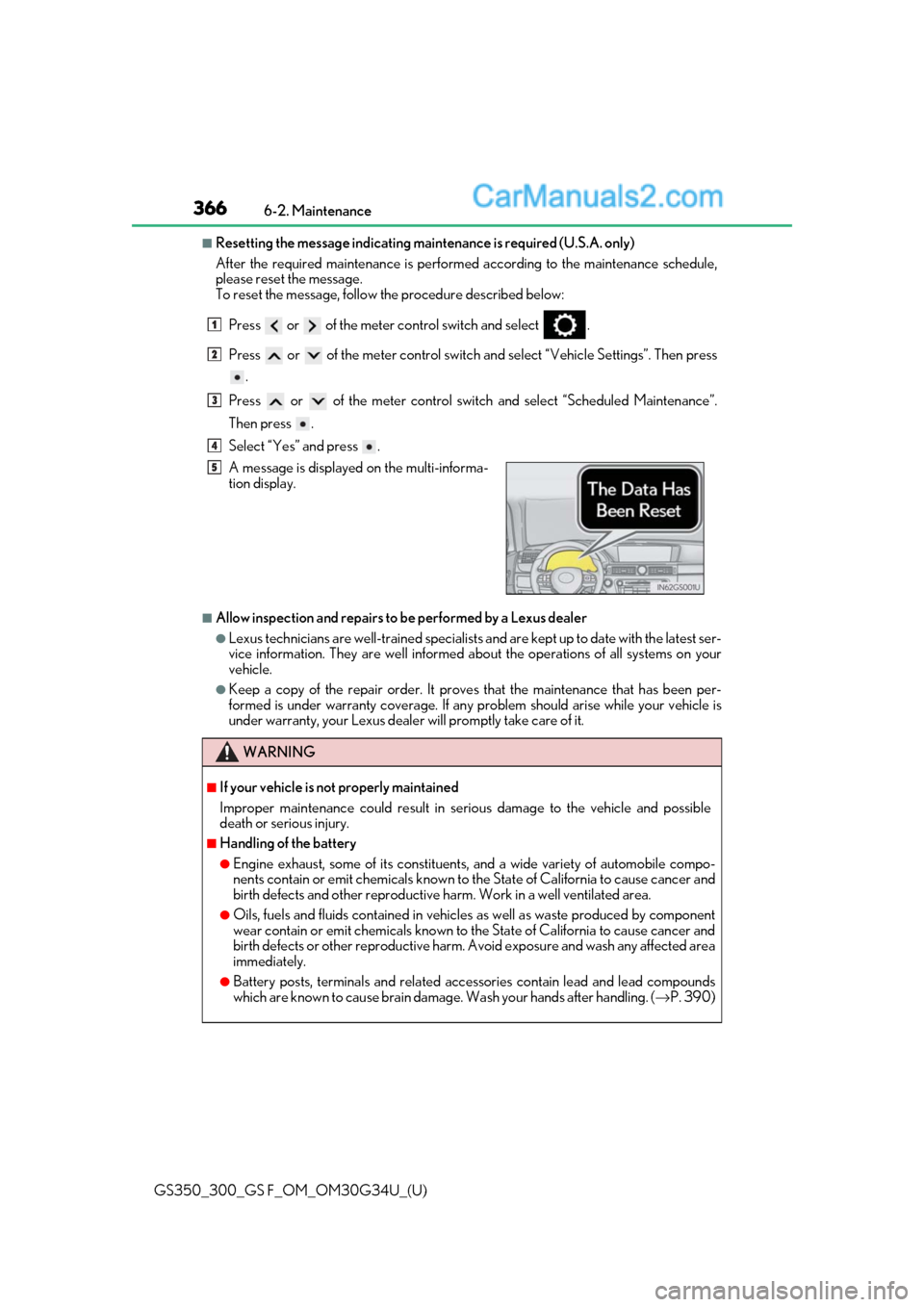
■Resetting the message indicating main
tenance is required (U.S.A. only)
After the required maintenanc e is performed according to the maintenance schedule,
please reset the message.
To reset the message, follow the procedure described below:
Press or of the meter co ntrol switch and select .
Press or of the meter control switch an d select “Vehicle Settings”. Then press
.
Press or of the meter control switch and select “Scheduled Maintenance”.
Then press .
Select “Yes” and press .
■Allow inspection and repairs to be performed by a Lexus dealer
●Lexus technicians are well-trained specialists and are kept up to date with the latest ser-
vice information. They are well informed about the operations of all systems on your
vehicle.
●Keep a copy of the repair order. It proves that the maintenance that has been per-
formed is under warranty coverage. If any problem should arise while your vehicle is
under warranty, your Lexus dealer will promptly take care of it. A message is displayed on the multi-informa-
tion display.
WARNING
■If your vehicle is not properly maintained
Improper maintenance could result in se rious damage to the vehicle and possible
death or serious injury.
■Handling of the battery
●Engine exhaust, some of its constituents, and a wide variety of automobile compo-
nents contain or emit chemicals known to th e State of California to cause cancer and
birth defects and other reproductive ha rm. Work in a well ventilated area.
●Oils, fuels and fluids contained in vehicles as well as waste produced by component
wear contain or emit chemicals known to the State of California to cause cancer and
birth defects or other reproductive harm. Avoid exposure and wash any affected area
immediately.
●Battery posts, terminals and related acce ssories contain lead and lead compounds
which are known to cause brain damage. Wash your hands after handling. ( →P. 390)
1
2
3
4
5
Page 372 of 602

370
GS350_300_GS F_OM_OM30G34U_(U)6-2. Maintenance
Emission inspection and maintenance (I/M)
programs
The OBD system determines that a problem exists somewhere in the emission
control system. Your vehicle may not pass the I/M test and may need to be
repaired. Contact your Lexus dealer to service the vehicle.
●When the battery is disconnected or discharged
Readiness codes that are set duri
ng ordinary driving are erased.
Also, depending on your driving habits , the readiness codes may not be com-
pletely set.
●When the fuel tank cap is loose
The malfunction indicator lamp comes on indicating a temporary malfunction
and your vehicle may not pass the I/M test.
The error code in the OBD system will not be cleared unless the vehicle \
is driven
40 or more times.
Contact your Lexus dealer to pr epare the vehicle for re-testing.
Some states have vehicle emission in spection programs which include OBD
(On Board Diagnostics) checks. The OBD system monitors the operation of
the emission control system.
If the malfunction indicator lamp comes on
Your vehicle may not pass the I/M te st in the following situations:
When the malfunction indicator lamp still remains on after several driv-
ing trips
If your vehicle does not pass the I/M test
Page 374 of 602
372
GS350_300_GS F_OM_OM30G34U_(U)6-3. Do-it-yourself maintenance
WARNING
The engine compartment contains many mechan
isms and fluids that may move suddenly,
become hot, or become electrically energize d. To avoid death or serious injury, observe
the following precautions.
■When working on the engine compartment
●Keep hands, clothing and tools away from the moving fan and engine drive belt.
●Be careful not to touch the engine, radiator, exhaust manifold, etc. right after driving
as they may be hot. Oil and other fluids may also be hot.
●Do not leave anything that may burn easily, such as paper and rags, in the engine
compartment.
●Do not smoke, cause sparks or expose an open flame to fuel or the battery. Fuel and
battery fumes are flammable.
●Be extremely cautious when working on the battery. It contains poisonous and corro-
sive sulfuric acid.
■When working near the electric cooling fans or radiator grille
Be sure the engine switch is off.
With the engine switch in IGNITION ON mode, the electric cooling fans may auto-
matically start to run if the air conditioning is on and/or the coolant temperature is high.
( → P. 388)
■Safety glasses
Wear safety glasses to prevent flying or falling material, fluid spray, etc. from getting in
your eyes.
NOTICE
■If you remove the air cleaner filter
Driving with the air cleaner f ilter removed may cause excessive engine wear due to dirt
in the air.
Page 406 of 602
404
GS350_300_GS F_OM_OM30G34U_(U)6-3. Do-it-yourself maintenance
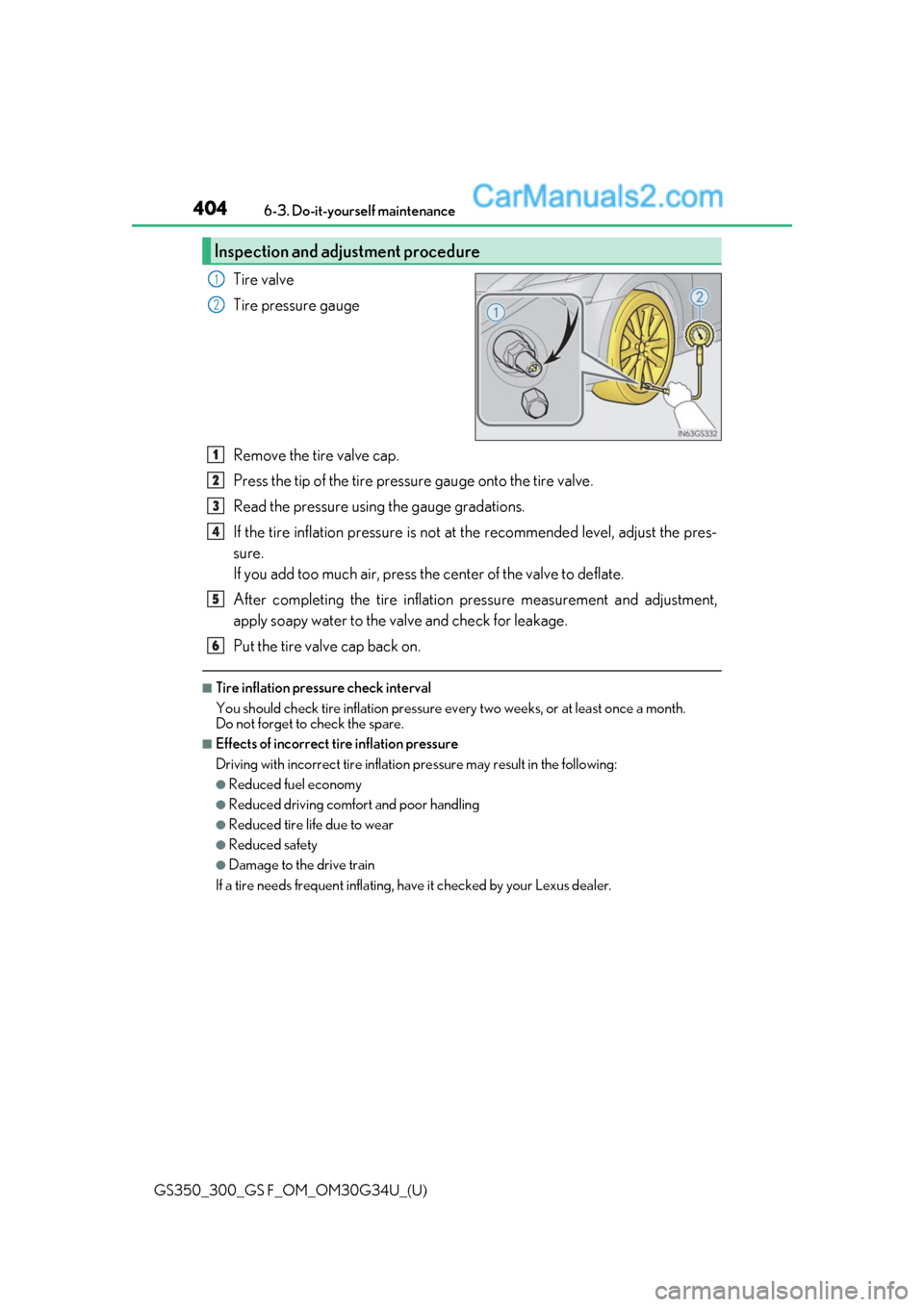
Tire valve
Tire pressure gauge
Remove the tire valve cap.
Press the tip of the tire pressure gauge onto the tire valve.
Read the pressure using the gauge gradations.
If the tire inflation pressure is not at
the recommended level, adjust the pres-
sure.
If you add too much air, press the center of the valve to deflate.
After completing the tire inflation pressure measurement and adjustment,
apply soapy water to the valve and check for leakage.
Put the tire valve cap back on.
■Tire inflation pressure check interval
You should check tire inflation pressure ev ery two weeks, or at least once a month.
Do not forget to check the spare.
■Effects of incorrect tire inflation pressure
Driving with incorrect tire inflation pressure may result in the following:
●Reduced fuel economy
●Reduced driving comfort and poor handling
●Reduced tire life due to wear
●Reduced safety
●Damage to the drive train
If a tire needs frequent inflating, ha ve it checked by your Lexus dealer.
Inspection and adjustment procedure
1
2
1
2
3
4
5
6
Page 425 of 602
423
GS350_300_GS F_OM_OM30G34U_(U)
7When trouble arises
7-1. Essential informationEmergency flashers................... 424
If your vehicle has to be stopped in an
emergency .................................425 7-2. Steps to take in an
emergency
If your vehicle needs to be towed................................ 426
If you think something is wrong ................ 432
Fuel pump shut off system ...... 433
If a warning light turns on or a warning buzzer
sounds.......................................... 434
If a warning message is displayed.......................................441
If you have a flat tire (vehicles with spare tire) ......................... 472
If you have a flat tire (vehicles without spare tire)...................483
If the engine will not start ........ 497
If the parking brake cannot be released ................................ 499
If the electronic key does not operate properly ...................... 501
If the vehicle battery is discharged .................................504
If your vehicle overheats .........509
If the vehicle becomes stuck .............................................. 515