2018 KIA STONIC window
[x] Cancel search: windowPage 444 of 523

SymbolFuse ratingCircuit Protected
INJECTOR15AFuel Pump Relay, ECM/PCM, Injector #1~#4, Oil Control Valve #1, #2 (A/T), Purge Control Sole‐
noid Valve (A/T)
10A Back-Up Lamp Switch
40A Instrument Panel Junction Block
50A Instrument Panel Junction Block (Power Window Relay)
40A Ignition Switch, PDM Relay Box (IG2 Relay)
40A Cooling Fan1 Relay, Cooling Fan2 Relay
30A Main Relay
10A Air Conditioner Clutch Type ECV Relay
20A PCM (A/T)
20A Head Lamp Relay
20A Head Lamp High Relay
FUEL
PUMP20A Fuel Pump Relay
15A Horn Relay, Burglar Alarm Horn Relay
E315A ECM/PCM
AMS10A Battery Sensor
40A Instrument Panel Junction Block (Tail Lamp Relay)
Maintenance
8-98
Page 447 of 523
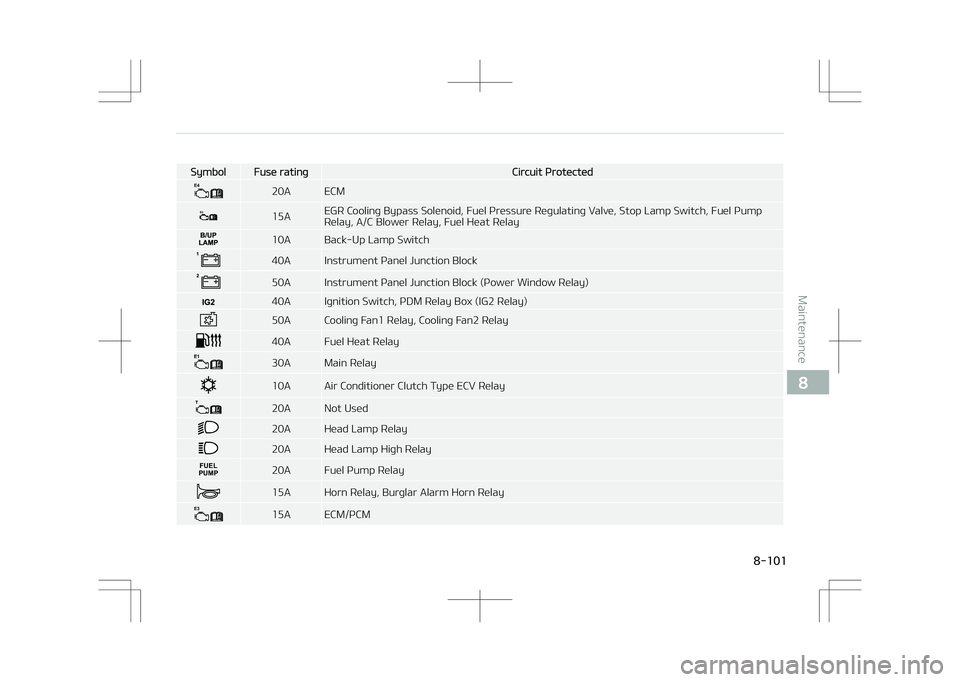
SymbolFuse ratingCircuit Protected
E420A ECM
S315AEGR Cooling Bypass Solenoid, Fuel Pressure Regulating Valve, Stop Lamp Switch, Fuel Pump Relay, A/C Blower Relay, Fuel Heat Relay
10A Back-Up Lamp Switch
40A Instrument Panel Junction Block
50A Instrument Panel Junction Block (Power Window Relay)
40A Ignition Switch, PDM Relay Box (IG2 Relay)
50A Cooling Fan1 Relay, Cooling Fan2 Relay
40A Fuel Heat Relay
30A Main Relay
10A Air Conditioner Clutch Type ECV Relay
20A Not Used
20A Head Lamp Relay
20A Head Lamp High Relay
FUEL
PUMP20A Fuel Pump Relay
15A Horn Relay, Burglar Alarm Horn Relay
E315A ECM/PCM
8-101
8
Maintenance
Page 451 of 523

•Lamp part malfunction due to electri‐cal control system stabilization
A normally functioning lamp may
flicker momentarily. This momentary occurrence is due to stabilization unc‐
tion of the vehicle's electrical on con‐
trol system. If the lamp soon returns
to normal, the vehicle does not re‐
quire service.
However, if the lamp goes out after he momentary flickering, or the flick‐
ering continues, have the system
serviced by a professional workshop.
Kia recommends to visit an author‐
ized Kia dealer/service partner.
NOTICE
•If the light bulb or lamp connector
is removed from an operating
lamp activated by electricity, the
fuse box’s electronic device may
scan it as a malfunction. There‐
fore, a lamp malfunction history
may be recorded in Diagnostic
Trouble Code (DTC) in the fuse
box.
(Continued)
(Continued)
•It is normal for an operating lamp
may blink temporarily. Since this
occurrence is due stabilization
function of the vehicle’s electronic
control device, if the lamp lights up
normally after temporary blinking,
there is no problem in the vehicle.
However, if the lamp continues to
blink several times or turn off
completely, there may be an error
in the vehicle’s electronic control
device. In this case, have the vehi‐
cle checked by a professional
workshop immediately. Kia recom‐
mends to visit an authorized Kia
dealer/service partner.
NOTICE
After an accident or after the head‐
light assembly is reinstalled, have
the headlight aiming adjusted by a
professional workshop. Kia recom‐
mends to visit an authorized Kia
dealer/service partner.
NOTICE
After driving in heavy rain or wash‐
ing, headlamp and taillamp lenses
could appear frosty. This condition is
caused by the temperature differ‐
ence between the lamp inside and
outside. This is similar to the con‐
densation on your windows inside
your vehicle during the rain and
doesn’t indicate a problem with your
vehicle. If the water leaks into the
lamp bulb circuitry, have the vehicle
checked by a professional workshop.
Kia recommends to visit an author‐
ized Kia dealer/service partner.
NOTICE
nTraffic Change (For Europe)
The low beam light distribution is
asymmetric. If you go abroad to a
country with opposite traffic direc‐
tion, this asymmetric part will dazzle
oncoming car driver. To prevent daz‐
(Continued)
8-105
8
Maintenance
Page 474 of 523

APPEARANCE CARE
Exterior care
Exterior general caution
It is very important to follow the label
directions when using any chemical cleaner or polish. Read all warning and
caution statements that appear on the
label.
Finish maintenance
Washing
To help protect your vehicle’s finish
from rust and deterioration, wash it thoroughly and frequently at least once
a month with lukewarm or cold water.
If you use your vehicle for off-road
driving, you should wash it after each off-road trip. Pay special attention to
the removal of any accumulation of
salt, dirt, mud, and other foreign mate‐ rials. Make sure the drain holes in the
lower edges of the doors and rocker
panels are kept clear and clean.
Insects, tar, tree sap, bird droppings, in‐ dustrial pollution and similar deposits
can damage your vehicle’s finish if not
removed immediately.
Even prompt washing with plain water
may not completely remove all these
deposits. A mild soap, safe for use on
painted surfaces, may be used. After washing, rinse the vehicle thor‐
oughly with lukewarm or cold water. Do
not allow soap to dry on the finish.
CAUTION
•Do not use strong soap, chemicaldetergents or hot water, and donot wash the vehicle in direct sun‐light or when the body of the vehi‐cle is warm.
•Be careful when washing the sidewindows of your vehicle.Especially, with high-pressure wa‐ter, water may leak through thewindows and wet the interior.
•To prevent damage to the plasticparts and lamps, do not clean withchemical solvents or strong deter‐gents.
WARNING
nWet brakes
After washing the vehicle, test thebrakes while driving slowly to see if
(Continued)
(Continued)
they have been affected by water. Ifbraking performance is impaired, drythe brakes by applying them lightlywhile maintaining a slow forwardspeed.
High-pressure washing
• When using high-pressure washers, make sure to maintain sufficient dis‐
tance from the vehicle.
Insufficient clearance or excessive pressure can lead to component
damage or water penetration.
• Do not spray the camera, sensors or its surrounding area directly with a
high pressure washer. Shock applied
from high pressure water may cause the device to not operate normally.
• Do not bring the nozzle tip close to boots (rubber or plastic covers) or
connectors as they may be damaged
if they come into contact with high
pressure water.
Maintenance
8-128
Page 479 of 523

Fabric seat cover using precautions
(If equipped)
Please clean the fabric seats regularly
with a vacuum cleaner in consideration of fabric material characteristics. If
they are heavily soiled with beverage
stains, etc., use a suitable interior cleaner. To prevent damage to seat
covers, wipe off the seat covers down
to the seams with a large wiping mo‐ tion and moderate pressure using a
soft sponge or microfiber cloth. Velcro
closures on clothing or sharp objects may cause snagging or scratches on
the surface of the seats. Make sure not
to rub such objects against the surface.
Cleaning the upholstery and
interior trim
Vinyl
Remove dust and loose dirt from vinyl
with a whisk broom or vacuum cleaner. Clean vinyl surfaces with a vinyl clean‐
er.
Fabric
Remove dust and loose dirt from fabric
with a whisk broom or vacuum cleaner. Clean with a mild soap solution recom‐
mended for upholstery or carpets. Re‐
move fresh spots immediately with a fabric spot cleaner. If fresh spots do
not receive immediate attention, the
fabric can be stained and its color can be affected. Also, its fire-resistant
properties can be reduced if the mate‐
rial is not properly maintained.
CAUTION
Using anything but recommendedcleaners and procedures may affectthe fabric’s appearance and fire-re‐sistant properties.
Cleaning the lap/shoulder belt
webbing
Clean the belt webbing with any mild
soap solution recommended for clean‐ ing upholstery or carpet. Follow the in‐
structions provided with the soap. Do
not bleach or re-dye the webbing be‐ cause this may weaken it.
Cleaning the interior window glass
If the interior glass surfaces of the ve‐
hicle become fogged (that is, covered
with an oily, greasy or waxy film), they should be cleaned with glass cleaner.
Follow the directions on the glass
cleaner container.
CAUTION
Do not scrape or scratch the insideof the rear window. This may resultin damage to the rear window de‐froster grid.
8-133
8
Maintenance
Page 481 of 523

• If you use unauthorized electronicdevices, it may cause the vehicle to
operate abnormally, wire damage, battery discharge and fire. For your
safety, do not use unauthorized elec‐
tronic devices.
Engine exhaust gas precautions
(carbon monoxide)
• Carbon monoxide can be present with other exhaust fumes. Therefore, if
you smell exhaust fumes of any kind inside your vehicle, have it inspected
and repaired immediately. If you ever
suspect exhaust fumes are coming
into your vehicle, drive it only with all
the windows fully open. Have your vehicle checked and repaired immedi‐
ately.
WARNING
nExhaust
Engine exhaust gases contain carbonmonoxide (CO). Though colorless andodorless, it is dangerous and couldbe lethal if inhaled. Follow the in‐structions on this page to avoid COpoisoning.
• Do not operate the engine in confined or closed areas (such as garages) any
more than what is necessary to move the vehicle in or out of the area.
• When the vehicle is stopped in an open area for more than a short time
with the engine running, adjust the
ventilation system (as needed) to
draw outside air into the vehicle.
• Never sit in a parked or stopped vehi‐ cle for any extended time with the
engine running.
• When the engine stalls or fails to start, excessive attempts to restart
the engine may cause damage to the
emission control system.
Operating precautions for catalytic
converters (if equipped)
WARNING
nFire
(Continued)
(Continued)
•A hot exhaust system can igniteflammable items under your vehi‐cle. Do not park the vehicle over ornear flammable objects, such asgrass, vegetation, paper, leaves,etc.
•The exhaust system and catalyticsystem are very hot while the en‐gine is running or immediately af‐ter the engine is turned off. Keepaway from the exhaust systemand catalytic, you may get burned.Also, do not remove the heat sinkaround the exhaust system, donot seal the bottom of the vehicleor do not coat the vehicle for cor‐rosion control. It may present afire risk under certain conditions.
Your vehicle is equipped with a catalytic
converter emission control device.
Therefore, the following precautions must be observed: • Make sure to refuel your vehicle ac‐ cording to the L
Page 516 of 523

Bulb replacement..........................................................8-104
Bulb wattaþe................................................................... 9-04
Button start/stop: see "Enþine start/stop button".. 6-10
C
Camera (rear view)......................................................... 4-79
Care Exterior care..............................................................8-128
Interior care...............................................................8-132
Tire care....................................................................... 8-67
Center console storaþe................................................4-122
Certiýication label............................................................ 9-18Chains
Tire chains....................................................................6-83
Checkinþ tire inýlation pressure....................................8-68
Child restraint system................................................... 3-26
Installinþ a Child Restraint System (CRS)............... 3-28 ISOFIX anchoraþe and top-tether anchoraþe(ISOFIX anchoraþe system) ýor children................ 3-29
Selectinþ a Child Restraint System (CRS)...............3-26
Child-protector rear door lock...................................... 4-19
Ciþarette liþhter............................................................ 4-126
Climate control (manual)............................................... 4-99
Climate control air ýilter........................ 4-106,4-116,8-59 Climate control system (automatic)......................... 4-108
Clothes hanþer.............................................................. 4-132
Combined instrument, see instrument cluster..........4-45
Compact spare tire replacement.................................. 8-72
Coolant.............................................................................. 8-48
Coolinþ ýluid: see "Enþine coolant"............................... 8-48
Crankcase emission control system.......................... 8-134
Cruise control system.................................................... 6-43
Cup holder...................................................................... 4-127
Curtain air baþ................................................................. 3-53
D
Dashboard illumination: see "Instrument panel illumination".................................................................... 4-46
Dashboard, see instrument cluster............................. 4-45
Declaration oý conýormity............................................. 9-23
Deýoþþinþ (Windshield)................................................ 4-118
Deýoþþinþ loþic (Windshield)....................................... 4-119
Deýroster (rear window)................................................ 4-98
Deýrostinþ (Windshield)............................................... 4-118
Diesel particulate ýilter................................................ 8-136
Dimensions....................................................................... 9-03
Alphabetical index
I-2 Alphabetical index
Page 518 of 523

Jack and tools.............................................................. 7-12
Tire mobility kit........................................................... 7-20
Floor mat anchor(s)......................................................4-131 Fluid
Automatic transaxle ýluid..........................................8-53
Washer ýluid.................................................................8-55
Foldinþ the rear seat...................................................... 3-10
Front seat adjustment................................................... 3-05
Fuel ýiller lid...................................................................... 4-30
Fuel ýilter.......................................................................... 8-57
Fuel þauþe........................................................................ 4-50
Fuel requirements...........................................................1-03
Fuses................................................................................. 8-77
Fuse/relay panel description.......................... 8-82,8-83
Instrument panel ýuse............................................... 8-79
Multi ýuse..................................................................... 8-81
G
Gauþes Enþine temperature þauþe....................................... 4-49
Fuel þauþe....................................................................4-50
Glove box........................................................................ 4-122
H
Hazardous drivinþ conditions........................................ 6-78
Headliþht bulb replacement........................................ 8-104
Headrest (ýront).............................................................. 3-06
Headrest (rear)................................................................ 3-09
Heated steerinþ whee.................................................... 4-39
Hiþhway drivinþ............................................................... 6-81
Hood.................................................................................. 4-28
Horn...................................................................................4-39
How to use this manual................................................. 1-02
I
Immobilizer system........................................................ 4-05
In case oý an emerþency while drivinþ........................ 7-03
Inside rearview mirror.................................................... 4-41
Instrument cluster.......................................................... 4-45 Enþine temperature þauþe....................................... 4-49
Fuel þauþe....................................................................4-50
Instrument cluster control........................................ 4-46
LCD window control....................................................4-47
Speedometer............................................................... 4-48
Tachometer................................................................. 4-49
Instrument panel ýuse................................................... 8-79
Alphabetical index
I-4 Alphabetical index