2018 KIA STONIC ignition
[x] Cancel search: ignitionPage 321 of 523
EMERGENCY STARTING
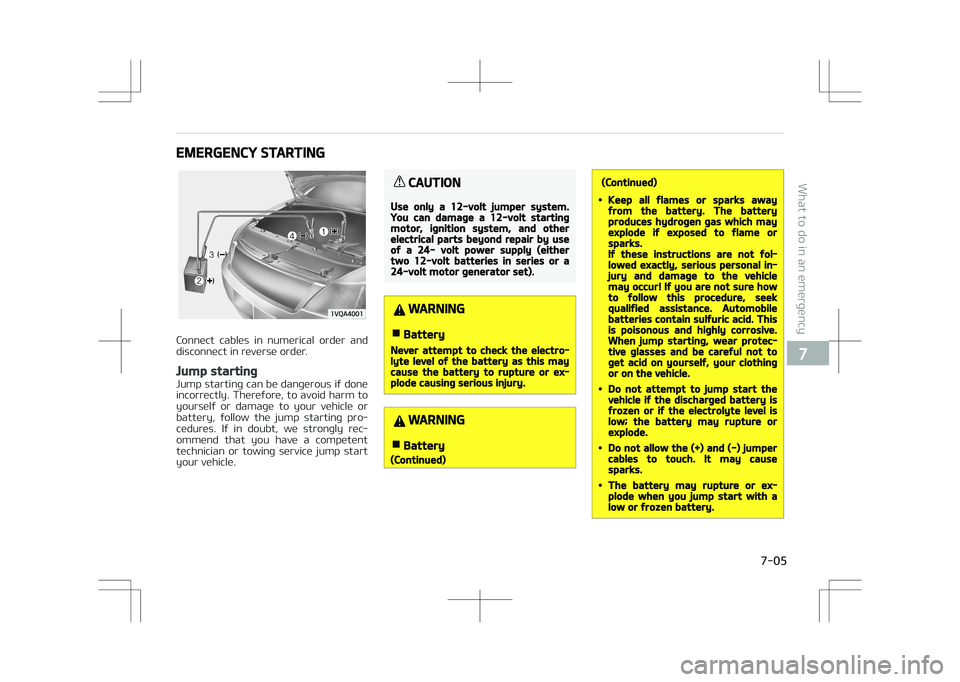
Connect cables in numerical order and
disconnect in reverse order.
Jump starting
Jump starting can be dangerous if done
incorrectly. Therefore, to avoid harm to yourself or damage to your vehicle or
battery, follow the jump starting pro‐
cedures. If in doubt, we strongly rec‐ ommend that you have a competent
technician or towing service jump start
your vehicle.
CAUTION
Use only a 12-volt jumper system.You can damage a 12-volt startingmotor, ignition system, and otherelectrical parts beyond repair by useof a 24- volt power supply (eithertwo 12-volt batteries in series or a24-volt motor generator set).
WARNING
nBattery
Never attempt to check the electro‐lyte level of the battery as this maycause the battery to rupture or ex‐plode causing serious injury.
WARNING
nBattery
(Continued)
(Continued)
•Keep all flames or sparks awayfrom the battery. The batteryproduces hydrogen gas which mayexplode if exposed to flame orsparks.If these instructions are not fol‐lowed exactly, serious personal in‐jury and damage to the vehiclemay occur! If you are not sure howto follow this procedure, seekqualified assistance. Automobilebatteries contain sulfuric acid. Thisis poisonous and highly corrosive.When jump starting, wear protec‐tive glasses and be careful not toget acid on yourself, your clothingor on the vehicle.
•Do not attempt to jump start thevehicle if the discharged battery isfrozen or if the electrolyte level islow; the battery may rupture orexplode.
•Do not allow the (+) and (-) jumpercables to touch. It may causesparks.
•The battery may rupture or ex‐plode when you jump start with alow or frozen battery.
7-05
7
What to do in an emergency
Page 339 of 523

(Continued)
Please note the expiry date on thesealant bottle.
Using the Tire Mobility Kit
1. Detach the speed restriction label(1) from the sealant bottle (2), and
place it in a highly visible place in‐
side the vehicle such as on the
steering wheel to remind the driver
not to drive too fast.
2. Filling the sealant Strictly follow the specified sequence, otherwise
the sealant may escape under high pressure.
3. Shake the sealant bottle.
4. Connect the filling hose (3) onto the connector of the sealant bottle (A).
5. Ensure that the button (9) on the compressor is not pressed.
6. Unscrew the valve cap from the valve of the defective wheel and
screw the filling hose (3) of the
sealant bottle onto the valve.
7. Insert the sealant bottle into the housing of the compressor so that
the bottle is upright (B).
8. Ensure that the compressor is switched off, position 0.
9. Connect between compressor and the vehicle power outlet using the
cable and connectors.
NOTICE
Only use the front passenger side
power outlet.
10. With the ignition switched on or en‐ gine start/stop button position on:
Switch on the compressor and let it
run for approximately 3 minutes to
fill the sealant. The inflation pres‐
sure of the tire after filling is unim‐
portant.
11. Switch off the compressor.
7-23
7
What to do in an emergency
Page 340 of 523

12. Detach the hose from the sealantbottle connector and from the tire
valve.
Return the Tire Mobility Kit to its stor‐ age location in the vehicle.
WARNING
Carbon monoxide poisoning and suf‐focation is possible if the engine isleft running in a poorly ventilated orunventilated location (such as insidea building).
Distributing the sealant
13. Immediately drive approximately 7~10km (4~6miles or, about 10min)
to evenly distribute the sealant in
the tire.
CAUTION
Do not exceed a speed of 60 km/h(35 mph). If possible, do not fall be‐low a speed of 20 km/h (12 mph).
(Continued)
(Continued)
While driving, if you experience anyunusual vibration, ride disturbanceor noise, reduce your speed anddrive with caution until you cansafely pull off of the side of theroad. Call for road side service ortowing.When you use the Tire Mobility Kit,the wheel may be stained by seal‐ant. Therefore, remove the wheelstained by sealant and have the ve‐hicle inspected at a professionalworkshop. Kia recommends to visitan authorized Kia dealer/servicepartner.
Checking the tire inflation
pressure
1. After driving approximately 7~10 km (4~6 miles or about
10 minutes), stop at a suitable lo‐
cation.
2. Connect the filling hose (3) of the compressor (clip mounted side) di‐
rectly and then connect the filling
hose (3) (opposite side) to the tire
valve. 3. Connect between compressor and
the vehicle battery using the cable
and connectors.
4. Adjust the tire inflation pressure to 200 kPa (29 psi). With the ignition
switched on, proceed as follows.
-
To increase the inflation pressure:
Switch on the compressor, position I.
To check the current inflation pres‐
sure setting, briefly switch off the
compressor.
WARNING
Do not let the compressor run formore than 10 minutes, otherwisethe device will overheat and may bedamaged.
-To reduce the inflation pressure:
Press the button (9) on the compres‐
sor.
What to do in an emergency
7-24
Page 342 of 523
TOWING
Towing service
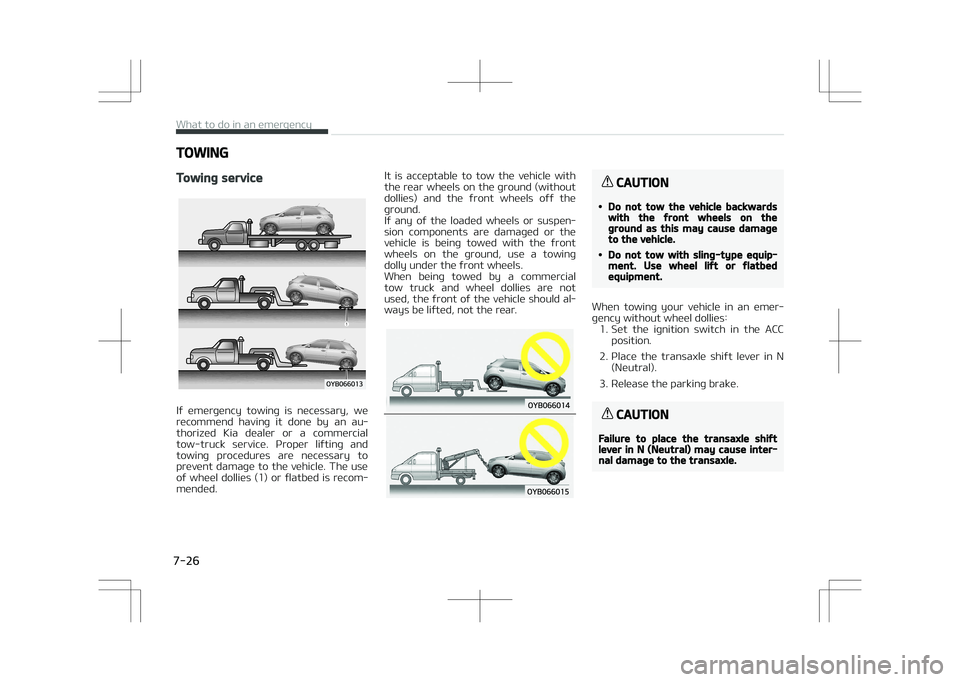
If emergency towing is necessary, we
recommend having it done by an au‐ thorized Kia dealer or a commercial
tow-truck service. Proper lifting and
towing procedures are necessary to prevent damage to the vehicle. The use
of wheel dollies (1) or flatbed is recom‐
mended. It is acceptable to tow the vehicle with
the rear wheels on the ground (without
dollies) and the front wheels off the
ground.
If any of the loaded wheels or suspen‐ sion components are damaged or the
vehicle is being towed with the front
wheels on the ground, use a towing dolly under the front wheels.
When being towed by a commercial
tow truck and wheel dollies are not
used, the front of the vehicle should al‐ ways be lifted, not the rear.
CAUTION
•Do not tow the vehicle backwardswith the front wheels on theground as this may cause damageto the vehicle.
•Do not tow with sling-type equip‐ment. Use wheel lift or flatbedequipment.
When towing your vehicle in an emer‐
gency without wheel dollies: 1. Set the ignition switch in the ACC position.
2. Place the transaxle shift lever in N (Neutral).
3. Release the parking brake.
CAUTION
Failure to place the transaxle shiftlever in N (Neutral) may cause inter‐nal damage to the transaxle.
What to do in an emergency
7-26
Page 344 of 523
(Continued)
•Using a portion of the vehicle oth‐er than the tow hooks for towingmay damage the body of your ve‐hicle.
•Use only a cable or chain specifi‐cally intended for use in towingvehicles. Securely fasten the cableor chain to the towing hook provi‐ded.
• Before emergency towing, check ifthe hook is not broken or damaged.
• Fasten the towing cable or chain se‐ curely to the hook.
• Do not jerk the hook. Apply it steadily and with even force.
• To avoid damaging the hook, do not pull from the side or at a vertical an‐
gle. Always pull straight ahead.
WARNING
Use extreme caution when towingthe vehicle.
(Continued)
(Continued)
•Avoid sudden starts or erratic driv‐ing maneuvers which would placeexcessive stress on the emergencytowing hook and towing cable orchain. The hook and towing cableor chain may break and cause seri‐ous injury or damage.
•If the disabled vehicle is unable tobe moved, do not forcibly continuethe towing. We recommend thatyou contact an authorized Kiadealer or a commercial tow truckservice for assistance.
•Tow the vehicle as straight aheadas possible.
•Keep away from the vehicle duringtowing.
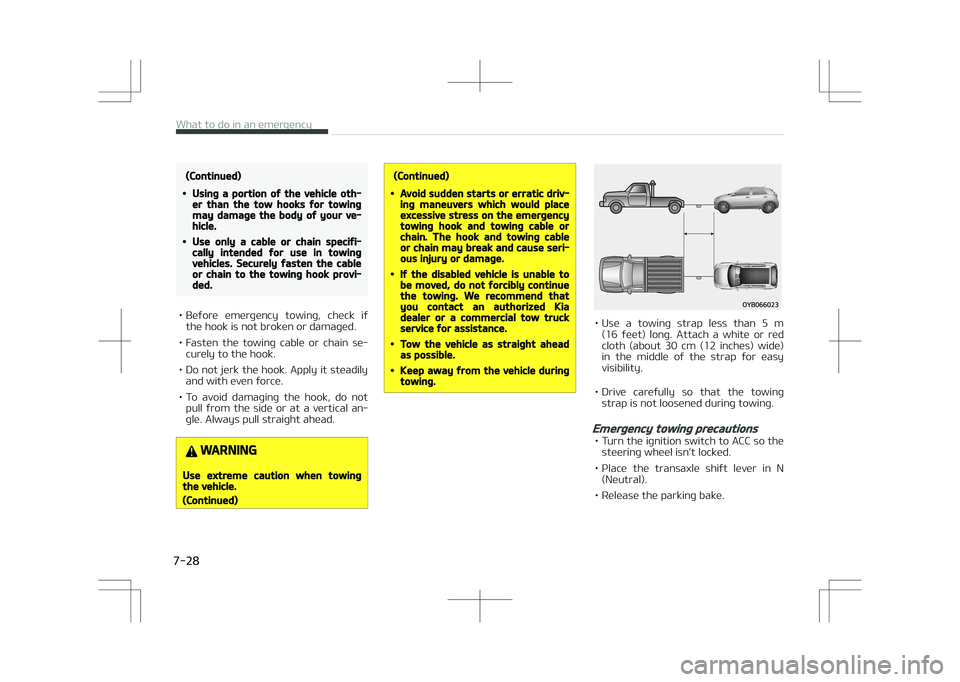
• Use a towing strap less than 5 m (16 feet) long. Attach a white or red
cloth (about 30 cm (12 inches) wide) in the middle of the strap for easy
visibility.
• Drive carefully so that the towing strap is not loosened during towing.
Emergency towing precautions
• Turn the ignition switch to ACC so the
steering wheel isn’t locked.
• Place the transaxle shift lever in N (Neutral).
• Release the parking bake.
What to do in an emergency
7-28
Page 345 of 523

• Press the brake pedal with moreforce than normal since you will have
reduced brake performance.
• More steering effort will be required because the power steering system
will be disabled.
• If you are driving down a long hill, the brakes may overheat and brake per‐
formance will be reduced. Stop often
and let the brakes cool off.
CAUTION
nAutomatic transaxle
•If the car is being towed with allfour wheels on the ground, it canbe towed only from the front. Besure that the transaxle is in neu‐tral. Be sure the steering is un‐locked by placing the ignitionswitch in the ACC position. A drivermust be in the towed vehicle tooperate the steering and brakes.
•To avoid serious damage to theautomatic transaxle, limit the ve‐hicle speed to 15 km/h (10 mph)and drive less than 1.5 km (1 mile)when towing.
(Continued)
(Continued)
•Before towing, check the auto‐matic transaxle for fluid leaks un‐der your vehicle. If the automatictransaxle fluid is leaking, flatbedequipment or a towing dolly mustbe used.
7-29
7
What to do in an emergency
Page 387 of 523

EXPLANATION OF SCHEDULED MAINTENANCE ITEMS
Engine oil and filter
The engine oil and filter should be
changed at the intervals specified in the maintenance schedule. If the vehi‐
cle is being driven in severe conditions,
more frequent oil and filter changes are required.
Drive belts
Inspect all drive belts for evidence of
cuts, cracks, excessive wear or oil satu‐ ration and replace if necessary. Drive
belts should be checked periodically for
proper tension and adjusted as neces‐
sary.
CAUTION
When you are inspecting the belt,place the ignition switch in theLOCK/OFF or ACC position.
Fuel filter cartridge (for diesel)
A clogged filter can limit the speed at
which the vehicle may be driven, dam‐
age the emission system and cause multiple issues such as hard starting. If
an excessive amount of foreign matter
accumulates in the fuel tank, the filter may require replacement more fre‐
quently.
After installing a new filter, run the en‐
gine for several minutes, and check for leaks at the connections. Have the fuel
filter replaced by a professional work‐
shop. Kia recommends to visit an au‐ thorized Kia dealer/service partner.
Fuel filter (for gasoline)
Kia gasoline vehicle is equipped a life‐
time fuel filter that integrated with the fuel tank. Regular maintenance or re‐
placement is not needed but depends
on fuel quality. If there are some im‐ portant safety matters like fuel flow
restriction, surging, loss of power, hard
starting problem etc, fuel filter inspec‐ tion or replace is needed.
Have the fuel filter inspected or re‐
placed by a professional workshop. Kia
recommends to visit an authorized Kia dealer/service partner.
Fuel lines, fuel hoses and
connections
Check the fuel lines, fuel hoses and
connections for leakage and damage. Have the fuel lines, fuel hoses and con‐
nections replaced by a professional
workshop. Kia recommends to visit an authorized Kia dealer/service partner.
WARNING
nDiesel only
Never work on the injection systemwith the engine running or within 30seconds after shutting off the en‐gine. High pressure pump, rail, injec‐tors and high pressure pipes aresubject to high pressure even afterthe engine stops. The fuel jet pro‐duced by fuel leaks may cause seri‐ous injury, if it touches the body.People using pacemakers should notmore move than 30 cm closer to theECU or wiring harness within the en‐gine room while the engine is run‐ning, since the high currents in theCommon Rail system produce con‐siderable magnetic fields.
8-41
8
Maintenance
Page 403 of 523

FUEL FILTER (FOR DIESEL)
Draining water from the fuel
filter
The fuel filter for diesel engine plays an
important role of separating water
from fuel and accumulating the water in its bottom.
If water accumulates in the fuel filter,
the warning light comes on when the
ignition switch is in the ON position.
If this warning light illumi‐ nates, take your car to a pro‐
fessional workshop and havedrain the water and check the
system. Kia recommends tovisit an authorized Kia dealer/
service partner.
CAUTION
If the water accumulated in the fuelfilter is not drained at proper times,damages to the major parts such asthe fuel system can be caused bywater permeation in the fuel filter.
Fuel filter cartridge replacement
NOTICE
When replacing the fuel filter car‐
tridge, use parts for replacement
from a professional workshop. Kia
recommends to visit an authorized
Kia dealer/service partner.
8-57
8
Maintenance