2018 KIA STINGER brake
[x] Cancel search: brakePage 478 of 551
Maintenance
50
7
Production options weight: The
combined weight of installed regular
production options weighing over 2.3
kg (5 lb.) in excess of the standard
items which they replace, not previ-
ously considered in curb weight or
accessory weight, including heavy
duty brakes, ride levelers, roof rack,
heavy duty battery, and special trim.
Recommended Inflation Pressure:
Vehicle manufacturer's recommend-
ed tire inflation pressure and shown
on the tire placard.
Radial Ply Tire: A pneumatic tire in
which the ply cords that extend to the
beads are laid at 90 degrees to the
centerline of the tread.
Rim: A metal support for a tire and
upon which the tire beads are seat-
ed.
Sidewall: The portion of a tire
between the tread and the bead. Speed Rating:
An alphanumeric
code assigned to a tire indicating the
maximum speed at which a tire can
operate.
Traction: The friction between the
tire and the road surface. The
amount of grip provided.
Tread: The portion of a tire that
comes into contact with the road.
Treadwear Indicators: Narrow
bands, sometimes called "wear
bars," that show across the tread of a
tire when only 1/16 inch of tread
remains.
UTQGS: Uniform Tire Quality
Grading Standards, a tire information
system that provides consumers with
ratings for a tire's traction, tempera-
ture and treadwear. Ratings are
determined by tire manufacturers
using government testing proce-
dures. The ratings are molded into
the sidewall of the tire.
Vehicle Capacity Weight: The num-
ber of designated seating positions
multiplied by 68kg (150 lbs.) plus the
rated cargo and luggage load. Vehicle Maximum Load on the
Tire:
Load on an individual tire due
to curb and accessory weight plus
maximum occupant and cargo
weight.
Vehicle Normal Load on the Tire:
Load on an individual tire that is
determined by distributing to each
axle its share of the curb weight,
accessory weight, and normal occu-
pant weight and driving by 2.
Vehicle Placard: A label permanent-
ly attached to a vehicle showing the
original equipment tire size and rec-
ommended inflation pressure.
Page 498 of 551
![KIA STINGER 2018 Owners Manual Maintenance
70
7
Fuse NameFuse ratingCircuit Protected
E-CVVT 220A[THETA II 2.0L T-GDI Engine] ECM (Engine Control Module)
ESC 310AESC (Electronic Stability Control) Control Module, Multipurpose Check](/manual-img/2/40391/w960_40391-497.png "KIA STINGER 2018 Owners Manual Maintenance
70
7
Fuse NameFuse ratingCircuit Protected
E-CVVT 220A[THETA II 2.0L T-GDI Engine] ECM (Engine Control Module)
ESC 310AESC (Electronic Stability Control) Control Module, Multipurpose Check")
Maintenance
70
7
Fuse NameFuse ratingCircuit Protected
E-CVVT 220A[THETA II 2.0L T-GDI Engine] ECM (Engine Control Module)
ESC 310AESC (Electronic Stability Control) Control Module, Multipurpose Check Connector
ECU 310AECM (Engine Control Module)
ECU 215AECM (Engine Control Module)
HORN20AHorn Relay
WIPER 130AWiper Power Relay
TCU 215ATCM (Transmission Control Module)
SENSOR 410ABrake Vacuum Switch, Vacuum Pump Relay, Electric Oil Pump Inverter
TCU 120ATCM (Transmission Control Module)
WIPER 210AIBU (Integrated Body Control Unit), ECM (Electronic Control Module)
SENSOR 115ARear Sub Junction Block (Fuel Pump Relay)
SENSOR520A[THETA II 2.0L T-GDI Engine] Ignition Coil #1/#2/#3/#4
[Lambda II 3.3L T-GDI Engine] Ignition Coil #1/#2/#3/#4/#5/#6
Page 505 of 551

777
Maintenance
LIGHT BULBS
Bulb replacement precaution
Please keep extra bulbs on hand
with appropriate wattage ratings in
case of emergencies.
Refer to “Bulb Wattage” in chapter 8.
When changing lamps, first turn off
the engine at a safe place, firmly
apply the parking brake and detach
the battery’s negative (-) terminal.
Use only bulbs of the specifiedwattage.✽ ✽ NOTICE
• If the light bulb or lamp connector
is removed while the lamp is still
on, the fuse box's electronic sys-
tem may log it as a malfunction.
Therefore, a lamp malfunction
incident may be recorded as a
Diagnostic Trouble Code (DTC) in
the fuse box.
• It is normal for an operating lamp to flicker momentarily. This is due
to a stabilization function of the
vehicle’s electronic control device.
If the lamp lights up normally
after momentarily blinking, then
it is functioning as normal.
However, if the lamp continues to
flicker several times or turns off
completely, there may be an error
in the vehicle’s electronic control
device. Please have the vehicle
checked by an authorized Kia
dealer immediately.
WARNING- Working on
the lights
Prior to working on the light,
firmly apply the parking brake,
ensure that the ignition switch
is turned to the LOCK position
and turn off the lights to avoid
sudden movement of the vehi-
cle and burning your fingers or
receiving an electric shock.
CAUTION -Light replace-
ment
Be sure to replace the burned- out bulb with one of the samewattage rating. Otherwise, itmay cause damage to the fuseor electric wiring system.
CAUTION -Headlamp
Lens
To prevent damage, do notclean the headlamp lens withchemical solvents or strongdetergents.
Page 519 of 551
791
Maintenance
APPEARANCE CARE
Exterior care
Exterior general caution
It is very important to follow the label
directions when using any chemical
cleaner or polish. Read all warning
and caution statements that appear
on the label.
Finish maintenance
Washing
To help protect your vehicle’s finish
from rust and deterioration, wash it
thoroughly and frequently at least
once a month with lukewarm or cold
water.
If you use your vehicle for off-road
driving, you should wash it after each
off-road trip. Pay special attention to
the removal of any accumulation of
salt, dirt, mud, and other foreign mate-
rials. Make sure the drain holes in the
lower edges of the doors and rocker
panels are kept clear and clean.
Insects, tar, tree sap, bird droppings,
industrial pollution and similar
deposits can damage your vehicle’s
finish if not removed immediately.
Even prompt washing with plain water
may not completely remove all these
deposits. A mild soap, safe for use on
painted surfaces, may be used.
After washing, rinse the vehicle thor-
oughly with lukewarm or cold water.
Do not allow soap to dry on the finish.After washing the vehicle, test the
brakes while driving slowly to see if
they have been affected by water. If
braking performance is impaired, dry
the brakes by applying them lightly
while maintaining a slow forward
speed.
Page 522 of 551
Maintenance
94
7
Do a thorough washing of the
undercarriage at the end of the
winter.
Use professional service techni- cians or governmental inspection
stations to annually inspect for cor-
rosion.
Immediately seek an inspection of your vehicle if you become visually
aware of corrosion flaking or scal-
ing or if you become aware of a
change in vehicle performance,
such as soft or spongey brakes,
fluids leaking, impairment of direc-
tional control, suspension noises
or rattling metal straps.Aluminum wheel maintenance
The aluminum wheels are coated
with a clear protective finish.
Do not use any abrasive cleaner,polishing compound, solvent, or
wire brushes on aluminum wheels.
They may scratch the finish.
Clean the wheel when it has cooled.
Use only a mild soap or neutral detergent, and rinse thoroughly
with water. Also, be sure to clean
the wheels after driving on salted
roads. This helps prevent corro-
sion.
Avoid washing the wheels with highspeed vehicle wash brushes.
Do not use any alkaline or acid detergents It may damage and cor-
rode the aluminum wheels coated
with a clear protective finish.
Corrosion protection
Protecting your vehicle from corrosion
By using the most advanced design
and construction practices to combat
corrosion, we produce vehicles of
the highest quality. However, this is
only part of the job. To achieve the
long-term corrosion resistance your
vehicle can deliver, the owner's
cooperation and assistance is also
required.
Common causes of corrosion
The most common causes of corro-
sion on your vehicle are:
Road salt, dirt and moisture that isallowed to accumulate underneath
the vehicle.
Removal of paint or protective coatings by stones, gravel, abra-
sion or minor scrapes and dents
which leave unprotected metal
exposed to corrosion.
Page 537 of 551
87
Specifications & Consumer information
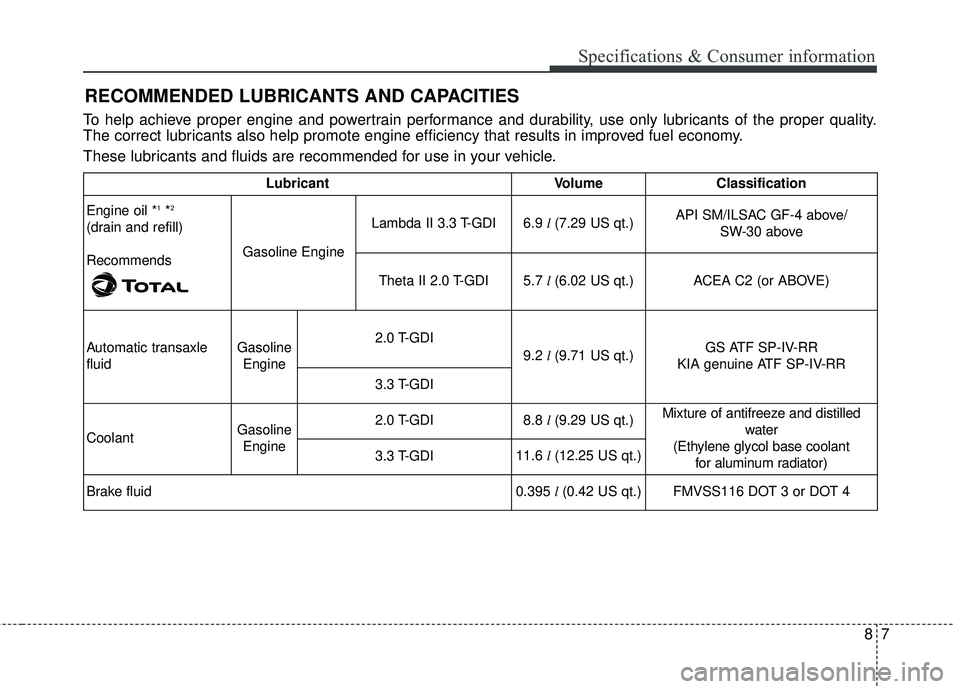
RECOMMENDED LUBRICANTS AND CAPACITIES
To help achieve proper engine and powertrain performance and durability, use only lubricants of the proper quality.
The correct lubricants also help promote engine efficiency that results in improved fuel economy.
These lubricants and fluids are recommended for use in your vehicle.
Lubricant VolumeClassification
Engine oil *1*2
(drain and refill)
Recommends
Gasoline Engine
Lambda II 3.3 T-GDI6.9 l (7.29 US qt.)API SM/ILSAC GF-4 above/
SW-30 above
Theta II 2.0 T-GDI5.7 l (6.02 US qt.)ACEA C2 (or ABOVE)
Automatic transaxle
fluidGasoline
Engine 2.0 T-GDI
9.2 l (9.71 US qt.)GS ATF SP-IV-RR
KIA genuine ATF SP-IV-RR
3.3 T-GDI
CoolantGasoline Engine2.0 T-GDI8.8 l (9.29 US qt.)Mixture of antifreeze and distilled
water
(Ethylene glycol base coolant for aluminum radiator)
3.3 T-GDI11.6 l (12.25 US qt.)
Brake fluid0.395 l (0.42 US qt.)FMVSS116 DOT 3 or DOT 4
Page 544 of 551
I3
Index
Before driving . . . . . . . . . . . . . . . . . . . . . . . . . . . . . . . . . 5-5Before entering vehicle . . . . . . . . . . . . . . . . . . . . . . . 5-5
Before starting . . . . . . . . . . . . . . . . . . . . . . . . . . . . . . 5-5
Necessary inspections . . . . . . . . . . . . . . . . . . . . . . . . 5-5
Blind-spot Collision Warning (BCW) . . . . . . . . . . . . 5-120 BCW (Blind-spot collision warning) . . . . . . . . . . . 5-121
Driver's attention . . . . . . . . . . . . . . . . . . . . . . . . . . 5-127
RCCW (Rear Cross-traffic Collision Warning) . . . 5-123
Brake fluid . . . . . . . . . . . . . . . . . . . . . . . . . . . . . . . . . . 7-26\
Checking the brake fluid level . . . . . . . . . . . . . . . . . 7-26
Brake system. . . . . . . . . . . . . . . . . . . . . . . . . . . . . . . . . 5-40 Anti-lock Brake System (ABS) . . . . . . . . . . . . . . . . 5-54
Auto hold . . . . . . . . . . . . . . . . . . . . . . . . . . . . . . . . . 5-50
Electronic Parking Brake (EPB) . . . . . . . . . . . . . . . 5-44
Electronic Stability Control (ESC) . . . . . . . . . . . . . 5-56
Good braking practices . . . . . . . . . . . . . . . . . . . . . . 5-62
Hill-start Assist Control (HAC) . . . . . . . . . . . . . . . . 5-61
Parking brake – Foot type . . . . . . . . . . . . . . . . . . . . 5-42
Power brakes . . . . . . . . . . . . . . . . . . . . . . . . . . . . . . 5-40
Vehicle Stability Management (VSM) . . . . . . . . . . . 5-60
Warning messages . . . . . . . . . . . . . . . . . . . . . . . . . . 5-53
Bulb wattage . . . . . . . . . . . . . . . . . . . . . . . . . . . . . . . . . . 8-3
Checking fluid levels . . . . . . . . . . . . . . . . . . . . . . . . . . 7-19 Child Restraint System (CRS) . . . . . . . . . . . . . . . . . . . 3-34
Children always in the rear . . . . . . . . . . . . . . . . . . . 3-34
Installing a Child restraint System (CRS) . . . . . . . . 3-38
Selecting a Child restraint System (CRS) . . . . . . . . 3-35
Climate control air filter . . . . . . . . . . . . . . . . . . . . . . . . 7-30 Filter inspection . . . . . . . . . . . . . . . . . . . . . . . . . . . . 7-30
Cruise control system . . . . . . . . . . . . . . . . . . . . . . . . . . 5-78 To cancel cruise control, do one of the following . . 5-80
To decrease the cruising speed . . . . . . . . . . . . . . . . . 5-80
To increase cruise control set speed . . . . . . . . . . . . . 5-79
To resume cruising speed at more than approximately 30 km/h (20 mph) . . . . . . . . . . . . . . . . . . . . . . . . . 5-81
To set cruise control speed . . . . . . . . . . . . . . . . . . . . 5-79
To temporarily accelerate with the cruise control on . 5-80
To turn cruise control off, do one of the following . 5-81
Declaration of Conformity . . . . . . . . . . . . . . . . . . . . . 4-166 IC . . . . . . . . . . . . . . . . . . . . . . . . . . . . . . . . . . . . \
. . 4-166
Defroster . . . . . . . . . . . . . . . . . . . . . . . . . . . . . . . . . . . 4-\
131 Rear window defroster . . . . . . . . . . . . . . . . . . . . . . 4-131
Dimensions . . . . . . . . . . . . . . . . . . . . . . . . . . . . . . . . . . . 8-\
2
Door locks. . . . . . . . . . . . . . . . . . . . . . . . . . . . . . . . . . . 4-\
16 Child-protector rear door lock . . . . . . . . . . . . . . . . . 4-19
Door lock/unlock features . . . . . . . . . . . . . . . . . . . . 4-19
Operating door locks from inside the vehicle . . . . . 4-17
Operating door locks from outside the vehicle . . . . 4-16
C
D
Page 545 of 551

Index
4I
Drive mode integrated control system . . . . . . . . . . . . 5-105
Driver Attention Warning (DAW). . . . . . . . . . . . . . . . 5-129Resetting the system. . . . . . . . . . . . . . . . . . . . . . . . 5-131
System disabled . . . . . . . . . . . . . . . . . . . . . . . . . . . 5-131
System malfunction . . . . . . . . . . . . . . . . . . . . . . . . 5-132
System setting and activation . . . . . . . . . . . . . . . . . 5-129
Economical operation . . . . . . . . . . . . . . . . . . . . . . . . . 5-134
Emergency starting . . . . . . . . . . . . . . . . . . . . . . . . . . . . . 6-5 Jump starting . . . . . . . . . . . . . . . . . . . . . . . . . . . . . . . 6-5
Push-starting . . . . . . . . . . . . . . . . . . . . . . . . . . . . . . . . 6-6
Emission control system . . . . . . . . . . . . . . . . . . . . . . . . 7-99 Crankcase emission control system . . . . . . . . . . . . . 7-99
Evaporative emission control (including ORVR Onboard Refueling Vapor Recovery) system. . . . . 7-99
Exhaust emission control system . . . . . . . . . . . . . . 7-100
Engine . . . . . . . . . . . . . . . . . . . . . . . . . . . . . . . . . . . . \
. . . 8-2
Engine compartment . . . . . . . . . . . . . . . . . . . . . . . . 2-6, 7-3
Engine coolant . . . . . . . . . . . . . . . . . . . . . . . . . . . . . . . 7-22 Changing the coolant . . . . . . . . . . . . . . . . . . . . . . . . 7-25
Checking the coolant level . . . . . . . . . . . . . . . . . . . . 7-22
Engine number . . . . . . . . . . . . . . . . . . . . . . . . . . . . . . . 8-11
Engine oil . . . . . . . . . . . . . . . . . . . . . . . . . . . . . . . . . . . 7-\
20 Changing the engine oil and filter . . . . . . . . . . . . . . 7-21
Checking the engine oil level . . . . . . . . . . . . . . . . . . 7-20 Engine start/stop button . . . . . . . . . . . . . . . . . . . . . . . . . 5-7
Engine start/stop button position . . . . . . . . . . . . . . . . 5-7
Illuminated engine start/stop button. . . . . . . . . . . . . . 5-7
Starting the engine with a smart key . . . . . . . . . . . . . 5-9
Explanation of scheduled maintenance items . . . . . . . 7-16
Exterior overview . . . . . . . . . . . . . . . . . . . . . . . . . . . . . . 2-2
Forward Collision-avoidance Assist (FCA) . . . . . . . . . 5-64 Brake operation . . . . . . . . . . . . . . . . . . . . . . . . . . . . 5-68
FCA front radar/camera sensor . . . . . . . . . . . . . . . . 5-68
FCA warning message and system control . . . . . . . 5-67
Limitation of the system . . . . . . . . . . . . . . . . . . . . . 5-72
System malfunction . . . . . . . . . . . . . . . . . . . . . . . . . 5-70
System setting and activation . . . . . . . . . . . . . . . . . . 5-64
Fuel filler lid . . . . . . . . . . . . . . . . . . . . . . . . . . . . . . . . . 4-41 Closing the fuel filler lid . . . . . . . . . . . . . . . . . . . . . 4-41
Emergency fuel filler lid release . . . . . . . . . . . . . . . 4-42
Opening the fuel filler lid. . . . . . . . . . . . . . . . . . . . . 4-41
Fuel requirements . . . . . . . . . . . . . . . . . . . . . . . . . . . . . . 1-3 Do not use methanol . . . . . . . . . . . . . . . . . . . . . . . . . 1-5
Fuel additives . . . . . . . . . . . . . . . . . . . . . . . . . . . . . . . 1-5
Gasoline containing alcohol and methanol . . . . . . . . 1-3
Gasoline containing MMT . . . . . . . . . . . . . . . . . . . . . 1-5
Operation in foreign countries . . . . . . . . . . . . . . . . . . 1-6
Other fuels . . . . . . . . . . . . . . . . . . . . . . . . . . . . . . . . . 1-4
Use of MTBE . . . . . . . . . . . . . . . . . . . . . . . . . . . . . . . 1-5
EF