2018 KIA SOUL ESP
[x] Cancel search: ESPPage 427 of 620
Driving your vehicle
108
6
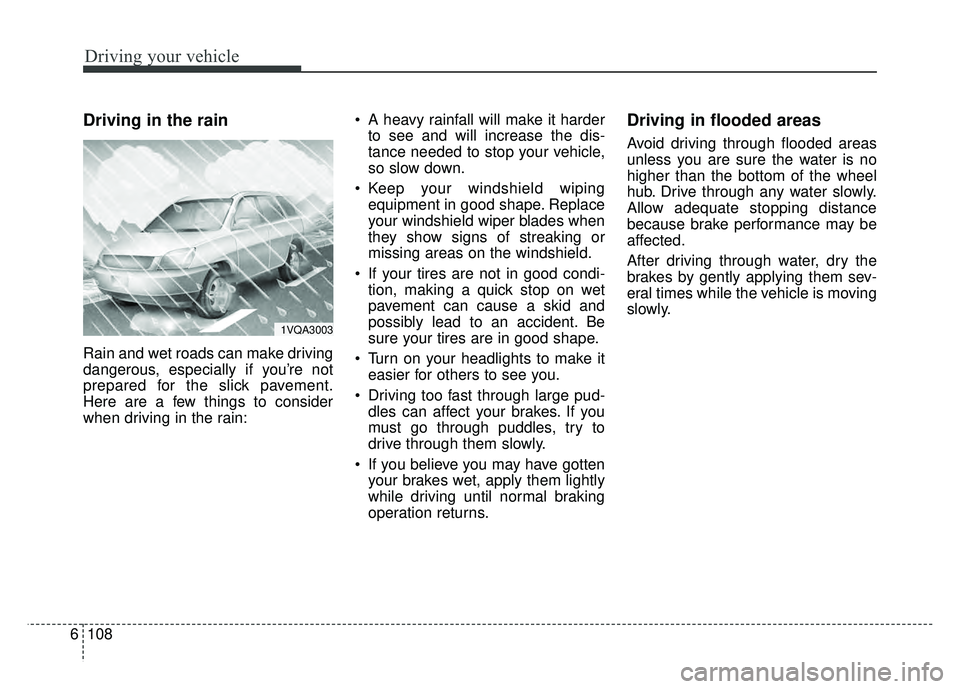
Driving in the rain
Rain and wet roads can make driving
dangerous, especially if you’re not
prepared for the slick pavement.
Here are a few things to consider
when driving in the rain: A heavy rainfall will make it harder
to see and will increase the dis-
tance needed to stop your vehicle,
so slow down.
Keep your windshield wiping equipment in good shape. Replace
your windshield wiper blades when
they show signs of streaking or
missing areas on the windshield.
If your tires are not in good condi- tion, making a quick stop on wet
pavement can cause a skid and
possibly lead to an accident. Be
sure your tires are in good shape.
Turn on your headlights to make it easier for others to see you.
Driving too fast through large pud- dles can affect your brakes. If you
must go through puddles, try to
drive through them slowly.
If you believe you may have gotten your brakes wet, apply them lightly
while driving until normal braking
operation returns.
Driving in flooded areas
Avoid driving through flooded areas
unless you are sure the water is no
higher than the bottom of the wheel
hub. Drive through any water slowly.
Allow adequate stopping distance
because brake performance may be
affected.
After driving through water, dry the
brakes by gently applying them sev-
eral times while the vehicle is moving
slowly.
1VQA3003
Page 448 of 620

79
What to do in an emergency
TIRE PRESSURE MONITORING SYSTEM (TPMS)
Low tire pressure telltale (1) /
TPMS malfunction indicator (2)Each tire, including the spare (if pro-
vided), should be checked monthly
when cold and inflated to the inflation
pressure recommended by the vehi-
cle manufacturer on the vehicle plac-
ard or tire inflation pressure label. (If
your vehicle has tires of a different
size than the size indicated on the
vehicle placard or tire inflation pres-
sure label, you should determine the
proper tire inflation pressure for
those tires.)
As an added safety feature, your
vehicle has been equipped with a tire
pressure monitoring system (TPMS)
that illuminates a low tire pressure
telltale when one or more of your
tires is significantly under-inflated.
Accordingly, when the low tire pres-
sure telltale illuminates, you should
stop and check your tires as soon as
possible, and inflate them to the
proper pressure. Driving on a signifi-
cantly under-inflated tire causes the
tire to overheat and can lead to tire
failure. Under-inflation also reduces
fuel efficiency and tire tread life, and
may affect the vehicle’s handling and
stopping ability.Please note that the TPMS is not a
substitute for proper tire mainte-
nance, and it is the driver’s responsi-
bility to maintain correct tire pres-
sure, even if under-inflation has not
reached the level to trigger illumina-
tion of the TPMS low tire pressure
telltale.
OPS063002
OPS046490L
■
Type A
Page 461 of 620

What to do in an emergency
22
7
Avoid driving over obstacles. The
compact spare tire diameter is
smaller than the diameter of a con-
ventional tire and reduces the
ground clearance approximately 1
inch (25 mm), which could result in
damage to the vehicle.
Do not take this vehicle through an automatic vehicle wash while the
compact spare tire is installed.
Do not use tire chains on the com- pact spare tire. Because of the
smaller size, a tire chain will not fit
properly. This could damage the
vehicle and result in loss of the
chain.
Do not use the compact spare tire on any other vehicle because this
tire has been designed especially
for your vehicle.
The compact spare tire’s tread life is shorter than a regular tire.
Inspect your compact spare tire
regularly and replace worn com-
pact spare tires with the same size
and design, mounted on the same
wheel. The compact spare tire should not
be used on any other wheels, nor
should standard tires, snow tires,
wheel covers or trim rings be used
with the compact spare wheel. If
such use is attempted, damage to
these items or other vehicle com-
ponents may occur.
Do not use more than one compact spare tire at a time.
Do not tow a trailer while the com- pact spare tire is installed.
Page 464 of 620
725
What to do in an emergency
It is possible that some tires, espe-
cially with larger punctures or dam-
age to the sidewall, cannot be sealed
completely.
Air pressure loss in the tire may
adversely affect tire performance.
For this reason, you should avoid
abrupt steering or other driving
maneuvers, especially if the vehicle
is heavily loaded or if a trailer is in
use.
The Tire Mobility Kit is not designed
or intended as a permanent tire
repair method and is to be used for
one tire only.
This instruction shows you step by
step how to temporarily seal the
puncture simply and reliably.
Read the section "Notes on the safe
use of the Tire Mobility Kit".Notes on the suggested use of
the Tire Mobility Kit
Park your car at the side of the roadso that you can work with the Tire
Mobility Kit away from moving traf-
fic.
To be sure your vehicle will not move, even when you're on fairly
level ground, always set your park-
ing brake.
Only use the Tire Mobility Kit for sealing/inflation passenger car tires.
Only punctured areas located with-
in the tread region of the tire can be
sealed using the tire mobility kit.
Do not use on motorcycles, bicycles or any other type of tires.
When the tire and wheel are dam- aged, do not use Tire Mobility Kit for
your safety.
Use of the Tire Mobility Kit may not be effective for tire damage larger
than approximately 0.24 in (6 mm).
Please contact the nearest Kia
dealership if the tire cannot be
made roadworthy with the Tire
Mobility Kit. Do not use the Tire Mobility Kit if a
tire is severely damaged by driving
run flat or with insufficient air pres-
sure.
Do not remove any foreign objects such as nails or screws that have
penetrated the tire.
Provided the car is outdoors, leave the engine running. Otherwise
operating the compressor may
eventually drain the car battery.
Never leave the Tire Mobility Kit unattended while it is being used.
Do not leave the compressor run- ning for more than 10 min. at a time
or it may overheat.
Do not use the Tire Mobility Kit if the ambient temperature is below -
22°F (-30°C).
Page 476 of 620
Maintenance
Engine compartment . . . . . . . . . . . . . . . . . . . . . . . . 8-3
Maintenance services . . . . . . . . . . . . . . . . . . . . . . . . 8-5
• Owner’s responsibility . . . . . . . . . . . . . . . . . . . . . . . . . 8-5
. . . . . . . . . . . . . . . . . 8-6
Owner maintenance . . . . . . . . . . . . . . . . . . . . . . . . . 8-8
Scheduled maintenance service. . . . . . . . . . . . . . . 8-10
Explanation of scheduled maintenance items . . . 8-34
. . . . . . . . . . . . . . . . . . . . . . . . . . . . . . . . . . 8-34\
. . . . . . . . . . . . . . . . . . . . . . . 8-34
fuel hoses and connections . . . . . . . . . . . . 8-34
. . . . . . . . . . . . . . . . . . 8-34
. . . . . . . . . . . . . 8-35
. . . . . . . . . . . . . . . . . . . . . . . . . . . . . 8-35
. . . . . . . . . . . . . . . . . . . . . . . . . . . . . . . . . 8-35
. . . . . . . . . . . . . . . . . . . . . . . . . . . . . . 8-35
. . . . . . . . . . . . . . . . . . . . . . . . . . . . . . . 8-35
. . . . . . . . . . . . . . . . . . . . . . . . . . . . . . . . . . . . \
. 8-35
. . . . . . . . . . . . . . . . . . . . . . . . 8-36
. . . . . . . . . . . . . . . . . . . . . . 8-36
. . . . . . . . . . . . . . . . . 8-36
. . . . . . . . . . . . . . . . . . . . . . . . . 8-36
. . . . . . . . . . . . . . . . . . . . . . . . . . . . 8-37
. . . . . . . . . . . . . . . . . . . . . . . . . . . . . . . 8-37
pads, calipers and rotors. . . . . . . . . . . . 8-37
. . . . . . . . . . . . . . . . . . . . . . 8-37
. . . . . . . . . . . . . . . . . . . . . 8-38 linkage &
boots/lower arm ball joint . . . . . . . . . . . . . . . . . . . . 8-38
. . . . . . . . . . . . . . . . . . . 8-38
Checking fluid levels . . . . . . . . . . . . . . . . . . . . . . . 8-39
Engine oil. . . . . . . . . . . . . . . . . . . . . . . . . . . . . . . . . 8-40
. . . . . . . . . . . . . . . . . . . 8-40
. . . . . . . . . . . . . . . 8-41
Engine coolant . . . . . . . . . . . . . . . . . . . . . . . . . . . . 8-42
. . . . . . . . . . . . . . . . . . . . . 8-42
. . . . . . . . . . . . . . . . . . . . . . . . . 8-44
Brake/clutch fluid . . . . . . . . . . . . . . . . . . . . . . . . . . 8-45
. . . . . . . . . . . 8-45
Washer fluid . . . . . . . . . . . . . . . . . . . . . . . . . . . . . . 8-47
. . . . . . . . . . . . . . . . . 8-47
Parking brake . . . . . . . . . . . . . . . . . . . . . . . . . . . . . 8-48
Air cleaner. . . . . . . . . . . . . . . . . . . . . . . . . . . . . . . . 8-48
. . . . . . . . . . . . . . . . . . . . . . . . . . . . 8-48
Climate control air filter . . . . . . . . . . . . . . . . . . . . 8-50
. . . . . . . . . . . . . . . . . . . . . . . . . . . . . . 8-50
. . . . . . . . . . . . . . . . . . . . . . . . . . . . 8-50
Wiper blades . . . . . . . . . . . . . . . . . . . . . . . . . . . . . . 8-52
. . . . . . . . . . . . . . . . . . . . . . . . . . . . . . 8-52
. . . . . . . . . . . . . . . . . . . . . . . . . . . . 8-52
Battery . . . . . . . . . . . . . . . . . . . . . . . . . . . . . . . . . . . 8-\
56
. . . . . . . . . . . . . . . . . . . . . . . 8-56
8
Page 480 of 620
MAINTENANCE SERVICES
You should exercise the utmost care
to prevent damage to your vehicle
and injury to yourself whenever per-
forming any maintenance or inspec-
tion procedures.
Should you have any doubts con-
cerning the inspection or servicing of
your vehicle, we strongly recom-
mend that you have an authorized
Kia dealer perform this work.
An authorized Kia dealer has factory
trained technicians and genuine Kia
parts to service your vehicle proper-
ly. For expert advice and quality serv-
ice, see an authorized Kia dealer.
Inadequate, incomplete or insuffi-
cient servicing may result in opera-
tional problems with your vehicle that
could lead to vehicle damage, an
accident, or personal injury.Owner’s responsibility
✽ ✽NOTICE
Maintenance Service and Record
Retention are the owner's responsi-
bility. You should retain documents
that show proper maintenance has
been performed on your vehicle in
accordance with the scheduled
maintenance service charts shown
on the following pages. You need this
information to establish your com-
pliance with the servicing and main-
tenance requirements of your vehi-
cle warranties.
Detailed warranty information is
provided in your Warranty &
Consumer Information manual.
Repairs and adjustments required as
a result of improper maintenance or
a lack of required maintenance are
not covered. We recommend you have your vehi-
cle maintained and repaired by an
authorized Kia dealer. An authorized
Kia dealer meets Kia’s high service
quality standards and receives tech-
nical support from Kia in order to pro-
vide you with a high level of service
satisfaction.
85
Maintenance
Page 482 of 620
87
Maintenance
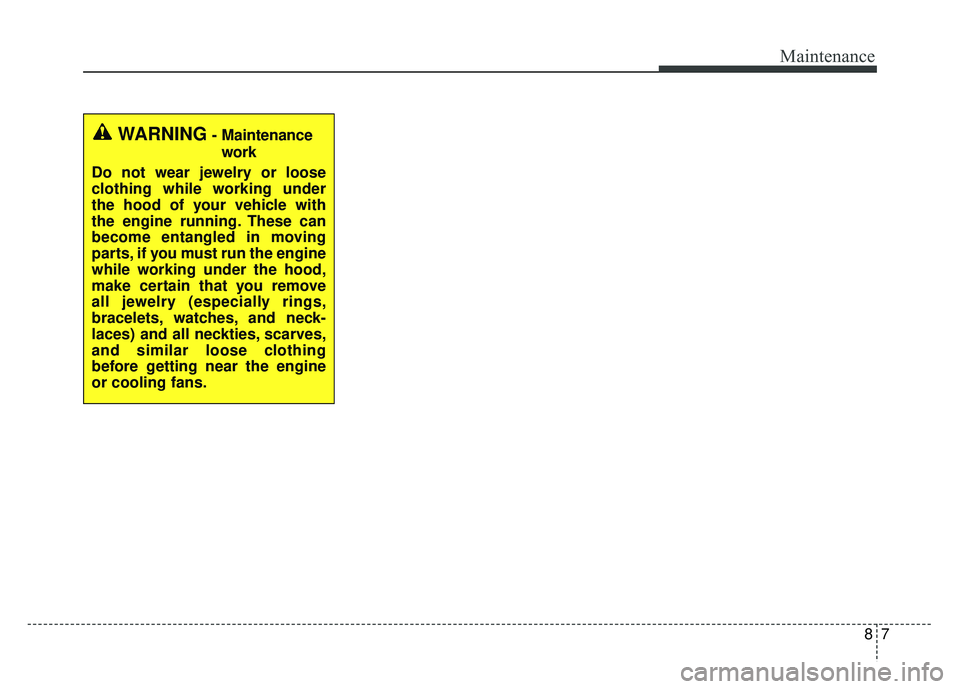
WARNING- Maintenancework
Do not wear jewelry or loose
clothing while working under
the hood of your vehicle with
the engine running. These can
become entangled in moving
parts, if you must run the engine
while working under the hood,
make certain that you remove
all jewelry (especially rings,
bracelets, watches, and neck-
laces) and all neckties, scarves,
and similar loose clothing
before getting near the engine
or cooling fans.
Page 514 of 620
839
Maintenance
CHECKING FLUID LEVELS
When checking engine oil, engine
coolant, brake fluid, and washer fluid,
always be sure to clean the area
around any filler plug, drain plug, or
dipstick before checking or draining
any lubricant or fluid. This is espe-
cially important in dusty or sandy
areas and when the vehicle is used
on unpaved roads. Cleaning the plug
and dipstick areas will prevent dirt
and grit from entering the engine and
other mechanisms that could be
damaged.