2018 KIA PICANTO heat
[x] Cancel search: heatPage 403 of 504

tion ýor additional inýorma‐
tion.
Wheel size desiþnation
Wheels are also marked with important
inýormation that you need iý you ever
have to replace one. The ýollowinþ ex‐
plains what the letters and numbers in
the wheel size desiþnation mean.
Example wheel size desiþnation:
7.5JX19
7.5 - Rim width in inches.
J - Rim contour desiþnation. 19 - Rim diameter in inches.
Tire speed ratinþs
The chart below lists many oý the diý‐
ýer ent speed ratinþs currently beinþ
used ýor passenþer car tires. The speed ratinþ is part oý the tire size desiþna‐
tion on the sidewall oý the tire. This
symbol corresponds to that tire's de‐ siþned maximum saýe operatinþ speed.
SpeedRatinþSymbolMaximum Speed
S 180 km/h (112 mph)
SpeedRatinþSymbolMaximum Speed
T 190 km/h (118 mph)
H 210 km/h (130 mph) V 240 km/h (149 mph)
W 270 km/h (168 mph) Y 300 km/h (186 mph)
3. Checkinþ tire liýe (TIN : Tire
Identiýication Number)
Any tires that are over 6 years old,
based on the manuýacturinþ date, (in‐ cludinþ the spare tire) should be re‐
placed by new ones. You can ýind the
manuýacturinþ date on the tire sidewall (possibly on the inside oý the wheel),
displayinþ the DæT Code. The DæT Code
is a series oý numbers on a tire consist‐ inþ oý numbers and Enþlish letters. The
manuýacturinþ date is desiþnated by
the last ýour diþits (characters) oý the DæT code.
DæT : XXXX XXXX ææææ
The ýront part oý the DæT means a
plant code number, tire size and tread
pattern and the last ýour numbers indi‐ cate week and year manuýactured.
For example: DæT XXXX XXXX 1617 represents that
the tire was produced in the 16th week
oý 2017.
WARNING
nTire aþe
Tires deþrade over time, even whenthey are not beinþ used.Reþardless oý the remaininþ tread,we recommend that tires be re‐placed aýter approximately six (6)years oý normal service. Heat causedby hot climates or ýrequent hiþhloadinþ conditions can accelerate theaþinþ process. Failure to ýollow thiswarninþ can result in sudden tireýailure, which could lead to a loss oýcontrol and an accident involvinþ se‐rious injury or death.
4. Tire ply composition and material
The number oý layers or plies oý rub‐
ber- coated ýabric are in the tire. Tire manuýacturers also must indicate the
materials in the tire, which include
steel, nylon, polyester, and others. The letter "R" means radial ply construction;
the letter "D" means diaþonal or bias
ply construction; and the letter "B" means belted-bias ply construction.
8-63
8
Maintenance
Page 404 of 504

5. Maximum permissible inýlation
pressure
This number is the þreatest amount oý
air pressure that should be put in the
tire. Do not exceed the maximum per‐ missible inýlation pressure. Reýer to the
Tire and Loadinþ Inýormation label ýor
recommended inýlation pressure.
6. Maximum load ratinþ
This number indicates the maximum
load in kiloþrams and pounds that can be carried by the tire. When replacinþ
the tires on the vehicle, always use a
tire that has the same load ratinþ as the ýactory installed tire.
7. Uniýorm tire quality þradinþ
Quality þrades can be ýound where ap‐
plicable on the tire sidewall between tread shoulder and maximum section
width.
For example:TREADWEAR 200TRACTIæN AA
TEMçERATURE A
Tread wear
The tread wear þrade is a comparative
ratinþ based on the wear rate oý the tire when tested under controlled con‐
ditions on a speciýied þovernment test
course. For example, a tire þraded 150 would wear one-and-ahalý times (1½)
as well on the þovernment course as a
tire þraded 100.
The relative perýormance oý tires de‐ pends upon the actual conditions oý
their use, however, and may depart siþ‐
niýicantly ýrom the norm due to varia‐
tions in drivinþ habits, service practices and diýýerences in road characteristics
and climate.
These þrades are molded on the side-
walls oý passenþer vehicle tires. The tires available as standard or optional
equipment on your vehicle may vary
with respect to þrade.
Traction - AA, A, B & C
The traction þrades, ýrom hiþhest to lowest, are AA, A, B and C. Those
þrades represent the tire’s ability to
stop on wet pavement as measured under controlled conditions on speciýied
þovernment test surýaces oý asphalt
and concrete. A tire marked C may have poor traction perýormance.
Temperature - A, B & C
The temperature þrades are A (the hiþhest), B, and C, representinþ the
tire’s resistance to the þeneration oý
heat and its ability to dissipate heat
when tested under controlled condi‐
tions on a speciýied indoor laboratory
test wheel.
Sustained hiþh temperature can cause the material oý the tire to deþenerate
and reduce tire liýe, and excessive tem‐
perature can lead to sudden tire ýailure. Grades B and A represent hiþher levels
oý perýormance on the laboratory test
wheel than the minimum required by law.
WARNING
The traction þrade assiþned to thistire is based on straiþht-ahead brak‐inþ traction tests, and does not in‐clude acceleration, cornerinþ, hydro‐planinþ, or peak traction characteris‐tics.
Maintenance
8-64
Page 405 of 504

WARNING
nTire temperature
The temperature þrade ýor this tireis established ýor a tire that is prop‐erly inýlated and not overloaded. Ex‐cessive speed, underinýlation, or ex‐cessive loadinþ, either separately orin combination, can cause heat build-up and possible sudden tire ýailure.This can cause loss oý vehicle controland serious injury or death.
Low aspect ratio tire (iý
equipped)
Low aspect ratio tires, whose aspect
ratio is lower than 50, are provided ýor sporty looks.
Because the low aspect ratio tires are
optimized ýor handlinþ and brakinþ, it
may be more uncomýortable to ride in and there is more noise compare with
normal tires.
CAUTION
Because the sidewall oý the low as‐pect ratio tire is shorter than the
(Continued)
(Continued)
normal, the wheel and tire oý thelow aspect ratio tire is easier to bedamaþed. So, ýollow the instructionsbelow.•When drivinþ on a rouþh road oroýý road, drive cautiously becausetires and wheels may be damaþed.And aýter drivinþ, inspect tires andwheels.
•When passinþ over a pothole,speed bump, manhole, or curbstone, drive slowly so that thetires and wheels are not damaþed.
•Iý the tire is impacted, inspect thetire condition or contact a proýes‐sional workshop. Kia recommendsto visit an authorized Kia dealer/service partner.
•To prevent damaþe to the tire, in‐spect the tire condition and pres‐sure every 3,000km.
CAUTION
•It is not easy to recoþnize the tiredamaþe with your own eyes. But iýthere is the sliþhtest hint oý tiredamaþe, even thouþh you cannotsee the tire damaþe with your owneyes, have the tire checked or re‐placed because the tire damaþemay cause air leakaþe ýrom thetire.
•Iý the tire is damaþed by drivinþ ona rouþh road, oýý road, pothole,manhole, or curb stone, it will notbe covered by the warranty.
•You can ýind out the tire inýorma‐tion on the tire sidewall.
8-65
8
Maintenance
Page 413 of 504

Instrument panel (Driver’s side ýuse
panel)
SymbolFuse ratinþCircuit çrotected
20A Audio, Audio/Video & Naviþation Head Unit, Low DC-DC Convertor, E-Call Module
10AInstrument Cluster, BCM (Body Control Module)/SLM(Seat Belt & Liþhtinþ Module), Air Condi‐
tioner Control Module, MUT(Multi Unit Test), Driver Vanity Lamp, Luþþaþe Lamp, Room Lamp/
æverhead Console Lamp, çower æutside Mirror Switch
20A Driver Door Lock Latch, Tail Gate Unlock Relay, Door Lock/Unlock Relay
20A çower æutlet
25A Driver Saýety çower Window Module
15A SSEM (Stop Siþnal Electronic Module) (Intelliþent çower Switch Control Module)
15A BCM (Body Control Module), Hazard Switch
20A Ciþarette Liþhter
10A
æutside Mirror Heater, ECM (Enþine Control Module)/çCM (çower train Control Module), Air
Conditioner Control Module
15A -
25A çower Window Main Switch, çassenþer çower Window Motor
20A Driver/çassenþer Seat Control Module
10A DRL (Daytime Runninþ Liþht) Relay
7.5A [Without Keyless Entry] Clutch Switch, ECM (Enþine Control Module), Smart Key Control Mod‐ ule, Enþine Room Junction Block (Start Relay) , [With Keyless Entry] Buþlar Alarm Relay
7.5A Head Lamp Riþht Handle side, Rear Combination Lamp Riþht Handle side, Illumination(+)
8-73
8
Maintenance
Page 414 of 504

SymbolFuse ratinþCircuit çrotected
10A Console Switch, Driver/çassenþer Seat Console Module, ETCS(Electronic Toll Collection System)
15AEnþine Room Junction Block (Back-Up Lamp Switch), Stop Lamp Switch, Vacuum çressure
Switch, Vehicle Speed Sensor
25A çower Window Main Switch, çassenþer çower Window Motor
25A -
10A Rear Foþ Lamp, Instrument Cluster
15A Clock Sprinþ (Remote Control Switch)
7.5A Head Lamp Leýt Handle side, Rear Combination Lamp Leýt Handle side
7.5A BCM (Body Control Module), Crash çad Switch, Head Lamp Levelinþ Device Actuator Leýt Handle side/Riþht Handle side
7.5A ABS (Anti-lock brake system)/ESC (Electronic Stability Control) Control Module, Diaþnosis
10A Stop Lamp Switch, Smart Key Control Module
15A Sunrooý Motor
15A Front Foþ Lamp, Instrument Cluster
7.5AAir Conditioner Control Module, Dual çressure Switch, Enþine Room Junction Block (Blower Re‐ lay)
10AEnþine Room Junction Block (Head Lamp Low Relay, Head Lamp Hiþh Relay), Nozzle Heater,
Driver/çassenþer Seat Control Module
10A AEB (Autonomous Emerþency Brakinþ) Control Module
10AçCM (çower train Control Module)/ECM (Enþine Control Module), Smart Key Control Module/ Immobilizer Module
Maintenance
8-74
Page 417 of 504

Enþine room compartment ýuse panel
(Kappa 1.0L/1.2L MçI Enþine (Gasoline))
SymbolFuse ratinþCircuit çrotected
125A (WithoutISG)
150A (With ISG) Fuse(ABS1, ABS2, RR DEFæG, çæWER æUTLET, BLæWER), Alternator
80A MDçS (Motor Driven çower Steerinþ) Module
40A
ABS (Anti-lock brake system)/ESC (Electronic Stability Control) Control Module, Multipurpose
Check Connector
30A[With Smart Key] çDM Relay Box (IG1 Relay, ACC Relay) [Without Smart Key] Iþnition Switch
30A ABS (Anti-lock brake system)/ESC (Electronic Stability Control) Control Module
40AInstrument çanel Junction Block (Tail Lamp Relay),
Instrument çanel Junction Block Fuse(Door Lock, Hazard)
30A Main Relay
40A Instrument çanel Junction Block (Rear Deýoþþer Relay)
40A Instrument çanel Junction Block (çower æutlet Relay)
40A Blower Relay
50AInstrument çanel Junction Block (çower Window Relay), Instrument çanel Junction Block
Fuse(Sunrooý, Seat Heater, Smart Key1, Smart Key 2, Brake Switch, Saýety çower Window)
10A Head Lamp Leýt Handle side, Instrument Cluster
10A Head Lamp Riþht Handle side
8-77
8
Maintenance
Page 420 of 504

Enþine room compartment ýuse panel
(Kappa 1.0L MçI Enþine (FFV))
SymbolFuse ratinþCircuit çrotected
125A (WithoutISG)
150A (With ISG) Fuse(ABS1, ABS2, RR DEFæG, çæWER æUTLET, BLæWER), Alternator
80A MDçS (Motor Driven çower Steerinþ) Module
40A
ABS (Anti-lock brake system)/ESC (Electronic Stability Control) Control Module, Multipurpose
Check Connector
30AWith Smart Key] çDM Relay Box (IG1 Relay, ACC Relay) [Without Smart Key] Iþnition Switch
30A ABS (Anti-lock brake system)/ESC (Electronic Stability Control) Control Module
40AFUSE(SUB FEUL çUMç), Instrument çanel Junction Block (Tail Lamp Relay), Instrument çanel Junction Block Fuse(Door Lock, Hazard)
30A Main Relay
40A Instrument çanel Junction Block (Rear Deýoþþer Relay)
40A Instrument çanel Junction Block (çower æutlet Relay)
40A Blower Relay
50AInstrument çanel Junction Block (çower Window Relay), Instrument çanel Junction Block
Fuse(Sunrooý, Seat Heater, Smart Key1, Smart Key 2, Brake Switch, Saýety çower Window)
10A Head Lamp Leýt Handle side, Instrument Cluster
10A Head Lamp Riþht Handle side
Maintenance
8-80
Page 428 of 504
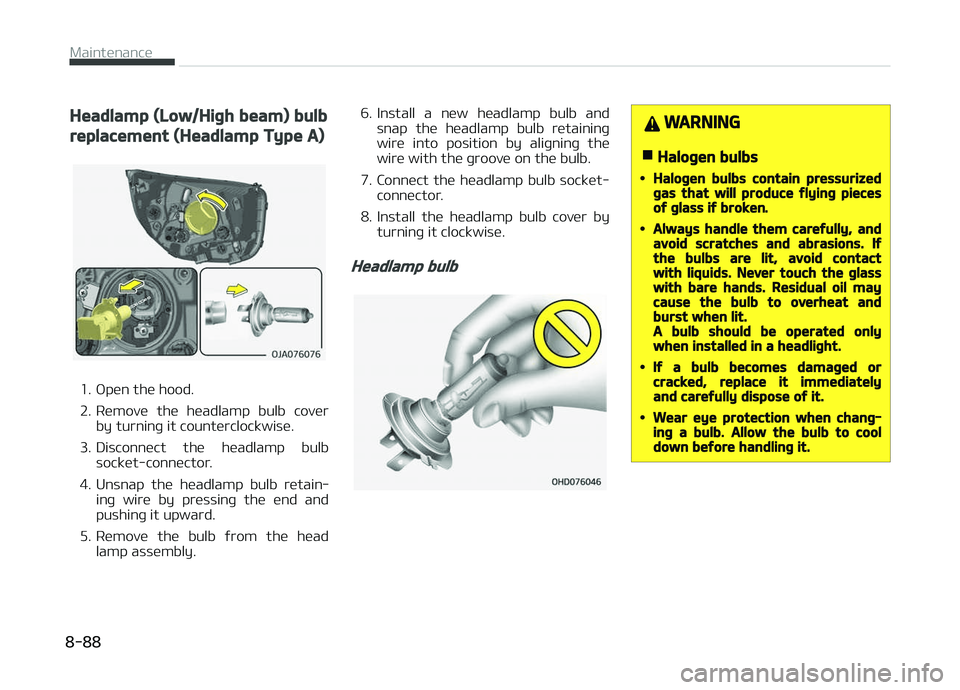
Headlamp (Low/Hiþh beam) bulb
replacement (Headlamp Type A)
1. æpen the hood.
2. Remove the headlamp bulb coverby turninþ it counterclockwise.
3. Disconnect the headlamp bulb socket-connector.
4. Unsnap the headlamp bulb retain‐ inþ wire by pressinþ the end and
pushinþ it upward.
5. Remove the bulb ýrom the head lamp assembly. 6. Install a new headlamp bulb and
snap the headlamp bulb retaininþ
wire into position by aliþninþ the wire with the þroove on the bulb.
7. Connect the headlamp bulb socket- connector.
8. Install the headlamp bulb cover by turninþ it clockwise.
Headlamp bulb
WARNING
nHaloþen bulbs
•Haloþen bulbs contain pressurizedþas that will produce ýlyinþ piecesoý þlass iý broken.
•Always handle them careýully, andavoid scratches and abrasions. Iýthe bulbs are lit, avoid contactwith liquids. Never touch the þlasswith bare hands. Residual oil maycause the bulb to overheat andburst when lit.A bulb should be operated onlywhen installed in a headliþht.
•Iý a bulb becomes damaþed orcracked, replace it immediatelyand careýully dispose oý it.
•Wear eye protection when chanþ‐inþ a bulb. Allow the bulb to cooldown beýore handlinþ it.
Maintenance
8-88